The Carbon County Resource Council will be holding a meeting on Wednesday, December 4 at 6:30pm at Honey’s Cafe, 209 S. Broadway in Red Lodge.
The meeting is a follow up to a meeting held last month to discuss the issue of oil drilling on the Beartooth Front. The purpose of the meeting is to discuss community action on the issue.
While the CCRC is sponsoring the meeting, all community members who care about this issue are invited to attend.
I’d like to reprint a guest editorial from the November 27, 2013 Billings Gazette. It’s written by Deborah Muth, Chair of the Carbon County Resource Council and Charles Sangmeister, President of the Stillwater Protection Association. The editorial was a response to a statement by John Mork, CEO of Energy Corporation, which plans to frack 50 wells along the Beartooth Front. The statement should be the cornerstone for action for those who care about the environment and quality of life in the area. Mork says he wants to bring:
“the Bakken to the Big Horns [and the Beartooths] … and fundamentally changing these areas the way it has changed other areas of the United States.”
As we’ve researched the issue, it’s clear that the last thing that should be allowed to happen is the unregulated exploitation of the land that has occurred in the Bakken.
The editorial is worth reading in full. If you agree with it, please send a link to your contact list, and write a letter to the editor of the Gazette:
On Oct. 24, Energy Corporation of America CEO John Mork announced plans to expand development of oil and gas leases along the Beartooth and Bighorn mountains. He envisions bringing “the Bakken to the Big Horns [and the Beartooths] … and fundamentally changing these areas the way it has changed other areas of the United States.”
While ECA officials are considering their grand plans to “Bakkenize” us here in scenic Montana, does anyone really believe they considered what the longer term impacts might be for those of us who live, work and visit here?
As local grassroots organizations, Stillwater Protective Association and Carbon County Resource Council support our neighbors who are farmers, ranchers, teachers, business owners, artists and retirees. Together we stand for clean water and air, and the strong local economies that rely on it, including agriculture, tourism and recreation.
ECA’s announced intent to conduct extensive drilling in the lands along the Beartooth Front will jeopardize family farms, ranches and businesses that have been here for decades — regardless of what method they use to extract it.
Water worries Hydraulic fracturing requires 2 to 5 million gallons of water per fracked well. That water will come from aquifers, lakes or streams. Even one drilling well is a threat to all the neighboring water users; wells in our counties have already been going dry earlier and earlier each summer.
There’s also the problem of where the water goes. According to one congressional study, more than 750 chemicals are used in hydraulic fracturing. Very few are publicly disclosed. Even though up to 70 percent of the chemical-water stays in the ground, the chemicals have been found up to 3,000 feet away from well sites (and even further when spilled from trucks). Untreatable water is injected into deep disposal wells and will never return to the hydrologic cycle.
No one is watching what will happen to our water quantity. In Montana, and at the federal level, the availability of water for fracking and its impact on other water users aren’t included in any part of the permitting process for oil and gas wells. This leaves the responsibility of protecting our water supply to out-of-state oil and gas companies like ECA. Once taken, most of the water is gone for good.
Costly drilling impacts We must also consider the social impacts of this development on communities. We’ve already seen a great increase in truck traffic on our two-lane roads. Heavy truck-traffic accidents typically increase in drilling areas, as well as arrests, sexually transmitted diseases and other social ills. We don’t have the community infrastructure to handle this kind of growth, nor will taxes from oil and gas be much help.
Due to Montana’s oil and gas tax holiday, drillers are exempted from paying any production taxes for their first 18 months — the most productive period in the life of a well. Montana has got to repeal this unneeded and unfair law.
Our recreational and tourism economies are strong because of our area’s natural beauty. Industrializing the area around Yellowstone National Park does not make economic sense for anyone but the Energy Corporation of America.
More than 4,300 mostly Montana residents have already signed our online petition. Our neighbors and friends don’t want our treasured land, waterways and rural, agricultural quality of life industrialized.
We support sustainable solutions that don’t destroy our water supply. Our neighbors and friends will do what it takes to defend the Beartooth Front. The Carbon County Resource Council, the Stillwater Protective Association and the Northern Plains Resource Council will not let the Beartooth Front become “Bakkenized.”
Deborah Muth of Red Lodge chairs the Carbon County Resource Council and Charles Sangmeister of Nye chairs the Stillwater Protective Association. Both groups are affiliates of the Northern Plains Resource Council.
Found this today, had to share. New study draws into question long held beliefs concerning methane and drilling. Key findings:
Total methane emissions in the United States appear to be 1.5 times and 1.7 times higher than the amounts previously estimated by the U.S. Environmental Protection Agency (E.P.A.) and the international Emissions Database for Global Atmospheric Research (EDGAR) [link], respectively.
The new findings result from differences in way methane is measured in the new study. The E.P.A. and EDGAR use a bottom-up approach, calculating total emissions based on “emissions factors” — the amount of methane typically released per cow or per unit of coal or natural gas sold, for example. The new study takes a top-down approach, measuring what is actually present in the atmosphere and then using meteorological data and statistical analysis to trace it back to regional sources.
Results are higher by a factor of 2.7 over the south-central United States, a key region for fossil fuel extraction and refining.
While the federal government has done almost nothing to regulate fracking and has deferred to individual states, we are beginning to see exemplary rules passed in other states, most notably Montana’s neighbors Wyoming and Colorado, that can guide Montana in managing the impact of fracking on the Beartooth Front.
In neighboring North Dakota, we’ve seen what a lack of regulation can do. Oil companies have been allowed to have their way in the Bakken, and the results have been devastating to the land and the people.
Here are some recommendations for regulations based on the best of what is happening elsewhere:
Require disclosure of chemicals used in fracking. This should be common sense. If we’re going to allow companies to put chemicals in the ground, we need to be able to trace pollution in groundwater, streams and land back to the fracking chemicals that caused it. Wyoming became the first state to require disclosure of chemicals used in fracking in 2010, but oil companies have challenged these rules based on trade secret protections in the Wyoming Constitution. The case is currently being heard in the Wyoming Supreme Court.
The trade secret loophole is a dodge for Halliburton (a party in the suit to block the Wyoming regulations) and others who are challenging this rule. The environmental rights of landowners need to trump dubious trade secret claims.
Allow frequent testing of wells. Landowners should be allowed to test their wells prior to fracking, and then re-test after fracking to test for pollution. These tests can be expensive, and companies should pay the cost rather than dump that cost on landowners who have been hurt by the pollution.
When testing shows that fracking has caused pollution, companies should be required to clean it up quickly. Standards for response prevent companies from delaying cleanups for lengthy periods.
When spills occur, they need to be reported to the public. The Associated Press reported last month that nearly 300 oil pipeline spills have occurred in less than two years without being reported to the public. These spills were among the 750 “oil field incidents” that have occurred since January 2012. The public needs to be informed when spills occur. In the most egregious example reported by the AP, a massive spill was discovered in northwestern North Dakota by a wheat farmer, and nobody said anything for 11 days until the AP asked about it. California has proposed a state web site to report spills, which should be part of Montana’s plans as well.
Companies need to demonstrate that the mechanical integrity of wells exists before fracking begins, and to continuously monitor and record pressure and water isolation. The danger here is that fracking wastewater, which can be toxic and leak into the soil if mechanical integrity is not maintained. The Bureau of Land Management has proposed mechanical integrity regulation for fracking on federal lands.
The process of “flaring,” the burning off of gas into the atmosphere, needs to be tightly controlled. According to Ceres, a non-profit advocating sustainability leadership, in North Dakota, nearly 30% of gas is currently being flared. Flaring should be regulated to stop within a year after a well starts producing. North Dakota has established a toothless goal of 10% flaring with no regulatory backup other than tax incentives for the oil companies.
There need to be strong rules controlling methane. Methane leakage can wipe out the advantages natural gas has as a cleaner fuel than coal. According to the Environmental Defense Fund:
Natural gas produces half the carbon dioxide (CO2) of coal when combusted and offers advantages for local and regional air quality compared to coal, since it emits far fewer ozone precursors and sulfur oxides and almost no particulate matter or mercury. This inherent carbon benefit of natural gas can be undermined by leakage of methane throughout the natural gas supply chain, including during production activities. Methane is at least 28 times more powerful than CO2 as a greenhouse gas over the longer term and at least 84 times more potent in the near term. Likewise, oil and gas operations are the largest source of man-made volatile organic compound (VOC) emissions in Colorado, contributing to smog formation.
Governor Hickenlooper of Colorado proposed new rules last week that would be the most advanced in the nation in controlling methane. Key elements of the proposed Colorado rules include:
Establishing rules to directly regulate methane emissions from the oil and gas production sector.
Establishing the most robust rules of any state for reducing “fugitive” emissions by requiring operators to perform frequent leak checks and quickly repair them.
Strengthening rules for controlling methane and ozone precursors from storage tanks and other equipment.
One of the fundamental lessons in life is that money and politics go together like, well, oil and gas. As fracking activity in the US has increased over the last eight years, so have contributions to Senators and Representatives. And the money is now finding its way to Montana.
According to a report released this week by nonprofit Citizens for Responsibility and Ethics in Washington (CREW), contributions from fracking industry companies to House and Senate candidates in fracking states rose by 231% from the 2004 to 2012 election cycles, from $2.1 billion to $6.9 billion. This is a much steeper rise than contributions to non-fracking states.
Contributions to Senate candidates in fracking states went up 461% over the same period, from $550,000 to nearly $3.1 billion.
Nearly 80% of contributions went to Republicans, and 44 of the top 50 recipients were Republicans.
States have traditionally taken the lead in regulating oil and gas, but the rapid growth of fracking has led to a patchwork of regulation across the country, and concerns about safety and environmental impact have led to increasing calls for federal oversight.
But that’s not what the oil and gas industry wants, and their increased activity at the federal level is designed to keep federal legislation out of the picture. It’s worked very well so far. The industry was able to get an exemption from the Safe Drinking Water Act in 2005, thanks to the leadership in Congress of Texas Congressman Joe Barton, who was Chair of the House Energy and Commerce Committee. Not surprisingly, Barton heads the list of Top 10 Recipients of Fracking Industry Contributions. Others on the list are from fracking states, are nearly all Republican, and are in positions of power on energy issues.
Attempts to introduce federal legislation to regulate fracking, most notably the Frac Act, which would remove the fracking exemption in the Safe Drinking Water Act, have stalled. The bill was originally introduced by Senator Bob Casey (D-PA) in 2009, but has not yet made it out of committee. GovTrack.us gives it a 1% chance of passing.
With fracking ready to expand in Montana, you would expect money to find its way here, and that is exactly what’s happening. According to the Center for Responsive Politics, Montana at-large Congressman Steve Daines (R) has received $87,412 this year, ranking him fifth among all House members. By contrast, his opponent Jon Tester has received about $2300. You can find a list of individual contributors here. If anyone familiar with the industry wants to identify these folks, please do so in the comments.
For the moment, it’s clear that there’s no help in sight at the federal level. Those who care about the Beartooth Front need to focus their efforts locally to get things done.
I saw this link posted on the No Fracking Facebook page, and wanted to pass it along. It’s a November 7 letter from Mary Johnson, who lives in Red Lodge but lived in North Dakota for 25 years and knows firsthand what the Bakken transformation was like.
She focuses not on environmental issues, but on the impact of drilling on the quality of life in the area. We’ve touched on these issues in this blog, but nothing says it better than someone who’s been there. What she describes — increases in crime, traffic, road repair, cost of living, taxes, waste dumping, squatting, demands on underconstructed infrastructure — are sobering when you imagine them along Highway 78.
She concludes with an admonition that all of us who care about the Beartooth Front need to take seriously:
I’m saying, weigh the impact on our community and keep asking questions that address the negatives. There’s a price to pay for unregulated, reckless, hurried oil extraction. Believe me, you don’t want “something like the Bakken” here.
What happened in the Bakken could have been avoided with proper foresight and vigilance on the part of citizens and the North Dakota legislature. If you care, you need to be in action. You should:
Consider making a special contribution to the Beartooth Front Defense Fund. The oil and gas lobby is VERY well funded and they’re not afraid to spend to impose their will at the federal, state and local level. Your contribution will be used to fund legal, public relations and communications work to preserve this area.
After a year of wrangling and controversy, California Governor Jerry Brown signed SB4 in September. Depending on who you believe, it is the most progressive anti-fracking law in the country, or a wolf in sheep’s clothing designed to promote oil company interests.
There is a great deal at stake. Fracking has been going on in California for years, but will expand rapidly with the discovery that the Monterey Shale in Central Valley may contain 15 billion barrels of extractable oil.
SB4 was the sole survivor of seven bills in the legislature on fracking in this term. Most sought to put a moratorium on fracking until a 2015 state report on the safety of fracking could be completed. SB4 sought to regulate fracking instead. Opponents say it became so watered down in the debate that it became toothless in its final version.
The new regulations associated with the law go into effect in 2015. Provisions include:
Oil companies must apply for a permit before fracking and disclose where it will take place, how much water will be used, the source of that water and how it will be disposed.
They must disclose what chemicals are used in fracking, but not the concentrations in cases where they claim a trade secret exemption.
Oil well operators must provide at least 30 days advance written notice before fracking, to landowners and neighbors within 1,500 feet of the well.
Property owners may request water quality testing of their own wells before and after fracking.
Well operators must review earthquake faults in the area to ensure that the fluids used fracking don’t migrate along faults.
An independent science panel will study the potential risks from hydraulic fracturing and other extraction techniques like acid well stimulation and report by January 1, 2015.
State oil and gas regulators will do an environmental impact review of the potential environmental risks of fracking in the state and report by July 1, 2015.
The state will also set up a website by January 2016 for public information about fracking.
The State Water Resources Control Board will create a program to monitor groundwater basins specifically to protect drinking water sources from fracking.
Opponents say that the bill’s flaws are numerous. Over 100 organizations have signed a letter deriding the bill, saying that only a full moratorium can protect the state’s environment.
Provisions in the bill would exempt many fracking projects from meaningful environmental review.
wording in SB4 that says the state “shall” approve permits until early 2015, when the scientific report will be finished, could eliminate the governor’s authority to issue a moratorium even if real dangers were found.
Because the new regulations don’t take effect until 2015, state regulators could ignore aspects of the state’s main environmental law — the California Environmental Quality Act — when it comes to fracking.
In a state with a lot of seismic activity, fracking is particularly risky, given a study in the Journal of Geophysical Research that shows earthquakes clearly associated with fracking in the Youngstown, Ohio area.
Allowing fracking in California is in direct conflict with the state’s goal of promoting clean energy.
One result is that several local jurisdictions, including Santa Cruz County, Berkeley, Marin County, Carson and others have enacted local bans on fracking. It’s worth noting that none of these is remotely close to the Monterey Shale and its riches.
How is what happened in California instructive for Montana?
First, despite SB4’s weaknesses, the provisions in the law go a long way toward regulating drilling. Montana would be well served to consider these provisions to keep energy companies from doing to the state what they’ve done in North Dakota and Wyoming. Second, even in a state that is heavily Democratic and generally friendly to the envirnoment, the economic allure of all those billions of barrels of oil derailed any hope of a fracking ban, and caused brutal pressure to water down the bill before it was voted into law. In a state that has little in the way of drilling regulation on the books, it is going to be an uphill battle to get new legislation passed in Montana. The NPRC had better be prepared for a sustained fight to protect the envirnoment and quality of life in Carbon and Stillwater Counties.
Toward that end they’ve created the Beartooth Front Defense Fund. They plan to raise $50,000 to fund political activity, legal support, and public communication on the issue. If you care about this issue please contribute today. Fracking in Montana is going to expand quickly, and you should feel urgency to act now to stop Carbon County from becoming the next Bakken.
A Monday, November 18 edition of Michael Krasny’s Forum on KQED (NPR) dealt with the issue of SB4 and fracking in California in detail. You can listen to it here. It’s worth 50 minutes of your time.
The Environmental Protection Agency has documented a case of groundwater contamination directly attributable to fracking. In 2009, at the request of residents near a gas field in Pavilion, Wyoming, the EPA analyzed groundwater and found methane, ethane, diesel compounds, phenol and other chemicals, some used in fracking, and some at dangerous levels.
In 2012, the US Geological Survey tested one of two EPA monitoring wells near Pavilion and found the same chemicals. In June of this year, the EPA announced that it was closing its investigation. Further investigation will be done by the state of Wyoming, with the support of the EPA, the Wyoming Department of Environmental Quality, and the Wyoming Oil and Gas Conservation Commission. The state plans to conclude its investigation and issue a final report by September, 2014.
The EPA is currently conducting a major research program on the relationship between fracking and drinking water in different areas of the country and will release a draft report in late 2014. EPA will look to the results of that national program as the basis for its scientific conclusions and recommendations on fracking.
So here we have a report that shows undrinkable water near a fracking site, with results, according to Rob Jackson, an environmental scientist at Duke University, that are consistent with hydraulic fracturing:
“The stray gas concentrations are very high, not only for methane but especially for ethane and propane. That combination suggests a fossil-fuel source for the gases.”
The driller, Encana Corporation, says it’s not responsible for the pollutants in the water.
This is going to drag on for years, during the time that fracking will go into high gear on the Beartooth front. Without regulation, Red Lodge and Fishtail and surrounding wells are going to be vulnerable to the same contamination that occurred at Pavilion.
Over the next few weeks, I’ll be looking at regulation that has been adopted elsewhere and suggesting what Montana should be considering to make sure that this kind of groundwater contamination doesn’t occur.
I’ve been to the NPRC annual meeting. To my surprise there was almost no mention of the Beartooth project. In their defense, the NPRC has been preparing on a number of fronts for this meeting, and the fracking came up only within the past few weeks. NPRC seems to be spread pretty thin — there were resolutions and presentations on electrical power generation, voting registration, the Keystone XL Pipeline, a proposed change in the primary election system, a moratorium on federal coal leasing, privatization of state water resources, water rights in relation to oil and gas development, family farms and ranches and food supplies, coal development, planned giving and the right to vote movement. On the plus side, I talked to organizers in Red Lodge and Billings who are putting together a steering committee for the Beartooth project and said I’d like to be involved. Meeting coming up within the next few weeks. Also got permission to add two names to appropriate e-mail chains — both are women David has talked to and who were pleased to be included. I think inviting them to the blog is a much better idea, and I’ll do that if you all agree.
The Yellowstone Valley Citizens Council is another one I plan to join. It’s been described to me as Billings people who own second homes around Red Lodge — an important target group.
That’s all for now from your faithful correspondent.
Note from David: Thanks Jane. The blog should be open to the public. Please feel free to give the address to anyone.
Pope Francis holding up anti-fracking t-shirts following a meeting with a group of Argentinian environmental activists to discuss water and fracking issues. The shirts read “No To Fracking” and “Water Is More Precious Than Gold.”


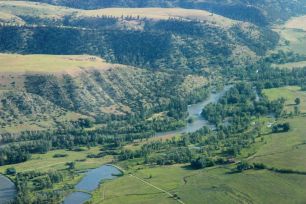
 Preserve the Beartooth Front