Pennsylvania Supreme Court protects local zoning rights against drilling

In a move that has potential for informing opposition to Beartooth Front drilling, the Pennsylvania Supreme Court voted 4-2 yesterday to declare major provisions of the state’s Marcellus Shale drilling law, Act 13, unconstitutional. The key element of the decision overturns the section of the law that allows gas companies to drill anywhere, overriding local zoning laws.

The decision was based on a suit filed by a small number of Pennsylvania townships challenging the law, and signaled a victory for the rights of citizens against corporate interests. It also is an important step in protecting the environment against uncontrolled drilling. Chief Justice Ronald Castille, writing for the majority, indicated possible Court support for future restrictions on drilling when he wrote in the decision that

 the exploitation of the Marcellus Shale Formation will produce a detrimental effect on the environment, on the people, their children, and the future generations, and potentially on the public purse, perhaps rivaling the environmental effects of coal extraction.

With the quasi-ban passed last week in Dallas, we have now seen recent significant political and legal victories against destructive drilling. On the Beartooth Front, we will need to aggressively explore the same options to make sure the environment, economy and quality of life are protected.
Posted in Fracking Information | Tagged , , , | 1 Comment

Dallas and Fort Worth: 900 feet and a world apart

This is a tale of two cities.

On December 11, 2013 the Dallas City Council voted 9-6 to approve a recommendation by the City Plan Commission that requires natural gas wells to be set back at least 1500 feet from homes. According to the Dallas Morning News, the decision came after years of arguments over well safety, toxic air emissions, gas leasing rights and the use of hydraulic fracturing. The new limit is an increase from the former limit of 300 feet.

The gas industry reacted strongly, calling the ordinance a “de facto fracking ban.” It’s hardly that, since the Council can still set the requirement aside and allow permits, but it is a strong statement. Shale development has been discussed in Dallas since at least 2008, and the city has yet to issue a permit.

The industry cites Fort Worth’s 600 foot setback requirement as a model, but a model of what? Fort Worth is the first major city in the United States to allow extensive fracking within its city limits. The city has 2000 gas wells and more are being drilled. The city has granted a number of exceptions to the 600 foot limit, and in some cases fracking is taking place 300 feet from homes and businesses.

I’ve published this before, but it’s worth watching again. This is the true cost of giving up control of your environment as they have in Fort Worth:

Most of Northern Texas is now a mess, as the industry has moved quickly to exploit the Marcellus Shale. But Dallas has held out, and they’re going to reap the benefits of wise civic decision making.

This is the decision that confronts Carbon and Stillwater Counties. Follow the path of Fort Worth and let Energy Corporation of America turn the area into a modern version of Fort Worth, or stand up as Dallas has and demand the preservation of the environment.

Posted in Community Organization, Politics and History, Fracking Information | Tagged | 3 Comments

New Study Links Fracking Water to Hormone-Disrupting Chemicals

The oil and gas industry’s claim that there is no evidence linking hydraulic fracturing to negative impacts on human health is crumbling bit by bit as new scientific evidence comes in.

Today we have new evidence that fracking waste water contains high levels of hormone-disrupting chemicals. According to Susan Nagel of the University of Missouri School of Medicine, these chemicals “could raise the risk of reproductive, metabolic, neurological and other diseases, especially in children who are exposed to EDCs [endocrine-disrupting chemicals].” Nagel is one of the authors of the study, which has been accepted for publication in The Endocrine Society’s journal Endocrinology.

The report’s description of the study’s methodology:

Researchers took surface and ground water samples from sites with drilling spills or accidents in Garfield County, Colo. The area has more than 10,000 natural gas wells. Researchers also looked at control samples from sites without spills in Garfield County, as well samples from Boone County, Missouri.

The water samples from drilling sites had higher levels of EDC activity that could interfere with the body’s response to the reproductive hormone estrogen, and androgens, a class of hormones that includes testosterone.

Drilling site water samples had moderate to high levels of the hormone-disrupting chemical. Water samples from the Colorado River, which is the drainage basin for the natural gas drilling sites, had moderate levels.

Researchers found little EDC activity in the water samples from the sites with little drilling.

If you’re thinking, “They only found problems in samples taken from wells with spills. ECA touts their great safety record, so we won’t have that problem here,” think again. In the Bakken in North Dakota, there have been over 750 oil field “accidents” and 300 spills since January 2012. Montana, like North Dakota, doesn’t regulate drilling. There will be spills on the Bearfront too.


In an ecosystem as fragile as ours, the introduction of EDCs into the water system will be devastating. Note that the EDCs are found not only in the groundwater, but have made their way into the Colorado River.


Posted in Fracking Information | Tagged , , , , , | 8 Comments

Video: The real cost of fracking

We’ve talked quite a bit about the impact of hydraulic fracturing on the environment and quality of life in the Bakken in North Dakota, but the Guardian today published Fracking hell: what it’s really like to live next to a shale gas well, a compelling account of how fracking has affected the life of a community in North Texas. Fracking has been going on in populated areas for seven years, and this article paints a graphic picture of how the lives of the local residents have been affected.

Today six million Texans live within a mile of a fracked well. In north Texas, the number of new oil and gas wells has gone up by nearly 800% since 2000.

Nobody in Carbon County or Stillwater County lives next to a fracking well today. This story is a cautionary tale of what might lie in store for you if you sit back and let it happen.

The article tells the story of Veronica Kronvall, who bought a new house in Ponder, Texas in 2007. It was her first home, a chance at the American dream. But four years later, an energy company drilled five wells behind her home.

Kronvall’s story is told graphically in the video below. The description of what it has been like is chilling.

The crews proceeded to flatten the earth and install a 200ft red and white drilling tower that loomed high above their homes. Convoys of articulated (trucks) rumbled down the main road. “It was terrible,” Kronvall says. “There was a lot of banging and clanging. The number of trucks was just phenomenal, and the exhaust, the fumes in the air, it was 24/7.”

She says the activities on the other side of her fence deposited a layer of white powder on her counter tops. The sound of the crew shouting into megaphones invaded her bedroom. Bright lighting pierced her curtains and made it difficult to sleep. The rumble of trucks and equipment rattled the glasses in her cupboard, and the smell – an acrid blend of chemicals – was all-pervasive.

“My wife was pregnant the whole time the rig was there,” (her husband) Wesley says. There was the din of diesel generators belching soot, and a nauseating mix of chemicals competing with the aroma of dinner. The noise and smells penetrated to the next street over, where Christina Mills lives. Like the Howards and Kronvall, Mills, 65, was attracted to Ponder because of its sleepiness, and bought the fourth house built in the entire development when she moved to the town in 2001. “But when that derrick was up, you would have thought you were in Las Vegas,” she says, “and I live one street over.”

Could the be what life in Red Lodge is going to be like?

Only if you let it. It’s time to be in action.

Posted in Community Organization, Politics and History, Fracking Information | Tagged , , , , | Leave a comment

The toxins used in oil and gas drilling

Because the federal government has chosen not to regulate fracking and states are just beginning to step up to regulation, energy companies are not required to reveal the chemicals they use in the hydraulic fracturing process. Until disclosure requirements change, we simply don’t know the range of toxins we are exposed to, either through the air or through our groundwater.

But there’s quite a lot of literature on the toxins generally used in oil and gas drilling, and I thought it would be worthwhile to call them out here. Even if we don’t know the exact chemical composition of the fluids incorporated into fracking water, we can be certain that the chemicals mentioned below will be included, as well as others we don’t yet know about.

The primary source for this post is an excellent article by Don Lieber at EcoWatch. He lists the following chemicals as specifically used in fracking:

  • Benzene is one of the largest-volume petrochemical solvents used in the fossil fuel industry. Exposure through the air or through groundwater causes substantial long-term health problems. According to the Center for Disease Control, these are the long-term effects of benzene exposure:
  • The major effect of benzene from long-term exposure is on the blood. (Long-term exposure means exposure of a year or more.) Benzene causes harmful effects on the bone marrow and can cause a decrease in red blood cells, leading to anemia. It can also cause excessive bleeding and can affect the immune system, increasing the chance for infection.
  • Some women who breathed high levels of benzene for many months had irregular menstrual periods and a decrease in the size of their ovaries. It is not known whether benzene exposure affects the developing fetus in pregnant women or fertility in men.
  • Animal studies have shown low birth weights, delayed bone formation, and bone marrow damage when pregnant animals breathed benzene.
  • The Department of Health and Human Services (DHHS) has determined that benzene causes cancer in humans. Long-term exposure to high levels of benzene in the air can cause leukemia, cancer of the blood-forming organs.

Lieber points out that these effects will take place long after drilling starts..  “The use of benzene, like other toxins used in oil and gas, is particularly insidious because the effects…take many years to manifest. And due to lax regulations, these products have been rushed into use long before any long-term testing has been possible.”

  • Formaldehyde is commonly used in fracking although usually not disclosed. In 2006, the fracking industry was granted waivers from federal clean air and water regulations (known as The Halliburton Loophole) — since then, it has operated with few, if any, reporting requirements regarding the chemicals it uses. But drillers use it, and here’s how it affects human health, according to the EPA:

Formaldehyde, a colorless, pungent-smelling gas, can cause watery eyes, burning sensations in the eyes and throat, nausea, and difficulty in breathing in some humans exposed at elevated levels (above 0.1 parts per million). High concentrations may trigger attacks in people with asthma. There is evidence that some people can develop a sensitivity to formaldehyde. It has also been shown to cause cancer in animals and may cause cancer in humans.  Health effects include eye, nose, and throat irritation; wheezing and coughing; fatigue; skin rash; severe allergic reactions.

Again, the most serious effects are long-term.

  • Silica is commonly used in large quantities during fracking operations. Each stage of the process requires hundreds of thousands of pounds of silica quartz–containing sand. Millions of pounds of this “frac sand” may be used for a single well.

According to OSHA, exposure to silica has the following impacts on human health:

Inhalation of respirable crystalline silica particles has long been known to cause silicosis, a disabling, non-reversible and sometimes fatal lung disease. Respirable crystalline silica also causes lung cancer. The International Agency for Research on Cancer has designated crystalline silica as carcinogenic to humans, and the U.S. National Toxicology Program has concluded that respirable crystalline silica is known to be a human carcinogen….In addition, exposure to respirable crystalline silica has been associated with other respiratory diseases, such as chronic obstructive pulmonary disease (including bronchitis and emphysema), as well as kidney and immune system diseases.

Despite this, there are no federal or state standards for the amount of silica in ambient air. In fact, regulations seem to be headed in an entirely different direction. In Pennsylvania, a key fracking state, physicians, by law,  can obtain information about chemicals used in the fracking process that may be relevant to a patient’s care, but only after requesting the information in writing and executing a nonstandardized confidentiality and nondisclosure agreement drafted by the drilling companies. The New England Journal of Medicine decries this practice: “By reducing health care decisions to a series of mandates, lawmakers devalue the patient–physician relationship.”

As fracking technology advances, the use of silica is increasing. New fracking techniques are currently being developed that require shorter and wider fracks that use higher volumes of silica.

  • Radon. Radon is a colorless, odorless, tasteless gas released into local groundwater and air during fracking operations. According to the EPA, radon is the leading cause of cancer in non-smokers, responsible for about 21,000 deaths per year. Higher levels of radon can be seen around pipelines and storage facilities.

What’s important to understand here is that the deleterious health effects of all these chemicals are long term. They are ignored by legislators and denied by the oil and gas industry.

People who travel through the Bakken report chemical smells that burn the nostrils and lungs. They are most likely talking about the chemicals described here.

ECA and other companies will come in, tout their safety records, spend two or three decades pulling out the extractable oil and gas, and then leave a ticking population health time bomb in their wake.

Unless they are prevented from starting. Take heed.

Posted in Fracking Information | Tagged , , , , | 4 Comments

Activities week of December 9, 2013

Activities this week:

  • Tuesday, December 10, 6pm: Forum on drilling in Carbon County and surrounding areas. Elks Club, 114 N Broadway, Red Lodge.  The forum will examine the social consequences that might occur from high levels of oil extraction as in the Bakken. Knowledgeable panelists will discuss the likelihood of Bakken activity here, the impact on towns in the Bakken from that activity, and the efforts of Bakken towns to mitigate the undesirable consequences of the activity.
  • Wednesday, December 11, 12:30pm, rally at Yellowstone County Courthouse, 217 N 27th St, Billings, followed by petition delivery at Energy Corporation of America (ECA) offices. Petition now has 4500 signatures.

    Schedule:
    12:30  Rally begins at County Courthouse Park, 217 N. 27th St., Billings
    12:50  Caravan heads to ECA office, 3737 Grand Ave.
    1:20    Deliver the petition to ECA
    2:00    Board of Oil and Gas Conservation meeting, 2535 St. Johns Ave.

  • Wednesday and Thursday, December 11-12, Montana Board of Oil and Gas
    Conservation (MBOGC) meetings, 2535 St. Johns Avenue, Billings. Wednesday’s meeting is at 2pm. The agenda allows for public comment on ECA’s application for a permit to drill a horizontal fracking well three miles east of Belfry.
    On Thursday at 8am at MBOGC, the group will also attend a formal hearing on the Belfry well permit, requested by the Carbon County Resource Council.During that meeting, the seven members of the oil and gas board will hear testimony and then vote on about 60 issues, including oil and gas permits and well spacing. ECA’s Belfry permit is on the agenda.Under state law, permit applications must be advertised at the state Capitol in Helena and in the county where the well would be located. The public then has 10 days to request a hearing.
Posted in Community Organization, Politics and History | Leave a comment

Bakken Report

Taylor Brorby, a writer based in the Twin Cities, recently visited the Bakken and this week filed a first-hand report in the Huffington Post. It provides a chilling warning to Montanans — be vigilant or lose.

Brorby pulls no punches:

The oil boom in the Bakken formation of North Dakota is ruining the environmental vitality of the state.

At this point it’s going to be hard to go back. In North Dakota, the 1.1 million acres in the National Grasslands is 95% leased for oil development. The Little Missouri State Park is open for development, leaving Brory to ask, “What’s safe from oil development in North Dakota?”

His experience driving through the area is heartbreaking:

In my travels around the western half of North Dakota last month I smelled both sulfur and propane in wheat fields, making my breathing difficult. Flares lit my path down Highways 85 and 2 through the night, making me feel as if I were baking in an oven. The evening sunset reflected pink and blazing orange, highlighting the increasing toxicity of the air.

How long will it be before someone can write the same sad story about the Red Lodge – Fishtail area? Time to heed this warning:

So far we in North Dakota, and we as a nation, have voted to love the bottom line rather than draw the line and say enough. We have allowed corporations to remain simple, allowing the destruction of vital ecosystems and environments — including the environments of our own thinking. We have lapsed into thinking that we should have a life of abundance, rather than an abundance of life.

Imagine hiking through the pristine trails of Custer National Forest with the smell of sulfur and propane burning in your lungs. Consider what it would be like to cast in a Stillwater River ravaged by methane.

There is no time to work yourself into action on this. The time to preserve the Beartooth Front is now.

Posted in Bakken | Leave a comment

Hydraulic Fracturing and Water Contamination

It’s frustrating to try to figure out what the deal is on the relationship between hydraulic fracturing and water contamination.

Fracking proponents will tell you unequivocally that “there’s still no evidence of hydraulic fracturing fluids migrating from depth to contaminate aquifers.” They hang their hats on a largely debunked 2004 EPA study that claimed, “the injection of hydraulic fracturing fluids into coalbed methane wells poses little or no threat to USDWs (underground sources of drinking water).”

But evidence is mounting that there is a relationship between fracking and water contamination. A peer-reviewed 2013 study from Duke University concluded that “some homeowners living near shale gas wells appear to be at higher risk of drinking water contamination from stray gases.” Another recent study from the University of Texas-Arlington found elevated levels of arsenic and other heavy metals in groundwater near fracking sites in Texas’ Barnett Shale. Neither study is conclusive, but it’s clear that we need to get conclusive answers.

But here’s where the frustration comes in. The EPA, which has the resources and the responsibility to fund studies that determine the safety of our water supply, is caught in political infighting and isn’t doing its job in providing conclusive proof of the dangers that fracking poses to water supply.

They’ve come close, but they can’t seem to find their way to the finish line.

In 2011 they issued a report showing that a pair of monitoring wells drilled deep into an aquifer in Pavilion, Wyoming contained high levels of cancer-causing compounds and at least one chemical commonly used in fracking. The findings were limited to raw sampling data. The agency did not interpret the findings or make any attempt to identify the source of the pollution, being careful not to cross a political line in interpreting the data. But instead of completing the peer review necessary to validate the study, the EPA punted, turning the investigation over to the state of Wyoming in 2013.

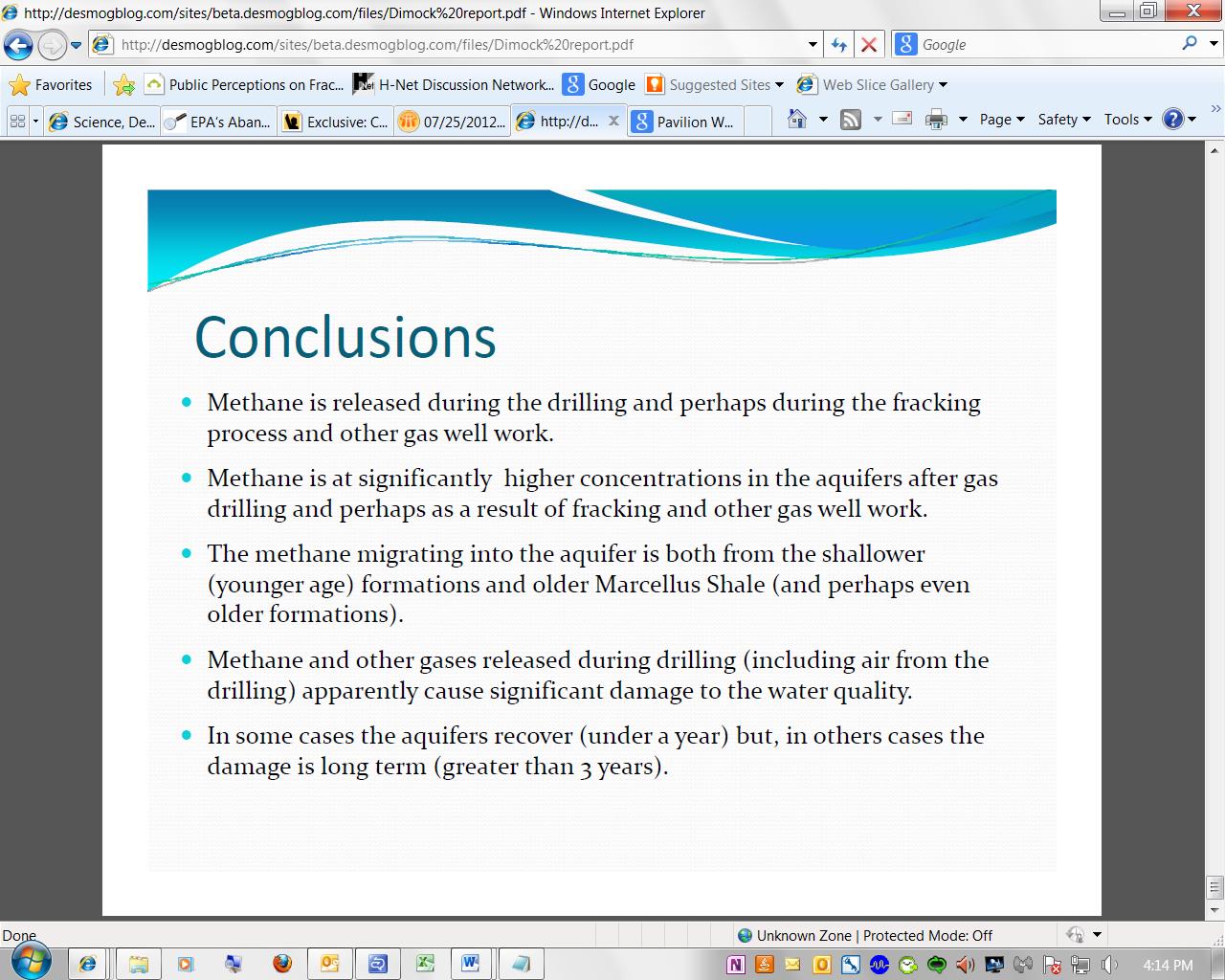
In July of this year, the EPA issued a press release that announced the results of a study on drinking water in Dimock, PA. The release stated that “the EPA has determined that there are not levels of contaminants present that would require additional action by the Agency.” However, according to the Los Angeles Times (original link not available), it turns out that regional officials with the EPA based in Philadelphia did not agree with EPA’s national office’s decision to close the investigation on water contamination in Dimock. They leaked a PowerPoint slide that showed very different conclusions: Image

The EPA is supposed to deliver a definitive study on the relationship between hydraulic fracturing and drinking water in 2014, but who knows whether that will actually happen, whether it will be killed by pro-fracking Congressmen, or whether it will be definitive at all. Political pressure is already mounting.

***

The bottom line here is that fracking is happening along the Beartooth Front and activity is about to accelerate. Does it make sense to wait to (maybe) get the definitive word on whether fracking causes water contamination, or do you want to take action now to protect our precious aquifers? If Energy Corporation of America is going to be drilling, they need to act aggressively to prove that their activity is not harming the water supply:

  • ECA needs to disclose the chemicals they are using in the fracking process.
  • ECA should pay for baseline testing before fracking occurs, and then re-testing throughout the process to make sure that chemicals are not being introduced into the water supply.
  • When testing shows that water is polluted, ECA should clean it up right away.

The community needs to hold ECA accountable. You can help by joining the Carbon County Resource Council or the Stillwater Protective Association today.

Posted in Fracking Information | Tagged , , , | 3 Comments

Fracking Homework

If you’re planning to attend the Carbon County Resource Council meeting in Red Lodge on December 4 or if you just want to do some quick homework about the community impacts of hydraulic fracturing (fracking), I recommend that you download the fracking informational toolkit published by the Union of Concerned Scientists. It’s called Science, Democracy and Fracking: A Guide for Community Activists and Policy Makers Facing Decisions Over Hydraulic Fracturing. It’s short (18 pages), highly informational, and doesn’t advocate anything except making the best decisions for your community.

An informed community can be dangerous. It is important to deal in facts, and taking the time to read this in advance of the meeting will be useful to everyone.


Posted in Community Organization, Politics and History, Fracking Information | Tagged , , | 1 Comment

The Montana Oil and Gas Holiday Needs to End

Since the mid-1990s the Montana legislature has granted a tax holiday to oil and gas producers. They pay a tax of only 0.5 percent of the production value for the first 12 months of production on all wells and 18 months on oil and gas from horizontally drilled wells. When the holiday ends, the rate will go up to 9 percent.

This tax holiday is a disaster for communities trying to manage the impact of increased oil and gas drilling. We’ve seen what a quick increase in drilling does in the Bakken. Increases in crime, prices, traffic, and pressure on infrastructure transform these communities to the detriment of everyone.

The tax holiday keeps these communities from getting the revenues they need to deal with increasing pressure on law enforcement, human services, health care, road repair and other key services.

It’s a simple proposition. Why provide these incentives to oil and gas companies if you’re going to ruin the communities affected by the drilling? The tax savings during the first year of drilling — when production and profits are greatest — isn’t going to make a difference in the number of wells drilled and production of those wells. It just creates profits for oil and gas companies at the expense of local communities.

The legislators in Helena who are making these decisions aren’t anonymous. They’re the members of the State Senate Taxation Committee, which voted 7-5 along party lines to continue the tax holiday last March. Senators voting against ending the tax holiday include:

Bruce Tutvedt, Kalispell, Chair, 406-257-9732
Fred Thomas, Stevensville, Vice Chair, 406-370-4001
Ron Arthun, Wilsall, 406-220-0399
Jeff Essmann, Billings, 406-534-3345
Jim Peterson, Buffalo, 406-374-2277
Janna Taylor, Dayton, 406-849-6096
Art Wittich, 406-599-9836

If you oppose subsidizing oil and gas companies at the expense of Montana communities, let them know. You’re not alone. A recent survey of Montana citizens shows 72% want to shut down the oil and gas tax holiday.

Posted in Community Organization, Politics and History, Fracking Information | Tagged | 13 Comments