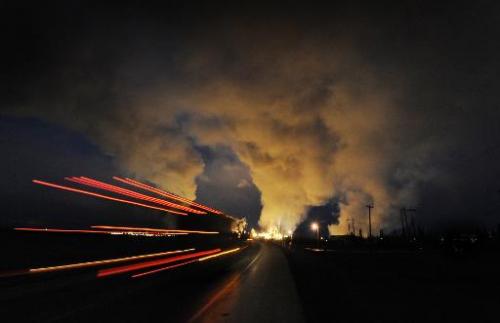
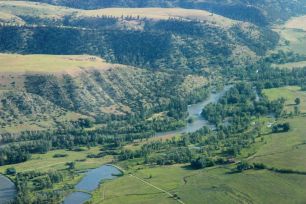
Does fracking cause earthquakes? (Hint: yes)


Earthquakes.

Mere mention of the word sends people on all sides of the fracking argument into a frenzy. Fracking proponents say without equivocation that there is no link between drilling and earthquakes. The most vehement fracking opponents scream “earthquake!” and believe that the argument is won.

But the evidence is clear. Fracking wastewater injection wells can cause mid-level earthquakes, and it’s really indisputable at this point. We’ve got scientific proof that this happened in at least 99 earthquakes in Ohio, in a swarm of small earthquakes in Texas, and in an earthquake sequence in Oklahoma. US Geological Survey (USGS) seismologist Dr. Elizabeth Cochrane is a co-author of the Oklahoma study, which she describes in the video above.

If you watch the video, the case is convincing, and despite the reporter’s questions, there is no peer-reviewed evidence that she is wrong.

USGS now tracking man-made quakes
For me, what clinches the link between fracking and earthquakes is that the USGS, which has an impeccable record of tracking earthquake activity, is now recording and tracking “man-made” earthquakes. Here’s what they have to say:

The number of earthquakes has increased dramatically over the past few years within the central and eastern United States. Nearly 450 earthquakes magnitude 3.0 and larger occurred in the four years from 2010-2013, over 100 per year on average, compared with an average rate of 20 earthquakes per year observed from 1970-2000.

This increase in earthquakes prompts two important questions: Are they natural, or man-made? And what should be done in the future as we address the causes and consequences of these events to reduce associated risks? USGS scientists have been analyzing the changes in the rate of earthquakes as well as the likely causes, and they have some answers.

USGS scientists have found that at some locations the increase in seismicity coincides with the injection of wastewater in deep disposal wells. Much of this wastewater is a byproduct of oil and gas production and is routinely disposed of by injection into wells specifically designed for this purpose.

I recommend that you read the entire linked page. The next time you go to a meeting where an oil and gas industry representative says there’s no evidence linking earthquakes to fracking, don’t let them get away with it.

Don’t overstate the issue
Where fracking opponents hurt their own credibility in talking about the Beartooth Front is when they suggest that “fracquakes” might somehow awaken the slumbering Yellowstone Caldera. This, they say, could cause a supervolcano that would spew magma all over the Western US, resulting in global climate change and potentially wiping out civilization. But the Caldera slept through the nearby 1959 Hebgen Lake Earthquake, the largest (7.3 on the Richter Scale) in Montana history. That one killed 28 people, caused a huge avalanche that stopped the flow of the Madison River, created a large 170 foot deep lake and made new geysers erupt in Yellowstone Park. The Caldera hasn’t erupted for 640,000 years and can probably sleep through mid-level earthquakes happening a hundred miles away.

But you don’t need to scream the world is going to end to be concerned about earthquakes caused by fracking along the Beartooth Front. The ecosystem here is fragile. A spill that
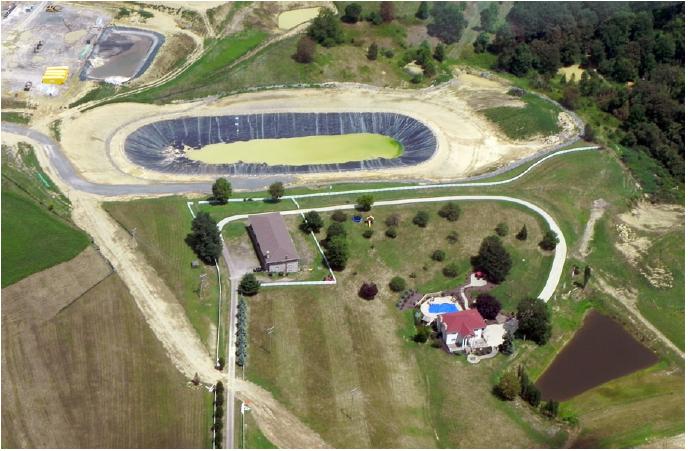
Tailings pond

A tailings pond adjacent to private property in Pennsylvania (click to enlarge)

infects the Stillwater or the Clarks Fork Yellowstone or the Boulder River would be disastrous. Click on the picture at left and take a look at the tailings pond containing frac water, the liquid that is returned to the surface after fracturing is completed, and you’ll see the problem.

The real danger
An earthquake that breaches the walls of the pond would not only contaminate the adjacent properties, but could migrate into a nearby river as well.

The Stillwater Mine has two tailings ponds, one on site and one near the intersection of  Stillwater River Road (Route 420) and Nye Road (Route 419) in Stillwater County. While the Mine tells me that these tailings ponds can withstand a 7.0 earthquake, wouldn’t it make sense to consider a protective zone to ensure they are safe?

The relationship between fracking and earthquakes is not idle speculation, it’s proven. Yet elected officials want to rush headlong into drilling. Wouldn’t it make more sense to consider setting limits based on earthquake risk? The USGS suggests an approach:

One risk-management approach…involves the setting of seismic activity thresholds for safe operation. Under this “traffic-light” system, if seismic activity exceeds preset thresholds, reductions in injection would be made. If seismicity continues or escalates, operations could be suspended.

The current regulatory framework for wastewater disposal wells was designed to protect drinking water sources from contamination and does not address earthquake safety….(O)ne consequence is that both the quantity and timeliness of information on injection volumes and pressures reported to the regulatory agencies is far from ideal for managing earthquake risk from injection activities.

You don’t get a second chance to protect your water.

Posted in Fracking Information | 3 Comments

I’m not going to wade too far into the issue of the Keystone XL Pipeline because this blog focuses on issues directly related to Stillwater and Carbon counties, but I came across something today that I think is relevant.

Some basic facts about the pipeline:

The Keystone Pipeline System runs from the oil sands of Alberta to refineries in Nebraska, Illinois and Texas. It carries synthetic crude oil (syncrude) and diluted bitumen (dilbit) from the oil sands as well as light crude from the Bakken region in North Dakota and Montana.

Three phases of the project are in operation and the fourth, the controversial Keystone XL,

The Keystone Oil Pipeline        (Click to enlarge)

The Keystone Oil Pipeline
(Click to enlarge)

would deliver oil from Hardesty, Alberta to  Steele City, Nebraska. This phase is awaiting presidential approval (see map).

Last Friday, the US State Department issued a long-awaited environmental review of the Keystone XL that found the project would have a negligible impact on climate change. Since President Obama has said that carbon pollution is his main criterion for approving the extension, the report is seen by many as clearing the way for Keystone XL approval.

Here’s what’s new and disturbing:

According to a peer-reviewed study in the Proceedings of the National Academy of Sciences released yesterday, the actual levels of polycyclic aromatic hydrocarbon (PAH) emissions released into the air from the Canadian tar sands are 2-3 times more than originally estimated.

Alberta Tar Sands

Alberta Tar Sands
(click to enlarge)

Make no mistake about it, PAHs are bad carbon pollutants. They are known for their “carcinogenic, mutagenic and teratogenic” qualities, and are associated with lower IQ, childhood asthma, low birth weight, heart malformations, cancer, developmental delays and increased behavioral problems at age 6.

So here we are, four days after the State Department says the Keystone XL will have a negligible impact on climate change, and we discover that the original corporate estimates of PAH emissions on which the State Department report is based, which say that the oil sands are spewing the same amount of pollution as sparsely populated Greenland, are wildly underestimated.

I don’t pretend to know what this means for the Keystone XL, but my concern is that this is yet another reminder that we should not be relying on corporate data to make decisions about the impact of drilling on our water, our air, or our land.

We see it over and over again. The Montana Petroleum Association, The Montana Board of Oil and Gas Conservation, our elected officials, Environmental Corporation of America and others come into town and tell us everything will be great. They have a big economic interest in our believing that everything will be great. But we need to be smart enough to see what has happened elsewhere and manage drilling in a way that makes sense for our region.

Posted on by davidjkatz | 1 Comment

Missoulian: Environmental group sues Montana AG over ‘fracking’ documents

According to the February 1, 2014 Missoulian, the Montana Environmental Information Center (MEIC) has filed suit against Attorney General Tim Fox over Fox’s failure to disclose documents related to his support of a letter protesting federal efforts to regulate fracking.

This is the second suit filed against a state agency in the last month. On January 8 the Northern Plains Resource Council and Carbon County Resource Council filed suit against the Montana Board of Oil and Gas Conservation for refusing to allow public input into the granting of a permit to drill an exploratory well near Belfry.

This suit is a matter of concern to residents of Carbon and Stillwater counties for a couple of reasons. First, the general issue of government secrecy with regard to the expansion of oil drilling is a significant problem. Fracking will have a dramatic impact on many aspects of our lives, and government needs to be responsive to citizen concerns. Second, the notion that the federal government should abdicate regulation of drilling on federal lands to the states is just scary. The reason we have BLM lands is because the federal government set them aside for protection against local interests. We need active federal engagement to develop national policy that protects these lands rather than opening them up to corporate interests.

Here is the Missoulian article:

************

:HELENA – The Montana Environmental Information Center has sued Attorney General Tim Fox to gain access to certain documents related to the public position he took on hydraulic fracturing.

In the lawsuit, filed late this week in state District Court in Helena, MEIC said it wrote Fox on Aug. 30, 2013, expressing concern over his position in joining some other attorneys general in a letter to U.S. Interior Secretary Sally Jewell opposing federal efforts to further regulate hydraulic fracking, or “fracking.”

Hydraulic fracking, combined with horizontal drilling, is used in oil shale development.

Fox joined four other attorneys general in signing an Aug. 23, 2013, letter by Oklahoma Attorney General Scott Pruitt expressing “serious concerns with, and strong objections to, the U.S. Bureau of Land Management’s recently re-proposed rule to regulate hydraulic fracturing operations on federal and Indian lands.” The letter said the states were best equipped to design, administer and enforce laws and regulation related to oil and gas development.

On the same day, Gov. Steve Bullock wrote a separate letter to Jewell expressing his “deep concern” about the proposed hydraulic fracturing rules. Bullock said those states that already regulate fracturing should retain primary authority for regulating the activity on public lands through a memorandum of understanding with the BLM.

“This lawsuit is simply about the attorney general of Montana refusing to comply with the public records act and the Montana constitutional right to know, plain and simple,” said Jim Jensen, MEIC’s executive director. “We asked for documents and they refused to give a full disclosure. What is the attorney general hiding?”

In response, Fox’s spokesman John Barnes issued this statement to reporters: “The true political nature of MEIC’s lawsuit is made evident by the fact that MEIC went to the press before notifying our office of the lawsuit, and the fact that the lawsuit singles out the Republican Attorney General’s office when both our Democrat governor and the attorney general worked together to protect Montana jobs from unnecessary federal regulation.”

In response, Jensen said under state law, only the governor of the state has the authority to represent Montana to another state and the federal government.

***

On Aug. 30, MEIC requested from Fox any documents in his office regarding his office’s involvement with the letter. The request sought memos, policy directives, correspondence, emails, letters, research analysis, documents and communications. The letter asked that if Fox chose to withhold documents, that a “privilege log” be kept detailing the reasons.

On Nov. 6, MEIC’s lawsuit said, Fox’s office responded with a letter of explanation and a privilege log showing that certain documents were withheld because they were nonresponsive to the request, while others were withheld because they were a “litigation item” or in “anticipation of litigation.”

Some email addresses were redacted for “privacy reasons,” the lawsuit said, even though it appears all individuals on the email chains were public officials in Montana or elsewhere.

“Government email addresses are not protected by any individual privacy rights,” said the complaint, filed by Helena attorney David K.W. Wilson. “To the extent that any of the individuals are not public officials or employees, they are members of the public involving themselves in a public policy debate.”

MEIC wrote again on Nov. 26 and argued to the attorney general that most of the items on the privilege log could not be withheld under the state’s constitutional right to know or case law construing it.

On Jan. 3, the Attorney General’s Office responded with more documents and an updated privilege log, but it continued to withhold certain documents that MEIC argued should be made public, the complaint said.

“When the attorney general of the state of Montana took a broad policy position on a controversial environmental matter on behalf of the state of Montana, there can be, and is no, individual privacy interest at state in documents generated by, or sent to, the attorney general,” the complaint said.

No active litigation exists involving Montana over federal attempts to further regulate fracking, the complaint said.

It said that the attorney general’s concern that litigation on this topic may arise in the future “does not justify under the constitutional and statutory right to know, the withholding of any documents.”

MEIC’s lawsuit said no exception exists to Montana’s right to know to allow the redaction of portions of public documents dealing with other states’ lawsuits against the federal government that have been provided to an agency of the state of Montana.

Posted in Uncategorized | Tagged , , , , , , , | 1 Comment

I received comments from a number of people who went to last night’s Petroleum Forum at the Elks Club in Red Lodge. A quick summary follows. People who attended are welcome to describe their experiences in the comments below.

The meeting room was packed. Estimates of attendance ranged from 100-150 people, roughly mixed between those in favor and opposition to drilling expansion.

My take from hearing the reports is that this wasn’t really a forum. Those in favor listened to the presentations, which made the positive case, and left. Those who wanted to raise concerns were frustrated by the length of the presentations and the lack of time left to get satisfactory responses or the chance to even voice their concerns.

Nobody felt the pro-drilling presentations were completely out of line. They were informational, but they were just one-sided. Everyone did seem to single out Tom Richman of the Montana Board of Oil and Gas Conservation as a poor representative for the pro-drilling side. He was alternatively described by attendees as a “dismissive smart ass,” “someone who tried to sugar coat everything,” “completely sure he has all the right answers,” and “so unaware of the contents of the Belfry permit that I wondered if he had even read it.”

Attendees felt that there were inadequate or unclear responses to concerns about water supply and contamination, chemical spills, and monitoring and reporting.

This is a wasted opportunity, of course, and seems like a classic political mistake. More than most issues, this is one that is going to affect the entire community. Commissioner Prinkki is just kidding himself if he thinks he can steamroll people who are concerned about the local economy, their water, their property values, and their way of life.

His constituents deserve an opportunity to have a thorough public airing of the issues. The community needs to come up with a solution that meets the needs of everyone – ranchers, farmers, small town residents — not just the oil companies.

Posted on by davidjkatz | 11 Comments

Video: The effects of oil and gas drilling on water quality

https://vimeo.com/69253030

On Tuesday I posted a reader’s report from last week’s water testing seminar in Lewistown. This video lecture looks at the issue of water from a different standpoint: what we know and don’t know about the risks to water quality created by oil and gas drilling.

The presenter is Dr. Joe Ryan, Associate Professor in the Department of Civil, Environmental, and Architectural Engineering at the University of Colorado. He has recently received a five-year, $12 million grant to study the effect of oil and gas drilling on water in the Rocky Mountain region.

It’s an hour long and academic, but it’s really interesting if you want to understand why it’s so hard to figure out the relationship between the chemicals used in fracking fluid and the impact on source water.

The fact that this is such a hard question should raise a red flag right at the beginning. Thewwk4 oil and gas industry loves to say there is no proven relationship between fracking and water contamination. The fact that scientific proof is elusive speaks to how much is unknown in the process, not whether it has actually happened. A short drive to talk to the residents of Pavilion, Wyoming will convince you that it has.

Channeling Rumsfeld
Ryan begins by quoting former Defense Secretary Donald Rumsfeld, who famously said,

There are no “knowns.” There are things we know that we know. There are known unknowns. But there are also unknown unknowns. And each year, we discover a few more of those unknown unknowns.

Proving the relationship between fracking chemicals and contamination is a tall order. Proof requires not only knowing the composition of the water used — the initial fracking

Proving contamination

Proving contamination requires knowing the source of the water, the pathway it has taken, and where it was received. (click to enlarge)

fluid, the flowback water, and the produced water; but also the persistence and mobility of the chemicals in the fracking fluid, and the underground pathways that it takes to get to an end point, or receptor.

He looks at three case studies to illustrate why the standard of proof is so hard to achieve:

  • Methane in groundwater above the Marcellus Shale in Pennsylvania
  • Benzene and other contaminants in groundwater near Pavilion, Wyoming
  • Benzene and other contaminants in springs in Garfield County, Colorado

These are all locations where common sense tells you there was water contamination due to fracking, but where the difficulty of proving it after the fact makes it almost impossible to say that fracking was undoubtedly the cause. (Remember the discussion in the reader’s report about “chain of custody” in the storing of water samples? This is why it is so critical for you to get your water tested before drilling starts.)

He closes by looking at what we know, what we don’t know, and, in Rumsfeld’s words, what

Fracking: the unknown unknowns

We simply don’t know wha tthe impact of exposure to the fracking chemicals over the long term will be (click to enlarge)

are the “unknown unknowns.” In the “what we know” category, he tamps down the rhetoric of those who argue there are dozens of potential toxins in frac water. There are only a few. Under “known unknowns” he lists the proprietary chemicals in frac water,  the underground flowpaths of water, and what happens to potential contaminants under the high temperature and pressure of fracking. And the big “unknown unknown” is what happens to people and water when they are exposed to fracking chemicals over time.

The bottom line
Here’s the bottom line for me. There are a lot of known and unknown unknowns in the business of fracking and how it affects local water. But this isn’t an academic exercise. There is only one water supply in Carbon and Stillwater Counties. Here’s how the Montana Department of Environmental Quality describes the Red Lodge source water:

The aquifer serving the two Red Lodge wells is interpreted to be unconfined, based on well logs information for the area.  According to the Source Water Protection Program criteria, an unconfined aquifer is considered highly sensitive to potential sources of contamination….Surface water is also considered to be highly sensitive. (Chapter 1)

Why would residents of the area want to take a chance on having their precious water supply sullied by a technology that is still in its early stages, and one where the chances of contamination have not been disproven? How can public officials in good conscience risk leaving a legacy of spoiled water?

If public officials are going to rush headlong to let this happen, citizens need to look at ways to make sure there are enforceable standards for drilling throughout the area.

REMINDER: Petroleum industry presentation with Q&A TONIGHT (Thursday, January 30) from 6-8pm at the Elks Club in Red Lodge. Please come and communicate your concerns.

Posted in Community Organization, Politics and History, Fracking Information | Tagged , , , | 3 Comments

Report from the water testing seminar in Lewistown

A reader attended the water testing seminar in Lewistown last Wednesday and provided a detailed report of the proceedings. His report was an eye opener for me. My key takeaways:

  • It is absolutely essential for landowners to do baseline water testing to protect their water and property. If you don’t do it, you are completely vulnerable to contamination from drilling, and will have no recourse if it happens.
  • To protect your water from contamination from oil drilling, you have to create a document that will withstand a legal challenge. This means you have to have it done by an independent professional who does it according to exacting standards. The promises by oil companies to perform the testing are self serving — this is your water, and you need to be responsible for protecting it.
  • While in a perfect world it might be possible for oil companies to exert care to prevent the migration of toxins in frac water from aquifer to aquifer, in the real world of oil exploration (as we have seen in North Dakota and Wyoming), it is impossible to prevent migration and contamination. This is a huge issue for the Beartooth Community as oil companies begin to ramp up activity.
  • We should hold a meeting like this in Red Lodge so landowners and residents can understand the criticality of this issue for themselves.

Reader’s Report from Lewistown
“The meeting was crowded, with about 45 attendees, mostly from Daniels, Fergus and Petroleum Counties. Most were concerned about leasing and exploration, with many expecting that we are beginning a period of extensive drilling and fracking, although nobody had evidence that this has started. I was there because discussions in Red Lodge of “free” baseline water collection or testing done either by an oil company or a sub paid by them is a scary proposition. Who pays the piper calls the tune.

A seminar on baseline water testing was held in Lewistown on January 22. (click to enlarge)

A seminar on baseline water testing was held in Lewistown on January 22. (click to enlarge)

Adam Sigler of the MSU Extension in Bozeman gave most of the presentation. One point he stressed throughout was the importance of not generalizing about water testing. You have to understand the particular geography, geology and hydrology of an area before you can understand the possibility of chemical fluid contamination and migration from one location to another. Dealing in generalities is dangerous, and could miss risks that are peculiar to a local environment. To me, this raised a flag about an oil company coming in and volunteering to do baseline testing, and Adam confirmed this.

“Sampling: water samples must be taken after a minimum of three well volumes of water are drawn prior to sampling, in order to be considered samples of the aquifer and not samples of the casing, pipes, pressure tank or hot water heater. As a general rule, measure from the standing water level in the well to the bottom of the well:

  • 4″ well (inside the casing diameter) has a capacity of 00.65306 gallons per foot
  • 6″ well has a capacity of 01.46938 gallons per foot
  • 8″ well has a capacity of 2.61224 gallons per foot

“You multiply water depth in feet by the given volume per foot, then multiply by 3 to determine the total gallons to be flushed before sampling begins.

Creating a legal record
“He spent a fair amount of time talking about ‘self interest bias’ and the possibility of ‘legal contamination’ of a sample. Since a baseline test can become part of a legal proceeding if there is subsequent contamination, water samples must be collected by a disinterested and professionally qualified and trained third party. The documentation needs to be written, witnessed, and saved, and needs to include the chain of custody from the collecting person and site to the lab and the time interval between collection and testing. This by itself is a complicated process and really brought home to me how critical it is to get a quality sample. You’ve got to include the particulars of collection and transport — container origin, integrity, post-sample sealing, labeling, and any required agitation and refrigeration.  The tests must be performed in a lab certified to do the particular test by people qualified and experienced in doing those particular tests.

“In other words, you’re not just doing testing, you’re creating a legal record of the state of your water at a given point in time. If you don’t do this right, you’re going to get caught in a legal buzzsaw, with an oil company’s attorney turning your sample into legal garbage.

“You also need to do time-spaced samples of the same water source (one of every source every 90 days for a year) to rebut the polluter’s certain argument that the increase in X chemical is a natural stream or well seasonal variation.

Where to go for help
“The local county conservation district (Carbon’s is in Joliet, Stillwater’s is in Columbus) may be persuaded to do baseline water testing of wells, springs and streams for “producers” (framers or ranchers producing livestock or crops, including grazing for livestock. Reclamation and development grants might be available from the Montana Department of Natural Resources and Conservation (DNRC) to local agencies to survey aquifers of producers”

MSU Extension Service by county can test and interpret for domestic wells.

Kyna Hogg of Pace Analytical Labs in Billings was interested enough to attend, brief the attendees and answer questions. Pace is certified for nitrate, inorganics, metals and VOC water testing, but not bacterial (E.coli/total coliform) water testing. She gets points in my book.

Joe Meek of the Montana Department of Environmental Quality was recommended as a starting point for finding well logs.”

Posted in Community Organization, Politics and History, Fracking Information | Tagged , , | 10 Comments

Montana Petroleum Forum at the Elks in Red Lodge, January 30

On January 30 there will be a panel on issues regarding petroleum exploration and development in Montana, at the Elks Lodge in Red Lodge from 6-8pm. The panel, sponsored by The Elks, will present on geological studies in Carbon County, explain the permitting process, and discuss water quality as it pertains to energy production.

The expansion of drilling along the Beartooth Front is of critical importance to residents. It is essential to have public forums about the implications of increased activity, but make no mistake about it: this is a petroleum industry event. Three of the four speakers, through their public comments and affiliations, have strong industry ties and histories of dismissing public concern about drilling as “unsubstantiated” or previously “rebutted.”

The Speakers

  • Greg Mohl, local geophysicist and Red Lodge track and volleyball coach. Mohl received his B.S. in Geological and Earth Sciences from Montana State University, and a PhD in Geology from Washington State University. He is an expert in seismology, petroleum geology, oil and gas, and reservoir management among other areas. According to Mr. Mohl’s bio, he has been responsible for prospect generation for Ellwood Exploration LLC, a Wyoming oil and gas company, for the last 10 years.

He is also a public endorser (#453) of The Manhattan Declaration on Climate Change, which denies that climate change is a man-made crisis, and asserts that any attempts to restrict CO2 emissions “will slow development while having no appreciable impact on the future trajectory of global climate change.”

  • Tom Richmond, Division Administrator and Petroleum Engineer on the Board of Oil & Gas Conservation (BOGC) will be present to discuss the regulatory side of petroleum exploration and production. Richmond is a long time staff member at BOGC, which is the quasi-judicial state agency that oversees petroleum production activity in Montana. He has been instrumental in much of the state’s energy regulation. Richmond is Montana’s Associate Official Representative to the Interstate Oil and Gas Compact Commission, and serves on the Board of Directors of the Ground Water Protection Council, an association of state groundwater program managers and oil and gas agency officials.  The BOGC was recently sued for failing to allow public debate over the permitting of a well in the Belfry area.

Mr. Richmond has authored an article in the Billings Gazette in which he said,

(T)he safety of hydraulic fracturing is being called into question by organizations trying to convince Congress and the Environmental Protection Agency to establish or broaden federal regulations. These organizations are using fear tactics — unsubstantiated claims of groundwater contamination by dangerous chemicals — to make their case.

  • John LeFave, Senior Hydrogeologist at the Bureau of Mines and Geology at Montana Tech. The Montana Bureau of Mines and Geology is the principal source of earth science information. Since 1919, the Bureau has been mandated to conduct research and assist in the orderly development of the State’s mineral and water resources. John is also the Program Manager of the Ground Water Assessment Program, and holds a Masters in Geology, and will be sharing a presentation on water testing that’s been done in areas of oil and gas development.
  • Jessica Sena, a representative from the Montana Petroleum Association, will also be present to provide a brief overview of the current activity. Ms. Sena authored an article in the Sidney Herald this week that stated, among other things,

Claims of contamination from drilling, flammable tap water, earthquakes, water shortages and even cancer have been reviewed and rebutted by the top regulatory agencies and medical centers in the country,…

The event, which will be facilitated by Elks member and County Commissioner John Prinkki, will conclude with a Q&A.

Please attend
If you’re looking for a balanced give and take on issues related to drilling, this might not be the event for you. However, it is important for people who have concerns to show up and make sure their issues are known and reported on by the press. My experience in talking to people in the area is that they are not using “fear tactics” or making unsubstantiated claims. They have a genuine concern about their water, their land, their air, their economy and way of life. These concerns should not be dismissed — there is much in the recent experience of residents of North Dakota and Wyoming to prove that these concerns are valid.

Legitimate areas for questions might include:

  • Water supply – Where is all the water coming from? How will local aquifers be protected?
  • Groundwater contamination – Who will do impartial baseline testing? What is the plan for regular ongoing testing during the drilling? What is the timeline for cleanup when spills occur?
  • Mineral rights – How will property owners be protected from unscrupulous mineral rights holders in an area where most mineral rights are separated from property?
  • Toxins – What specific toxins are used in the fracking process? Why does the industry keep this list secret?
  • Airborne pollutants – What will be the impact of public exposure to gases like methane or hydrogen sulfide?
  • Flaring – How much flaring can we expect? What is the plan to reduce the amount of flaring required?
  • Reporting – Can we expect that spills will be as frequent as they have been in North Dakota? What are the reporting standards for spills?
  • Taxes – Who will pay for the increased infrastructure required to support heavy industry: roads, police, jails, health care, housing, sewage?
  • Earthquakes – Can the industry state categorically that there is no link between fracking and earthquakes? What would be the impact of earthquakes on critical impoundments and tailings ponds in the area?
  • Crime – What support will we get to deal with the increase in crimes related to drug use and human trafficking that go with rapid expansion of drilling?
  • Railway safety – In the wake of railway disaster after railway disaster, how concerned should we be that the area in and around Columbus is safe?
  • Climate changeReally?

It is important that your questions be aired, so the community understands that there are legitimate issues that can’t be easily dismissed.

A little knowledge can be a powerful thing:

Posted in Community Organization, Politics and History, Fracking Information | Tagged , , , , , , , , | 10 Comments

Video: The Ethics of Fracking

A new film by Scott Cannon of the Gas Drilling Awareness Coalition in Pennsylvania.

This film isn’t what I expected when I first sat down to watch it. It has an anti-fracking point of view, but it’s not a polemic. If you’re not familiar with fracking it lays out a number of issues and explores them from an ethical point of view. The narrators are multi-faith religious leaders, an engineer and a Congressman.

It’s lengthy (about 37 minutes) and I found myself rushing through some of the moral and religious discussions, but it does lay out key issues related to fracking and explores them in depth. If you want to know more about fracking and the arguments pro and con, it’s a reasonable way to go about it.

I’d be interested to hear your thoughts.

Posted in Fracking Information | Tagged | 6 Comments

A report issued yesterday by the federal Pipeline and Hazardous Materials Safety Administration shows that there is yet another reason Montana residents should be concerned about the proposed expansion of drilling along the Beartooth Front. According to the report, more oil was spilled in railway accidents in 2013 in the US than in the previous four decades combined.

And the 1.15 million gallons of oil spilled in the US in 2013 doesn’t even include this hellacious accident of a train from the Bakken that crashed in Lac-Megantic, Ontario last July, destroying much of the town, killing 47 people and spilling 1.5 million gallons of oil.

To underscore the significance of this report, on Monday night, the same day the report was issued, this train from the Bakken derailed in Philadelphia:

And, of course, there was this horrific derailment in Casselton, North Dakota just three weeks ago:

It doesn’t take a very long look at a map of the Montana rail system to recognize that it’s

Montana Rail System

There are two primary train routes through Montana. One passes right through Columbus (click to enlarge)

just a matter of time before something similar happens in Montana. There are only two routes headed west out of the Bakken, the southern route passing right through Columbus. And if drilling expands in the Beartooth region, Columbus will be the primary loading spot for the extracted oil.

The Department of Transportation met with the American Petroleum Institute (API) last week to discuss the issue. They promised safety changes that will be announced in 30 days.

After that meeting,  API was vocal about the need for change. “The DOT needs to do more than just host meetings,” said Eric Wohlschlegel, director of media relations for the API. “We’re calling on the DOT to take action.” Potential steps include routing changes and tank car changes, but according to the report, the federal government would not be able to make any changes for over a year.

And the state of Montana needs to take responsibility for protecting the safety of its citizens, not just stand by and let the industry expand at the expense of the state’s small towns and rural communities.

The dangers inherent in the transport of oil need to be considered before we rush off to expand drilling along the Beartooth Front.

Posted on by davidjkatz | 3 Comments

There’s bipartisanship on drilling in Washington. Who knew?

I don’t usually pay too much attention to what is going on at the federal level with regard to oil and gas drilling. I looked at the impact of oil and gas money on Congress awhile ago, and concluded that industry money is being spent specifically to keep the federal government out of oil and gas policy. The industry feels that by pushing action down to state and local levels they have a better chance to run their businesses without interference.

Bureau of Land Management Streamlining Act
So I didn’t even notice at the end of the year when President Obama signed into law the Bureau of Land Management (BLM) Streamlining Act.  The bill expands the service area of the Miles City BLM office to include North Dakota. The office will now be able to process permits for the Bakken, which will help to address backlog and delays.

According to Senator John Hoeven, who carried the bill in the Senate with fellow North Dakota Senator Heidi Heitkamp,

“This legislation is about helping to cut red tape and making the federal permitting process more timely and efficient, Right now, it takes about 180 to 270 days to permit an oil well on BLM land in North Dakota, compared to about ten days on private lands. There are currently about 525 permits awaiting approval. This will help us to alleviate the backlog and other delays that are costing us jobs and economic growth. The BLM Streamlining Act will help us to achieve our goal of true energy independence.”

Not really, but that’s another post.

What is completely amazing is that, in a Congress where you can’t get bipartisan support to do anything, the bill passed unanimously in the Senate and with only one nay vote and 16 abstentions in the House.

These are the members of Congress in both houses who carried the bill, and the amount of contributions* they have received from the oil and gas industry prior to this election cycle:

Senate
John Hoeven (R-SD): $298,097
Heidi Heitkamp (D-SD): $111,050

House
Kevin Cramer (R-ND): $213,000
Steve Daines (R-MT): $212, 032
Cynthia Lummis (R-WY): $109,050
Kristi Noem (R-SD): $95,501

* – Numbers may vary as contributions come in.

It’s worth noting that this bill to accelerate drilling to breakneck speed occurred four days before the Casselton rail disaster, a fairly clear signal that maybe things ought to be slowing down rather than speeding up.

If you want to know why this shining example of bipartisanship has occurred, you need look no further than the huge contributions from the industry that benefits from those votes. And to think I personally contributed to a couple of the elected officials mentioned in this post. Unfortunately not $100,000.

What it means for Carbon and Stillwater Counties
So where does that leave us out here in Carbon and Stillwater Counties?

The only real action the feds are willing to take is to grease the skids to keep oil extraction moving as fast as possible. Forget regulating drilling standards, water and emission standards, chemical composition of fracking water. From a federal point of view, these are irrelevant compared to tuning the economic engine.

At the state level, we’ve seen clear evidence that the industry-controlled Montana Board of Oil and Gas Conservation has no interest in being  responsive to local needs to protect water and keep the Beartooths from becoming the land of train wrecks, explosions, expansion of drug cartels, and all the other things that breakneck oil and gas exploration are bringing to the Bakken. The statewide oil and gas tax holiday ensures that any state funds that flow our way in support will be inadequate.

It’s clear that nobody is motivated about the critical local issues with regard to maintaining water supply and quality, and preserving the local quality of life except local citizens. Local action is critical to keeping the community from getting overrun by the oil and gas industry: regional planning, zoning, strict binding requirements for corporations to treat land and water respectfully.

Without local action, what has happened in Powder River and the Bakken is likely to happen in Carbon and Stillwater Counties.

Posted on by davidjkatz | 6 Comments