Billings Gazette: Letter to the Editor

This letter from Charles Sangmeister appeared in the Billings Gazette on Sunday, January 19, 2014. The Northern Plains Resource Council and Carbon County Resource Council have filed suit to block a decision by the Montana Board of Oil and Gas Conservation to prevent the public from testifying on a proposed oil well permit for the Belfry area last month.

Board is too close to oil-and-gas industry
The Board of Oil and Gas represents industry, not Montanans. On Dec. 9, the Board of Oil and Gas Conservation canceled a scheduled public comment hearing on Energy Corporations of America’s oil well planned along the Beartooth Front. Because of their decision, affected landowners and concerned Montanans had no opportunity to officially voice their concerns about its development.

Given that the BOGC’s membership is composed of three representatives of the oil-and-gas industry, one landowner with mineral rights, one landowner without mineral rights, one from the public and one attorney, it’s clear the industry holds a majority over any other group impacted by oil and gas development.

Because of the oil-and-gas industry’s overwhelming representation on the BOGC, it’s not surprising they acquiesced to ECA’s last-minute demand to deny Northern Plains Resource Council and Carbon County Resource Council comments, because, although ECA and the BOGC had received the complete file, a certificate of delivery had not been included. When this was brought to the council’s attention, and the valid certificate promptly provided, it’s also not surprising that the board refused to accept it and allow the public hearing to proceed.

Apparently, the board is against hearing Montanans’ concerns and is in favor of ECA’s CEO’s publicly stated goal that he “would love to bring something like the Bakken . . . to the area in the Big Horns and other areas in Montana.”

Charles Sangmeister
Nye

Posted in Community Organization, Politics and History | Tagged , , , | 1 Comment

If you are a landowner who depends on a private water supply, you should be paying attention to the current discussion regarding the expansion of drilling along the Beartooth Front. Acting now to protect your water and your rights can avoid heartache later.

My primary source for this post is an excellent brochure put out by the Northern Plains Resource Council, which I recommend you download. I’ll be pointing out the key water issues you should be paying attention to.

Volume of water use
Hydraulic fracturing, or fracking, or horizontal drilling is a non-traditional form of extraction that is extremely water intensive. A single well uses an average of 4.2 million gallons of water per fracturing, a year’s worth for 42,000 people consuming a thousand gallons each. Each well can be fractured up to 10 times over the course of its life. If my math is right, the 50 wells that ECA plans to drill will use 2.1 billion gallons of water if each is fractured 10 times. That’s enough to supply the entire population of the United States for almost a month.

This water will need to come from one of two sources:

  • A well that the drilling company digs on your property, or
  • by truck from an outside source. This is not a trivial amount — a single well can result in over 2,000 truck runs.

Things to Know #1: Your Water Rights
If you are negotiating with the mineral rights holder for your land, you should be careful to include your specific requirements with regard to water:

  • If you don’t want a well on your property, you will need to negotiate that into the lease
  • If you are willing to accept a well, require a clause allowing a water well in the lease. This is important because Montana code exempts wells flowing 35 gallons  per minute or less from regulation.

DO NOT negotiate a lease without consulting an attorney. Damage to your water supply or your land could substantially reduce the value of your property.

Wastewater
The water used in fracking is treated with chemicals, many of which are toxic.  Some of this is left in the ground, but the remains must be disposed. This “flowback” is either pooled on-site in “impoundments,” hardened and buried; or trucked to a disposal site.

Drilling proponents will tell you that if fracking water is disposed of properly it won’t harm groundwater, water on firebut as we’ve seen all over the country, the reality is an entirely different story. Spills are common, impoundments are sometimes built too close to water supplies, and waste water can seep into the ground even when impoundments are lined.

Things to Know #2:                                        Test Your Water Now
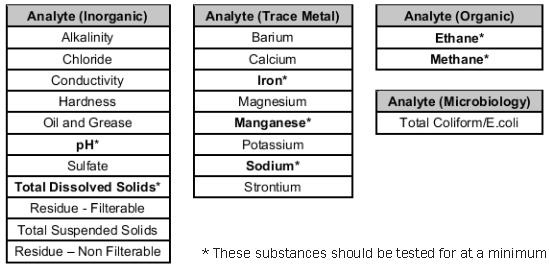
As a property owner, it is absolutely critical to test your water supply BEFORE drilling begins, so you can determine whether there’s been contamination later. If your water supply is damaged, you will need to prove that the damage was caused by the drilling and its aftermath. Without a baseline test you won’t be able to do that.

What should you test for?
Knowing what to test for is difficult because drilling companies are not required to reveal
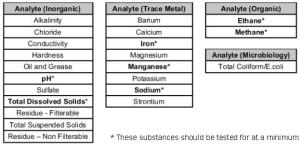
Water tests

The Pennsylvania Department of Environmental Protection recommends at least these tests. Click to enlarge.

the chemicals they use in fracking. You should absolutely consult with an independent professional for advice on this.The Pennsylvania Department of Environmental Protection recommends at least the tests on the left, but you should talk to a professional to determine what is right for you.

You can find an example of pricing information here.

Who’s going to do the testing?
ECA has said in public meetings in Red Lodge that they will do baseline testing within a mile of each drilling site, but there has been no written verification of this.

You should be aware that in Texas, the EPA declared that a group of Texas homes near a gas-drilling operation didn’t have dangerous levels of methane in their water, relying on tests conducted by the driller. Since then, independent tests from Duke University researchers have found potentially explosive levels of methane in some of the same wells.

I’m sure ECA is a reputable company, but it’s your property. Baseline testing will probably cost a few hundred dollars, so you’ll need to weigh whether to wait to see if ECA will do the test, or do it yourself. Keep in mind also that we have no information from ECA about where they plan to drill and when, so acting soon will make sure you get the testing done before nearby drilling takes place.

You can find a guide to local independent water testing labs at the Montana State University Extension Office web site, or by calling 406-994-7381.

Things to Know #3: How to find out more
Time is of the essence. If you’re interested, Montana State University is holding a free seminar on baseline water testing in Lewistown on January 22. A bit of a hike perhaps, but

A seminar on baseline water testing will be held in Livingston on January 22. (click to enlarge)

A seminar on baseline water testing will be held in Lewistown on January 22. (click to enlarge)

it would be a worthwhile thing for you and/or your neighbors to do if you’re concerned about protecting your water.

If you go and have materials you’d like to share with the community, let me know and I’ll post them here. This event is certainly valuable enough that it would be worth considering doing one in Red Lodge.

But don’t wait. You need to be in action now.

Posted on by davidjkatz | 6 Comments

Just a short post, probably relevant to only a few of you.

A reader was kind enough to send a link to a 2010 US Geological Survey document that characterizes and evaluates the undiscovered oil and gas resources of the Bighorn Basin in north-central Wyoming and south-central Montana. It’s a short but dense document written for geologists, but I’m posting it here in case someone finds it useful.

Index map of the areas included in the report (click to enlarge).Beartooths

Posted on by davidjkatz | Leave a comment

I got a number of personal responses to my op ed in yesterday’s Gazette, many of them supportive, some not so much. Thanks to all who sent me supportive notes.

The not-so-supportive ones tended to fall into three general categories:

  • If you don’t like oil why don’t you try walking out to the Beehive?
  • Extraction pays for schools and other things you like. Why do you hate children?
  • The geology of the Beartooths makes it impossible for anything like the Bakken to happen here.

The top two are pretty easy to think about. The first is a version of “America: love it or leave it.” If you love it, you try to make it better. The second would be easier to accept if Montana didn’t have an oil and gas tax holiday that starves local governments.

The third is scary to me. The notion that what’s happened in the Bakken is somehow a geological phenomenon misses the whole point of the argument. It’s clear that there will never be as much oil here as in the Bakken, but the issue isn’t just the geology. It’s the social ruination of the place as much as the environmental impact.

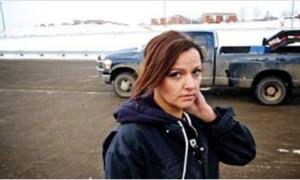
Today’s New York Times has a sobering first-person video, what they call an “op doc,” Running on Fumes in North Dakota. It depicts the experience of Jonnie Cassens, a 38-year old truck driver who was unemployed in California and has come to North Dakota to seek her fortune. She finds a job as a “hotshot” driver making $34,000 a year, which, with prices inflated to Manhattan levels, isn’t really enough to get by.

Her desolate existence, compounded by being a woman in a world full of men, describes exactly what we should fear about the expansion of drilling here.

In her words:
Those people that are making all the money, the suits, they don’t know what it’s like to be on the floor, they don’t know what it’s like to go to the truck stop and see a pregnant girl living in a car with her boyfriend, with a full size dog tied up outside as a guard dog, they don’t know the crazy stuff that you see people are doing for survival. I’m not even making as much as I was in California driving full time, I’m not getting any benefits, I’m not getting insurance….I’m in the land of hell….If you make a wrong move you’ll end up back living in your car.

What Jonnie understands is that the Bakken is all about money, and the “suits” — the corporations, the mineral rights holders, the government officials with bloated budgets — are doing it at the expense of land owners, residents in the community, and workers who come to the community to try to make a living.

In order to understand the impact of expanded drilling along the Beartooths, it’s critical we focus not just on the potential damage to the environment, but also on the destruction of community.

Posted on by davidjkatz | 3 Comments

Billings Gazette: Guest Opinion by David Katz

The following op ed appeared in the January 13 Billings Gazette under my byline:

Guest opinion: Citizens can make difference in Beartooth development

A Jan. 3 guest opinion paints a gloomy picture of the inevitability of oil drilling along the Beartooth Front. “Once you see the first well being drilled,” Christopher Eckoff says, “it is too late to stop the oil industry.”

It doesn’t have to be that way. Recent Montana history shows things can be different here.

The process Eckoff describes is exactly what happened in the Bakken. Like many Western states, Montana has laws that are favorable to mineral, oil and gas extraction. But there are excellent examples of organized citizens standing their ground to make sure that companies aren’t allowed to ruin the economy, environment and quality of life in our communities at the expense of a quick buck.

Bozeman Pass zoning
Perhaps the best example occurred in Gallatin County. In 1999, citizens along the Bozeman Pass experienced a situation similar to the one Carbon and Stillwater Counties face today. A New Jersey company announced plans to drill more than 100 coalbed methane wells on 18,000 acres of leased land. In response, an active group of citizens moved forward on a plan to create special zoning districts where coalbed methane drilling was proposed.

In 2002 the Gallatin County Commission created an emergency zoning district which banned the development of coalbed methane for two years, and in 2005 they adopted a permanent zoning district to regulate coalbed methane development.

Today the Bozeman Pass area remains unsullied because Gallatin County developed a conditional use permitting system in several special zoning districts. Permits are granted only if conditions exist that preserve the community. These include evidence of land owner’s consent, plans to protect property values and water quality, a detailed plan to reclaim all disturbed areas at the completion of drilling, and monthly monitoring by a state of Montana licensed and bonded environmental engineer.

Good Neighbor pact
The Stillwater Mine Good Neighbor Agreement, the only legally binding contract between a local community and a hardrock mine, is another example. Because citizens of Stillwater and Sweet Grass counties stood their ground, the Stillwater and Boulder Rivers remain pristine, traffic is controlled, pollutants are managed at the mining site, and there is an ongoing dialogue between the mine and the community. Today, as the mine is proposing expansion of activities, the community is engaged and negotiating about how the expansion takes place.

These examples prove that natural resource extraction isn’t an inevitable choice between short-term economic growth and long-term protection of the environment. When citizens in Montana engage with each other to develop creative solutions to complex issues like the proposed drilling along the Beartooth Front, they serve the interests of the community, not big corporations.

David Katz has been visiting a family home in Stillwater County for 40 years, and lives there part-time when not in California. He blogs on Beartooth issues at davidjkatz.wordpress.com.

Posted in Bakken, Community Organization, Politics and History | Tagged , , , , , , , , , | 3 Comments

Bozeman Daily Chronicle: Beartooth fracking challenge could affect Shields Valley

Laura Lundquist of the Bozeman Daily Chronicle published an analysis today on the recent lawsuit filed against the Montana Board of Oil and Gas Conservation.

The article contends that the lawsuit could have broad applicability in Shields Valley

Photo by Adrian Sanchez-Gonzalez/Bozeman Daily Chronical

Adrian Sanchez-Gonzalez/Bozeman Daily Chronicle

and across the state as oil development expands. Shields Valley is expecting a large influx of oil companies to move in as the state begins auctioning mineral rights in the area. Companies could then begin exploring for oil, gas or coal.

Lundquist interviewed former Bozeman resident Bonnie Martinellii, who raises organic fruits and vegetables less than two miles from the proposed Belfry well:

She said no similar fruit farm exists for 500 miles because only three parts of the state have the right climate conditions.

Martinell didn’t learn about the exploratory well until November. Now she and other area farmers are worried about the future of their property and livelihood.

“We get only 2 inches of rain a year, so we rely on irrigation and well water. It’s scary when you look at how much water is used by fracking wells and the potential for having our groundwater ruined,” Martinell said. “This is a huge farming community and most are against this. We’d at least like to have some baseline water testing.”

According to Martinelli, ECA has not yet begun exploration. They have about two weeks left in the 45 days granted by the permit.

Posted in Community Organization, Politics and History | Tagged , , , , | Leave a comment

Video Trailer: Backyard by Deia Schlosberg

Deia Scholsberg is a self-described “filmmaker, photographer, graphic artist, expeditioner, conservationist, idealist-realist” currently living in Bozeman. Backyard, her new 30 minute film, is screening today at the Wild & Scenic Film Festival in Nevada City, California.

The themes of the film are similar to the ones we saw in the video created by the Dakota Resource Council. Backyard tells the stories of five people in four states. They all have very different backgrounds and perspectives, but all are at odds with the extraction occurring around them. Despite their differences, unnerving similarities emerge from their shared experiences with the massive unseen entity that is “the industry.” Brief, animated interludes remind us to ask the bigger picture questions as well.

Two of the characters are in Montana and North Dakota. Here’s Schlosberg’s descripton of their stories:

Dick is in eastern Montana. Their family has been in the area for generations farming the whole time. They have surface rights and water rights, but no mineral rights. So they got…drilling right out their windows, which is affecting their cows and livelihoods. The cows have fallen in the trenches from the pipelines. There are constant dust clouds from the road. But the [industry] also treats the road with chemicals to reduce the dust, but it all gets kicked up anyways.

And that’s where Jacki is too. She’s also on the Bakken, but in North Dakota. She’s a rancher, certified organic, very mindful of the inputs cows were getting, and she farmed as well. Surrounding her property they drilled, her stream became contaminated; they found that it didn’t freeze in the winter anymore – and we’re talking like –30 degrees. Her cows starting getting sick and died. Her dogs got sick and died. Barn cats got sick and died.

I’ve sent her a note asking if there might be an opportunity to screen the entire film in Red Lodge. I’ll let you know if she responds. In the meantime, here’s more video from Backyard. My guess is that this section is about the two people described above.

Posted in Bakken, Personal stories | 2 Comments

Video: Living with the Wild West Oil Boom

Every resident of Carbon and Stillwater Counties should watch this 30 minute video. It was created by the Dakota Resource Council.

It’s one thing to read the news accounts of what the oil and gas boom has done to communities in the Bakken. This video shows you, through the eyes of people who live there, how a way of life has been ruined in five years. As one resident says, “You either work in the oil fields or you leave.”

Take some time to watch and reflect. For me, the enormity of what I saw has sunk in over the course of the day. It’s devastating.

Posted in Bakken, Community Organization, Politics and History | Tagged , , , , | 1 Comment

Media on MBOGC lawsuit

As of 4:00pm on 1/9/14. Feel free to add additional examples in comments

Billings Gazette
Beartooth Front drilling spawns lawsuit

Great Falls Tribune
Lawsuit filed over Beartooth Front drilling permit

Montana Standard
Lawsuit filed over Beartooth Front drilling permit

KXLF.com, Butte
Environmental group: state board blocked comment on MT oil well

Kansas City Star
Lawsuit filed over Beartooth Front drilling permit

Oklahoma City Times
Lawsuit filed over Beartooth Front drilling permit

Seattle Post Intelligencer
Lawsuit filed over Beartooth Front drilling permit

Sacramento Bee
Lawsuit filed over Beartooth Front drilling permit

Public News Service
Shut Out of BOGC Hearing, Testifiers Sue

Jackson County (IN) Tribune
Lawsuit filed over Beartooth Front drilling after public hearing canceled prior to approval

Posted in Shared Letters and Posts | Leave a comment

NEWS RELEASE: Montana Board of Oil and Gas Sued for Shutting Out Public

Wednesday, Jan. 8, 2014

CONTACTS: Deb Muth, Carbon County Resource Council
Bonnie Martinell, Bridger organic farmer and producer
Charles Sangmeister, Stillwater Protective Association
Maggie Zaback or Larry Winlsow, Northern Plains staff

The Northern Plains Resource Council and Carbon County Resource Council (CCRC) are challenging in court a decision by the Montana Board of Oil and Gas Conservation (BOGC) to prevent the public from testifying on a proposed oil well permit for the Belfry area last month.

A lawsuit was filed this morning with the Montana 13th District Court in Yellowstone County. (Cause No. DV-14-0027 Dept. 3)

At the December BOGC meeting in Billings, CCRC (an affiliate of Northern Plains) was taken off the agenda and not allowed to speak about the pending oil permit, despite having been granted the hearing and being on the agenda for weeks. This abrupt reversal came in an 11th-hour BOGC stunt claiming CCRC had not yet provided an official “service list,” although the group hand-delivered, mailed, and faxed its protest to all parties weeks in advance.

December 12 was the day of the hearing on the well of concern, Hunt Creek 1-H by Energy Corporation of America (ECA) east of Belfry, however once the CCRC protest was removed, there was no hearing for the well at all. Irrigators and other members of the public were not allowed to speak about a permit that was under consideration by the BOGC.

“Public participation is not only a vital right to Northern Plains and CCRC members – it is also a cornerstone of our Montana Constitution and the democratic processes that are at the heart of a free and open society,” said Deb Muth of Red Lodge, who is Chair of Carbon County Resource Council.

“It’s a shame that, if we want the right to speak about this proposed oil well permit in the Belfry area, we are forced to sue the BOGC. When people have to go to court just to have the right to speak, the system is very broken.”

While enforcing this technicality against the resource council, the BOGC looked the other way on an error made by the drilling company, whose start date on its application was off by a year.

“If the BOGC is going to be perfectionist,” said Muth, “then it needs to require the same standard of the industry that it does of ordinary citizens. BOGC should render this permit invalid until it allows the public to testify.”

Without hearing any public comment specific to the permit, the BOGC rubber-stamped the permit with no additional conditions or landowner protections. Citizens from the area were particularly concerned about the well’s potential to pollute irrigation water.

“They’re putting a reserve pit in a drainage and when we get flash floods, water flows right through there. But the company wouldn’t know that, nor would the board, since no one will listen to our cautions,” said Bonnie Martinell, organic farmer and producer just a few miles from the well.

“You would think they would want local input, since we know this area best, but instead the public was silenced. The BOGC appears to operate hand-in-hand with the oil and gas industry, although its job is to oversee that industry on behalf of the people of Montana,” said Martinell.

Charles Sangmeister Chair of the Stillwater Protective Association observed that, “This oil well is the beginning of what ECA says could be a large development in Carbon and Stillwater counties. We have many members whose lives and property will be directly affected by both this well and the others along the Beartooth Front and Bighorn Basin. That’s why we couldn’t stand for the BOGC to simply keep the public from testifying on this permit.”

Posted in Community Organization, Politics and History | Tagged , , , , , | 13 Comments