A newly released study on national attitudes toward fracking received a lot of coverage in the press, but newspapers don’t have the space or staff to go very deep into analysis. They reported only the top line information on the results. The Billings Gazette headline was typical: “Study: Few Americans understand fracking.”

But a look below the surface of the study provides excellent guidance for those seeking to shape community action.

American attitudes about fracking are just forming, but we’re deeply divided
The headlines are correct. Most Americans don’t know much about fracking. According to the survey, conducted by researchers at three universities, 55% of Americans say they know little or nothing about fracking, and only 9% say they know a lot. Among those who indicated they knew something about fracking, a majority (59%) indicated they were opposed to fracking, while 42% were in favor.

There are other pieces of information in the study that are worth noting:

  • Support for fracking is correlated with age. About 7% of people under 60 strongly
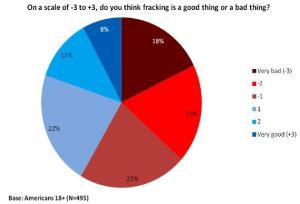
    Divided attitudes on fracking

    (click to enlarge)

    support fracking; more than 15% over 60 strongly support. Conversely, over 20% under 60 somewhat or strongly oppose fracking, while fewer than 15% of those over 60 feel that way.

  • People with more formal education are more likely to take a position on fracking, and are more likely to oppose it, although even among respondents with advanced degrees, opinions are relatively evenly divided.
  • Importantly and not surprisingly, respondents who identify as liberals oppose fracking 39% – 12%, while conservatives favor fracking 37% – 10%.
  • The more people say they know about fracking, the more likely they are to have an opinion about whether it is good or bad. However, knowledge doesn’t drive them to opposition. Even people who say they know a lot about fracking are evenly divided about whether it is a good or bad thing.
  • Respondents in the Western US are slightly more opposed to fracking than those in other parts of the country.
  • No surprise here — people who oppose fracking are most concerned about environmental impacts; people who favor it cite its economic benefits and the path to energy independence.

What does this tell us about public opinion in Carbon/Stillwater Counties?
The first thing to recognize is that, even if most people don’t know much about fracking, we can look beneath the surface of the data to see what it tells us about our local community. To start with, we are all aware of how divided our country is on key wedge issues. According to a 2013 Pew Research Study, summarized below, environmental issues are the most divisive issues between Republicans and Democrats, with a huge 37% difference in how members of the two parties prioritize them for action along party lines

Pew Research Poll: 2013

Environmental issues are most divisive along party lines (click to enlarge)

Anyone who is familiar with the voting patterns of these counties also knows that they consistently vote strongly Republican. In the 2012 Presidential election, Carbon County voted for Romney over Obama 60-36. Stillwater County favored Romney 71-26. Statewide, Romney won 55-42.

So, the data tells us that conservatives strongly favor fracking, that environmental issues are among the most divisive issues in our country today, and that Carbon and Stillwater Counties are conservative, even moreso than the rest of the state. The first clear lesson should be painfully obvious. To the extent that the community discussion becomes a fight pitting pro-fracking vs. anti-fracking, the anti-fracking side will lose.

This shouldn’t be surprising or discouraging to activists who want drilling along the Beartooth Front controlled or eliminated. Montana law is permissive to oil and gas extraction, so a divided community will not be able to stand up to corporate interests.

A second important lesson that the data teaches us is that providing information isn’t a critical factor in determining attitudes about fracking. According to the survey, people who know the most about fracking and people with the most education are still bitterly divided about the benefits or risks of fracking. Activists who believe that all they need to do is provide the facts about fracking to their opponents and poof! — their opinions will change — are missing the point. There are real divisions of thought among informed people about the relative value of economy/energy independence vs. the environment. So the second lesson is that community activism on this issue is not a teaching exercise where one side has the right information and explains it to everybody else.

This brings us to a third critical lesson. The expansion of drilling along the Beartooth is not just an environmental issue. We need to look only at the Bakken and Powder River in Wyoming to see that the expansion of drilling will have a dramatic and far-reaching impact on the community.

  • It will affect the long-term viability of Red Lodge, Fishtail, Roscoe and surrounding towns, which will experience a boom when drilling expands, and a bust when the drillers leave.
  • It is a property rights issue that will affect farmers, ranchers, and homeowners alike. Few landowners in Carbon and Stillwater Counties own their own mineral rights, and Montana law is permissive about the ability of mineral rights holders to exploit their assets. It is in everyone’s interest to make sure that landowners are protected from predatory land use agreements.
  • It is a social issue. In the Bakken we have clear examples of tax increases, inflation, illegal drug use, prostitution, homelessness, inadequate sewage, urban-level traffic jams, health care shortages and more. When you impose heavy industrial use on a rural area, that’s what happens.
  • Yes, it is very much an environmental issue. Expanded drilling will affect the viability of our long-term water resources for agriculture, for ranching, and for recreation. It will scar the land. Where will the drillers get the millions of gallons of water they will need for drilling, where will they dump it, and how will we make sure that toxins don’t leak into our ground water? And how will we know what the impact is if we don’t move quickly to establish a baseline for where we are today?
  • It affects our local elected officials, who are key to decisions about planning and land use. Whatever happens will happen on their watch, and they will need to be responsive to local interests.

The third lesson then, is that the expansion of drilling will affect everyone, regardless of political inclinations. This should not be a fight at all, but an opportunity to join together as a community to take ownership of our fate, not leave it to corporate interests.

These are lessons that towns in the Bakken, both in North Dakota and Montana,  have all learned the hard way, and not a single one of them was prepared for what happened after the drilling rigs showed up.

We can’t predict the future. Drilling expansion may or may not happen. But the worst thing we can is to shut up and let it happen. We have a unique opportunity to benefit from the lessons learned in North Dakota, Wyoming and around the country.

People should fight for what they believe in. But they need to do it in the context of community, not in the service of corporate interests.

Posted on by davidjkatz | 5 Comments
I try to provide as much analysis as I can on this blog, but from time to time I repost letters, comments, and blog entries that I think are worthwhile. The following is an open letter to the Illinois Department of Natural Resources, which has been holding public hearings about fracking.

david e christensenJanuary 2, 2014

My name is David E. Christensen. I am a retired geography professor. I received my Masters and PhD degrees from the University of Chicago. I taught geography at several universities and for a year at universities in the United Kingdom and China and for summers in Canada and Malaysia.

For your information professional geographers are concerned with the human use — and misuse — of the surface of the Earth, and that concern includes thousands of feet below the surface and the atmosphere. That concern obviously includes activities that relate to the well-being and survival of humans and other living things with which we share this planet and on which we depend. Thank you for providing this opportunity to speak to you about an issue that concerns me — and all of us — deeply.

For two centuries the amount of CO2 in the atmosphere has steadily increased to the point of endangering living things, including humans. Climate change is real and near an unknown tipping point. That knowledge is based in part on the chemistry of the air going back 800,000 years (Antarctic Ice cores).

As persuasive as are “jobs and profits” arguments for “frack now and worry about it later,” my concern with hydraulic fracturing (“fracking”) is long term. After our two centuries of “creaming off” the “easy to mine and drill” fossil fuels (coal and oil) we have entered into more and more expensive and controversial modes, the latest being horizontal fracking. Yes, there has been fracking at the bottom of bore holes for decades, but the major change came about only a dozen years ago when horizontal fracturing (out to about 2 miles from the bore hole!) and the rising cost of prospecting and production (and renewed prospects for generous profits) opened the huge reservoir of impregnated oil and gas in shales thousands of feet below Earth’s surface.

I need not review with you details about the many controversial aspects of fracking. You know them well:

  • The use and contamination of vast amounts of limited fresh water resources,
  • The problem of disposal of the toxic contaminated water that rises with released oil and gas through the bore hole,
  • The contamination of ground water resources as remaining toxic fluids, oil and gas rise randomly to the surface for miles around the bore hole,
  • The record of increasing low and mid-level earthquakes causing damage to infrastructure and structures on or near the surface, jeopardizing and disrupting the health and lives of humans at the surface.

The use of natural gas from fracking over the next decades or century would only exacerbate our already precarious situation in regard to CO2 in the atmosphere and climate change.

Just because the fracking technology has been invented and can increase the production of oil and gas that provides jobs and prof-its for a while does NOT justify its use if it puts the health, well-being and survival of the human species and our accumulated civilization at risk. (Humans also invented nuclear bombs but must not use them for similar reasons!)

We should not be playing games with fracking rules. More stringent rules and nickel and dime fines for environmental damages are part of that game. We should not even be considering a moratorium. Fracking technology very simply should not be used.

We should be intensively researching and developing alternative energy sources and dealing realistically with the Earth’s over-population.

DAVID E. CHRISTENSEN of Carbondale is an emeritus professor of geography at Southern Illinois University Carbondale. He is the author of “Earth is Overpopulated Now” and “Healing the World.”

Posted on by davidjkatz | Leave a comment

Video: Preserve the Beartooth Front

This video really struck a chord with me. It was created by a young woman named Starr Brainard, who grew up in St. Paul and is now a student at American University. Her family has vacationed in the Beartooth area throughout her life.

What struck me about it is that Starr’s story is my family’s story. My wife’s family is from the Twin Cities, and every summer her parents would drive her and her three sisters out to the Gallatin Canyon for an extended period.

Forty years ago they found a place on the Stillwater River at Beehive, and eventually retired there. My wife and I would make pilgrimages here with our three boys, and her sisters would come with their families too.

The grandchildren all fell in love with a land that was so different from the cities in which they grew up. They learned what it means to love the land, to use it responsibly, to enjoy its beauty every day we were here.

Today the 13 grandchildren are spread to the winds, in New York City, Washington DC, Nashville, Chicago, the Twin Cities, Denver, Boulder, Eugene, and Santa Barbara. Our place on the Stillwater is hopping from the time the snow melts to the day we close it down in the winter, as they come back to fish, backpack, and enjoy the solitude as the Stillwater goes roaring by.

Starr’s video makes me wonder whether this will be the same place in a generation that it is today. When she brings her kids back, after the drillers have found what they wanted, will there be drinkable water, will the land be scarred beyond recognition, will the beautiful little towns that supply us still exist?

Ultimately the video strengthens my resolve to keep this place from being overrun in the same way that Pavilion, Wyoming and Williston, North Dakota have.

Thanks Starr, and everyone else who is determined to preserve this place for future generations.

Information about Starr comes from the good folks at the No Fracking the Beartooth Front Facebook page. You should like them. They do good work.
Posted in Community Organization, Politics and History | Tagged , | 3 Comments

Fracking is Bad for Babies

Pullout quoteAs I wander around the Internet finding out what I can about oil and gas drilling, I run into an increasing amount of academic research that links fracking to a variety of health and environmental issues. As an example, a couple of weeks ago I wrote about how fracking raises the risk of reproductive, metabolic, neurological and other diseases among children who are exposed to the endocrine-disrupting chemicals used in fracking.

No matter how this list accumulates, there is a constant refrain from pro-frackers: “There is no proven link between fracking and health issues.”

Unless you look.

In a study presented today at the annual meeting of the American Economic Association in Philadelphia, the researchers — Janet Currie of Princeton University, Katherine Meckel of Columbia University, and John Deutch and Michael Greenstone of the Massachusetts Institute of Technology — looked at Pennsylvania birth records from 2004 to 2011 to assess the health of infants born within a 2.5-kilometer radius of natural-gas fracking sites. They found that proximity to fracking increased the likelihood of low birth weight by more than half, from about 5.6 percent to more than 9 percent. The chances of a low Apgar score, a summary measure of the health of newborn children, roughly doubled, to more than 5 percent.

The study corroborates similar results from a 2012 study by Elaine Hill, a PhD student at Cornell University.

The study did not conclude why the relationship exists between fracking and the health of newborns. According to the authors, it does not appear that water is the culprit.– results were the same for babies who drank from monitored public water supplies and private wells.

When the drill at any cost folks say, “This is the price we have to pay for economic growth,” is this really what they mean?

The study has yet to be peer reviewed or published on the Internet, but you can read more about it in a piece by Mark Whitehouse at Bloomberg.

Posted in Fracking Information | Tagged , , | 3 Comments

Video: Chaos in North Dakota

Who’s minding the store? It’s clear that nobody is looking after the public interest. We hear it over and over again from public officials in North Dakota and eastern Montana, “This is the price you have to pay for energy independence.”

It isn’t. This is the price you have to pay when citizens don’t stand up for their rights.

NOTE: At the request of a reader I’m adding the Montana railway map. There are only two routes westbound trains can take out of the Bakken, one north and one south.

Montana Rail System

Montana Rail System: Only two main routes

Trains that take the southern route go right through Billings, Laurel and Columbus. The next plume of smoke you see could be right nearby.

Posted in Bakken, Community Organization, Politics and History | Tagged , , | 2 Comments

This post considers actions taken by Gallatin County a decade ago to stop coalbed methane drilling, and looks at whether that strategy might be adopted in Carbon County today as a way to keep the Environmental Corporation of America (ECA) from ruining the community.

About Montana Land Use Law
In 1963, the Montana legislature adopted Mont. Code Ann. § 76-2-209 as part of the Montana Zoning and Planning Act (MZPA). This law effectively prohibits local governments from

prevent(ing) the complete use, development or recovery of any mineral, forest, or agricultural resource.

This is similar to laws in other Western states. The owners of natural resource rights have a protected ability to get those resources out of the ground. However, they can be constrained to some extent by conditions imposed by local governments. Montana counties and municipalities have authority to adopt local ordinances and zoning regulations necessary to promote the general welfare of their citizens. In exceptional circumstances, counties can adopt interim zoning maps or regulations — including moratoriums on mineral developments — as emergency measures to promote public health, safety, morals and public welfare.

What happened in Gallatin County
Here is a timeline of events in Gallatin County that provided a unique solution to the unwanted intrusion of companies seeking to extract natural resources:

1999: JM Huber Corporation of New Jersey announced plans for the development of more than 100 coalbed methane (CBM) wells on 18,000 acres of leased land in the Bozeman Pass area. They proposed a network of pipelines and access roads to accompany the wells. Bozeman citizens and elected officials began to mobilize in the wake of the announcement.
August, 2001: The Montana Board of Oil and Gas Conservation (MBOGC) voted to grant Huber a permit to drill an initial test well, causing an outcry among the locals. The company then withdrew the permit, saying they wanted to reapply and address concerns of the local citizens.

The citizens group moved forward on a zoning plan designed to “prevent coalbed methane drilling in the (zoning) district.” Eventually Huber resubmitted a request for a conditional use permit, but the Bridger Canyon Zoning Commission voted 5-0 to deny the request. Huber filed suit, contending that the decision was a violation of federal and state law.
June, 2002: The Gallatin County Commission created an emergency zoning district which banned the development of CBM for two years.
December, 2005: The Gallatin County Commission adopted a permanent zoning district designed to regulate CBM development.

Regulations relating to CBM have subsequently been adopted by several different zoning districts in the County. All of these districts consider the development of CBM as a conditional use and have laid out a distinct set of criteria that must be met to proceed with drilling. Similar regulations have also been developed in Park County, which is adjacent to Gallatin along the Bozeman Pass.

The zoning district has developed a detailed Natural Resources Conditional Use Permitting (NRCUP) system through which it may grant a Natural Resources Conditional Use permit to oil and gas development activities only if the following conditions exist:

  • evidence of the owner’s consent
  • documented plans to protect property values, water quality, wildlife and plant habitat
  • documented plans for long-term maintenance of surrounding lands and weed control regulations
  • documented plans to reclaim all disturbed areas
  • property appraisal of all adjacent properties with 1.5 miles
  • a monitoring schedule for effective third party monitoring, at least every month, by a State of Montana licensed and bonded environmental engineer, of all development.

These zoning restrictions have been challenged and upheld in court, but the line between the provision of state law that prohibits local governments from blocking the exploitation of natural resources and those that allow local governments to zone to “improve the present health, safety, convenience and welfare of their citizens” is a fine one. Any citizen group that attempts to utilize zoning to block energy extraction is going to have to walk that line.

What it would take to do this in Carbon County
It’s easy to argue that Bozeman and Gallatin County are fertile ground for this kind of community action. As a writer for the Bozeman Daily Chronicle put it at the time, plans for CBM extraction were a mismatch for the community, characterizing the development as “heavy industry in an area of mixed agricultural and rural subdivisions, places with expensive homes placed in quiet, bucolic settings.”

It’s also true that coalbed methane and fracking are different, but the key problems with CBM are very close to those involved with fracking: huge volumes of water usage, disposition of wastewater, and heavy industry with all its problems — crime, traffic, infrastructure requirements — into an area that has no industrial base.

Red Lodge and Carbon County are somewhat different from Gallatin County, but it’s possible to imagine how something similar could happen here. It would take three basic things:

  • A unified community. It will be important to engage the community to keep this from being simply a battle between people who care about the environment first and those who favor growing the economy. Citizens need to understand that allowing the Beartooth Front to look like the Bakken will destroy everything that local residents care about: not only the environment, but the quality of life, the tourism industry, and, in the long run, when the drillers have gotten what they can get, the economy. It is this understanding that can give a strong voice to the entire community.
  • Political leadership. Ultimately, if Carbon County is going to take this road, it will be a decision that will be made by public vote. County Commissioners are not going to decide to make controversial zoning decisions on their own. They’ll have to be persuaded by effective voices in the community: ranchers and landowners, environmentalists, and business leaders.
  • Strong legal footing. As I think this post has shown, the law on this subject is complicated. Local communities are restricted as to what they can do to stop drilling, but they do have the right to protect the local community. Any zoning restrictions will have to crafted to withstand the legal challenges that will certainly result.

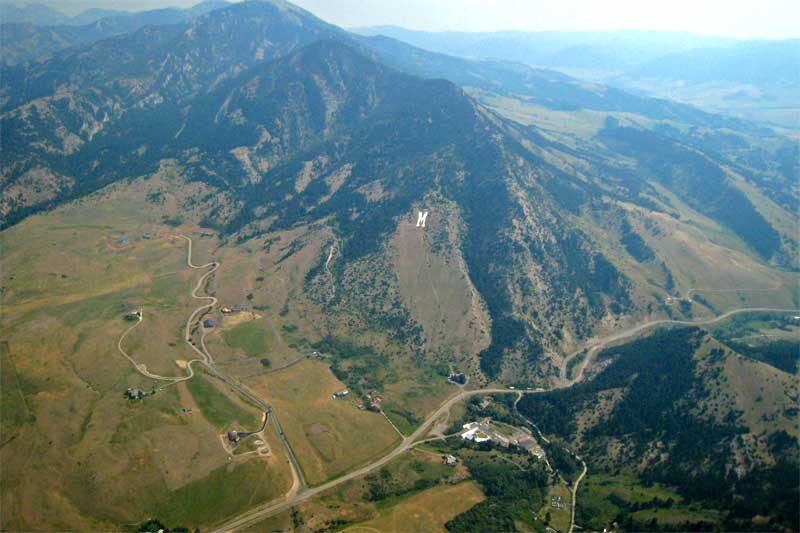
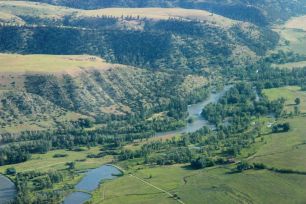
This is not a battle for the faint hearted. But a well executed strategy could have a far-reaching impact on a community that needs to be preserved. As inspiration, here’s the Bozeman Pass today, as beautiful as it was 20 years ago, thanks to the committed citizens of Gallatin County.bozeman_pass_web

Special thanks to Derf Johnson of the Montana Environmental Information Center for his invaluable help in preparing this post. MEIC is a non-profit environmental advocacy group founded in 1973. They do great work lobbying in the State Legislature, as a government agency watchdog, as a promoter and protector of the Constitution, and as a grassroots organizer and public educator. You can join their email network here. Derf shared with me a research paper he did on this subject, which provided information I was unable to find elsewhere.
Disclaimer: I am not an attorney or an expert on environmental law. Please consult with an attorney before acting on any of the information presented here.
Posted on by davidjkatz | 3 Comments

Don’t Bakken the Beartooths

Fans of Breaking Bad no doubt appreciated the irony when Walter White of Lockwood was recently sentenced to 12 years for his part in a conspiracy to distribute methamphetamines in the Bakken oil fields. But his conviction was not part of a fantasy TV drama, it was a symptom of a very real problem — the explosion of crimes related to drugs and violence that oil and gas drilling has brought to western North Dakota and eastern Montana.

It’s no mystery why the proliferation of drilling brings crime with it. You bring in thousands of men to work in the fields, house them in “man camps” because there’s no place for them to live locally, pay them large salaries, and you’ve got a substantial crime problem. Hangers on come to the camps to provide vices to young men with money: drugs and prostitution mostly, but in an environment that is mostly men and few women, rape and domestic violence increase as well.

“It’s following the money,” said Michael W. Cotter, the U.S. attorney for Montana. “I hate to call the cartels entrepreneurs, but they’re in the business to make money. There’s a lot of money flying around that part of Montana and North Dakota.”

Sgt. Kylan Klauzer, an investigator in Dickinson where violent crime is up nearly 500% over five years, said, “It feels like the modern-day Wild West.”

Domestic violence shelters are filling up, the residue of troubled migrations.

Families arrived hoping for $20-an-hour jobs, but discovered that modest homes rent for $2,000 and everything from gasoline to dinner costs more. The stresses of life piled up. Alcohol and drugs added to the problem. Old patterns of domestic abuse crossed state lines.

ND officials try to sugar coat the story
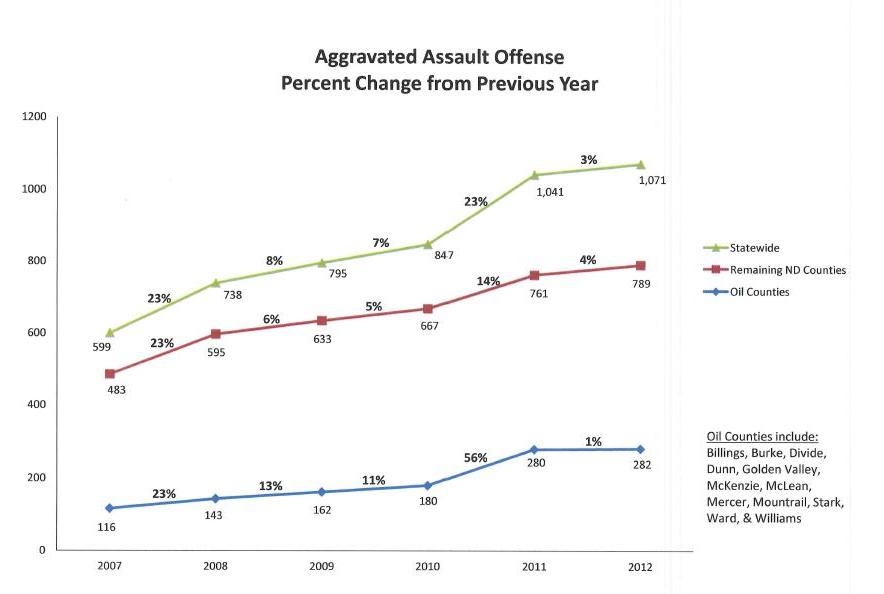
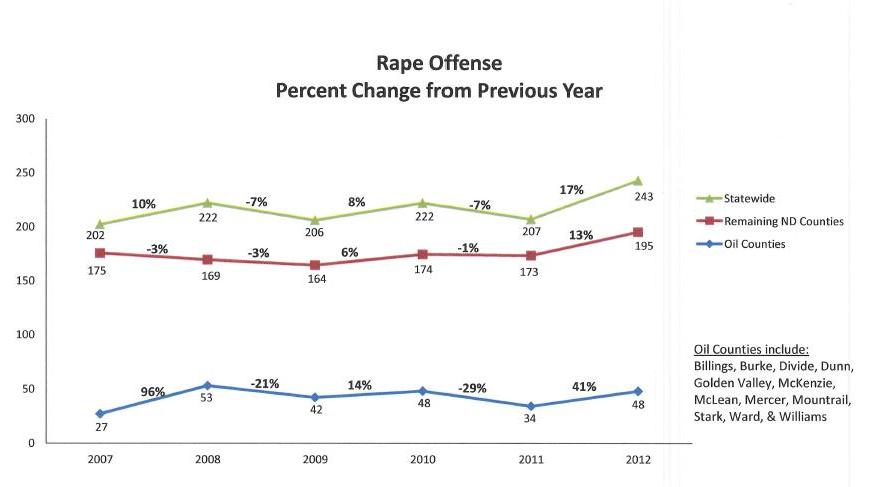
North Dakota Attorney General Wayne Stenehjem tried to put a calm face on it last summer when he released crime statistics comparing the state’s oil counties with the rest of the state, saying that there wasn’t much proportional difference between the two. That’s ridiculous. The numbers he released speak for themselves, and if he looked only at towns like Williston and Dickinson, which are right at the center of the boom, the comparison would be even more stark.

Aggravated assault was up 56% in the oil counties form 2010-11, and 14% statewide;
Image

Rape has nearly doubled in the oil counties in the five years from 2007-12 while increasing only slightly in the non-oil counties:Image

According to a recent article in the Billings Gazette, prisons in the area, designed to be filled over a period of years, are overflowing:

  • The Dawson County jail, one of the region’s largest, with 24 beds and four holding cells, was at or near capacity all but two months during 2013.
  • In Sidney, the 24-bed jail maxed out in July and began housing overflow inmates in a separate wing normally reserved for juveniles. Two days after Christmas, inmates there numbered 29. The juvenile wing was again occupied by adults.
  • In Williston, the new 116 bed facility is at capacity. Inmates are being shipped as far away as Helena.
  • In Roosevelt County, Montana, where arrests were up 855 percent in five years, Sheriff Freedom Crawford says his jail is so full that he is ticketing and releasing offenders for minor crimes like disorderly conduct. Why? “I don’t have nowhere to put them,” Crawford says.

If you’ve got the stomach for it, you can find for yourselves the stories of the abduction and murder of a 43 year old Sidney teacher, the rape of an 83 year old Dickinson woman, or the disappearance of a 30 year old Dickinson man putting in water and sewer pipes.

No new money coming
Because of the federal sequester  and local funding cuts, you won’t see money pouring in for more law enforcement personnel or more jails. According to Michael Cotter, US attorney for Montana, which experienced $672,000 in Department of Justice sequestration cuts in 2013,

The decrease in funds will result in a decrease in agents and officers investigating cases, a decrease in cases prosecuted at local and federal levels and a decrease in criminals brought to justice. Lives of the folks living in Eastern Montana will be negatively affected.

Don’t let it happen in Red Lodge
This didn’t have to happen. Public officials like Williston Mayor Ward Koeser will tell you, “if you’re going to be an oil town, that’s what you’re going to have.”

Nonsense. It is the responsibility of public officials to protect the public safety. You can’t have an oil and gas tax holiday, which deprives local counties of revenues it desperately needs, and expect them to build jails and hire law enforcement personnel. It is irresponsible for our senators, state and local officials to stand by and let Red Lodge get turned into Dickinson, North Dakota. If they’re going to bring in the engines of economic growth, they’ve got to find a way to protect the land and the residents so you’ve got a viable community when the boom turns to bust.

What has happened in North Dakota and eastern Montana is about to happen on the Beartooth. Oil permits are starting to be issued, and energy companies are promising to turn this area into another Bakken.

Don’t be complacent. It’s time to stand up and say, “Don’t Bakken the Beartooths.”

Posted in Bakken | Tagged , , | 6 Comments

Wyoming natural gas bust leaves landowners and taxpayers holding the bag

What goes up must come down. The boom and bust economy that goes with oil and gas drilling can leave state and local governments and local landowners with big problems when boom times dry up.

The New York Times reports that the bust has hit in eastern Wyoming, where a natural gas boom has dried up as a result of rapidly falling natural gas prices. As a result,

Hundreds of abandoned drilling wells dot eastern Wyoming like sagebrush….The companies that once operated the wells have all but vanished into the prairie, many seeking bankruptcy protection and unable to pay the cost of reclaiming the land they leased. Recent estimates have put the number of abandoned drilling operations in Wyoming at more than 1,200, and state officials said several thousand more might soon be orphaned by their operators.

As a result, the state of Wyoming is scrambling to plug the wells and keep toxins from seeping into groundwater. The governor is advocating that taxpayers pay $3 million to plug the wells, and landowners are left with a mess — unproductive land that needs to be cleaned up and is at risk for long-term chemical damage. If thousands more wells go bust, this money won’t come close to paying the cost.

In Wyoming companies often disappear when their wells go under:

Companies must pay a $75,000 blanket bond to cover all of the wells they operate — often numbering in the hundreds — on state and private land in Wyoming. Once a well stops producing and is deemed idle, the operator must pay up to $10 a linear foot in bonding to offset the cost of reclamation.

But it is at that point that some companies drift into financial trouble and cannot pay the additional fees, leaving the state to scramble to make up the cost.

It’s easy for legislators and landowners to get excited about the prospect of energy independence, profits and jobs when production is increasing and prospects are great. But oil and gas are cyclical businesses, prone to booms and busts. When the bust hits, it’s local residents and taxpayers who get left holding the bag.

Posted in Community Organization, Politics and History, Fracking Information | Tagged , , | 1 Comment

Energy Corporation of America Activity in Carbon County

On October 24, 2013 Energy Corporation of America (ECA) opened an office in Billings in conjunction with an announcement of plans to expand development of oil and gas leases along the Beartooth and Bighorn mountains. ECA CEO John Mork said he envisions bringing “the Bakken to the Big Horns [and the Beartooths] … and fundamentally changing these areas the way it has changed other areas of the United States.”

This post looks at ECA and their current activities in Carbon County.

About ECA
ECA was founded 50 years ago, and since 1979 the company’s corporate headquarters has been located in Denver. The company’s operations are totally dedicated to oil and gas drilling, initially on the East Coast and in the Appalachian Basin from New York to Kentucky, where they have been active for 45 years.

To give you an idea of the scope of their operations, ECA owns over 1 million acres from New York to Tennessee, and operates over 4,600 wells and over 5,000 miles of pipeline. The company has more than 10,000 drilling locations, with over 15 trillion cubic feet (TCF) of resource potential and more than 400 billion cubic feet (BCF) of proved reserves. ECA also has the capability to transport over 55 mmcf/d through multiple pipeline systems. In the past five years, ECA has drilled as many as 100 wells in a year, with up to 6 active drilling rigs operating at one time.

Suffice it to say they are a big organization with tremendous capabilities.

In its Rocky Mountain Division, ECA holds multiple high-potential oil prospects and is beginning development of its reserves of over 60 million barrels of oil in Carbon and Stillwater Counties. ECA also has shallow gas holdings and owns and operates existing gathering and transportation infrastructure.
westMap
Source: ECA Web site

ECA also has operations in Texas and New Zealand.

Current ECA activity in Carbon County
The information in this section comes from publicly available sources. You will need a password to view it.

Total oil production in Carbon County has been declining slowly since 2000, from a high of nearly 56,189 barrels per month in July, 2000 to its current level of 31,788 barrels per month in August 2013.

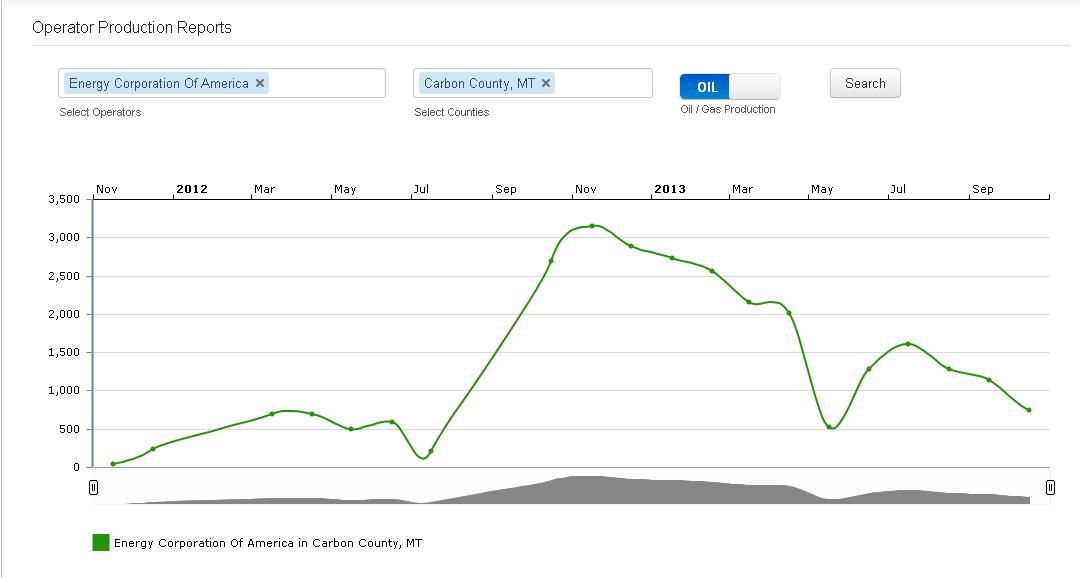
ECA currently has two operating wells and one injection well in Carbon County, all from their Foothills lease (8464):

  • ECA Foothills 1-H (API 25-009-21297), completed in November, 2011. The well has produced 6416 total barrels of oil since that time, including 86 barrels in October, 2013. It has also produced 111,684 MCF of gas.
  • ECA Foothills 2-H (API 25-009-21299), completed in September, 2012. The well has produced 21,305 total barrels of oil, including 657 in October, 2013. It has also produced 20,700 MCF of gas.
  • Foothills 6-D is a nearby waste water injection well.

The chart below shows total ECA production by month from these two wells.

Image

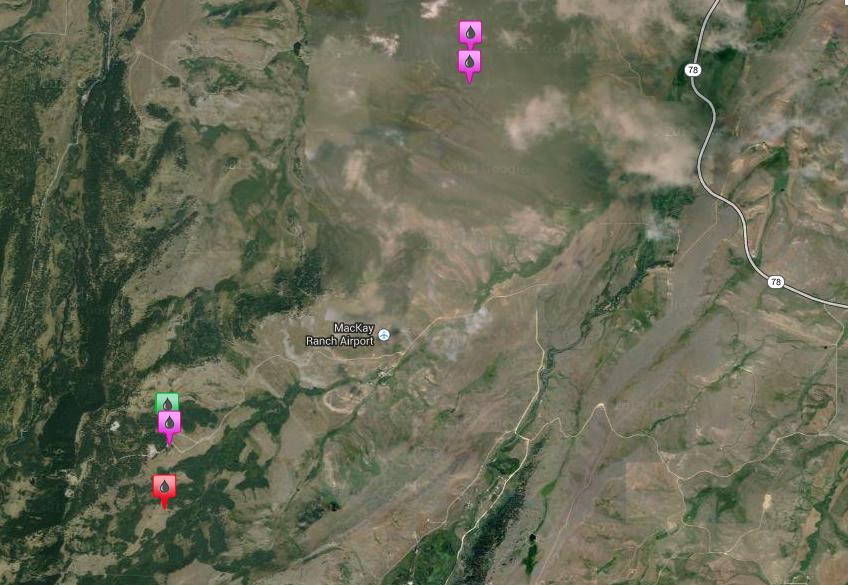
The map below shows the location of the two wells. The green marker represents the two producing wells, and the red marker is the waste water injection well. The pink markers are inactive wells.Image

ECA is clearly just ramping up their activities in Carbon County. We know they received an additional lease approval for a well near Belfry in December.

We can use this information to track their activities going forward.

Edit:
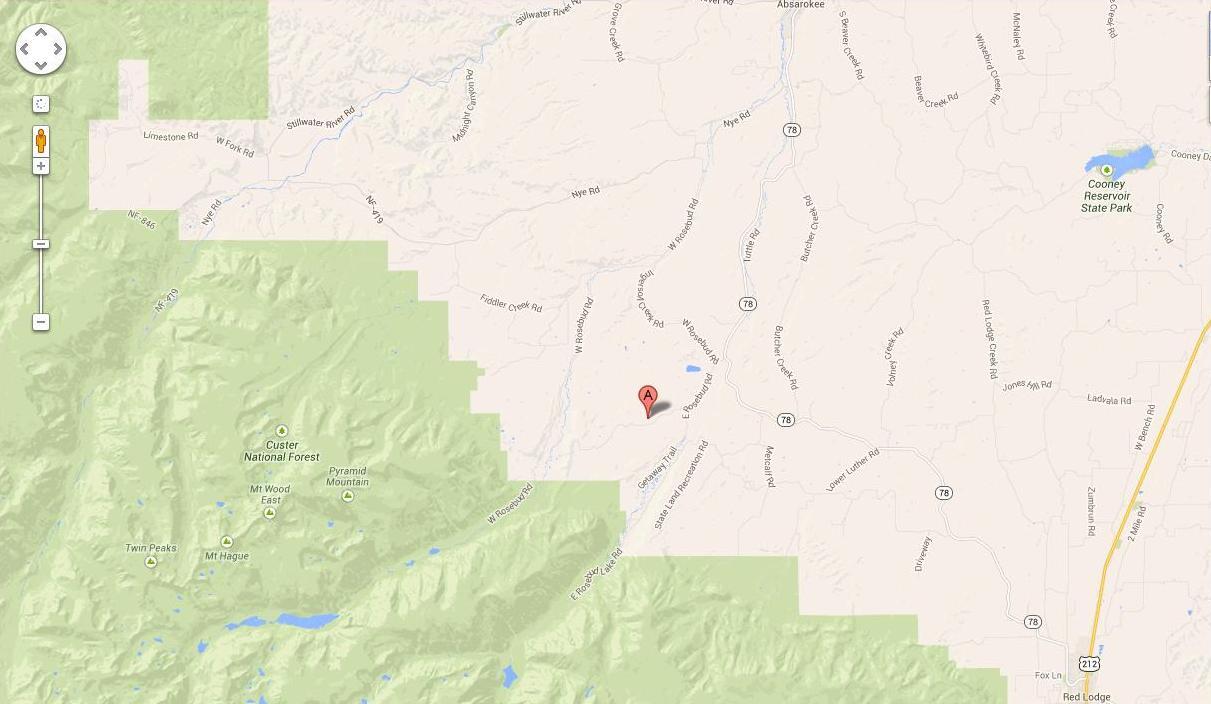
mckayranch3At the request of a commenter below, I have expanded the map. The A marker on the map represents the McKay Ranch Airport, just east of the ECA wells. Absarokee is at center north, Stillwater River Road runs along the top, Red Lodge is in the bottom right, and Highway 78 is at the center. Click on the map to expand it.

Posted in Fracking Information | 6 Comments

The Montana Chamber of Commerce is busy promoting their new “scientific” survey of Montana residents. The survey, conducted in October, shows that 59% of Montanans approve of fracking.

It’s important to keep in mind that the Chamber is a political organization with a stated mission of being “the advocate of business in Montana and the driving force in promoting a favorable business climate.” This survey is a propaganda tool to push that agenda, not an accurate reading of the opinions of residents.

Here’s the actual question they asked (see page 28):

A 60-year old process known as hydraulic fracturing (also known as “fracking”) along with horizontal drilling is producing oil and gas across the U.S.that was previously unrecoverable. The process has produced significant economic growth and American-made energy. Opponents of fracking claim that the process threatens the environment through groundwater contamination, earthquakes, disease and methane leaks. While none have been substantiated, such claims have affected public policy on “fracking” in some states by way of bans and moratoriums. Do you think “fracking” should or should not be used in Montana to continue increased oil and gas production.

In other words, do you believe in America or those damned environmentalists?

The important lesson here is that one of key goals of the movement to prohibit fracking on the Beartooth Front has to be education. If people understand the proven dangers of fracking, they will be much more reluctant to allow the practice.

Imagine what the response would be if the question were asked this way:

Fracking is a method of oil and gas extraction that has dubious economic benefits, that has been proven to endanger groundwater through the contamination of known carcinogens, that releases large amounts of carbon into the air, that is associated with dramatic increases in crime and disastrous changes in the quality of life in areas where it has become widespread. Do you approve of going forward with fracking as quickly as possible without regulation, or would you prefer to wait until fracking technology becomes safe and the government has had time to control the practice in a way that will ensure the safety of you and your neighbors?

If people see the issue as a choice between economic growth or unsubstantiated claims about the risks of fracking, it’s obvious what they will choose. If they understand clearly there are proven dangers from fracking, and that they only need to look next door in North Dakota to find them, their opinions will be substantially different.

Posted on by davidjkatz | 3 Comments