Energy Corporation of America dismissed from Carbon County lawsuit. Will landowners be next?

Energy Corporation of America (ECA) has been dismissed from the lawsuit filed by Silvertip landowners against the Carbon County Commissioners. The dismissal came at the request of ECA, which indicated that it had no interest that it wished to defend in the case.

The lawsuit challenges the January decision of the County Commissioners to deny the Silvertip Zone. The suit was filed on February 13.

Silvertip lawsuitAccording to the suit, ECA was named as a defendant even though the plaintiffs sought no damages against them. They were named because they might “claim an interest which would be affected by the declaration.” ECA conducted exploratory oil and gas drilling in the Silvertip area, and the company’s representatives participated in public meetings concerning establishment of the Silvertip Zoning District and, through its attorney Mike Dockery, ECA submitted extensive comments to the Commissioners opposing the establishment of the Zone.

Public meeting at Belfry School, September 2014

Public meeting at Belfry School, September 2014

However, ECA informed the Commissioners in December that the company had decided not to pursue further development in the Belfry area, and, according to the stipulation, “ECA does not claim an interest that it wishes to defend in the claims currently raised.”

As a result, ECA was dismissed from the case.

Will protesting landowners follow the same path?
You have to wonder whether the protesting landowners, who were also named in the lawsuit, might take the same path as ECA did. According to the lawsuit, “no relief is sought” against these individual landowners, “but they are considered necessary parties because of their interest in the outcome of this appeal.”

In other words, they were named as defendants not because anybody wants any money from them, but because they protested and the law requires that they have the opportunity to explain themselves if they choose to do so.

However, if they choose not to testify, they could conceivably opt out of the case in the same way ECA did.

What the Silvertip landowners ultimately decide to do is s between them and their attorney, but they have a path to get out of the suit if they want to.

Posted in Uncategorized | 1 Comment

Guest editorial: Senate Bill 374 ensures oil companies pay their fair share

The following editorial appeared in Butte’s Montana Standard on March 11. SB374 will be debated before the Senate Taxation Committee on Wednesday, March 18. If you support this bill, follow directions for contacting your representatives at the end of this post immediately to make your voice heard.

To read previous posts on the Montana Oil and Gas Tax Holiday, click here. To read posts on Montana infrastructure requirments related to oil and gas drilling, click here.

Senate Bill 374 ensures oil companies pay their fair share
by State Sen. Christine Kaufmann, D-Helena

Christine Kaufmann. Photo: ckaufmann.com. Click to enlarge.

Christine Kaufmann. Photo: ckaufmann.com. Click to enlarge.

In Montana, we believe in fairness and a level playing field. But right now, oil and gas companies extracting Montana resources are not paying their fair share. From 2008 to 2014, these companies received a tax break of more than $126 million, costing local communities and the state critical revenue to meet infrastructure, social service, and public safety needs.

In 1999, the legislature created a huge tax break for oil and gas companies. It lowers the taxation of oil and gas production to almost nothing during the most profitable period of extraction – the first 12 to 18 months. At the time, proponents of the tax break claimed that it would encourage development. Studies show, however, that oil companies do not base their decisions on state taxes. Quite simply, these out-of-state corporations operate where there is oil, period. We know now that this tax policy has cost Montana hundreds of millions in lost revenue, but the costs have been especially high to the communities who feel the strain on their public services and infrastructure.

Let’s compare. In North Dakota, during times when oil prices are high, a typical Bakken well producer is taxed at an average rate of 10.6%. However Montana taxes these companies at less than one percent during the first 12 to 18 months, regardless of how high oil prices are and how much profit a producer makes.

The money Montana hands over to oil and gas companies as a tax break should instead be invested in our communities, on maintaining critical public services like education, water systems, housing, and roads. Increasing population in oil- and gas-impacted counties has overwhelmed local police, firefighters, domestic violence shelters, and child abuse officials.

What could this revenue have provided? The tax breaks to oil companies in 2014 alone could have instead funded any one of the following:

  • Over a third of the projected costs for maintaining roads in Eastern Montana as a result of increased traffic from heavy equipment in the area;
  • The critical services provided to victims of domestic violence and their families through the 22 shelters in Montana for six years;
  • The state’s costs in addressing disaster and emergency services for 20 years;
  • The state’s budget for veteran services and their families for 15 years; or
  • Three-fourths of the annual state budget for the Montana Highway Patrol.

The revenue Montana lost between 2008 and 2014 could have supported seven years of Early Edge, an investment to ensure Montana’s children enter kindergarten ready to learn.

Aren’t those more important than a tax break for big out-of-state corporations?

We can fix this. I am proposing Senate Bill 374 to ensure oil companies pay their fair share. The bill will place a “trigger” on the tax holiday. When oil prices are high, the state and communities are ensured a revenue stream. North Dakota, experiencing a similar oil boom, has had a similar tax structure in place for several years.

My bill will also ensure that the majority of this revenue goes to where it is needed most – the communities in Eastern Montana. A fund will be set up to address the ongoing infrastructure, safety, and social service needs of the communities hit the hardest by the production.

The oil and gas tax holiday is costing Montana millions in revenue for public services and infrastructure. It’s time to fix it and put those dollars to better use.

What you can do:

First of all, this bill is likely to be heard in the Taxation Committee on Wednesday, March 18. It is important that you act NOW to be heard.

Leave a phone message for the committee members. 
Call the Capitol at (406) 444-4800 during business hours: 7:30 a.m. to 5 p.m. Leave a message for the members of the Senate Taxation Committee asking them to vote YES on SB 374.

Taxation Members, 2015

Democratic members (5) Republican members (7)
Dick Barrett, Minority Vice Chair Bruce Tutvedt, Chair
Jill Cohenour Fred Thomas, Vice Chair
Christine Kaufmann Mark Blasdel
Sue Malek Taylor Brown
JP Pomnichowski Brian Hoven
Janna Taylor
Duane Ankney

You also can email the Committee. Use this online form. About halfway down it will ask you to choose which committee.

NOTE: You should be aware that the Taxation Committee voted entirely along party lines in the 2013 legislature to table a similar bill. Senators Tutvedt, Homas and Taylor were all on that 2013 committee, and all voted to kill the bill. Focus your efforts on the Republicans — two of them will have to vote yes to get this bill out of Committee.

Posted in Fracking informaation, Politics and History | Tagged , , , | 1 Comment

Support SB374, which would provide infrastructure support for Montana communities impacted by oil and gas drilling

Montana’s oil and gas tax holiday, instituted by the legislature in the 1999, provides a huge and unnecessary tax break to oil and gas companies. They pay a tax of only 0.5 percent of the production value for the first 12 months of production on all wells and 18 months on oil and gas from horizontally drilled wells. After the grace period ends, the rate goes up to 9 percent.

We have often looked at the damaging impact of the oil and gas tax holiday on infrastructure, with a particular focus on Sidney, a bedroom community for the Bakken, which is struggling with a need to improve roads, water treatment facilites, schools, and jails while oil companies profit.

Central Avenue in Sidney is inundated with truck traffic.

For legislators looking to even out the boom and bust impact of the oil and gas industry, it makes some sense to argue that a holiday is justified when oil prices bust, as they have recently. But when oil is booming along at $100 a barrel, it’s ridiculous to deny the state revenues necessary for infrastructure rebuilding while the oil companies are making huge profits.

SB 374, introduced into the Senate Taxation Committee in this session, by Senator  Christine Kauffman of Helena, would impose a “trigger” on the current tax holiday that would require oil and gas companies to pay the full 9% tax when the price of gas rises above $52.59 a barrel. This is a fair trigger — it protects company profits when prices are low, and requires them to pay when prices and profits are high.

The bill would also increase funding for cities and towns impacted by oil development by requiring that half resulting revenue would go to oil and gas producing counties, with the other half of revenue going to the state general fund.

The bill could be heard in Committee as early as Wednesday, so your action is needed to help get this bill out of Committee on onto the Senate floor.

UPDATE 3/17/2015. Op-ed by Senator Kauffman on SB374.

Courtesy of Northern Plains Resource Council, here’s what you can do to help:

Leave a phone message for the committee members. 
Call the Capitol at (406) 444-4800 during business hours: 7:30 a.m. to 5 p.m. Leave a message for the members of the Senate Taxation Committee asking them to vote YES on SB 374.

Taxation Members, 2015

Democratic members (5) Republican members (7)
Dick Barrett, Minority Vice Chair Bruce Tutvedt, Chair
Jill Cohenour Fred Thomas, Vice Chair
Christine Kaufmann Mark Blasdel
Sue Malek Taylor Brown
JP Pomnichowski Brian Hoven
Janna Taylor
Duane Ankney

You also can email the Committee. Use this online form. About halfway down it will ask you to choose which committee.

Don’t wait — this bill will protect Montana communities. Yours could be next.

Posted in Politics and History | Tagged , , , | 2 Comments

Incredible Beartooth Front nature photography

In my search for relevant content I sometimes run into unexpected treasures to share.

A Red Lodge resident posting as rdragon on a site called wunderground.com has posted hundreds of amazing photos that he has taken of the region. Thought I’d share a few here and point you in his direction so you can enjoy some amazing photography, a reminder of the beauty of the Beartooth Front and the importance of preserving it.

You can find rdragon’s photo collection here. Be sure to click on “Next 50 results” at the bottom right to find the pages of photos he has posted. You can click on the photos below to enlarge them.

Palisades formation along the Eastern Beartooth Front south of Belfry
Raven harrassing a golden eagle. A subsequent photo shows the two battling over an animal carcass.
Raven harassing a golden eagle in a dispute over an animal carcass
Chrome Mountain summit northwest of Nye
Beartooth Pass
Beartooth Pass
Sandhill cranes
Sandhill cranes
Posted in Uncategorized | Tagged , | Leave a comment

Sidney, Montana: Riding the boomtown roller coaster (with NPR audio)

Sidney oil derrick

Pump-jack sits on an oil well near downtown Sidney. Photo: David Gilkey, NPR

Sidney, Montana is riding the boomtown roller coaster.

Last year we reported on Sidney’s unmet infrastructure needs as the town was  riding the upwards Bakken boom. Growth had taxed the city’s infrastructure to bursting. A summary from a Montana Public Radio report in late 2013:

  • Traffic up as much as 50 percent in the last five or six years, “pounding local roads into gravel.”
  • New hotels and housing straining the city’s sewer system to its limit.
  • The town brings in about $10 million dollars a year in taxes, but it has $55 million dollars in infrastructure needs.

Help from Helena was not forthcoming. According to then-Mayor Bret Smelser, Governor Bullock had vetoed a bill that would have provided $35 million to eastern Montana to pay for increased infrastructure costs. Bullock said he vetoed it because he had to cut $150 million of “spending or tax cuts to balance the budget.”

At the time, Sidney had raised taxes and fees as much as they could:

  • raised water rates
  • raised sewer rates
  • raised sewer hookup fees
  • initiated impact fees

A new infrastructure strain
The funding crunch began to ease somewhat in 2014, but now, according to a new report on National Public Radio, the oil price bust is providing a new infrastructure hit. According to new Mayor Rick Norby, the town will receive $600,000 less in tax revenue from oil production, plus a hit in hotel and gambling taxes. As the report says, “That’s a big deal when your whole budget is $11 million and your town now has a major highway running through it.”

The money coming from the oil boom pays for fundamental services that are stretched thin. Sidney is looking for $30 million to build a new truck bypass. A new $70 million water treatment plant is also needed.

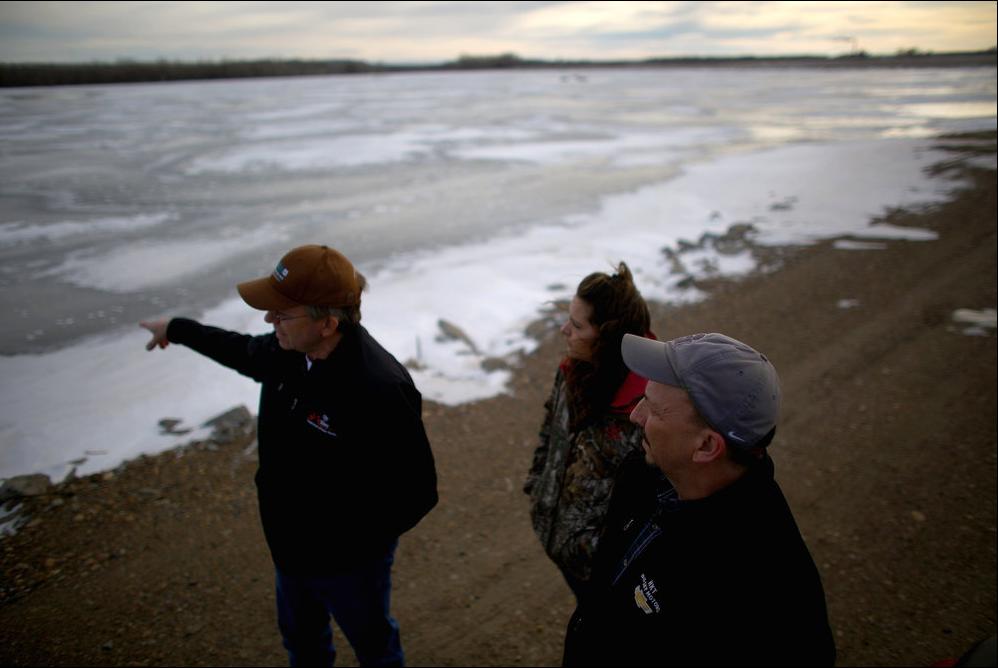
Mayor Rick Norby (right) and two staff members inspect one of Sidney's wastewater lagoons, which needs to be replaced by modern treatment plant. Photo: David Gilkey, NPR

Mayor Rick Norby (right) and two staff members inspect one of Sidney’s wastewater lagoons, which needs to be replaced by modern treatment plant. Photo: David Gilkey, NPR

According to the report the infrastructure strain is tremendous:

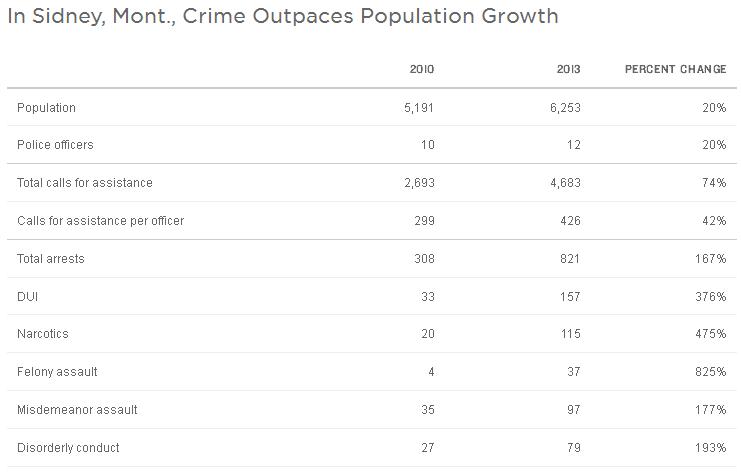
  • Crime is up and Norby doesn’t have the police force to deal with it. The town’s population has grown 20% since 2010, and his police force has grown the same amount. But, as shown in the chart below, arrests for DUI, Assault, narcotics and disorderly conduct have increased as much as 475% in the same period

Sidney crime chart

  • Sidney’s schools, which have funding that is closely tied to oil revenues, had been slowly climbing out of a hole as recent additional funding had provided more teachers and classroom aides. The school district recently started a long-term facilities plan. But that plan depended on high oil prices. As a local administrator says, “One of my biggest fears is that tomorrow, all of a sudden, it’s gone.”

The piece concludes:

From the schools to the police station to city hall, people in Sidney are worried right now about what the drop in oil prices is going to mean for them. Mayor Rick Norby says the only option is to start cutting, unless the state Legislature taps emergency funds to help out boom towns like his.

“That’s why we’re screaming,” Mayor Norby says. “We’re drowning, we need help.”

You can listen to the NPR report here.

What it means for the Beartooth Front
This is a cautionary tale for communities along the Beartooth Front. The boom cycle can be ruinous to a town. Sidney is still booming, but the oil price collapse could be a precursor of a complete bust.

The boom was something that happened to Sidney. Growth occurred outside any ability of the town to control it.

Communities concerned about their long-term futures need to plan and take local control of growth.

Montana connection to the NPR report. The report was done by Kirk Siegler, a national reporter for NPR based in Culver City, CA. Siegler is a Montana native who got his start in reporting 2003 covering the Montana Legislature for Montana Public Radio. He grew up in Missoula.

Posted in Bakken, Fracking Information | Tagged , , , , , , , | 1 Comment

Energy Corporation of America loses lawsuit; owes over $900,000 for underpaying landowners

eca-logoLast October we reported that Energy Corporation of America (ECA) was being sued in federal court for underpaying royalties to landowners. The suit, Pollock et al. v. Energy Corporation of America, went to trial this week.

An eight-person jury agreed with the property owners following four days of testimony.

“The damage amount is in excess of $900,000,” said William Caroselli, an attorney for the property owners. “With simple interest, it should be well over $1 million.”

Posted in Fracking Information | Tagged , , | 5 Comments

Why we can’t prove what we know is true about fracking and water contamination

Why can’t we pin down the relationship between fracking and water quality?

The answer lies in government bureaucracy, industry stonewalling, the unwillingness of our elected representatives to protect us, and the rapid growth of the fracking industry. The bottom line is that government and industry have conspired to keep us from proving what we know is true.

It’s no wonder that local citizens are taking matters into their own hands.

USGS: “not enough data available to assess”
According to a study just released by the US Geological Survey, we just don’t have enough data to understand the potential risks to water quality associated with unconventional oil and gas development in the United States:

“We mined the national water-quality databases from 1970 – 2010 and were able to assess long-term trends in only 16 percent of the watersheds with unconventional oil and gas resources,” said Zack Bowen, USGS scientist and principal author of the article that appears in American Geophysical Union’s Water Resources Research. “There are not enough data available to be able to assess potential effects of oil and gas development over large geographic areas.”

The key, says USGS, is the absence of baseline data in nearly every study. We often know that fracking occurred, and that water is contaminated after it occurs, but we can’t draw a causal link because we didn’t measure the content of the water before the drilling took place.

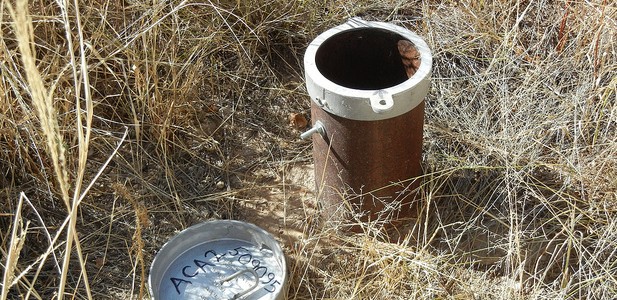
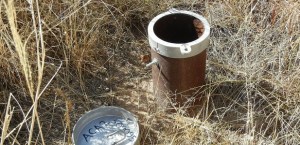
water-testing-300x200This is a problem that we’ve discussed often. Long-time readers will recognize the legal problems caused for individual landowners when baseline water data isn’t available. Your well water can be pristine, and after the oil operator has been there a month, it can become contaminated. Let’s say you have it sampled, and it contains benzene or other contaminants. But if you go to court to collect damages, you can prove that the water contains benzene, but, without baseline data, what you can’t prove is when and how the benzene contamination occurred.

You’re not going to get a judgment without the baseline data because you can’t legally prove the causal link between drilling and your brown water. Even if it happened a month after the oil company got there, you’ve got no proof as to the state of your water before the drilling started.

The State of Montana has inadequate laws for water testing
The laws of Montana do almost nothing to protect you. Baseline water testing is not required by Montana law, except for injection wells. In addition, there are

  • No location requirements
  • No specified water sources
  • No parameters for water source testing
  • No follow up testing
  • No required disclosure of any water source testing that is done
  • No presumption of liability against operators when contamination is found in a nearby water source
  • No requirement for operators to identify subsurface features that they are aware of
  • No siting restrictions, e.g. distance from occupied residences, if the well is to be hydraulically fractured
  • No requirement to identify the type or source of water used in operations

And there’s no help on the horizon. In the current Montana legislative session, Senate Bill 172, sponsored by Sen. Sharon Stewart-Peregoy of Billings, would have required oil and gas developers to pay for baseline water tests of groundwater before any development activity starts at a site and after a well is plugged. It died in committee, and won’t be considered again until at least 2017.

The EPA has spent five years not finding this out
So why doesn’t the federal government do something about it? They were going to, but…

This spring the EPA will release a draft of its long-awaited study of the relationship between fracking and water quality. It’s not going to give us the information we want.

“We won’t know anything more in terms of real data than we did five years ago,” said Geoffrey Thyne, a geochemist and a member of the EPA’s 2011 Science Advisory Board.  “This was supposed to be the gold standard. But they went through a long bureaucratic process of trying to develop a study that is not going to produce a meaningful result.”

In 2010, as the fracking industry was exploding in size, the House Appropriations Committee directed the EPA to conduct a comprehensive study of the relationship between fracking and water quality.

According to Neela Banerjee of Inside Climate News, The EPA jumped at the chance. “There is every opportunity for this study to clarify and give knowledge and insight about the [fracking] operations so that the American people can be confident that their drinking water is pure and uncontaminated,” said Paul Anastas, then-director of the EPA’s Office of Research and Development, which ran the study, at a congressional hearing in May 2011.
groundwater-e1376937616578The EPA designed the water study around these elements:

  • Analysis of data from companies about the ingredients in fracking fluids, fracking procedures and the health effects of fracking chemicals.
  • Computer modeling to understand whether fracking could contaminate water.
  • Laboratory studies of how fracking fluids might create new compounds in geological formations.
  • Toxicology assessments of fracking fluids.
  • Case studies, including retrospective research that would examine cases of reported water contamination at fracked sites.
  • Prospective, or baseline, studies in places where fracking had not yet happened.

But this design proved way too ambitious for the timeline, the budget and the ultimate political fallout.

Some members of the Committee’s Science Advisory Board urged the EPA to scale back the study design, given the project’s budget and timetable.

“The single most important thing you could do is prospective studies for a year or two at a few wells,” said Thyne, the board member.

A prospective study is one which seeks to assess the association between a hypothesized risk factor and an outcome by sampling both exposed and unexposed subjects (or intervention and non-intervention groups) and then following them for the period of study. In other words, get baseline data for a small number of wells, some in fracking areas and some not, and then test the water before, during and after drilling.

Prospective studies were included in the EPA project’s final plan in 2010 and were still described as a possibility in a December 2012 progress report to Congress. The problem is that you can’t do a prospective study with cooperation from the oil and gas companies.

As the political climate changed in their favor, the oil companies become less willing to cooperate. Republicans took control of Congress in 2010 and were more sympathetic to oil interests. And in 2012, President Obama was running for election and touting the economic benefits of fracking. Nobody was going to push the oil and gas industry.

They dug in their heels and not a single company agreed to participate in the EPA study.
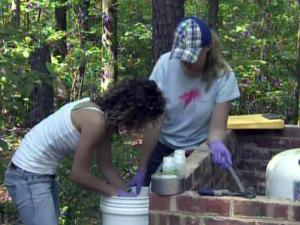
water testing2After three years of looking for suitable locations for baseline research, the EPA determined it had to move on or risk further delays to the overall study. Originally due in 2012, the final study is now expected in 2016 after the completion of reviews.  A draft version will be made public this spring.

It is no surprise that Congress didn’t push the industry to participate. For the last  35 years they have been gutting landmark environmental legislation by exempting the oil and gas industry from the rules, culminating in the infamous Halliburton Loophole, which enables the industry to avoid having to disclose the chemicals used in fracking.

So, this spring, after five years of bureaucratic bumbling, industry obfuscation and political dancing, we’ll be no further along in understanding the relationship between fracking and water contamination.

“Our expectations are low about getting anything conclusive about whether the risks with fracking are insurmountable or manageable,” said Briana Mordick, a staff scientist with the Natural Resources Defense Council. “When the report comes out, each side will be able to say what they want about it. I don’t think it will necessarily change the landscape.”

We know that it happens, and why
We certainly have plenty of information that tells us that contamination happens. In Pennsylvania alone, 243 wells near fracking sites have been contaminated.

And we know how it happens. The diagram below, from Inside Climate News, shows several ways water contamination can occur because of fracking:

  • Hazardous chemicals have been detected underground, and in the water and air around fracking pits
  • Fracking pits collect fracking waste, though the majority of the fracking fluids stay underground
  • Fracturing of the cement casing can allow contaminants to flow into groundwater

HydraulicFracking640px

But we can’t prove the causal relationship because the industry doesn’t want us to, and our elected representatives don’t want to offend the industry, which has been very generous in financing their election campaigns.

This is why we need local control of oil and gas drilling
This is why local communities feel they need to take control of protecting themselves. This is why community leaders in Carbon and Stillwater counties are fighting to establish districts in which they can require oil companies to do baseline water testing and then periodic testing afterward to make sure their water is safe.

This is not radical environmentalism. This is just landowners protecting their water. In rural communities like those along the Beartooth Front, water is life. There are no municipal water systems to fall back on. If an aquifer or well is contaminated, there is no water for feeding livestock or watering crops.

The State of Montana clearly isn’t going to do it, and the federal government isn’t either.

Who can blame landowners for wanting to protect their own water?

Posted in Fracking Information | Tagged , , , , , , | 3 Comments

This week: An entire issue of a peer-reviewed journal devoted to public health impacts of oil and gas drilling

Journal of Environmental Science and HealthThis week the peer-reviewed Journal of Environmental Science and Health devoted an entire issue to the public health impacts of fracking in Pennsylvania, a state that now supplies 25% of the natural gas produced in the United States. The issue, titled “Facing the Challenges—Research on Shale Gas Extraction.” includes eight articles on the topic.

We have often talked about growing research into the public health impacts of oil and gas drilling. This research was instrumental in the recent New York State ban on high volume hydraulic fracturing.

Among other things, the researchers in the journal published this week found that fracking may be polluting Pennsylvania streams with mercury; that dogs – good “health sentinels” for human effects – have gotten sick near drilling sites; and that “extreme exposures” to volatile organic compounds, such as the carcinogen benzene, can be expected during several stages of gas production and processing.

The special issue’s editor, John Stolz, director of the Center for Environmental Research and Education at Duquesne University in Pittsburgh, said the papers – outgrowths of a 2013 conference – should trigger additional studies.

Fracking is “not the traditional mom-and-pop drilling” and “could be considered a heavy industrial process,” Stolz said, indicating a need for careful siting of drilling rigs and other polluting facilities near residential areas.

“We’re not against the industry. That’s not the point,” Stolz said. “There are things related to this industry that have to be addressed. Let’s do it soberly and with eyes wide open.”

You can download all eight articles. They are listed below, with highlights:

1. Current perspectives on unconventional shale gas extraction in the Appalachian Basin

Uranium is found in flowback

Uranium is found in flowback

Highlights: The process of fracking requires large volumes of water, proppant, and chemicals as well as a large well pad (3–7 acres) and an extensive network of gathering and transmission pipelines. Drilling can generate about 1,000 tons of drill cuttings depending on the depth of the formation and the length of the horizontal bore. The flowback and produced waters that return to the surface during production are high in total dissolved solids (TDS, 60,000–350,000 mg L¡1) and contain halides (e.g., chloride, bromide, fluoride), strontium, barium, and often naturally occurring radioactive materials (NORMs) as well as organics. The condensate tanks used to store these fluids can contain a plethora of volatile organic compounds. The waste water, with its high TDS may be recycled, treated, or disposed of through deep well injection. Where allowed, open impoundments used for recycling are a source of airborne contamination as they are often aerated.

2. Long-term impacts of unconventional drilling operations on human and animal health

Highlights: More than a third of all exposures were associated with wastewater, processing and production operations; these exposures increased slightly over time. Health impacts decreased for families and animals moving from intensively drilled areas or remaining in areas where drilling activity decreased. In food animals, reproductive problems decreased and both respiratory and growth problems increased.

3. Human exposure to unconventional natural gas development: A public health demonstration of periodic high exposure to chemical mixtures in ambient air

Highlights: The findings show that peak PM 2.5 and VOC exposures occurred 83 times over the course of 14 months of well development. Among the stages of well development, the drilling, flaring and finishing, and gas production stages produced higher intensity exposures than the hydraulic fracturing stage. Over one year, compressor station emissions created 118 peak exposure levels and a gas processing plant produced 99 peak exposures over one year.

Dogs at greatest risk

Dogs at greatest risk

4. Reported health conditions in animals residing near natural gas wells in southwestern Pennsylvania

Highlights: When dogs were analyzed separately, we found an elevated risk of ‘any’ reported health condition in households less than 1km from the nearest gas well, with dermal conditions being the most common of canine disorders.

5. Marcellus and mercury_Assessing potential impacts of unconventional natural gas extraction on aquatic ecosystems in northwestern Pennsylvania

Full of mercury

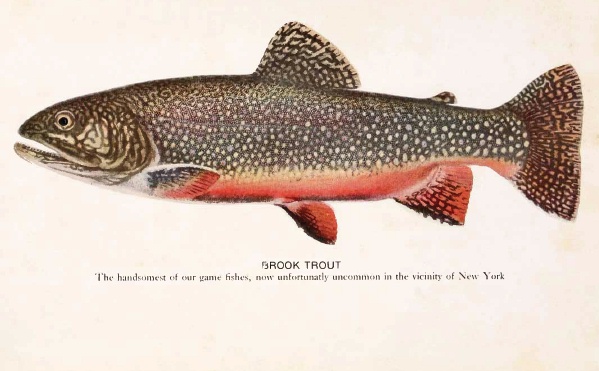
Brook trout at risk of mercury contamination

Highlights: Results showed significantly higher dissolved total mercury (FTHg) in stream water, lower pH, and higher dissolved organic matter at fracked sites. Total mercury (THg) concentrations in crayfish, macroinvertebrates , and predatory macroinvertebrates  were observed to be higher for fracked sites. A number of positive correlations between amount of well pads within a watershed and THg in crayfish, THg in predatory macroinvertebrates, and THg in brook trout were observed.

6. Data inconsistencies from states with unconventional oil and gas activity

Highlights: The significant variability of unconventional oil and gas data and its availability to the public is a barrier to regulatory and industry transparency. The lack of transparency also impacts public education and broader participation in industry governance. This study supports the need to develop a set of data best management practices (BMPs) for state regulatory agencies and the O&G industry.

7. Scintillation gamma spectrometer for analysis of hydraulic fracturing waste products

Highlights: Flowback and produced wastewaters from unconventional hydraulic fracturing during oil and gas explorations typically brings to the surface Naturally Occurring Radioactive Materials (NORM), predominantly radioisotopes from the U238 and Th232 decay chains. To achieve quantification accuracy, this gamma spectrometer must be efficiency calibrated with known standard sources prior to field deployments to analyze the radioactivity concentrations in hydraulic fracturing waste products.

8. Well water contamination in a rural community in Southwestern Pennsylvania near unconventional shale gas extraction.

Carol French of Pennsylvania with frack water

Carol French of Pennsylvania with frack water

Highlights: Fifty-six of the 143 respondents indicated changes in water quality or quantity. Color change (brown, black, or orange) was the most common (27 households). Chloride, sulfate, nitrate, sodium, calcium, magnesium, iron, manganese and strontium were commonly found, with 25 households exceeding the secondary maximum contaminate level (SMCL) for manganese. Methane was detected in 14 of the 18 houses tested.

Related:
Concerned Health Professionals of New York, A Compendium of Scientific, Medical, and Media Findings Demonstrating Risks and Harms of Fracking (Unconventional Gas and Oil Extraction

PSE Healthy Energy, Toward an Understanding of the Environmental and Public Health Impacts of Shale Gas Development: an Analysis of the Peer Reviewed Scientific Literature, 2009-2014

New York State Department of Public Health, A Public Health Review of High Volume Hydraulic Fracturing for Shale Gas Development

PSE Database of scientific studies, grouped by topic
First compendium of Alliance of New York Health Professionals
Posts on this blog about the health impacts of oil and gas drilling


Posted in Health impacts | Tagged , , , , , | 2 Comments

Update: Letter to BLM regarding Beartooth Front lease parcel

Many thanks for the substantial response to the request earlier this week for letters to the BLM regarding oil leasing of a large parcel on the Wyoming side of the Beartooth Front. At least 15 people indicated, either here or on the No Fracking the Beartooth Front Facebook page, that they were going to write letters.

Local organizations, including the Carbon County Resource Council, also responded, as you can see from the signatories on the letter below.

I thought I would post this excellent letter as a model for others. We will undoubtedly need to write letters about BLM leases in the future. This one states the case very effectively and can be used as a reference. (Remember that you can always use the search box on this site to find posts on topics of interest.)

If you are interested in finding out more about the devastating 2006 gas well blowout referenced in the letter, you can read the personal story of Deb Thomas here.

I’ve run this photo earlier this week, a shocking picture taken by a local resident of the blowout as it occurred.

Crosby 25-3 blowout as it occurred in 2006.

Crosby 25-3 blowout as it occurred in 2006.

Here is the letter:

BLM Wind River/Bighorn Basin District
Attn: Rita Allen
101 S. 23rd Street
Worland, WY 82401

February 23, 2015

Re: August 2015 Oil and Gas Lease Sale Parcel Environmental Assessment

Dear Ms. Allen:

Please accept the following comments regarding the above-referenced environmental  assessment (EA) that the Bureau of Land Management (BLM) has prepared.

We ask that Parcel WY 1508-237, located on the Absaroka-Beartooth Front be deferred. This parcel lies within a landscape important for wildlife.  It is within greater sage-grouse
general habitat and is within a four-mile buffer of an occupied lek. The area also provides
seasonal range for bighorn sheep, elk, moose, mule deer, pronghorn antelope, mountain goat, and white-tailed deer.  It is habitat for black and grizzly bear, wolves, mountain lion, bobcat, and red fox. A broad diversity of bird life is also present in the area.

This parcel includes and is adjacent to public lands extremely important for hunting,
fishing and recreation that includes hiking, biking, horseback riding, cross country skiing and snowshoeing.  These are uses that depend on clean air, clean water and a healthy outdoor environment.  These recreational activities bring important revenue to the area, the state of Wyoming and the region.

In addition, Parcel WY 1508-237 includes privately held surface, including property in
the Line Creek Wilderness Subdivision.  The rural residential subdivision consists of 90 lots that vary in size and include approximately 54 landowners.

The Line Creek Subdivision is a community that has already been seriously impacted by
oil and gas development.  Although the development consists of only two pads with six wells, the impacts to the community have been huge. Contamination issues, deterioration of community and quality of life, along with serious health issues continue to plague residents. Since 1999, the community has been subject to impacts from oil and gas development that include toxic air emissions, light pollution, noise pollution, dust, leaks, spills, inadequately remediated pits, and disposal of waste on private property.  The most serious, to date, was Windsor Energy Group’s Crosby 25-3 gas well blow out in 2006.

The Crosby blowout released what the Wyoming Department of Environmental Quality
(WDEQ) identifies as the worst case emissions of 97 tons of Volatile Organic Compounds, 11 tons of Hazardous Air Pollutants, which is over 2 tons of BTEX—(Benzene, Toluene, Ethyl Benzene, Xylene), 101 tons of methane and 43 tons of ethane.  During the blowout, twenty-five households in the subdivision were evacuated for three days.  Windsor Energy attempted to evaluate and control the situation for over four hours before alerting residents, putting them in extreme danger.  Luckily, there was no explosion or fire.

In addition to the initial disaster and toxic air emissions, the Crosby 25-3 blowout resulted in groundwater contamination, contaminated private drinking water wells and continues
to be the site of an ongoing monitoring project.  Over 100 monitor wells, 25 private drinking water wells, six springs that flow into Line Creek and four sites on the creek have been monitored for over nine years.  Monitored natural attenuation was approved by the State as a preferred remedial alternative for the shallow alluvial aquifer, and although a pilot project for remediation alternatives of the deeper aquifer has been conducted, remediation has not taken place. Almost ten years later, the contamination is still not remediated.

The many important resources along the Beartooth Front should not be sacrificed for the  development of one.  The oil and gas development in this area has produced small amounts of oil and gas that have resulted in low revenues.  However, the development has created immeasurable damage to the environment that has cost millions of dollars to investigate and monitor.   The development has not only fracked the sub-surface geology and hydrology, it has fractured the community.  It has created a toxic environment and destroyed the health and well being of people who are forced to live with it.

To allow further leasing, permitting or drilling in this area, already under such heavy
impact, is unconscionable.  The environment and the people who live along the Beartooth Front must be protected from any further oil and gas exploration or development.  Deferral of Parcel WY 1508-237 is necessary to protect both.

It is our understanding that all private surface owners were not contacted about the
leasing of this mineral parcel.  Until such due notice can be given to all surface owners, the
parcel must be deferred.  The BLM Handbook on “Competitive Leases,” updated in 2013, is clear that this notice is an essential step during preparation of the oil and gas lease sale
environmental assessment (H-3120-1 “Competitive Leases,” p.13). Before leasing a parcel, as the environmental assessment is being developed, the BLM must determine the impacts of the proposed action on the quality of the human environment. This is of heightened importance for split-estate parcels when the agency must take into account the views of the surface owners. Because due notice of the lease nomination was not made to all landowners affected by WY 1508-237, their views have been unable to be incorporated in the EA and this parcel must be deferred until that situation can be rectified.

Thank you for accepting our comments.  We respectfully ask that you take them into
consideration and recognize the importance of deferring Parcel WY 1508-237.

Sincerely,

John C. Mitchell, Line Creek Resident
Sands Dickson, Line Creek Resident
John Linebaugh, Line Creek Resident
James A. Sonderman, Line Creek Resident
James E. Melton, Line Creek Resident
Dick Bilodeau, Line Creek Resident
Deborah K. Thomas, Line Creek Resident
Pete Dronkers, Area Resident
Christina Denney, Chair, Clark Resource Council,
John Fenton, Board Director, Shale Test
Bruce Baizel Earthworks
Carbon County Resource Council
Jenny Harbine Earthjustice
Amanda Jashan, Wildlife Energy Conservation Fellow, Natural Resources Defense Council

If you’re interested in more on the well blowout referenced in the letter, you can view Deb Thomas’ horrifying description in the video below, beginning at 32:48.

https://vimeo.com/100376077

Posted in Shared Letters and Posts | Tagged , , , | 1 Comment

The long history of oil drilling in Elk Basin explains why local zoning in Belfry is necessary

To understand the need for the proposed Silvertip Zoning District near Belfry, you need to know about the long history of oil exploration in the area. Local residents have a well-established, stable relationship with the oil industry that has lasted for as long as anyone who lives there today has been alive.

Oil is part of their everyday existence. Elk Basin, a century-old oil field just up a hill from the area, has been pumping oil continuously since 1915. Every day, large trucks rumble down the dirt road from Elk Basin, spewing dust that coats crops and buildings.

The Silvertip Pipeline, which ruptured and leaked crude into the Yellowstone River in 2011, runs right under this area. Over the last several decades there have been spills that have poured contaminants onto the area below.

This is not what landowners in Belfry are worried about. What scares them is that recent pronouncements about oil company plans, coupled with advancements in technology, are about to change everything. This will put their properties, their water and their livelihoods at risk.

A look at the history of the area explains how deeply intertwined oil drilling is with this community, and why recent developments threaten the stability of that relationship.

Passing a tanker on the road to Elk Basin. Click to enlarge.

Passing a tanker on the road to Elk Basin. Click to enlarge.

Driving up the hill to Elk Basin
If you drive from the proposed Silvertip Zone a few miles up Silvertip Road, a narrow dirt stretch that winds up into the hills, you begin to smell the pungent aroma of hydrogen sulfide, the byproduct of existing conventional wells. Along the way you may pass a large tanker that coats your car and everything else with a cloud of dust.

About 12 miles up you reach Elk Basin, where wildcatters and large corporations have been producing oil for a century. If you like, you can follow Silvertip Road all the way over to Powell, Wyoming.

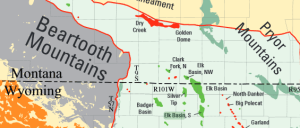
Elk Basin extends across the border from southern Carbon County into Park County, Wyoming, 20 miles north of Powell. (Follow link for Google map and see geological map below.)

From Chapter 3 of Petroleum System and Geological Assessment of Oil and Gas in the Bighorn Basin Province, Wyoming and Montana by US Geological Survey, 2010

Location of Elk Basin. Source: US Geological Survey

Early days of drilling in Elk Basin
George Ketchum, a geologist who owned a small farm at Cowley, is generally credited with first recognizing that this dusty area was a likely source of oil. He made his first trip into Elk Basin in 1906. After several years, the Utah-Wyoming Oil Company rented a rig for drilling, and a local company, Grub Stake Oil, was formed to finance a well.

Another group of men from Greybull and Basin had taken out a claim in the same area. The two groups didn’t take kindly to each other, and there was a confrontation in the field where the Grub Stake men turned back their competitors at gunpoint.

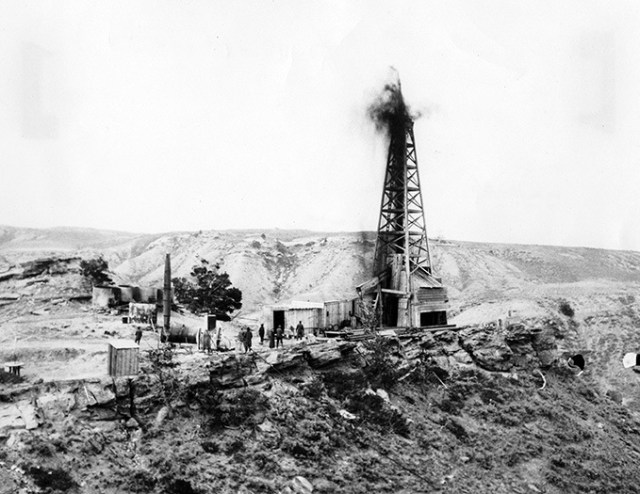
Nothing came of this but some hurt feelings, and it was not until October 8, 1915 that the Midwest Refining Company brought in the first successful well in Elk Basin. It produced between 50 and 150 barrels a day.

Jack McFadyenThe Ohio Company and the Continental Oil Company also staked claims in the area. Elk Basin operations for the Ohio Company, which became Marathon Oil in 1962, were run by a tough, relentless Wyoming legend named “Uncle Jack” McFadyen, who performed all functions for the Wyoming division of the company, from prospecting to securing leases, to procuring and operating the drilling equipment, building tanks and pipeline systems, and selling the crude.

The cost of drilling became prohibitive for the smaller local companies. The Grub Stake men drilled only one well and called it a day.

Elk Basin Gusher, 1917. Photo: American Heritage Center

Elk Basin Gusher, 1917. Photo: American Heritage Center

Placer claims, claim jumping, and the Mineral Leasing Act of 1920
Until 1920, oil claims were “placer claims,” which were technically 160 acres jointly staked in the names of eight persons. Land could be legally claimed by groups paying $2.50 per acre and improving the parcel with a building or other improvements. This entitled them to ownership of all oil, coal, and other mineral commodities discovered on that land. By dropping off one name from the ownership roll and adding a new one on a neighboring parcel, companies could put together large blocks of land for exploration. But since there were no precise surveys of the land in those days, claims sometimes overlapped and were disputed.

McFadyen set up 24 x 7 guard duty on the rigs to protect his interests. Drilling crews typically worked one shift and guarded the rig during another. Most of the early wells were completed in about 60 days. Scouts for rival companies were everywhere, so when men went into town they were told not to talk to anyone about their work. Once when drilling a discovery well, McFadyen pretended to be building a pipeline during the day and wildcatted at night.

adfasdfasdf

A Star Machine, a mobile, steam-powered drilling rig, used to drill wells in the early days. The machines were initially pulled from place to place by a team of horses and later by a McCormick tractor. The machines were steam powered with a boiler that was pulled along on another wagon. Photo: F.E. Smith Collection at the American Heritage Center, University of Wyoming

In addition to the problem of claim jumpers, the oil fields were remote. Drill pipe and other equipment were freighted in by mule teams from a distant railroad siding, and transportation costs often totaled more than the $3 per foot it cost to drill.

In 1920 the Mineral Leasing Act was passed, After that, producers of oil, coal, natural gas and phosphates paid up-front to lease federal land, and then paid the government a one eighth royalty on the mineral revenues from that land. For lands owned by homesteaders or railroads, contracts were drawn up on a royalty basis. Claim jumping became a thing of the past.

Elk Basin around 1916. Photo: Marathon Oil

Elk Basin around 1916. Photo: Marathon Oil

Workers camps and working conditions
By 1916, both the Midwest and Ohio companies had built camps for their workers in Elk Basin. This settlement became a small town with streets and sidewalks, a hotel, community hall, hospital, gas pump, post office and a barber shop. In winter, Anna Haney, whose husband worked in the field, battled foot-high snowdrifts blown into her tin and tarpaper house. In summer, the dust was so thick and the wind blew so hard that food had to be eaten quickly before it got too gritty.

There were two school buildings that served up to 80 students, one for grades one to six, and the other for grades seven to eight. High school students attended classes in Powell, boarding there because roads between Powell and Elk Basin were bad.

An early man camp. Note the residences right next to the derricks.

An early Wyoming oil camp. Note the residences right next to the derricks.

The idea that a company should take responsibility for the welfare of employees and their families was a foreign concept in the 1920s. When the residents of Elk Basin wanted to construct a community house, the families raised several hundred dollars themselves and the Midwest Oil Company offered to contribute $500. But Midwestern’s contribution was contingent on a match from Ohio Oil, and McFadyen killed the idea.

Lynd, Rockefeller and the controversy over working conditions
John D. Rockefeller, whose company, Indiana Standard, had massive oil interests in the region and who owned 13% of Ohio Oil stock, was not a promoter of workers rights. However, he was moved to improve conditions because of accounts of camp life written by sociologist Robert Staughton Lynd, who had spent the summer of 1922 working as a chaplain in the Elk Basin Field.

Lynd grew impatient with Rockefeller’s evasive stance on union recognition, so in the fall of 1922 he published two articles that held the oil magnate’s feet to the fire: “Crude Oil Religion” in the September issue of Harper’s and “Done in Oil” in the November Survey.  In “Done in Oil,” Lynd not only indicted life in the Elk Basin oil fields, but went on to cite a Federal Trade Commission report on Indiana Standard’s domination of the whole region. He added quotations from his own correspondence with Rockefeller and the Ohio Oil president, saying that improvements in working conditions were not economically feasible.

Rockefeller contended that the Elk Basin situation described by Lynd was an exception and rejected unionization, but developed a list of recommendations, including better homes for camp workers, schools for the children, higher wages, and a six-day, 48-hour work week. Conditions improved, but life in the Elk Basin field was still tough.

An oil rig in Elk Basin today. Click to enlarge

An oil rig in Elk Basin today. Click to enlarge

The population of Elk Basin peaked at between 800 and 1,000 sometime before the early 1940s when the town had to be moved to Polecat Bench, a few miles south. Poisonous hydrogen sulfide gas, escaping from deeper wells, was endangering the health of the workers and their families. Housing at Polecat Bench was more modern, and roads had improved, siphoning residents away to Powell. In 1955, the town was disbanded along with the company camps, and some residents purchased their houses in Polecat Bench and moved them to Powell.

Elk Basin and the South Elk Basin Field, discovered in June 1945, together produced a cumulative total of 92.8 million barrels by the end of 1956.

While I don’t have later data specific to Elk Basin, the field has been operating continuously since 1915. Total oil production in Carbon County from existing oil fields has been declining slowly since 2000, from a high of nearly 56,189 barrels per month in July, 2000 to 31,788 barrels per month in August 2013, and Elk Basin has been a continuous source of oil during that time.

Source: DrillingEdge.com (subscription required)

Source: DrillingEdge.com (subscription required)

Learning the lessons of history
The rich history of Elk Basin is pure Montana — hardy pioneers overcoming the harshest of conditions to build a rich tradition. But if you think about the way Elk Basin has developed, it becomes clear why zoning is necessary a few miles away.

When the first wells were built in Elk Basin, a whole community was imported to begin the oil industry. Then, as technology and roads improved, the community moved away from the oil production, largely because of health concerns, down the hill into nearby communities such as Belfry and Powell. If you drive up there today you see a few workers, but there are no homes. Over the course of a century, people have learned that it doesn’t make sense to drill where people live.

What has evolved over a century is a balance between the needs of corporations to extract oil and the needs of a community to engage in farming and ranching without risk to water, health or livelihood.

But horizontal drilling and hydraulic fracturing have changed all that. The lesson hasn’t changed — it remains dangerous to drill where people live — but the economic opportunity has. These technologies allow drillers to get oil out of tight shale where they couldn’t get it before. Consequently they drill near where people live.

According to the Wall Street Journal, 15.3 million people in the United States now live within a mile of a fracked well.

As these technologies have changed, few statewide regulations have been developed in Montana to keep up with the shift in where drilling takes place. As a result, residents who live near wells are not protected from the dangers of drilling. Based on the unwillingness of the current Montana legislature to act, this is not about to change any time soon.

That’s why local zoning is necessary. Silvertip residents down the hill from Elk Basin have a long and stable relationship with oil drilling. Fracking and horizontal drilling threaten that stability. It is right for landowners to want to take matters into their own hands and set their own regulations to protect themselves.

Posted in Community Organization, Politics and History | Tagged , , , , , , , , , , | 12 Comments