A personal story: Kip Gardner, Carroll County, Ohio (with video)

“It’s disappointing that private corporate interests can trump my rights as a landowner. I’m worried that I’ll be forced into an undesirable lease that does not protect my land or my ability to farm in the future,”

-Kip Gardner

Telling personal stories
The oil and gas boom has been underway for a number of years in many locations across North America, and there are now a lot of stories about individuals and families whose lives have been personally affected. This post is part of a regular weekly series of those stories on this blog to help you envision what could happen if drilling expands along the Beartooth Front.

Today’s post has a different point of view, one that should resonate with many residents of Carbon and Stillwater Counties. It’s not about someone who has suffered the effects of oil and gas drilling, but a person who is doing everything he can to protect his business and property rights from being ruined by drilling.

The issue here is one we haven’t yet discussed on this blog. It’s called “involuntary pooling” or “compulsory utilization” in Montana. We’ll have a subsequent post on the subject, but a basic definition is that involuntary pooling forces a land owner into participation in an oil and/or gas producing unit. Pooling is a technique used by oil and gas development companies to organize an oil or gas field.

So if there are separate tracts in a drilling unit owned by different people, the owners can pool their interests to drill a well. If one or more people do not want to drill, our good friends at the Montana Board of Oil and Gas Conservation can force those owners to participate in the pool.

This provision is described in Montana code 82-11-202. More on this topic later this week.

As you can see from Kip Gardner’s story, this provision would take his property rights and potentially ruin his business.

You can see other personal stories in this series by clicking here.

Kip Gardner, Carroll County Ohio
Kip Gardner, owner of Creekview Ridge Farm, purchased 18 acres of land in January 2011 in Carroll County. He currently grows a variety of specialty crops and raises free-range chickens on 10 acres. Kip is working to earn organic certification for his land, which takes three years to fully transition from conventional to organic status.

Kip began his journey knowing he would have to work hard to meet the challenges of starting a small farm business. But he didn’t anticipate that nearby fracking and the threat of mandatory pooling could put his land and his organic certification at risk, before he’s even had a chance to get started.

Water or soil contamination resulting from fracking could jeopardize Kip’s ability to certify his land. If a farm’s Organic System Plan or soil, product, or tissues samples indicate the presence of prohibited materials, a farmer must address these concerns. In some situations when a prohibited substance is detected, a producer must wait at least three years before the land can return to organic certification.

There are more than 500 certified organic operations and nearly 53,000 acres of certified organic pasture and cropland in Ohio, much of it in areas of the state containing shale deposits.

Kip’s Journey
When Kip purchased Creekview Ridge Farm on the edge of the Utica shale formations, few people in Ohio were talking about fracking, but over the last year the industry has exploded and fracking activity in Kip’s neigbhorhood has become progressively more noticeable.

In March 2011, a once empty railyard began to fill with trains and trucks, and there was a steady buzz of traffic on the local roadways. Kip watched as truckload after truckload of sand and chemicals traveled to and from fracking locations.

April 2011 began with a bang, literally, as the sounds of unannounced explosions and the rumble of bulldozers rang throughout the hills. Although Kip turned down multiple lease offers, by summer 2012, he learned that nearly all of his neighbors had signed leases, thanks in part to the organizing efforts of a local landowners group, the newly established Associated Landowners of the Ohio Valley.

With so much of the area now leased, Kip is concerned that the state will force him into a lease through a process called “mandatory pooling,” which allows oil and gas companies to petition the state for access to unleased land.

To petition the Ohio Department of Natural Resources, companies must acquire as little as 65 percent of the land needed for a particular site. Sadly, the process leaves little recourse for landowners to contest and appeal unwanted oil and gas wells or other fracking infrastructure.

“It’s disappointing that private corporate interests can trump my rights as a landowner. I’m worried that I’ll be forced into an undesirable lease that does not protect my land or my ability to farm in the future,” said Kip.

Kip Gardner
Kip Gardner believes there’s a nutritional difference in the eggs his hens lay compared to what you get in the supermarket because he feeds them only non-GMO grain. He’s fighting to preserve his organic business.

After a stressful year, and at the advice of a lawyer, Kip and his family approached oil and gas companies with an alternative proposal that would have strictly limited industry access to specific areas of his property.

Despite his efforts to negotiate, Kip and his attorney have yet to find a company that will agree to his specific terms. While Kip’s farm was once over a mile and a half away from the closest well, if drilling begins on his neighbor’s farm, fracking would literally be at his back doorstep.

Posted in Personal stories | Tagged , , , , , , , , | 1 Comment

Catching up on some items that have been sent to me and other things I’ve been meaning to post:

  • Work has now started on the ECA well in Belfry. A local resident reports, ““I drove up there and sure enough they have staked the pond and have a bulldozer in there. So yes they have started. And the pond is right where I thought it would be.” This obviously lends urgency to our efforts.
  • I have a number of new subscribers over the last few weeks, and I’d be remiss if I didn’t make sure you are aware of our great companion Facebook site No Fracking the Beartooth Front. They provide lots of links and commentaries to relevant online information, and they’ve got a lively community of passionate supporters. If you’re a Facebook user, just like them and their updates will appear in your news feed..
  • In February I posted a personal story about the long term contamination of a huge aquifer in Poplar, Montana, caused by oil drilling thirty years ago. Now a new report from the US Geological Survey shows that the contamination continues to spread. The federal agency says the issue has led to polluted drinking water for more than 3,000 people, and that it will only get worse over time.
  • The Montana Board of Oil and Gas has opened a position for a full-time administrator to replace Tom Richmond, who is running for the Montana State House. Applications close May 16. If you’re knowledgeable about oil and gas issues and have a concern about the plight of ordinary Montanans you should apply. You’d be a big improvement over Richmond.
  • dailykos rec list!

    dailykos rec list!

    I have cross-posted by post on the Belfry Well on dailykos to generate more exposure. It is already one of the most viewed posts on the blog, and I hope to use it to raise awareness of our activities. Update, 4/20/14, noon. I made the dailykos recommended list! This will give the post very wide exposure, and give me the opportunity to build a following for other posts that will develop a following. Not sure what to do with this, but it will come in handy in the long run.

  • This isn’t the kind of thing I usually post, but a reader sent it along and I thought it was pretty interesting. It provides in unusual detail the story of how a small drilling company from Cut Bank, MT that had never drilled a horizontal well put together an unusual financing package to get into the game in Bakken, and wound up quintupling their business and increasing their company value from $.10 a share to $.65 a share. What was most interesting to me was the huge amount of dollars at stake, the high risk to drilling a single well, and the phenomenal profits available to those who have the wherewithal to play. With this kind of money available, it’s hard for me to believe we can’t invest in preserving land, water and quality of life for people who live in a region that is being drilled.

A couple of events worth noting:

  • If you’re in Billings you can support our efforts, enjoy a wide variety of local bands and grab a pint of beer at the Music for the Mountains: Defend the Beartooth Front benefit concert. It’s next Monday, April 28 from 5:30-8pm at the Yellowstone Valley Brewing Company.  It’s free and open to the public.

    Satsang is an Acoustic Roots/Reggae duo from Southwestern Montana made up of David Cleaves(Mandolin) and Drew McManus(Guitar/Vocals). Blending world conscious lyrics with the belief that Roots Music was meant to be played on Roots Instruments.
    Satsang is an Acoustic Roots/Reggae duo from Southwestern Montana made up of David Cleaves(Mandolin) and Drew McManus(Guitar/Vocals). 

    Participating bands include Satsang (pictured at right), Poetic Intelligence, Reid Perry and the Cold City Lights, and Lindsey Jacobsen. Spoken word poet Dave Caserio will perform with musician Alex Nauman. Other poets include Cara Chamberlain, James Hickman, Danell Jones, Doug Oltrogge, Anna Page, and Bernie Quetchenbach.

    The musicians approached Northern Plains Resource Council with the idea to “encourage people to come learn more about what is happening in our back yard.”

  • Montana Environmental Information Center (MEIC) is hosting a series of rallies across Montana on Saturday, April 26 to raise the issue of climate change and to pressure public officials and businesses to support proactive and positive solutions to the climate crisis. There are events scheduled all over the state, with the one in Billings scheduled for the Yellowstone County Courthouse lawn from noon – 1pm.

Things to look for on the blog this week:

  • A personal story about an organic farmer struggling to survive in Ohio
  • A guest post by a friend who has been fighting fracking in Pennsylvania for years. The topic will be lessons learned, and I guarantee you’ll find it informative. Don’t miss it.
  • A post on the topic of forced pooling, another way in which oil and drilling takes away the property rights of local landowners.

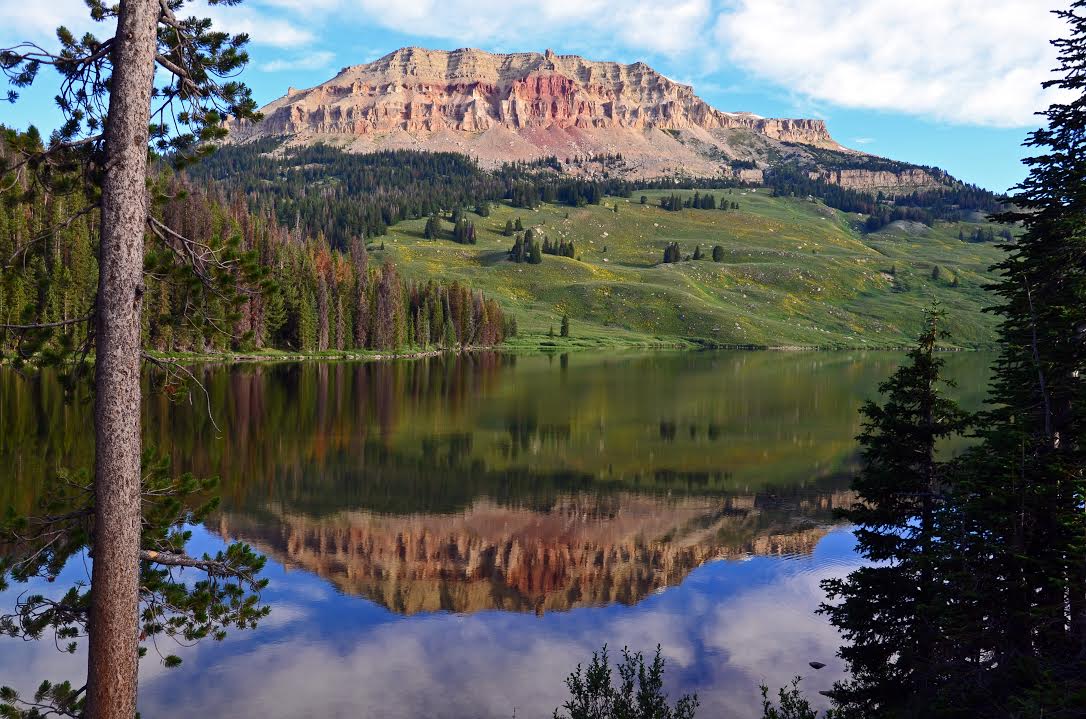
And last, a couple of photos taken by a local reader who spends a lot of time hiking and riding through the area. Sometimes it’s worth remembering what draws us to Montana and what it is that we want to preserve. You can click to see these full sized.

beartooth flowers


beartooth lake

Posted on by davidjkatz | Leave a comment

Bad news. Your property value is about to go down 22%

Recently we did a three-part series that looked at how increased oil and gas drilling will take away property rights in Stillwater and Carbon counties. The first part looked at the negative impact drilling has on property values, and how surface owners have few rights to protect themselves against the loss. Next we examined how mortgage companies have begun to shy away from lending on properties on or near drilling sites. Last we considered the factors that make it difficult for property owners to receive compensation for damages to their property, with data on the long-term impacts of oil and gas drilling on communities.

Today we’ve got more information on the impact of oil and gas drilling on rural property values, and it’s not good news.

Researchers from the University of Calgary and Duke University studied property sales from 1994 to 2012 in 36 Pennsylvania counties and seven counties in New York. They mapped sales against the locations of shale wells, and they compared homes connected to public drinking-water systems to homes with private wells.

Here’s what they found out:

  • The source of water is a critical factor in determining property values. Properties with private wells suffered a substantial loss in value compared to properties connected to a municipal water system.
  • The loss in property value also varied with distance from a fracked well. The closer you are to a well, the more your property value is reduced; even if you are a significant distance away, the association of your property with drilling mitigates any gains in property value.

“If two properties are similar in everything but the type of water they are using, then we find that difference equals negative 10 percent,” said Lucija Muehlenbachs, an assistant professor at the University of Calgary. In other words, properties with private wells lose 10% more value than properties connected to a municipal water system.

It gets worse. “If you get closer, if you look at the properties that are only 1 km from a shale well, then for the ones that are on groundwater we see a 22 percent loss in property values,” Muehlenbachs said, ”and for the ones that have access to pipe water, there’s zero gain, so essentially all of the positive benefits get wiped out by these negative externalities of having this well pad nearby.”

These “negative externalities” include truck traffic, noise, light, and air pollution.

The study is published at the Social Science Research Network, and can be downloaded here.

If you live in Stillwater or Carbon County, chances are you get your water from a well. If ECA fulfills its promise to frack 50 wells in these two counties, you’re probably going to be within a kilometer of a fracked well. If you don’t own the mineral rights to your land, you’ve got no royalties coming in. That means your property is going to decrease in value by about 22%, and you’ll have nothing coming in to offset it.

And you’ve got nothing to say about it.

However, your elected officials could do something about it if they wanted to. In Montana, county commissions and conservation districts have the power to place restrictions on oil and gas drilling. Here’s how to contact them to let them know you want them to take action to protect your property:

Carbon County Commission
Stillwater County Commission
Carbon County Conservation District
Stillwater County Conservation District

Posted in Fracking Information | Tagged , , , , | 4 Comments

A visit to the front in the war against rural America

Last week I took advantage of the beautiful Montana spring weather to drive over to Belfry. There I could see for myself the site of the well recently permitted by the Montana Board of Oil and Gas Conservation (BOGC). It was one of those incredible Montana days when Winter and Spring intersect. The temperature was near 70, yet the snow was piled high in Red Lodge, where it was the end of ski season. As I dropped down 2000 feet into Bridger the snow disappeared and it was spring.
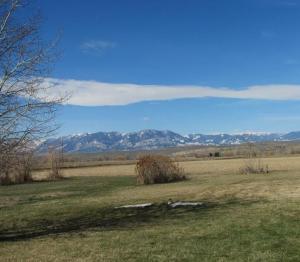
Beartooths from Bridger. Ski runs visible on the right.
The Beartooths from Belfry. Ski runs visible on the right. Click to enlarge.

In Belfry the Beartooth Mountains dominate the landscape, standing watch from nearly 13,000 feet. In one direction I could see the ski runs above Red Lodge, and in another the breathtaking Beartooth Pass that leads to Cooke City and Yellowstone Park. On the clearest days the Grand Tetons lend their wispy beauty from 200 miles away.

Latest front in the oil and gas war
It’s hard to imagine that this gorgeous scene could be the latest front in the war that pits the oil and gas industry against rural America. But it’s true: this is Ground Zero for the entry of fracking into southern Montana.

When John Mork, CEO of ECA, announced last October that his company plans to frack 50 wells in Carbon and Stillwater Counties and “bring the Bakken to the Beartooths,” it sent chills through the region. Residents here know that the cost of the oil and gas boom in the Bakken is being paid by the locals in unrecoverable environmental and social damage.

When the first fracking permit application was located right here off Silvertip Road, the battle began. The BOGC fast-tracked the permit, denying local residents and environmental organizations an opportunity for a hearing to present issues and concerns. Northern Plains Resource Council and Carbon County Resource Council quickly sued, demanding a hearing and reform of a process that is completely weighted in favor of the oil and gas industry at the expense of Montana citizens.

Because of the suit, BOGC granted a hearing, but it was all for show. The Board ignored requests from residents to modify the permit to provide property protection, and they paid no attention to expert testimony that there are very real dangers to the drilling plan: the permit does not mention hydraulic fracturing, yet it is clearly planned; there is no specification of the chemicals to be used in fracking; there is no source water specified for the millions of gallons that will be required; there are no specified disposal plans for waste water and flowback; and more.

Clarifying these things would not be onerous for ECA, yet BOGC appears willing to let the company do whatever it pleases regarding chemicals, water, and waste disposal. In the testimony the expert revealed that BOGC’s permitting standards are even lower than those recommended by the oil and gas industry. The permit was approved by a 6-1 vote.

The suit continues as Northern Plains and CCRC seek reformation of a state agency that is broken. It is simply an arm of the oil and gas industry, not a representative of the people of the state.

The Belfry community
ECA undoubtedly picked this well site because of geological considerations, but they probably didn’t know who they were dealing with. They may regret not finding out.

As beautiful as the landscape is, it is clear that people who settle here do not come to get rich. They live here because of the solitude and the beauty, to enjoy nature and to do battle with it for their existence. The growing season is short — four to five months. The risk of extreme weather in planting and harvesting threatens output every year.

Water is precious here. People dig their own wells, which go to very different depths: some eight feet, some 15 feet, some 60 feet. There is no map of the underground aquifers, so water quality is always a concern, vulnerable in unknown ways to environmental changes. There is a concern about the current water quality in Silvertip Creek, which runs through the area, but no money is available to test it. Neighbors share a common ditch for a variety of water uses, with a governing board of property owners to manage its use.

While neighbors tend to their own business, living in this rugged area creates a common bond among them. When someone is in trouble, neighbors are always right there to provide help and support.

The beginning of fracking in the area is certainly trouble, and neighbors are in action, ready to work together to protect their futures.

Oil and gas drilling in Carbon County
Oil and gas production isn’t a new issue here. The farmers and ranchers in this area have been coexisting with oil wells for decades. It is an uneasy balance, but the residents live with it. The introduction of fracking will dramatically change that balance. Instead of taking place away from their farms and ranches, fracking will bring drilling down the hill and onto their properties. This change threatens their water, their property values, and their personal health. They get that a single spill could wipe out everything they’ve worked to build and hold on to over the years.

An oil truck envelopes us in dust. Click to enlarge.
An oil truck enveloped in dust. Click to enlarge.

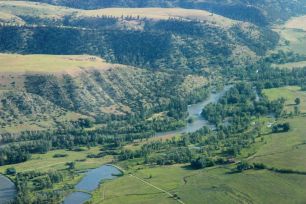
Heading up the two-lane dirt road to the area where oil drilling takes place, my guides and I take a few moments to enjoy the peaceful silence, punctuated only by the song of the Western Meadowlark, Montana’s state bird and the soundtrack of much of the American West. The geology is amazing, the rock cut in jagged patterns as we rise in elevation. From time to time a large oil truck passes by, breaking the silence and enveloping us in a cloud of dust that reduces visibility to zero.

Approaching the oil wells a couple of miles up the road, we smell the foul rotten egg stench of hydrogen sulfide, a byproduct of the drilling process. The smell is a stark contrast to the pure air down below, and a reminder of what it would be like if the wells moved down the hill. As we drive up Silvertip Road, the road extends through the oil country into Wyoming, where it goes all the way into Powell.

bridger oil well1The wells are sparse, one every couple of  hundred yards, and they clang away to their own beat, dipping and rising as they pull oil from the earth far below. Rusty tanks hold the product of their work. The pipeline that moves the oil is visible, and its condition isn’t encouraging. We note that this is the beginning of the Silvertip pipeline that flows under the Yellowstone River, the one that broke and caused a major spill in 2011.
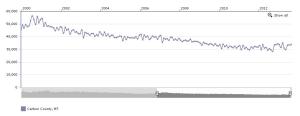
Carbon County Oil Production
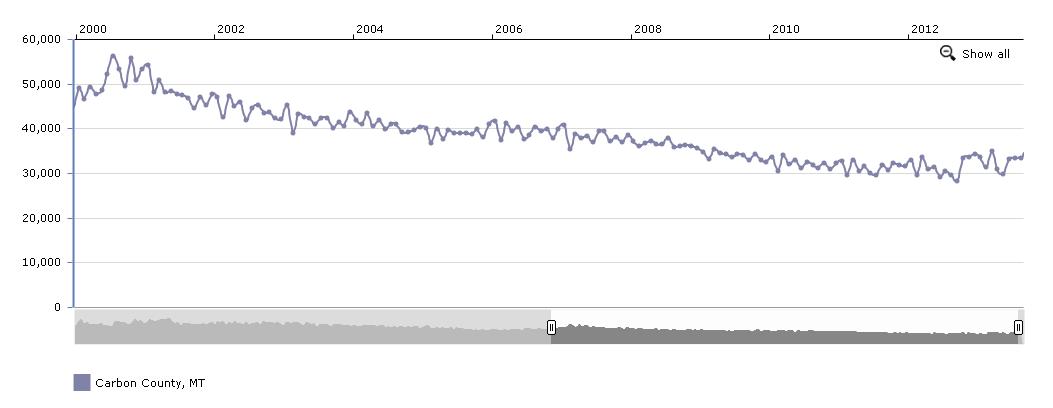
Carbon County Oil Production, 2000 – 2013 (click to enlarge)

Carbon County is not a huge oil producing area, and this is one of a handful of small pockets of production. County-wide oil output has been declining slowly since 2000, from a high of 56,189 barrels per month in July 2000 to its current level of 31,788 barrels in August 2013. Nobody lives up here where the oil wells are, so the daily balance between the farms and ranches down below is only broken by the trucks, which leave a trail of dust behind on houses, vehicles and crops as they rumble by.

There have been a handful of oil spills here dating back to the 1970s, most recently in the 1990s, and the residue of damage from them remains. Since the populated area is downhill from the wells, the risk of spills is always in the minds of residents.

Carbon County has been unwilling to provide much help to curb the dust. When a call from a resident to Senator Tester’s office generated an immediate response from ExxonMobil, the road was oiled right away. Unfortunately the county grader came through shortly after and scraped off the oil coating. Such is life in remote oil fields. The residents know that they are on their own in protecting themselves against the heavy industry fracking would bring.

ECA permitted well site. The well pad will go near the center of the picture, to the left of the house. Click to enlarge.

The ECA well site
When I got to the site of the permitted well. I imagined a big blinking neon sign that would say “FRACKING SITE,” but it is just a dry grassy field near a house. I was struck by the fact that the site is clearly a drainage area, very vulnerable to high water that could be dangerous to a water impoundment. I’m told that just a few weeks ago, when there was rapid snow melt that rushed water right through here, the water level was high and would likely have washed over an impoundment at that location.

I hear that the owners of this property, who do not own the mineral rights to the land, received a one-time payment of a few thousand dollars for access. They were persuaded that they really have no choice, which is true in split estates, and so they signed. Most of the estates in this area have been separated over the years. Many of the surface rights owners own none, some 25%, some 50% of the mineral rights.

Now that warm weather is here drilling will likely begin soon. ECA is advertising for a production foreman for the area.

What is at stake
Residents recognize that their tenuous balance with nature and oil and gas drilling depends on how broadly fracking is allowed to take place. And they don’t shy from a fight.

It’s important to understand that the people who live here are not the kind of folks who will march into a meeting holding up signs that say, “Don’t Frack My Back Yard.” They have lived with oil and gas drilling for years. They don’t expect to stop it. They know that Montana law favors mineral extraction over surface ownership. Many of them attended the meeting of the BOGC when the hearing over the permit took place. The dismissive body language of the Board members told residents all they needed to know about the contempt the Board had for their concerns.

But they also know the tenuous hold they have on their land hangs in the balance. And they’re well aware that few are fighting for them. Despite the lawsuit, they see every elected politician in Congress, in the state legislature and even the Carbon County Commission embracing the oil and gas boom as an economic growth engine. They know that they are just collateral damage.

Just another corporation
They’re also well aware that ECA is not going to be their friend or partner in this process. The company has stood up in meetings in Red Lodge and talked about corporate responsibility, but people in the area have seen ECA’s safety record in Pennsylvania and West Virginia — 66 inspections with violations, 90 separate violations, and 55 enforcement actions with fines totaling over $80,000 in Pennsylvania; 70 more violations in West Virginia. This is just another corporation wanting to exploit oil and gas. Spills, accidents and violations are just a part of doing business.
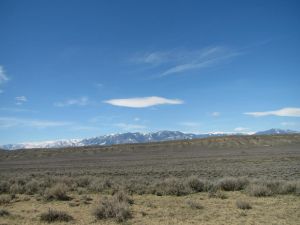
The Beartooth Pass. Click to enlarge

The Beartooth Pass. Click to enlarge

They know that nobody is going to fight for them, but they know they have to stand up for their rural way of life if it is going to survive. They’re clear on what will happen if BOGC grants every permit ECA requests with no concern over how it affects the area. It’s the same thing that has happened all over the country when the rights of citizens have been sacrificed for oil and gas drilling: their water will become contaminated and their air will be fouled. The music of the meadowlark will be drowned out 24 hours a day. Their crops will suffer and the wildlife will disappear. The destruction of the land will significantly reduce their property values. The truck traffic will congest the dirt road, leaving dust everywhere. They will need to lock their doors at night. Whatever royalties they receive for their mineral rights will eventually be gone, and their lives will never recover.

They also know that they have rights. Section 3 of the Montana Declaration of Rights, which is part of the state constitution adopted in 1972, says “the right to a clean and healthful environment” is an “inalienable” right.

What residents want
And they know what they need to hold onto their precarious balance with nature and oil and gas drilling. It’s not a long list, and it doesn’t keep mineral rights holders from getting what they want. It just makes them extract the oil in a way that preserves everyone’s rights and property. They’ve discussed it as a community, and they’re clear on what they need to protect themselves: limiting the number of well heads operating at any given time, protecting their water through constant testing and remediation, and designing and operating wells so the probability of spills and contamination is minimized.

If you think about it, these are the things the BOGC should have built into the ECA drilling permit if they were doing their jobs. It is respectful of mineral rights and surface rights, and it guarantees the citizens’ right to a clean and healthful environment.

The culture of Montana government is still rooted in the early 20th century, when mineral extraction was the only driver of the state’s economy. In the 21st century, when fracking technology endangers people’s lives, their livelihoods, and their health, it’s time for change.
******

Update from a resident, April 17: “I drove up there and sure enough they have staked the pond and have a bulldozer in there. So yes they have started. And the pond is right where I thought it would be.”

Update, April 20: I cross posted this on dailykos and was voted onto the recommended list. That will give this post wide readership.

Posted in Community Organization, Politics and History, Fracking Information | Tagged , , , , , , , , , , , , , , , , , , , , , , , , | 11 Comments

A personal story: Terry and Teresa Jackson, West Virginia

“They have no right to pollute my property, to desecrate the land we own. If I was out here pouring chemicals on my property, I’d be in jail.”

-Teresa Jackson

Telling personal stories
The oil and gas boom has been underway for a number of years in many locations across North America, and there are now a lot of stories about individuals and families whose lives have been personally affected. This post is part of a regular weekly series of those stories on this blog to help you envision what could happen if drilling expands along the Beartooth Front.

Today’s post deals with a common issue along the Beartooth Front: split estates. Most property in Carbon and Stillwater counties have been split over the years, which means that owners of the surface property do not own rights to the oil and other minerals under their land.

For more information about split estates and how to find out if you own the mineral rights to your property, click here.

You can see other personal stories in this series by clicking here.

Terry and Teresa Jackson, West Virginia
What used to be a hayfield on the Jackson property is now a well pad shaped like a bowling alley, with drilling rigs, rumbling diesel engines and steel tanks containing thousands of gallons of chemicals.

The Jacksons didn’t give the gas company permission to operate there, but they have to live with the noise, dust and smell it generates.

Teresa Jackson
The Jacksons now use bottled water for everything

They won’t get any royalty checks when the wells start producing natural gas, but they still have to pay taxes on a field they can no longer use.

The family has owned the rural property since the 1950s, but the Jacksons are just the surface owners. That means they control the top of the ground while someone else owns the mineral rights and dictates what can be taken from beneath the soil.

These split estates are common in West Virginia and throughout the Appalachian region, said Greg Buppert, a lawyer with the Southern Environmental Law Center.

In West Virginia, the estates were split decades to hundreds of years ago, according to a report by Alan Collins, a professor at West Virginia University.

Landowners sold or traded their mineral rights to other individuals or coal and lumber companies. Or they left their property to one group of heirs and the mineral rights to another, Collins wrote.

Many families, like the Jacksons, didn’t realize they didn’t own mineral rights until gas companies came calling.

As many reap the economic gains from natural gas in the Marcellus Shale region, “surface owners are often excluded.

Collins’ study looked at more than 1,400 completed well permits in 2012. He eliminated wells owned by oil and gas companies, governments and corporations.

That left 935 wells. Collins discovered that 70 percent of them were on split estates, meaning the decision to lease the land for gas drilling was controlled by someone who didn’t live on the property.

Surface owners are supposed to be notified of drilling and seismic testing and be compensated for the loss of their property, Collins wrote.

But Teresa Jackson said her family wasn’t notified, and their names aren’t listed on any permits.

She and her husband, Terry, both chemical plant workers, refused the $15,000 the gas company offered.

They filed a lawsuit, suing for the loss of land, the disturbance to property and lack of notification. Their case has never come to court—it’s been postponed repeatedly—and the Jacksons have spent about $15,000 on legal fees and water testing.

Jackson well
The well on the Jackson property. On March 28 fumes started coming from the well. The family was evacuated.

She realizes her family doesn’t own the rights to what’s in the ground, but she can’t abide by what the company has done above it. An explosion at the well pad in January spread black goo over the area, and the slime eventually oozed into a creek.

In March her family and others were forced to evacuate after getting sick from smells coming from the well.

The Jacksons stopped drinking from the faucet when drilling started. They use bottled water for everything, including bottles Teresa Jackson mixes with formula for her grandson.

“They have no right to pollute my property, to desecrate the land we own,” she said. “If I was out here, pouring chemicals on my property, I’d be in jail.”

Jackson, a cancer survivor, said she and her husband moved to the isolated area three years ago so she could plant an organic garden.

“We chose to live this way, we love it out here,” she said. “We don’t want to live next to an industrial zone.”

Posted in Personal stories | Tagged , , , | 1 Comment

A sharp-eyed reader spotted this on monster.com. Anyone who is complacent about ECA’s intentions after a long cold winter should think again.

District Production Foreman

ECA – Energy Corporation of America – Billings, MT

Energy Corporation of America is actively seeking a Production Foreman for our Billings, MT office. This position will report directly to the Rockies District Manager and will spend most of their time in Roscoe, Mt and the Billings office. The primary responsibility of the production foreman will include but is not limited to: • Daily monitoring of all Montana well production • Frequent visits to well sites • Supervising well workovers • Optimizing district production • Reducing well facilities costs • Overseeing Montana contract pumpers • Assisting in designing and implementing facility installs • Ensuring all state and federal regulations are being followed at each facility.

EDUCATION & EXPERIENCE • Minimum 3 years production experience with skills involving natural gas, oil, heater treaters, boilers, downhole pumps, transfer pumps, service rigs, Microsoft Office (Excel, Outlook, Word), etc. • High school graduate, post secondary education preferred.

BENEFITS. • Competitive salary • Excellent health insurance • 401k with company match at 35% • Profit Sharing • Company stock incentives • Reimbursement for qualified educational expenses • Dependent child scholarships Background checks will be required of all candidates for consideration. In addition, the successful applicant must pass a physical examination and drug screen. ECA employees enjoy a pleasant, family-oriented working environment, as well as a wide range of benefits and competitive salary.

To apply, submit your resume via email to hr@eca.com with the job title for which you are applying in the subject line of the email. All resumes are due by April 25, 2014. ECA is an equal opportunity employer.


Posted on by davidjkatz | 4 Comments

Alaska adopts strict new rules for fracking. What about Montana?

It’s interesting to see what other states do while Montana twiddles its thumbs.

Alaska’s oil and gas regulatory body has adopted new rules governing hydraulic fracturing that include increased testing of water wells for contamination. Final regulations are now being reviewed by state attorneys before they are signed by the Lieutenant Governor.

Cathy Foerster
Cathy Foerster, Chair of the Alaska Oil and Gas Conservation Commission

The rules will require testing of all water wells within a half-mile radius of a well to be fractured, and will mandate testing of the water wells for contamination after the fracture job is completed, said Cathy Foerster, chair of the Alaska Oil and Gas Conservation Commission (AOGCC). In some cases, testing of water wells prior to the fracturing may be required at the discretion of the commission.

The rule will also require disclosure of chemicals used in fracturing fluids and for the chemicals to be reported to FracFocus, a national website maintained for public disclosure of chemicals used in hydraulic fracturing. The disclosure requirements are similar to what other states require and will adequately protect the trade secrets of service companies working on frac jobs, Foerster said.

Predictable reaction from the industry:

“Our concern is that these regulations will result in substantial costs without providing any real tangible benefit to the public, as most hydraulic fracture treatments in Alaska take place thousands of feet below any drinking water,” said Kara Moriarity, executive director of the Alaska Oil and Gas Association.

Foerster talked about the reasons why the Alaska Oil and Gas Commission is taking these steps:

We’ve been hydraulic fracturing wells in Alaska for over 40 years. About a quarter of all wells drilled in Alaska have been fractured. The rule update has been a multi-year effort, first to keep up with technology advances, second to address fracturing fluids disclosure and water quality monitoring and third to gather all of our regulatory requirements into a section titled hydraulic fracturing, to make it easier for the public to see how we are regulating hydraulic fracturing.

Compare that to the chicanery that goes on with the Montana Board of Oil and Gas Conservation, which rubber stamps anything the industry puts in front of it. Why does one state focus on technology, transparency and water quality while another does whatever the oil and gas industry wants? Alaska’s new rules aren’t revolutionary, but they recognize the significant impact of fracking on water.

Montana needs reform.

Posted in Fracking Information | Tagged , , , , , , | 1 Comment

Rex Tillerson admits humans cause climate change; Steve Daines doesn’t get the message

“The good thing about science is that it’s true whether you believe in it or not.”

Neil deGrasse Tyson

Rex Tillerson
Rex Tillerson

When Rex Tillerson speaks, this blog listens. Rex is pretty much an icon around here. He’s the namesake of the Rex Tillerson Fracking Hypocrite Award, and the CEO of ExxonMobil who complained about government interference in fracking while he was suing his neighbors to stop construction of a fracking-related water tower near his home.

Rex has been under increasing fire lately over climate change, and so it’s worth noting that Exxon has, after five years of severe pressure from stockholders and the public, agreed to disclose more about the risks associated with its use of hydraulic fracturing, including, for the first time, a plan to mitigate the effects of climate change.

Scorecard

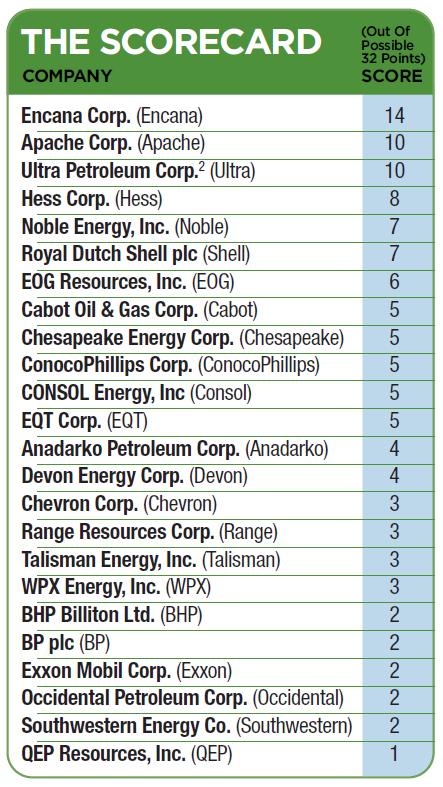
Scorecard: How drilling companies scored on transparency in disclosing risks of fracking

The Scorecard
The pressure has come from many sources, but it is a clear indication that people can make the oil and gas industry back down. The increasing pressure of moratoriums, economic boycotts, stockholder pressure and changes in public attitudes are having an impact in forcing change.

Exxon’s abysmal performance in disclosing the risks of fracking is summarized in the report Disclosing the Facts: Transparency and Risk in Hydraulic Fracturing Operations, put out by several investment groups. The report bench- marked 24 companies engaged in hydraulic fracturing against their disclosure of the operational impacts of fracking and their mitigation efforts.

As you can see from the scorecard at the right, none of the companies does a very good job of reporting risk — the best disclosure score was 14 out of 32 — but Exxon is particularly bad, with a disclosure score of only 2 out of 32.

What’s most remarkable about this is that Exxon has actually issued a report called Energy and Carbon — Managing the Risks. The report marked the first time Exxon has publicly acknowledged that climate change is real and that energy-related activities contribute to it. In Exxon’s words:

ExxonMobil takes the risk of climate change seriously, and continues to take meaningful steps to help address the risk and to ensure our facilities, operations and investments are managed with this risk in mind.

Many governments are also taking these risks seriously, and are considering steps they can take to address them. These steps may vary in timing and approach, but regardless, it is our belief they will be most effective if they are informed by global energy demand and supply realities, and balance the economic aspirations of consumers.

Exxon’s final report with recommendations for climate change mitigation is due out in September. We shouldn’t expect anything earthshaking, but it’s a small and important step. Until now the oil and gas industry has made it their business to deny everything that associates their activities with climate change.

Steve Daines letter

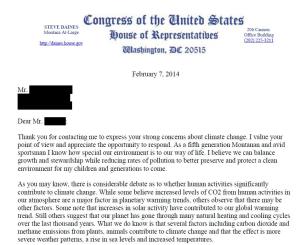
Letter from Congressman Steve Daines inventing his own science (click to read full letter)

Steve Daines doesn’t get it
I wish Steve Daines would get the message. He’s still clinging to the notion that he just doesn’t know whether human beings have anything to do with climate change. At right you see a letter he recently wrote to a constituent. You can click on it to read the whole letter, but the key passage reads,

While I believe we all have a moral responsibility to be good stewards of the environment, the current uncertainty surrounding climate change requires us to consider very carefully any legislation that would cost jobs and hurt families with only the promise of an extremely small impact on the reported problem. I graduated with an engineering degree from MSU. My education trained me to base decisions on sound math and science. I will not support policies that would harm America’s economy while having an insignificant or uncertain benefit to the environment.

Now this is not a political blog. I’m not going to endorse any candidate for Senate, and frankly, I don’t know whether John Walsh is any better. He hasn’t seen fit to tell us exactly where he stands on climate change. His web site indicates he’s for developing every energy resource known to man, from renewables to coal.

And once you’re in office, the money train from oil and gas makes it easy to hold on to climate change denial. Steve Daines has taken in $258,282 from the oil and gas industry since he’s been in Congress, including $140,812 in this year’s election cycle. Not to be cynical, but I’ll bet his engineering degree from MSU taught him more about how to count money than how to figure out that our dependence on fossil fuels is killing us.

Montana deserves better
The people of Montana deserve better than a Senator who cares more about his campaign war chest than the quality of life in this state and the entire world. The head-in-the-sand approach that says, well, we just don’t know, so it would be wrong to slow down is just stupid. Even if you really think we don’t know what’s causing climate change, wouldn’t it make sense to find out before we release more and more methane into the air?

Montana voters should pay attention to how pressure has forced Rex Tillerson to move. No matter who gets elected, voters need to demand a responsible approach to energy development from their next Senator. Full speed ahead just won’t do. If we can make Rex Tillerson get it, we ought to be able to reach the next Senator, whether it’s Steve Daines or John Walsh.

Posted in Community Organization, Politics and History, Fracking Information, Shared Letters and Posts | Tagged , , , , , , , , | 8 Comments

A personal story: Marilyn Hunt, Wetzel County, West Virginia

 We used to live the American dream; we had a middle class existence. Now we’re on a camping trip without the fun. We collect rain water to water the stock and we’ve set up a special system to treat the rainwater for our drinking water.

-Marilyn Hunt, Wetzel County, West Virginia

Telling personal stories
The oil and gas boom has been underway for a number of years in many locations across North America, and there are now a lot of stories about individuals and families whose lives have been personally affected. This post is part of a regular weekly series of those stories on this blog to help you envision what could happen if drilling expands along the Beartooth Front.

Previous posts in this series:
Tim and Christine Ruggiero, Wise County, Texas
Laura Amos, Encana, Colorado
Helen Ricker, Poplar, Montana
Diana Daunheimer, Didsbury, Alberta
John Fenton, Pavillion, Wyoming
Linda Monson, Williston, North Dakota
Bob Deering, Pennsylvania

Marilyn Hunt, Wetzel County, West Virginia
Thirty years ago we moved to Wetzel County. It was a quiet farming community crisscrossed with tiny country roads, abundant wildlife, strong families and churches, and blessed with clear night skies. Our water was clear and pure. It seemed like the perfect place to farm.

That all started to change in 2009. Convoys of trucks started coming in. Land men started making the rounds and trouble started.

Land men were very aggressive, gathering intelligence like CIA operatives, so they could pit one family member or one neighbor against another. Some unscrupulous land men even took advantage of older folks – sneaking into their homes while their caregivers were out and getting signatures on documents that sold their rights away. Marriages broke up, families fell apart, and longtime friendships were lost over disagreements about money and drilling.

Our local services and our way of life were overloaded and seriously altered. Serious crime exploded and our emergency responders weren’t equipped to handle the industrial accidents.

We didn’t have enough jail space to handle the criminals, many of them drillers from outside the area. Our quiet country roads were pocked with potholes.

Marilyn Hunt holds up a picture of a flaming gas well at a public meeting (click to enlarge)

A meeting was called and residents of the area were invited to hear the drillers talk about their operations. They assured us that the process they used was perfectly safe, that they were injecting just water and sand into the ground. They said that the only way anything could go wrong is if there were an accident or an anomaly.

Days later I was alarmed when I saw trucks pulling up with pallets and tanks of chemicals. If it was just sand and water, what were these chemicals?

The lawlessness went far beyond assaults and thievery, as we were soon to find out. We decided that we would not lease even though the drillers had designs on our farm. This, apparently, got some people upset. There were infringements upon our rights. There were attempts at intimidation. We were run off the road, there were attempts to change our property lines, and we caught a tanker truck emptying its contents on a local road without a permit.

Marilyn Hunt a personal story
Chickens grew deformed beaks after drinking water near a fracked well. The Hunts have been raising chickens for 21 years. (click to enlarge)

Then we started getting sick. In December 2009, we all came down with flu-like symptoms. Drinking water seems perfectly natural when you are sick – and our water was good. There were no smells or tastes but we did notice white flecks that we had never noticed before. It never occurred to us, though, that water might have been contaminated so far from the actual drilling. We assumed we were safe, insulated from harm by our 70-acre farm. We were over a mile from the nearest well. But then a neighbor called and told us her horses refused to drink the water from her well and it had a chemical smell. She, too, was over a mile from a drilling site. Our chickens developed neurological symptoms. They were unable to stand. The dying chicks moved their bodies in circles and died.

My husband Robert, a scientist with several patents to his name, tested the water and found acrylonitrile. Acrylonitrile is highly flammable and toxic and had migrated over a mile from the drill site. We have the findings of the volunteer lab and a private commercial lab. My neighbor has the deepest well in the area and her test results included benzene, toluene, and pages of other chemicals.

We used to live the American dream; we had a middle class existence. Now we’re on a camping trip without the fun. We collect rain water to water the stock and we’ve set up a special system to treat the rainwater for our drinking water.

I’m not sure if people realize how critical water is to our lives. We need it to drink, bathe, clean, cook, wash clothes, and it is also critical to our animals.

This country was set up to give all of its citizens certain rights. What seems to be happening is that we are sliding back to a tiered system where different people get different rights. We are in the midst of a prolonged and intense civil and human rights crisis.

The gas and oil industry buy the allegiance of our government officials with legalized bribes called campaign contributions. And who pays the steepest price? It’s the poor and marginalized.

Some people have benefited from this invasion but most people are no better off than when this “boom” hit Wetzel County. Some people have more money but the quality of their lives is no better and is often worse. You can’t live without clean air and water, and is life really living if you are nothing more than a serf? My father landed at Normandy and fought his way across Europe to protect our freedoms.

People need to stand up and fight for the government we were promised or we will lose all that so many gave so much for. We in America have become a beacon of hope and resolution to those who live under totalitarian and repressive regimes.

Closing note for Montanans
As I research these stories a very familiar theme comes through time after time. The evidence that links fracking to poisoning of the Hunts’ water supply is clear, but it is circumstantial. The drilling company denied that the contamination was fracking-related, or that they had used acrylonitrile in the frac fluid. The testing that Robert Hunt and the Hunts’ neighbors did showed contamination, but they were not able to establish that the contamination was related to the drilling in court.

The reason is that they had no baseline testing. Without pre-drilling baseline testing, it is impossible to prove the previous content of water.

Now is the time to get your water tested, before drilling takes place.

Posted in Personal stories | Tagged , , , , , | 2 Comments

If you’re in Stillwater County you may be aware of a comments period on a federal Bureau of Land Management (BLM) lease sale that ends tomorrow, April 9. The purpose of this post is to familiarize you with the BLM leasing process so you can understand whether to comment, and if you do what kind of comments would have the most impact.

This post comes from information provided by the BLM office and background data available on public web sites.

Background: The BLM leasing process

BLM Billings Field Office

The Billings BLM Field Office (click to enlarge)

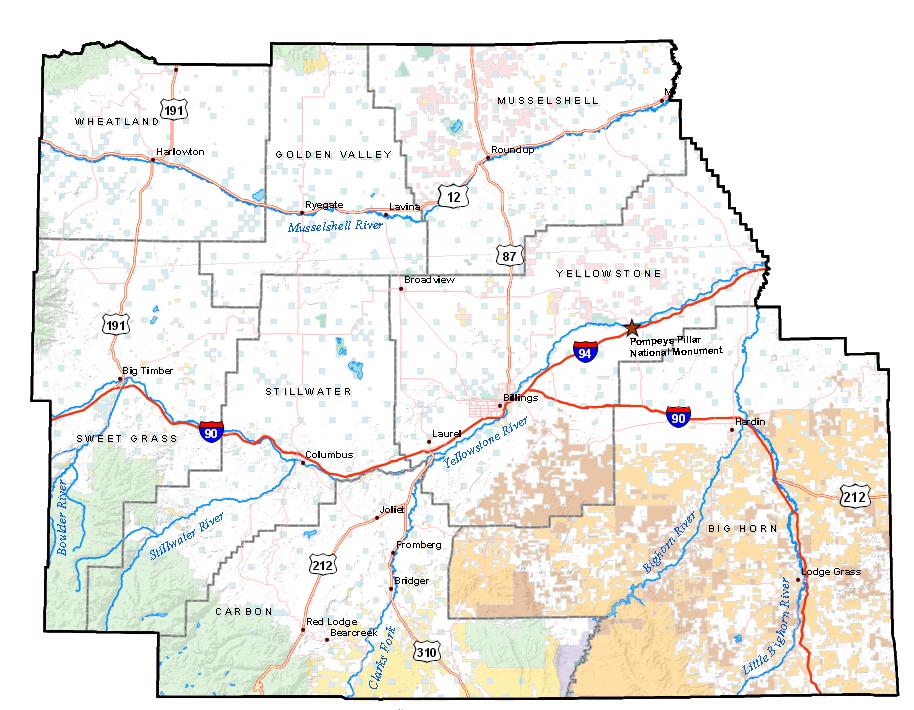
The BLM leasing process is governed by a resource management plan (RMP) and associated environmental impact statement (EIS). Together they provide a framework for managing BLM-administered lands and federal minerals. Stillwater and Carbon counties are part of the Billings BLM field office combined with the Pompeys Pillar National Monument, and are managed under an RMP originally developed in 1984.

The existing RMP is currently being revised. When complete the revision will guide management of approximately 434,000 acres of BLM land and 1.8 million acres of federal mineral estate managed by BLM for Big Horn, Carbon, Golden Valley, Musselshell, Stillwater, Sweet Grass, Wheatland and Yellowstone counties in Montana, and portions of Big Horn County, Wyoming.

This revision is important, since the RMP is only updated every 25 years or so. The process is well defined and underway. The public comment period ended in June, 2013, and a final document should be completed by September, 2015.

A current draft version of the 2800-page RMP is available online at the BLM web site. Of particular interest is Appendix C, which deals with Oil and Gas Stipulations. Key stipulations in the draft include the disruption of the habitats of endangered species, most notably the sage grouse, which, according to the BLM, is “the critical thing the RMP is looking for,” but also designated reservoirs with fisheries, 100-year flood plains, and others.

Lease sales
Leases on BLM land are put up for sale when there is a request from a company that wants to exploit mineral resources. The process is governed by the National Environmental Policy Act (NEPA), which requires federal agencies to integrate environmental values into their decision making processes by considering the environmental impacts of their proposed actions and reasonable alternatives to those actions.

To meet NEPA requirements federal agencies prepare a detailed statement known as an environmental assessment. EPA reviews and comments on environmental assessments prepared by other federal agencies, maintains a national filing system for all assessments, and assures that its own actions comply with NEPA.

The environmental assessment involves two steps:

  1. Public Scoping: This step involves the community in determining whether there are environmental impacts that need to be considered. These impacts might include:
  • Significant natural resources such as ecosystems and threatened and endangered species;
  • Commercial and recreational fisheries;
  • Current recreational uses of the land and waterways;
  • effects on water users;
  • Effects of potential controls on current lake and waterway uses such as flood risk management, commercial and recreational navigation, recreation, water supply, hydropower and conveyance of effluent from wastewater treatment plants and other industries; and
  • Statutory and legal responsibilities relative to use of land and water.

2. Preliminary environmental assessment: Public review of preliminary environmental assessment. This process takes 30 days before the final environmental assessment.

The current BLM lease under consideration in Dean

Current Montana BLM lease sales (click to enlarge)

Current Montana BLM lease sales (click to enlarge)

Available parcels in Montana during any leasing sales period are mapped and listed on the BLM web site. You can click through to get a listing and map for each of the 10 areas in the state. There is also a listing of all leases currently for sale in the state. In the current listing there are 75 total leases for sale in the state. Only one of these is in Stillwater County and none is in Carbon County.

BLM_Stillwater

BLM lease listed in Stillwater County (click to enlarge)

The lease for sale in Stillwater County is in Dean, on County 419, the road from Nye to Fishtail. For those who wish to look in more detail, map coordinates are 5S, 16E, Section 13. This land is adjacent to the current ECA lease. It is a split estate, which means that the BLM manages the mineral estate of the property, and the leasing will occur without input from the surface rights owner.

The commenting period that ends on April 9 is for the public scoping period. If you are going to comment you should be looking at the stipulations in Appendix C of the RMP — items such as habitats of endangered species, water usage, and others listed above. If you are aware of private structures on this land that the BLM may not be aware of, you can include those as well. General arguments that you might make on the appropriateness of oil and gas drilling are not relevant for this round of comments, except as they are listed as stipulations in Appendix C.

The preliminary environmental impact statement will be released on May 19, with BLM findings. At that point there will be an additional 30 day comment period. At that point, if you disagree with the EIS you can comment in a more specific way about the findings. If the decision is made to go forward, the actual lease will be put up for sale on October 21, 2014.

BLM recommendation
It is important to note that the current recommendation (see page 3) is for the lease to be deferred until the RMP is completed. This means that this lease would not be put up for sale in the October 21 round. The reasons are that the area covered by the lease is a Yellowstone cutthroat trout recovery habitat, and the unincorporated town of Dean is included in the lease parcel. The Billings BLM office is required to complete their input into the RMP by December, 2014, with the national RMP is to be completed by September, 2015, so the recommendation is that the lease sale will be deferred at least until then.

This does not mean you should be complacent. Consider this Round 1 of a long battle. The federal Council of Environmental Quality has published an excellent Citizen’s Guide to the NEPA that will give you more insight into this process. Don’t sit around wondering what you can do to help — this is an opportunity to make your voice heard.

When you coment, first go to Appendix C and read through the stipulations. There are over 200 of them. These need to be the basis for framing your comments. Use the words the BLM uses in phrasing the stipulations.

To comment:
Email: BLM_MT_BillingsFO_Lease_EA@blm.gov
Subject Line: 
October 21, 2014 Oil and Gas Lease Sale Comment  

Mail: Bureau of Land Management
Billings Field Office
Attention: Craig Drake
5001 Southgate Drive
Billings, MT 59101

(Note: if you’re reading this you have email access. I recommend you send your comments electronically to make sure they get to the BLM before the deadline.)

Posted on by davidjkatz | 6 Comments