Paris climate talks: the future of the planet is at stake

Beginning today, 40,000 world leaders, diplomats, experts and partisans will meet in Paris to begin 12 days of climate talks that could very well decide the future of our planet.

The conference is called Conference of the Parties 21, or COP 21, which refers to the countries that have signed up to the 1992 United Nations Framework Convention on Climate Change (UNFCCC). UNFCCC is an international treaty now signed by 195 parties, with the aim of reducing global greenhouse gas emissions to control climate change. This is the 21st meeting since 1992, hence COP 21.

The goal is a new global climate treaty, involving all nations, that would take effect in 2020 to help the world avoid the worst consequences of manmade global warming. According to the UNFCCC, this means limiting global warming in 2100 to less than 2°C, or 3.7°F, above pre-industrial levels.

According to recent data, we’re already halfway there. In 2015, global temperatures have reached 1°C higher than pre-industrial levels. Without action, temperatures are expected to increase by 3.7 – 4.8°C by 2100.

The consequences of inaction
Failure to act now will have huge consequences. According to NASA, this is what we can expect:

  • Increases in precipitation and major storms in some areas. The intensity, frequency and duration of North Atlantic hurricanes, as well as the frequency of the strongest (Category 4 and 5) hurricanes, have all increased since the early 1980s.
  • Droughts in the Southwest and heat waves (periods of abnormally hot weather lasting days to weeks) everywhere are projected to become more intense, and cold waves less intense everywhere. By the end of this century, what have been once-in-20-year extreme heat days (one-day events) are projected to occur every two or three years over most of the nation.

Source: NASA

Mount Kilamanjaro, Feb 1993 and Feb 2000. Source: NASA

  • Sea levels will rise 1-4 feet by 2100. Global sea level has risen by about 8 inches since reliable record keeping began in 1880. It is projected to rise another 1 to 4 feet by 2100. This is the result of added water from melting land ice and the expansion of seawater as it warms. In the next several decades, storm surges and high tides could combine with sea level rise and land subsidence to further increase flooding in many of these regions. The Arctic Ocean is expected to become essentially ice free in summer before mid-century.

    Source: Dr. James Hansen

    Source: Dr. James Hansen

In Montana, wildfires, insect outbreaks, and tree die-offs can be expected. Extreme heat, heavy downpours and flooding will affect infrastructure, health, agriculture, forestry, and water quality.

Reason for optimism
There is a great deal of optimism for progress at this year’s climate talks. There are several reasons for this.

  • The US and China, the two top carbon emitters in the world, reached a historic agreement on climate change this year. A key provision of the agreement is the two countries’ “commitment to a successful climate agreement in Paris” and “the importance of formulating and making available mid-century strategies for the transition to low-carbon economies, mindful of the below 2 degree C global temperature goal.”
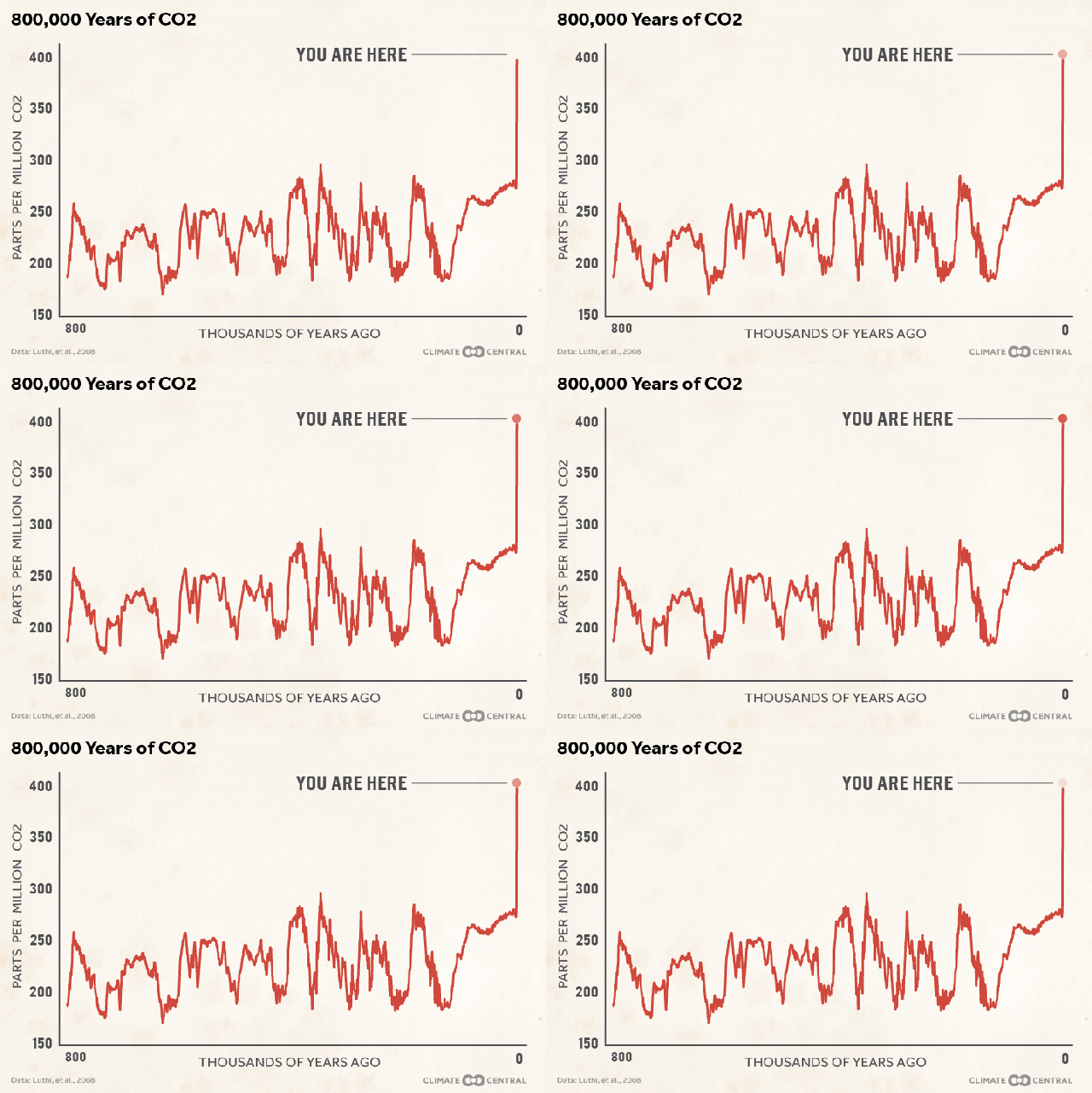
  • We’re running out of time. In addition to rapid temperature increases, the amount of greenhouse gases in the atmosphere is the largest in human history at 400 parts per million.
Source: Mashable

  • The framework for an agreement is different than it has been in the past. the new agreement will not be imposed centrally by the UN. Countries will decide for themselves what they are able to do in terms of curbing greenhouse gas emissions and increasing their investment in renewable energy.

What commitments have countries already made?
161 countries have submitted climate pledges in advance of Paris. While these commitments by themselves will not hold global warming under two degrees. According to the United Nations, these commitments would hold temperature increase to 2.7° – 3.7° by the year 2100.

But an agreement framework that provides for regular review and specific timelines can move us down the road to strict regulation in the future.

These are commitments made by the leading economies in the world going into the conference:

United States
President Obama’s Clean Power Plan is the largest commitment ever by the United States. This plan, introduced by executive order last August, cuts significant amounts of power plant carbon pollution while advancing clean energy innovation, development and deployment, and laying the foundation for the long-term strategy needed to tackle the threat of climate change. In Montana, for example, the Clean Power Plan would reduce power plant emissions from approximately 18 million tons of CO2 in 2012 to just over 11 million tons in 2030. However, the plan still faces legal and political challenges in the US.

European Union
The EU has submitted a plan for a binding, European-wide target of reducing greenhouse gases by at least 40% below 1990 levels by 2030. Negotiating such a plan across the 28 countries in the union is a substantial accomplishment.

China
China and the US made a historic agreement to emissions control prior to Paris, with China committing to peak its emissions by 2030 and scale up deployment of renewable energy. China also pledged to reduce its emissions per unit of GDP by 60 to 65% below 2005 levels by 2030.

Brazil
Brazil has pledged to cut greenhouse gas emissions by 37% below 2005 levels by 2025 and 43% by 2030.

Russia
Russia has proposed cutting emissions by 30% below 1990 levels by 2030.

Costa Rica
Costa Rica has made one of the most impressive commitments going into Paris: 100% reliance on renewable energy by 2030, carbon neutrality by 2085, and per capita emissions to net negative levels by 2100.

Saudi Arabia
This oil rich country has, for the first time, indicated a willingness to diversify it’s economy and reduce its emissions, but has offered no specific plan.

Ethiopia
Pledged to reduce greenhouse gas emissions by 60% from business as usual, a substantial commitment.

Muir Glacier, Alaska, Aug 1941 and Aug 2004. Source: NASA

Muir Glacier, Alaska, Aug 1941 and Aug 2004. Source: NASA

How American politics affects COP21
According to a poll released today by the New York Times, two-thirds of Americans support the United States joining a binding international agreement to curb growth of greenhouse gas emissions, but a slim majority of Republicans remain opposed, the poll found. Sixty-three percent of Americans — including a bare majority of Republicans — said they would support domestic policy limiting carbon emissions from power plants. Seventy-five percent of Americans polled said that global warming was already having a serious environmental impact or would in the future. Nine in 10 Democrats agreed, compared with 58 percent of Republicans.

Mitch McConnell

Mitch McConnell

Public support is shifting in favor of climate action, but you shouldn’t underestimate the difficulty of getting action in Washington. Last week Senate Majority Leader Mitch McConnell wrote an op ed in the Washington Post in which he said,

“It would obviously be irresponsible for an outgoing president to purport to sign the American people up to international commitments based on a domestic energy plan that is likely illegal, that half the states have sued to halt, that Congress has voted to reject and that his successor could do away with in a few months’ time….

“What his power plan will do is unfairly punish Americans who can least afford it. It could result in the elimination of as many as a quarter of a million U.S. jobs. It could raise energy costs in more than 40 states, with double-digit increases in states such as my home state of Kentucky.

“Predictably, the president’s attack on the middle class — one that won’t even meaningfully affect global carbon emissions — has received loud applause from wealthy left-wingers who just want to pat themselves on the back for “doing something.” Lost jobs or higher energy bills may be a mere trifle for some on the left, but it’s a different story for a senior citizen on a fixed income or for a working mom who struggles paycheck to paycheck.”

In Montana, NorthWestern Energy has sued to block the Clean Power Plan, predicting that it will do significant permanent damage to Montana’s economy, including shutting down all four of the Colstrip electrical generators by 2022, eliminating the coal mine that supports them, and building expensive replacements for all of them.

But the claims of Mitch McConnell, NorthWestern Energy and other litigants against the Clean Power Plan should be taken with a several large grains of salt. They seek to maintain the status quo, but according to Thomas Power, professor emeritus in the Economics Department at the University of Montana, these claims have little merit:

“Instead of analyzing the broad array of ways that Montana can meet its obligation to reduce carbon pollution under the Clean Power Plan and contribute to the development of a Montana plan, NWE has simply taken to shouting hysterically that the sky is falling and that the only way to avoid economic catastrophe in Montana is to abandon efforts to stabilize our climate.

“The flexibility allowed under the Clean Power Plan, and a realistic review of the electricity infrastructure in place in Montana, clearly indicate that that just is not so.”

A need for urgency
Obama in Paris
We need to feel great urgency about COP 21. Success will not get us where we need to be, but failure to reach an agreement that will include regular assessments of progress and a framework for future cuts will be a disaster.

This morning President Obama spoke in Paris and affirmed the need for action. “I come here personally as the leader of the world’s biggest economy and second biggest emitter to say that America not only acknowledges its role in climate change but embraces doing something about it,” he said this morning.

Update December 12:
Delegates reach historic climate agreement in Paris

 

Posted in Climate change | Tagged , , , , , , , | 2 Comments

Developing countries are moving fast to create clean energy capacity. Time for the US — and Montana — to step up

Some politicians characterize policies to address climate change as a choice between economic growth and the environment. What’s more, say Marco Rubio and Carly Fiorina, even if we were to take action on climate change, anything we do will make no difference because countries like China are “drilling a hole and digging anywhere in the world that they can get a hold of.”

Problem is, that just isn’t true.

Huge growth in clean energy in developing nations
According to new data published by Bloomberg New Energy Finance (BNEF), a majority of the investment in clean energy in the world in 2014 took place in 55 developing nations, including China, India, Pakistan, Brazil, Chile, Mexico, Kenya, Tanzania, South Africa and other nations.

Chinese worker installing a wind turbine. China will spend $27 billion in renewable energy projects this year alone. Source: Efergy

Chinese worker installing a wind turbine. China will spend $27 billion in renewable energy projects this year alone. Source: Efergy

Key findings of the study:

  • For the first time ever, over half of all new annual investment into clean energy power generating projects globally went toward projects in emerging markets, rather than toward wealthier countries. China led this growth by adding 35 gigawatts of new renewable power generating capacity — more than the US, UK and France combined.
  • New investment in renewables soared in 2014 in the 55 developing countries to hit a record annual high of $126 billion – up 39%, from 2013 levels.
  • Financial institutions in developing countries invested $79 billion in renewables in those countries, up 50% from the year before.
  • Continuing declines in clean energy costs appear to be driving growth. Costs associated with solar have declined 15% globally in the last year. Solar is particularly competitive in emerging markets which often suffer from very high power prices from fossil generation while also enjoying very sunny conditions.
  • On a percentage basis, clean energy capacity in developing countries is growing twice as quickly as in developed nations.

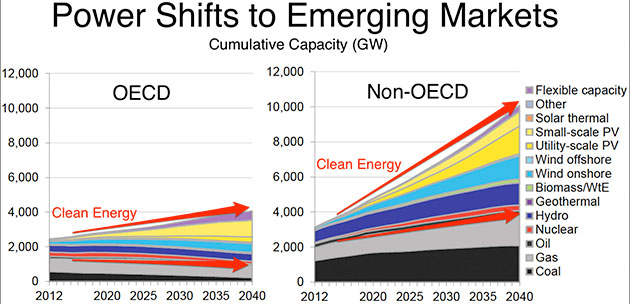
What’s more, The BNEF analysis says this trend is not only going to continue, but increase over the next 25 years. (OECD countries are the 34 most developed nations in the world.)

Clean energy power shiftSource: BNEF

As you can see from the chart above, use of oil, gas and coal in developing countries will continue to increase for the foreseeable future. China has announced that their emissions will peak in 2030. But during that time, the renewables capacity in developing nations will become 60% of their total energy output, up from the 33% it is today.

Time for the US — and Montana — to step up
In advance of the critical international climate talks scheduled to begin shortly in Paris, it is clear that the developing countries of the world are prepared to step to the table to make significant commitments to reducing carbon emissions. Rather than stick our heads in the sand, as candidates as Rubio and Fiorina and others would have us do, it is time for the United States to step up.

 And in Montana, where our leaders blithely talk about an “all of the above” energy policy, it’s time to wake up. The future is  going to be built around transitioning to clean energy, not extracting fossil fuels from the shale underneath the Beartooth Front.

They understand this in Pakistan, Tanzania and Mexico. Why not in Helena and Washington DC?

Related:
Comparing the 2016 presidential candidates on climate change

Posted in Climate change | Tagged , , , , , , | 2 Comments

Carbon County landowners file Supreme Court brief

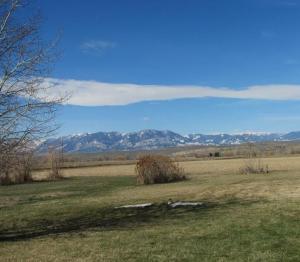
Beartooth Front viewed from the Silvertip Zone. Click to read landowners Supreme Court brief

Beartooth Front viewed from the Silvertip Zone. Click to read landowners Supreme Court brief

The plaintiffs in the Carbon County lawsuit over citizen initiated zoning filed their brief in Montana Supreme Court last week. This is the latest step in a process that should be decided in 2016.

You can read the brief by clicking the graphic on the right.

Case background
In 2014, a group of Belfry landowners petitioned the Carbon County Commissioners to grant the protections of citizen-initiated zoning after Energy Corporation of America announced plans in October 2013 to hydraulically fracture 50 wells along the Beartooth Front, an area that includes Carbon and Stillwater counties in Montana and forms the northeastern flank of the greater Yellowstone ecosystem. Mork boasted that ECA hoped to bring “a little bit of the Bakken” to the Beartooths.

The group sought to establish the Silvertip Zoning District, which would include nearly 3,000 acres of agricultural land north of Belfry. Montana law empowers landowners to initiate the development of zoning regulations for the protection of their land and community by petitioning their county commissioners to establish planning and zoning districts.

After initially approving the district, the Commissioners last January voted to deny the zone. The Commission’s rejection was based on the opposition of certain neighboring landowners under a provision of the law that the plaintiffs argue is unconstitutional.

In February of this year, the petitioners filed a legal challenge to the Carbon County Commission’s decision to reject their petition.  In a narrow ruling, Judge Blair Jones on July 8 dismissed the lawsuit without ruling on the merits of the landowners’ legal challenge.

In August, the Silvertip landowners appealed Judge Jones’ ruling to the Montana Supreme Court.

Silvertip landowners argument
In the brief, the petitioners argue that:

  1. The District Court ruled improperly in saying that the Carbon County Commissioners had no ability to waive their own procedural requirements for the submission of citizen-initiated zoning, even though the Commissioners admitted that those requirements were burdensome, and that waiving the procedure would not be unfair to anyone.
  2. The protest provision in Montana code MCA § 76-2-101(5) violates the Montana Constitution by allowing private individuals to veto county commissioners’ approval of citizen zlning proposals without any justification or opportunity for the commissioners to review.
  3. The Carbon County Commissioners’ reliance on the protest provision makes their decision unlawful.

What happens next
The Carbon County Commissioners have 30 days to file their response to the brief. We will keep you updated.

Related
Citizen initiated zoning: a way to restore fairness to oil and gas drilling in Montana
Frequently Asked Questions about the Silvertip citizen-initiated zone
Exciting news from Carbon County: Commissioners move forward on Silvertip Zone
Unbelievable. Carbon County Commissioners defy will of majority to deny Silvertip Zone
Commissioners action in denying Silvertip Zone clearly illegal
Why Silvertip landowners filed suit against the Carbon County Commissioners
Breaking: Decision in Silvertip Zone case
(includes timeline of events)
Judge Blair Jones’ ruling in District Court


Posted in Uncategorized | 1 Comment

Beartooth Front landowners present hundreds of signatures to Stillwater County Commissioners to set up oil and gas zoning district (with video)

Before a room packed with supporters, Stillwater County landowners from the Nye/Fishtail area yesterday presented hundreds of signed petitions to the Stillwater County Commissioners. The petitioners want to establish the Stillwater County Beartooth Front Zoning District to locally regulate oil and gas activity within the boundaries of the zone. The area of the proposed zone is large, approximately 79,500 acres, and includes about 600 properties.

Proposed Stillwater County Beartooth Zoning District Map. Click for enlarged version.

Proposed Stillwater County Beartooth Zoning District Map. Click for enlarged version. Read Beartooth District boundary and acreage

The submission is the culmination of over two years of work by local landowners in this rural community, who were jolted into action in October 2013 when John Mork, CEO of Energy Corporation of America, promised to use horizontal drilling and hydraulic fracturing technologies to “bring something like the Bakken” to the area.

Following Mork’s announcement, neighbors set to work learning about the impacts of oil and gas activity, studying Montana law and regulations, holding meetings to weigh possible alternatives, reaching broad consensus for action among landowners, and gathering signatures.

Stillwater Mine

Stillwater Mine

A history of local involvement in mineral extraction
This area of Stillwater County has a long history of successful coexistence with mineral extraction companies. The Good Neighbor Agreement with the Stillwater Mining Company, which is located near the proposed zone, is a legally binding contract that has stood for years. The agreement has established a process for citizens to regularly meet with company representatives to address and prevent problems related to mining impacts, reclamation, wildlife, and other issues. It set aside land in conservation easements, instituted a program to reduce traffic on winding valley roads, and provided for independent environmental audits.

What was submitted to the Commissioners
According to the petitions, the

“District is in the public interest or convenience because Oil and Gas Activity, without local regulation, threatens substantial adverse impacts within the proposed District to (1) the public health, safety, and welfare, (2) private property, (3) public property such as County roads and bridges, (4) the quality and quantity of both surface and ground water, (5) air quality, (6) the quality and quantity of soil, and (7) the rural residential and agricultural character of the area.”

Petition cover memo
Read the petition

List of documents submitted to Commissioners

The Stillwater River is a pristine mountain stream flowing through the proposed zone

The Stillwater River is a blue ribbon trout stream flowing through the proposed zone

To back up this argument, the petitioners submitted a document detailing recent peer-reviewed and other scientific studies showing the potential harm of oil and gas activity to water and air quality, to agriculture and soil quality, and to public health; the possible consequences of faulty wellpad engineering, and the impact of excessive noise and light associated with drilling. According to the document, scientific study is just beginning to catch up with the oil and gas boom in eastern Montana and elsewhere — “over half of the available studies on the adverse impacts of shale and tight gas development have been published since January, 2014.”

Read the document.

The County Commissioners meeting
At the November 10 meeting, the petitioners were represented by Kayce Donohoe Arthun, a fourth generation landowner who lives in the proposed zone. The Commissioners granted the petitioners an hour on the agenda to present their petitions and background information.

The proposed zone is rich ecosystem, home to Bighorn sheep, bear, elk, deer, foxes, eagles and many other animals

The proposed zone is a rich ecosystem, home to Bighorn sheep, bear, elk, deer, foxes, eagles and many other animals

The meeting was not a public hearing. That will take place later, after the signatures are verified. It was an opportunity for the group to formally present the petitions and provide a rationale behind this course of action.

While I recommend watching the entire video below to understand what happened at the meeting, I think the statement Kayce Arthun made beginning at 41:07 is an excellent summary of the case for the petitions, and her personal appeal at the end provides historical perspective explaining how the proposed zone is central to preserving a way of life:

“All we’re asking is to look forward, not to put regulations in place that don’t allow oil and gas development, but to do it responsibly, and to make sure that we protect our way of life….

My grandmother Mary Donohoe proposed the same type of citizen initiated zoning district back in the 90s. However, it was in regards to hard rock mining, and there was a lot of concern about that at the time because people wanted to see that develop here in our county. Well, her and a lot of like-minded people, they wanted to see it done responsibly. They knew hard rock mining was coming to our county and was here to stay, but they wanted to see it done the right way. So they came and presented to a group of individuals just like yourselves sitting in those chairs, and as a group, both the landowners and the County Commissioners, it was decided to move forward and to put a citizen initiated zoning district in place….

Many people thought that might be the death of hard rock mining in Stillwater County, and as we all know, it wasn’t. Stillwater Mining Company is Stillwater County’s largest employer….However, what it did do is it allowed neighbors and county government and the Stillwater Mine to work together and to say, ‘We’re neighbors, let’s do this responsibly, both as landowners and a mining company. Let’s protect what we all find is important in our home. And it’s been a real successful partnership,…and that’s why we’re here today.

You can view the meeting in the video below:

Commissioners, left to right:

  • Dennis Shupak (District 1), Chair
  • Jerry Dell (District 2)
  • Maureen Davey (District 3)

Presenters for the petitioners:

  • Kayce Donohoe Arthun, local resident
  • Hank Lischer, Nye, presenting the petitions
  • Burt Williams, Nye, presenting the map of the proposed zone
  • Kevin Chandler, Professional Scientist, Montana Bureau of Mines and Geology, presenting on “Hydrology of the Beartooth Front”
  • Julia Haggerty, Assistant Professor, Montana State University Department of Earth Sciences, presenting on the impacts of oil and gas drilling on communities in eastern Montana.

What happens next?
The right to set up a citizen initiated zone, or Part I zoning, is established in Montana law by MCA § 76-2-101. Any interested group of citizens in a county can create a zone. It is a democratic process. If 60% of the residents in an area want to create the zone, it can be brought forward to the County Commission. Here are the steps:

  • A zone map must be created to reflect the properties to be included in the zone and define the perimeter of the zone.   Complete ✔
  • Each landowner in the proposed zone who supports the district needs to sign a petition. The signature must match exactly the name on the title of the land.    Complete ✔
  • When more than 60% of the landowners in the district have signed the petition, it can be brought to the County Commission.     Complete ✔
  • The County Clerk verifies that the signatures are valid. This is the next step. The County has indicated that it will take some time to validate so many signatures. We will be monitoring to make sure they make timely progress.
  • After the signatures are validated, the Commissioners hold a public meeting to determine whether the zone is in the “public interest and convenience.” If so, a planning and zoning committee is established. This is a seven member board that reviews the zoning petition and recommends how it should be implemented.
  • After opportunities for public input, the planning and zoning commission puts in place the regulations for the district. These regulations must be consistent with the County’s growth plan.
  • The planning and zoning commission is responsible for the ongoing administration of the district.

We’ll keep you updated.

Updated 11/12/2015

Related:
Stillwater County News, “Protecting the Beartooths from Bakken Problems,” by Richard Hanners, November 12, 2015

Northern Plains Resource Council Press Release, “Stillwater County citizens initiate petition for zoning district,” November 12, 2015

Citizen initiated zoning: a way to restore fairness to oil and gas drilling in Montana

Susan Swimley letter regarding authority of Montana counties to regulate oil and gas activity if regulations avoid direct conflicts with state law and avoid preemption by state, December 15, 2014 (submitted to Stillwater County Commissioners)

Fox News, “Stillwater County citizens initiate petition for zoning district,” November 12, 2015

Posted in Community Organization, Politics and History | Tagged | 24 Comments

Montana elected leaders’ response to Keystone XL decision is unanimous, but not visionary

Say what you will about President Obama’s decision last week to reject TransCanada’s bid to build the Keystone XL Pipeline, it brought unity to Montana’s elected leaders. They  were unanimous in their displeasure.

In their bipartisan agreement they claim to be fighting for jobs and economic development, which is admirable, but they are failing to lead in a way that will point Montana to long-term energy viability.

Here’s what they had to say:

Bullock

Bullock

Governor Steve Bullock: “President Obama’s decision to deny approval of the Keystone XL Pipeline is wrong and bad for Montana. The jobs, economic benefit, and energy security the pipeline would afford Montana are now lost due to the dysfunction that has come to define Washington DC.”

Congressman Ryan Zinke: “The President is 100 percent wrong on Keystone and every candidate who sides with him on this will pay the price on Election Day because the American people are fed up with it.”

Daines

Daines

Senator Steve Daines: “President Obama had an opportunity to help create good-paying jobs with the construction of the Keystone pipeline, but instead he chose to blatantly disregard the economic needs of this nation, the need for good-paying jobs, like union jobs, energy costs for Montana families and the will of the American people.”

Senator Jon Tester, one of nine Democrats to support the Keystone XL: “I’m disappointed with the president’s decision.  After dragging his feet for years on the Keystone pipeline, the president missed an opportunity to strengthen America’s energy security. This decision prevents more good-paying Montana jobs and ensures that we continue to do business with hostile countries in the Middle East. ”

The “overinflated” importance of Keystone XL
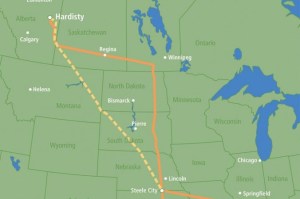
It’s not my intent to hash out the debate over the Keystone XL, which has enjoyed a plurality of support among the American electorate. The truth is, as the President said in his recent announcement, the proposed 1,179-mileKeystone XL, which would have carried 800,000 barrels of crude per day, has had “an overinflated role in our political discourse.”

The proposed path of the Keystone XL Pipeline. Click to enlarge.

The proposed path of the Keystone XL Pipeline. Click to enlarge.

Montana’s elected leaders are understandably concerned about the impact of Obama’s decision on jobs. Since the project would cut through Montana, some of those jobs would go here, but the Keystone XL would not be a long-term job creator. Most of the work would be in the construction phase — about 3900 temporary construction-related jobs during the two-year implementation period, plus additional spinoff economic benefits. After construction is completed, the Keystone would only produce about 50 permanent long-term jobs. Compared to the remarkable 271,000 new jobs created in the United States economy in October of this year alone, it’s not a huge number.

And the concerns of environmentalists are less about the pipeline itself than what would be transported through it. The oil would come from Alberta’s tar sands. It is dirty, thick crude oil that is energy-intensive and produces a significant amount of carbon emissions. Critics say that Keystone XL will elevate greenhouse gas emissions and contribute to climate change by encouraging expansion of the tar sand development. Also, if it leaks, the oil is corrosive and difficult to clean up. But according to the US State Department, the Keystone XL is “unlikely to significantly impact the rate of extraction in the oil sands” because Canadian officials and oil producers vow that the oil will be extracted and reach the American marketplace by other means if the pipeline is not constructed.

Man in the Moon leadership needed
But the big difference between the President and Montana’s elected leaders was the tone of their responses. Bullock, Zinke, Daines and Tester spoke mostly about jobs and economic factors —  short-term impacts that would directly affect their constituents.

Obama’s reasoning was at a different level — visionary and long-term: “America’s now a global leader when it comes to taking serious action to fight climate change,” Obama said. “And frankly, approving this project would have undercut that global leadership. And that’s the biggest risk we face — not acting.” His focus was on sending a message to the rest of the world in advance of the upcoming Paris Conference of the Parties (COP21) to the United Nations Framework Convention on Climate Change.

The message was that the United States will lead by word and action in combating climate change, focusing on both the demand and supply for fossil fuels. Regardless of the magnitude of the Keystone’s impact, moving forward on that pipeline would undercut our global leadership. If the Paris meetings are going to generate a major international agreement, the US needs to be seen as a strong and unequivocal leader

This is the level of leadership that Montana is missing. We expect that our elected leaders will fight for jobs and economic development in Montana, and they did that in their opposition to the Keystone XL. But we also expect that they will not push for short-term jobs at the expense of long-term viability.

Montana needs to transition its economy and energy grid away from fossil fuels to renewables. We need visionary leaders, who will become “Man on the Moon” leaders who will show a path to the future of energy in the state. On that scale, our elected leaders continue to fall short.

And, to close on a lighter note, here’s what Stephen Colbert had to say about the Keystone XL and climate change:

Posted in Community Organization, Politics and History | Tagged , , , , , , , , , | 3 Comments

This is Life with Lisa Ling: Filthy Rich (video)

I’ve been accumulating some information about the Bakken, so this is the first of a few posts on the subject. The posts will have more to do with the impacts of an oil society on communities rather than specific oil and gas issues.

Lisa Ling is a CNN reporter who hosts This is Life, a series of video-magazine stories that take her on a “gritty, breathtaking journey to the far corners of America.” One episode is entitled “Filthy Rich,” and it deals with the life of women in the Bakken.

Lisa Ling's series looks at women in the Bakken

Lisa Ling’s series looks at women in the Bakken

There’s no way to tell exactly, but a best-guess estimate of the ratio of men to women in and around Williston is about 10:1. Imagine — in a town of 40,000 people, that’s fewer than 4,000 women.

The episode opens by focusing on a few women who have been brave enough to come to Williston to seek their fortunes. Their stories are inspiring. They are tough. They learn to deal with intolerable housing, tremendous social pressure and numbing isolation, and, for the few who can stick it out, they are able to find high-paying jobs in service industries, in the oil fields, and in transport.

But the second half of the episode deals with the flip side of the stories of those strong women, and it is frightening. The trafficking industry is a substantial part of life around the oilfields, and the stories of who they are and how they got to the Bakken will make you angry.

When we look at the community cost of giving up our communities to the oil industry for temporary riches, we have to recognize that they are daunting. For every new millionaire there are dozens who wash out, and when the rigs are gone, what is left is less than what was there before.

You can watch the episode below.

http://www.youtube.com/watch?v=8x4x9cSN0pc

Posted in Bakken | Tagged , , , , , , | 2 Comments

American acceptance of climate change growing rapidly, opening opportunities for action

Click to download the study

American acceptance of the problem of climate change and the need for action is growing rapidly. A New National Survey on Energy and the Environment (NSEE) from the Gerald Ford School of Public Policy at the University of Michigan shows acceptance of mainstream science near an all time high. For the first time since 2008, at least 7 out of 10 Americans indicate that they believe there is solid evidence of global warming over the past four decades. This increased level of acceptance of evidence of global warming coincides with the lowest percentage of Americans expressing doubt in solid evidence of global warming in the history of the NSEE.

Key findings of the study:

  1. More Americans than at any time since 2008 indicate that there is solid evidence of increasing temperatures on Earth with 70% of residents now maintaining that view. (Note that this number was 52% as recently as Spring 2010.) Similarly, a record low number of Americans (16%) say that there is not evidence of global warming.
  2.  A majority of Republicans (56%) now believe that there is solid evidence of global warming, up from 47% a year ago, joining solid majorities of Democrats (79%) and Independents (69%). The number of Republicans who state there is no evidence of global warming has fallen from 41% to 26% in the last year.
  3.  Americans who believe there is evidence of global warming are also increasingly confident in their belief, with a record 65% saying they are “very confident” in their appraisal.
  4. Severe drought across many parts of the United States has become the factor most cited by Americans as having a “very large” effect on their position that global warming is occurring. A record 61% of Americans who indicate there is evidence of global warming said severe droughts were having a very large effect on their belief. This number has more than doubled since Spring 2013.
  5. In previous NSEE surveys, large majorities of American who do not believe there is evidence of global warming have pointed to local weather observations as the basis for their position. In the Fall 2015 survey, however, more than a third (34%) of those doubtful of global warming said local weather observation has “no effect” on their views about climate change, the highest percentage in the history of the NSEE.
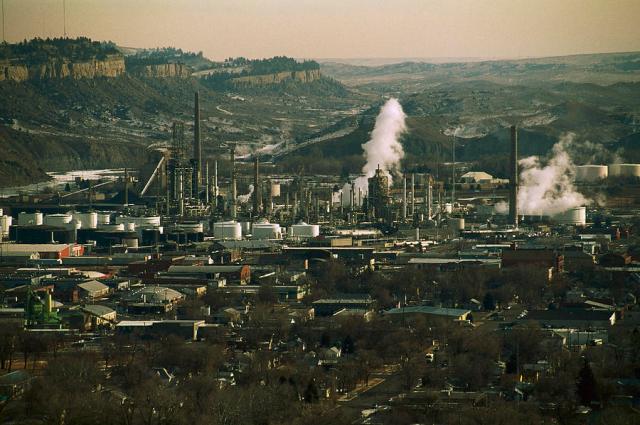
ExxonMobil's Billings refinery has been in operation for the last 65 years. Photo: Gordon Wiltsie

ExxonMobil’s Billings refinery has been in operation for the last 65 years. Photo: Gordon Wiltsie

This dramatic shift in believes about warming has a number of implications for policy and political action:

  • Climate change and policy change will take center stage in the next Presidential election. We have already seen Hillary Clinton adopt an aggressive approach to policy that promotes solar growth and against fossil fuel projects like the Keystone XL, while Republicans like Jeb Bush have energy plans that only promote deregulation of fossil fuels without mention of renewables or global warming. It will be interesting to observe whether the Republican nominee is forced to move their positions as the general election approaches.
  • On a local level, the opportunity to build community support for regulation of fossil fuel activities is increasing. This can have important implications for the efforts to establish citizen initiated zoning in Carbon and Stillwater counties.
  • From November 30 – December 11, 2015, France will be hosting the 21st Session of the Conference of the Parties (COP21) to the United Nations Framework Convention on Climate Change, otherwise known as “Paris 2015.” COP21 is critical, because the nations of the world need to achieve a new international agreement on the climate, applicable to all countries, with the aim of keeping global warming below 2°C.Failure to reach an aggressive agreement to curb carbon emissions will head the world down a dangerous path. Changes in US attitudes will enable President Obama to take a stronger leadership role in the conference. We’ll cover this session in greater detail as the time gets closer.

Dramatic changes in public attitudes toward climate change will force important policy shifts over the coming years. This should galvanize people to action. Change is in the wind.


Posted in Climate change | Tagged , , , , , | 3 Comments

Third edition of fracking compendium includes over 100 new studies on the risks of fracking

The third edition of the Compendium of Scientific, Medical, and Media Findings Demonstrating Risks and Harms of Fracking has just been published by two organizations: the Concerned Health Professionals of New York and Physicians for Social Responsibility (PSR). The compendium is a fully referenced compilation of the evidence outlining the risks and harms of fracking, bringing together findings from the scientific and medical literature, government and industry reports, and journalistic investigation.

Click to download the compendium

Click to download the latest edition of the compendium

The three editions have been released in fifteen months, which reflects the dramatic increase in the number of scientific studies on the impacts of fracking. The second edition, published last December, coincided almost exactly with the state of New York’s decision to ban high volume hydraulic fracturing.

According to the authors, the compendium “continues to exist in a moving stream of data.” Over 100 new peer-reviewed studies on the impacts of fracking have appeared since the 2nd edition was published, and over half of the total available studies that exist on the adverse impacts of shale and tight gas development have been published since January, 2014. The vast majority of these studies reveal problems.

According to a statistical analysis by PSE Healthy Energy:

  • 69% of the studies on water quality found potential for, or actual evidence of, water contamination
  • 88% of studies on air quality found elevated air pollutant emissions
  • 84% of studies on human health risks found signs or indication of potential harm

The compendium points to several “emerging trends” in the literature, which go far beyond those identified in previous editions in terms of risk and certainty:

  1. Growing evidence shows that regulations are simply not capable of preventing harm.
  2. Fracking threatens drinking water.
  3. Drilling and fracking emissions contribute to toxic air pollution and smog (ground-level ozone at levels known to have health impacts.
  4. Public health problems associated with drilling and fracking, including occupational
    health and safety problems, are increasingly well documented
  5. Natural gas is a bigger threat to the climate than previously believed.
  6. Earthquakes are a consequence of drilling and fracking-related activities in many locations.
  7. Fracking infrastructure poses serious potential exposure risks to those living near it.
  8. Drilling and fracking activities can bring naturally occurring radioactive materials to the surface.
  9. The risks posed by fracking in California are unique.
  10. The economic instabilities of fracking further exacerbate public health risks.

The Compendium’s final conclusion (p. 151):

“All together, findings to date from scientific, medical, and journalistic investigations combine to demonstrate that fracking poses significant threats to air, water, health, public safety, climate stability, seismic stability, community cohesion, and long-term economic vitality. Emerging data from a rapidly expanding body of evidence continue to reveal a plethora of recurring problems and harms that cannot be averted or cannot be sufficiently averted through regulatory frameworks.

“In the words of esteemed pediatrician Jerome Paulson, MD, there is ‘no evidence that…fracking can operate without risks to human health….Any claims of safety are based on wishful thinking.'”

It is no longer possible to look at the data and conclude that fracking is safe. Government agencies must act to protect the citizens they represent. If they fail to do so, citizens need to take local action to make sure their communities are protected.

More on this site on this topic:
Two excellent new collections of peer-reviewed scientific data on horizontal drilling
The precautionary principle and the science behind New York’s fracking ban

Download first edition of the compendium (July, 2014)
Download second edition of the compendium (December, 2014)

Update: In November, 2016 the Fourth Edition of the Compendium was published. Download.


Posted in Fracking Information, Health impacts | Tagged , , , , , , , , | Leave a comment

When North Dakota needed a new pipeline, they turned to the company that tainted Glendive’s water supply

Sometimes the news just makes you shake your head.

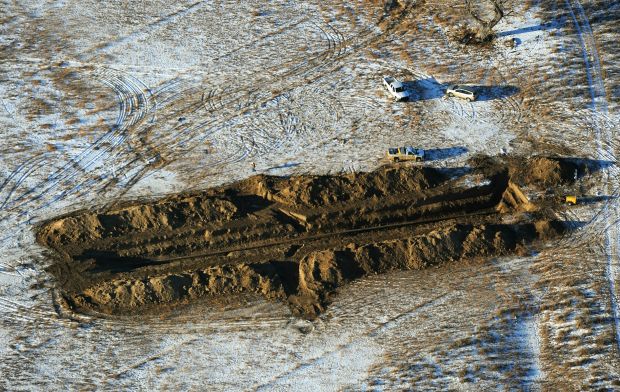
You probably remember Bridger Pipeline, LLC. They’re the company that operates the Poplar Pipeline. That’s the one that ruptured last January, sending 40,000 gallons of Bakken crude into the Yellowstone River, tainting Glendive’s water supply. We reported at the time that the company also operated the Parshall Gathering System, which gathers oil from over 250 wells in North Dakota’s Mountrail County for delivery elsewhere. That system leaked over 5,000 gallons of crude just north of Stanley.

Crews work to clean up spill near Glendive. Photo: Larry Mayer, Billings Gazette

Crews work to clean up spill near Glendive. Photo: Larry Mayer, Billings Gazette

So when the North Dakota Public Service Commission (PSC) needed a company to build a new pipeline, a “key piece of infrastructure” that will stretch 15 miles across Billings and Stark Counties, one that will transport 125,000 barrels per day and connect to an existing pipeline leading to Baker, Montana, who do you think they chose?

You know the answer. Bridger Pipeline LLC.

Fedorchak

Julie Fedorchak

According to PSC Chairwoman Julie Fedorchak, “We had a really thorough discussion about how they plan to operate this and monitor it and the latest and greatest technology they’ll be using, the newest pipe materials and monitoring systems, and I felt comfortable that the company … walked away with some good lessons learned on that (Poplar Pipeline) spill and will be incorporating that in this line.”

Fedorchak said the PSC examined a 10-year leak history from the company, and a control center in Casper that will monitor the new pipeline around the clock.

She said that while the Yellowstone River spill was “a really unfortunate incident,” that pipeline was 60 years old and was trenched under the river. The new $10.4 million pipeline will be bored 30 feet under the intermittent Heart River using horizontal directional drilling.

That explains everything.

Folks, the time has come for local regulation of oil and gas drilling. Local communities need to look out for themselves, because it’s clear that state agencies aren’t looking out for them.


Posted in Bakken | Tagged , , , , | 2 Comments

Watch Josh Fox’s new short film, Gaswork: The Fight for C.J.’s Law, here

Josh Fox, the creator of Gasland and Gasland 2, has released a new short film on the dangers of fracking jobs. The film is entitled Gaswork: The Fight for C.J.’s Law.

You can watch it below.

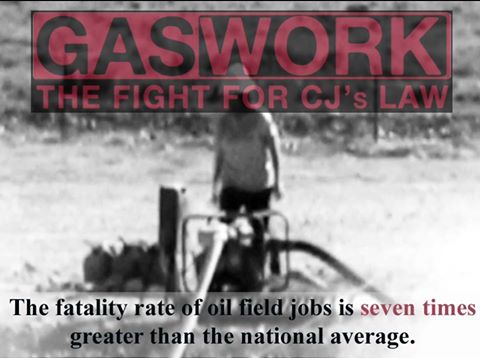
One of the great benefits of oil and gas drilling, according to its proponents, is the creation of new jobs in the communities where drilling occurs. But, according to Fox, many of these jobs are extremely dangerous, exposing workers to chemicals with unknown long-term impacts on human health. The fatality rate of oil field jobs in seven times greater than the national average.

Fox’s new film investigates worker safety and chemical risk. It follows Charlotte Bevins in her fight for CJ’s law, a bill to protect workers, named for her brother CJ Bevins, who died at a drilling site.

The film interviews workers who have been asked to clean drill sites, transport radioactive and carcinogenic chemicals, steam-clean the inside of condensate tanks which contain harmful volatile organic compounds (VOCs), and have been told to do so with no safety equipment.

Oil and Gas industry response
The oil and gas industry has responded quickly. They were hurt badly by the public outrage generated by Fox’s earlier films. According to a new study published in the October print issue of American Sociological Review, “screenings of Gasland in different locations had an effect on the mobilization of local campaigns agains the controversial practice of hydraulic fracturing; in turn, those local mobilizations made local policymakers significantly more likely to take action to ban the practice of fracking.”

Just as they produced FrackNation to rebut the claims of Gasland and Gasland 2, they have released GasHoax to rebut Fox’s claims in Gaswork. Phelim McAleer, who made both films, says Gaswork is “a zero credibility film because it comes from filmmaker Josh Fox, who has a history of health hoaxes regarding fracking.”

You can watch McAleer’s film here.

http://www.youtube.com/watch?v=ZGlTs55ywZ

Watch these films, review the evidence on this site about health impacts (including last week’s study on the impact of fracking on pregnant mothers), review the studies themselves, and make your own decisions about the need for regulation to protect workers and residents from the negative impacts of oil and gas drilling.

Gaswork11953038_928013053902560_4302473228596767418_n


Posted in Health impacts | Tagged , , , , , | 1 Comment