New study: Women living near fracked wells have increased likelihood of high-risk pregnancies, pre-term births

A new study in Pennsylvania shows that expectant mothers who live near active natural gas wells are at an increased risk of giving birth prematurely and for having high-risk pregnancies.

The study, published online in the Journal Epidemiology on September 30, looked at the health records of 9,384 mothers who gave birth to 10,946 babies between January 2009 and January 2013. They compared that data with information about wells drilled for fracking and looked at how close they were to the homes of the pregnant mothers as well as what stage of drilling the wells were in, how deep the wells were dug and how much gas was being produced at the wells during the mothers’ pregnancies. Using this information, they developed an index of how active each of the wells were and how close they were to the women.

Key finding:

  • Mothers living in the most active quartile of drilling and production activity had a
    • 40% increase in the likelihood of giving birth before 37 weeks of gestation (considered pre-term) and a
    • 30% increase in the chance that an obstetrician had labeled their pregnancy “high-risk,” a designation that can include factors such as elevated blood pressure or excessive weight gain during pregnancy.

An information age partnership
This study is one of the first results of a remarkable new partnership that we told you about last November. This partnership promises to cut through the secrecy and legal protections that the oil and gas industry enjoys by employing technology, science, and the collaboration of creative scientists and citizen activists all over the world.Photo: Simon Fraser University Communications
Here are the pieces that came together to make this partnership happen:

  • Brian Schwartz

    Brian Schwartz

    Brian Schwartz, an environmental epidemiologist, and a group of researchers at the Johns Hopkins Bloomberg School of Public Health in Maryland were interested in studying the health effects of living near a drilling or fracking site. The most logical state in which to do this is Pennsylvania, where the Marcellus Shale is Ground Zero in the shale revolution.

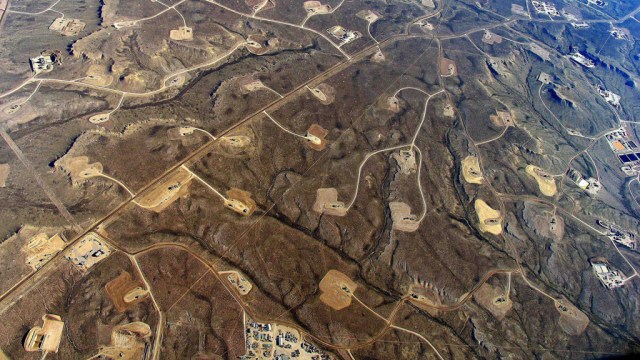
  • There is no public map or dataset of existing drilling sites, so the researchers went to an organization called SkyTruth and its FrackFinder Program, which “maps drilling and hydraulic fracturing (fracking) across the United States using crowdsourced image analysis of aerial and satellite imagery.” In other words, the program trains volunteers to view satellite images and identify drilling sites.
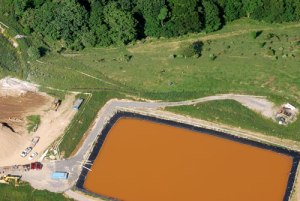
  • To find the sites, volunteers were trained to find impoundments, or ponds, where produced water from fracking is stored. Skytruth asked volunteers to look at aerial imagery of locations where drilling permits had been issued, and respond to very simple questions about what they saw on imagery taken in 2005, 2008, 2010 and 2013. The project used a multi-phased approach to make sure there was no confusion about what was an impoundment and what was a duck pond, a shadow, or a manure lagoon. The images were shown to multiple trained volunteers, and over 70% agreement was required for each site to verify that it was indeed an impoundment.
  • Schwartz and his colleagues then partnered with the Pennsylvania-based Geisinger Health System to “comb through the medical records of more than 400,000 patients across the state. They’re looking for any correlation between fracking sites and increased respiratory and neonatal health problems. Between the patient demographic information that exists in the electronic health records and the satellite location of the identified waste water ponds, they’ll be able to determine the exact distance between each patient and a drilling site. Geisinger had previously announced a plan to use their own 10-year database of electronic health records to map health trends before and during drilling. The database includes more than 2.6 million residents in a region that has some of the highest concentrations of fracking wells in the United States

impoundment-81The beauty of this is that the oil and gas industry has depended for years on keeping secrets. They come into a community and rely on spreading fear, uncertainty and doubt. They purchase loyalty and silence, and work to encode this in the law. One of their tools is secrecy about well locations, which is a barrier to research.


Possible environmental factors in study outcome
The study is still not a “smoking gun” that explains why the pregnant women had worse outcomes near the most active wells. But Schwartz points out that every step of the drilling process has an environmental impact:

  • When the well pads are created, diesel equipment is used to clear acres of land, transport equipment and drill the wells themselves.
  • Drilling down thousands of feet and then horizontally many more thousands of feet requires heavy equipment to break up the shale where the gas sits.
  • Hydraulic fracturing (fracking) then involves injecting millions of liters of water mixed with chemicals and sand to fracture the shale.
  • The fluids are then pumped back to the surface.
  • The gas itself also releases pollutants.
  • Wells cause increased noise, road traffic and other changes that can increase maternal stress levels.

Schwartz speculates that air quality and stress are the two leading candidates for the results of the study, and points out that policymakers must understand there may be real risks as they make decisions on future wells. While the research is still in its infancy, Schwartz says everything that has come out so far should give decision makers cause for concern.

“The growth in the fracking industry has gotten way out ahead of our ability to assess what the environmental and, just as importantly, public health impacts are,” says Schwartz. “More than 8,000 unconventional gas wells have been drilled in Pennsylvania alone and we’re allowing this while knowing almost nothing about what it can do to health….The first few studies have all shown health impacts. Policymakers need to consider findings like these in thinking about how they allow this industry to go forward.”

This is exactly why we need local regulation along the Beartooth Front
These findings directly relate to local regulation proposed by landowners in Stillwater and Carbon counties along the Beartooth Front. These regulations  address the issues raised by Schwartz as possible causes of adverse health outcomes:

  • setbacks of wellheads from residences, which increases the distance that people live from fracking sites
  • Testing of water, air and soil to make sure they are not contaminated
  • Noise abatement
  • Limits on truck traffic

The regulations are just common sense, and protect local residents from the proven dangers of living in close proximity to oil and gas drilling.

Posted in Uncategorized | Tagged , , , , , , , , , , , , | 1 Comment

“SLAPP suit” attempts to intimidate organizations protesting local oil and gas zoning

What happens in other oil and gas states is often instructive for us in Montana. The oil and gas industry constantly works to develop new legislative, legal and business strategies to try to control drilling without interference from landowners. Strategies that are successful get exported to other states. States that are farther ahead in the shale revolution, where these strategies have already been used, can teach us about the ways of the industry and how it works to keep landowners in check, and how these strategies might be used here.

In Texas and Oklahoma, for example, we have seen successful legislative strategies to keep localities from having any say in the regulation of oil and gas drilling. We know that this is now a national strategy that the industry will try to implement elsewhere. In Montana and other states we have seen oil money from outside the state funneled in to try to pack the courts with pro-oil ideologues. In Pennsylvania, we have seen Energy Corporation of America successfully sued for systematically underpaying royalties to lease owners.

Corporate landowners sue environmental organizations for protesting
So it is of particular interest that, in Pennsylvania, a corporate landowner and twelve individual landowners who have leased their shale gas drilling rights to an oil and gas operator have filed suit against environmental organizations that oppose the drilling.

Defendants' attorney Vic Walczak. Photo: Darrell Sapp/Pittsburgh Post-Gazette
Defendants’ attorney Vic Walczak argues in court that this is a SLAPP suit intended to intimidate environmental groups. Photo: Darrell Sapp/Pittsburgh Post-Gazette

Rex Energy has proposed drilling six shale gas wells about a thousand yards from a local school. The three-member Middlesex zoning hearing board, all of whom have leased shale gas under their properties to drilling companies, approved new zoning rules in May that would allow these wells and open up more than 90 percent of Middlesex Township to shale gas drilling.

The lawsuit claims that appeals by drilling opponents, including the Delaware Riverkeeper Network and the Clean Air Council, both statewide environmental organizations, are “a sham” and “frivolous.” The plaintiffs seek punitive damages and costs totaling more than $500,000 for the alleged contractual interference and civil conspiracy.

Attorneys for the environmental groups have argued that the suit is a “SLAPP suit” — a strategic lawsuit against public participation — targeting individuals and groups for participating in public debate on government policies and the legal appeals of those policies.

SLAPP suits
According to Wikipedia:

“A strategic lawsuit against public participation (SLAPP) is a lawsuit that is intended to censor, intimidate, and silence critics by burdening them with the cost of a legal defense until they abandon their criticism or opposition.

“The typical SLAPP plaintiff does not normally expect to win the lawsuit. The plaintiff’s goals are accomplished if the defendant succumbs to fear, intimidation, mounting legal costs or simple exhaustion and abandons the criticism. In some cases, repeated frivolous litigation against a defendant may raise the cost of directors and officers liability insurance for that party, interfering with an organization’s ability to operate. A SLAPP may also intimidate others from participating in the debate. A SLAPP is often preceded by a legal threat.

Courtesy lawcomix.com

How SLAPP suits work. Courtesy lawcomix.com

“There is a difficulty in that plaintiffs do not present themselves to the Court admitting that their intent is to censor, intimidate or silence their critics. Hence, the difficulty in drafting SLAPP legislation, and in applying it, is to craft an approach which affords an early termination to invalid abusive suits, without denying a legitimate day in court to valid good faith claims. Thus, anti-SLAPP laws target tactics used by SLAPP plaintiffs. Common anti-SLAPP laws include measures such as penalties for plaintiffs who file lawsuits ruled frivolous and special procedures where a defendant may ask a judge to consider that a lawsuit is a SLAPP (and usually subsequently dismiss the suit).”

There is no federal law against SLAPP suits, although 29 states have enacted anti-SLAPP laws. Montana is not one of them. Montana also doesn’t have any setback laws that would protect schools like the ones in Middlesex Township from winding up in the shadow of a well pad.

Update. Suit dismissed…for now
Since I started writing this post, plaintiffs’ lawsuit was dismissed for lack of specificity and for failure to associate various allegations with specific defendants. Although defendants’ attorneys are claiming that this is “a victory for the First Amendment and for the right of all Americans to speak their minds on important issues,” Plaintiffs were given 20 days to amend their complaint. (For those of you wanting to track this, the case is Dewey Homes & Investment Properties LLC et al. v. Delaware Riverkeeper Network et al., case number 15-10393, in the Butler County Court of Common Pleas.)

It could happen here
While there haven’t yet been any SLAPP suits relating to oil and gas development in Montana, it doesn’t take much imagination to realize it can happen here. Many of the elements that exist in Pennsylvania

  • Insufficient regulation of oil and gas. The primary topic that we cover on this site is the lack of regulation that exists at the state level in Montana. The lack of regulation means that environmental groups and landowners are required to fight oil and gas operators because state institutions fail to reign in their activities. Examples:
  • Apparent conflicts of interest among government officials. In Pennsylvania, the three members of the local zoning board who approved the zoning changes had already leased their properties to gas operators and stood to profit from their zoning decision. In Montana, some government officials who have the authority to approve citizen initiated zoning are also owners of mineral rights that enable them to profit from oil leases. In Stillwater County, for example, at least on County Commissioner is a mineral rights owner and has active oil leases on her property. This certainly creates at least an appearance of a conflict of interest.
Posted in Fracking Information | Tagged , , , | Leave a comment

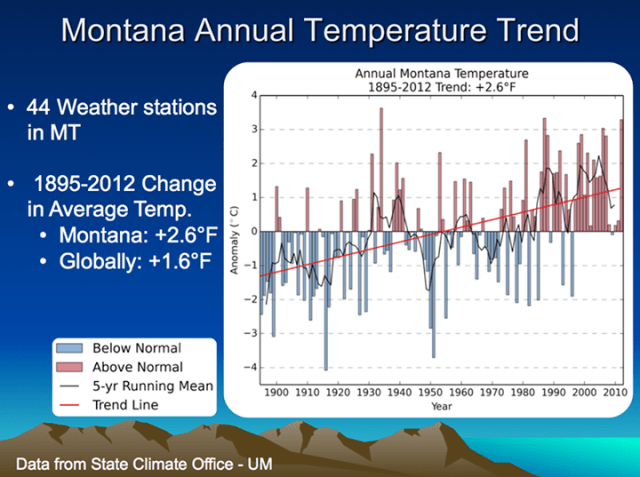
Montana temperatures have risen 2.6° over the last century

This chart is from the Montana Climate Office at the University of Montana, courtesy of Montana Environmental Information Center (MEIC) Facebook page.

This chart represents a statistical analysis of temperatures in the state from 1895-2012. The red trend line shows that average temperatures in the state have increased 2.6°, compared to 1.6° globally. The increase is most dramatic after 1990. In 23 years since that time, only four years have been below normal.

It is stunning that our representatives in Congress continue to deny the human causes of climate change. Are you listening Steve Daines?

Oil and gas development is directly linked to climate change. We need leaders who will establish a vision for change.

Montana Annual Temperature Trend

Posted in Uncategorized | Tagged , , , | Leave a comment

Montana Supreme Court agrees to hear Silvertip zoning case

We’ve often said that the road to progress on oil and gas issues is long, so it’s nice to get small victories along the way.

The Montana Supreme Court this month denied a motion to dismiss the Silvertip zoning case by the Carbon County Commission. The decision allows the case to continue and be heard by the Supreme Court in early 2016.

The Montana Supreme Court.

The Montana Supreme Court will hear the Silvertip landowners’ appeal of Judge Blair Jones’ ruling early in 2016

Case background
In 2014, a group of Belfry landowners petitioned the Carbon County Commissioners to grant the protections of citizen zoning after Energy Corporation of America announced plans in October 2013 to hydraulically fracture 50 wells along the Beartooth Front, an area that includes Carbon and Stillwater counties in Montana and forms the northeastern flank of the greater Yellowstone ecosystem. Mork boasted that ECA hoped to bring “a little bit of the Bakken” to the Beartooths.

The group sought to establish the Silvertip Zoning District, which would include nearly 3,000 acres of agricultural land north of Belfry. Montana law empowers landowners to initiate the development of zoning regulations for the protection of their land and community by petitioning their county commissioners to establish planning and zoning districts.

After initially approving the district, the Commissioners last January voted to deny the zone. The Commission’s rejection was based on the opposition of certain neighboring landowners under a provision of the law that the plaintiffs argue is unconstitutional.

In February of this year, the petitioners filed a legal challenge to the Carbon County Commission’s decision to reject their petition.  In a narrow ruling, Judge Blair Jones on July 8 dismissed the lawsuit without ruling on the merits of the landowners’ legal challenge.

In August, the Silvertip landowners appealed a ruling in a lawsuit they filed to assert their rights to protect their land against the harmful effects of oil and gas drilling. The appeal will go to the Montana Supreme Court.

The opening brief for the Silvertip landowners is due on November 18. The response of the Carbon County Commissioners and the protestors will be due on December 18, and the Silvertip landowners will submit a reply brief by January 4.

We will keep you updated on the schedule of the actual hearing before the Supreme Court.

Worth fighting for

Worth fighting for

You can read documents related to the case below:


Posted in Legal | Tagged , , , , | 5 Comments

Shell folds in Arctic as Obama wins a big bet

Royal Dutch Shell announced Monday that it has abandoned its Arctic search for oil after failing to find enough crude to justify the cost of continued investment. Shell has spent about $7 billion on exploration in the waters off Alaska so far and said it could book losses of up to $4.1 billion for pulling out of the Chukchi Sea for the “foreseeable future”.

As we recently described on this site, Arctic drilling has been a bone of contention between environmentalists concerned about the substantial risks of drilling, and pro-drilling forces who argue that, because the Arctic Ocean contains 20% of the world’s undiscovered oil, Arctic reserves could replenish a diminishing supply from the Bakken and other US shale fields.

Click to enlarge

Click to enlarge

In August the US Department of the Interior issued a permit to Shell to drill an exploratory well into oil-bearing zones in the Arctic Ocean, contingent on the company meeting strict environmental standards.

As he headed out on his recent trip to Alaska, President Obama described the rationale for the decision this way:

Now even as we accelerate this transition (to clean energy), our economy still has to rely on oil and gas. As long as that’s the case, I believe we should rely more on domestic production than on foreign imports, and we should demand the highest safety standards in the industry – our own.

The decision to close up shop in the Arctic is not totally surprising, given the currently-depressed state of the oil market. According to the New York Times,

Investors and industry executives questioned the wisdom of Shell’s spending heavily and putting its reputation at risk — especially with oil prices having fallen over the past two years from $110 per barrel to below $50 per barrel.

Stopping drilling in offshore Alaska is a major disappointment for Shell, whose executives thought they had locked up a potentially huge trove of oil there. In July, Ben van Beurden, Shell’s chief executive, said that the area where the company was drilling in the Chukchi Sea, 150 miles offshore, “has the potential to be multiple times larger than the largest prospects in the U.S. Gulf of Mexico.”

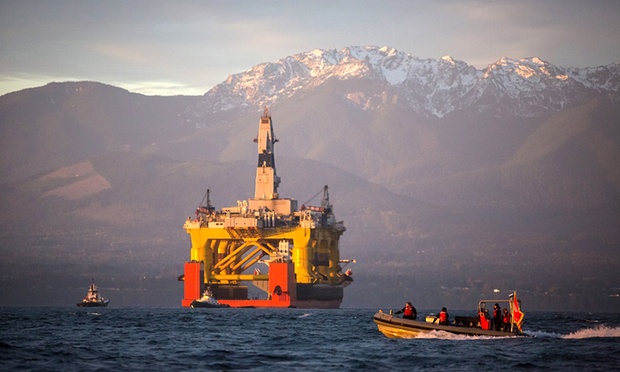
The Transocean Polar Pioneer, a semi-submersible drilling unit leased by Shell, was used to explore Arctic deposits. Photograph: Daniella Beccaria/AP

The Transocean Polar Pioneer, a semi-submersible drilling unit leased by Shell, was used to explore Arctic deposits. Photograph: Daniella Beccaria/AP

A victory for Obama
You have to score this one as a major victory for Obama, who likely anticipated that Shell was not going to be able to justify continued drilling activity when the permits were granted. He took considerable criticism from environmental groups like Greenpeace, who charged “We think it’s deeply hypocritical for a president who’s done so much for the climate, to see him do something that could undo that is a real tragedy.”

The President plays the long game, and he picks his battles carefully. He chose not to fight this one, but the ultimate outcome should satisfy his environmental critics without angering the oil and gas industry.

That’s good politics.

Posted in Politics and History, Uncategorized | Tagged , , , | 1 Comment

A personal story: Dennis Johnsrud, Williston, ND

Personal stories
Today’s post is one of a series of personal stories on this site about how the shale oil and gas boom has affected the lives of the people in the communities that are touched by drilling. It was written by reporter Renee Jean, and first appeared in the Williston Herald on September 26, 2015.

Renee Jean

Renee Jean,         Williston Herald

The experience of farmer Dennis Johnsrud provides clear evidence of the need for greater local regulation of oil and gas operators. We have shown often that, even more than North Dakota, the state of Montana largely ignores personal property rights, and provides few protections for water, air, soil and land. Without local regulation, communities risk long-term declines in standard of living, lower educational attainment and higher crime rates.

A personal story: Dennis Johnsrud, Williston, ND
The first thing Dennis Johnsrud hears anytime a pipeline company wants to site a line on his property is that they are there to ‘work with the farmers.’

“It’s a red flag to me now,” Johnsrud says on a fair-weather Thursday afternoon in a wheat field full of golden stubble. “The last 10 guys said that, and it never happened.”

There is a trail of broken promises tracking through Johnsrud’s fields. He says he’s telling his story because, if farmers won’t speak up, the story will only be told by the other side, and no one will realize the realities farmers are facing in an economy that is increasingly harsh and unforgiving to the families who have shepherded this land for generations.

Johnsrud’s grandfather came to America in 1906 and dug a hole in the ground roofed by a shack. That’s where he lived for five years, proving out his land.

“It took solid people to settle this 109 years ago,” he said. “That’s what really built this community.”

Dennis Johnsrud's son standing in a hole that’s opened up in a field where a pipeline was put in. “They always say, we’ll pack the trench,” Johnsrud said, shaking his head,. “I don’t think so.”
Dennis Johnsrud’s son standing in a hole that’s opened up in a field where a pipeline was put in. “They always say, we’ll pack the trench,” Johnsrud said, shaking his head,. “I don’t think so.”

Broken promises
Among the areas Johnsrud visits in this trail of broken promises is a pig launcher sited in the middle of a field he farms for a property owner. Their families have been friends for more than 90 years.

The owner had given a company permission to put the pig launcher on an adjacent tract in an end corner, where it wouldn’t have posed Johnsrud’s combining activity much issue. A stake with white tape fluttering in the breeze marks a spot near where the launcher was supposed to go.

The company simply ignored the property owner’s wishes, Johnsrud said, and decided to ask for forgiveness later, so they could put the launcher wherever they wanted it.

Johnsrud said the company did the same thing on land he owned, but as the landowner, he could insist it be taken out. On rented land, he had no such authority. He did advise the landowner, who is a friend, to require additional compensation.

“I didn’t get any of that money,” Johnsrud said. “But at least they had to pay some damages for doing that.”

To farm that area, Johnsrud has to go around it three times with a combine. Maybe that wouldn’t be a big deal. Just one little spot. Except that it’s happening all over his fields. One of his largest fields is now six smaller ones.

The company that put in the pig launcher now wants a road to it. Yet more division for that field — and less yield.

One big field is now two smaller ones
“This is all in the middle of what used to be one big field,” he says. “Now it’s two smaller fields, and it takes more time to combine. That’s all non-productive time with big equipment.”

Big equipment uses a lot of fuel. Spread that time out over all the acres, and it begins to add up to a lot of extra fuel.

Johnsrud estimates he’s spent $7,000 extra in fuel to smooth over pipeline issues in fields that he cannot get any help with. That’s not counting the extra spent for going around above-ground structures.

In another area of this same field lie some bare stretches where sterilant has painted abstract, dark fingers into golden stalks of wheat stubble. The sterilant was sprayed onto a nearby well pad to prevent growth of weeds, but it’s running off, down into the most productive areas of the field.

“It runs off into fields and kills whatever is growing,” Johnsrud explains. “There’s never been a washout here before, but now we have one.”

Near this newly washed-up area, there’s also a bowl in the dirt, probably 20-feet in circumference and a foot or two deep.

“When the dirt compresses, you can put it back in a hole, but you never have enough to fill the hole again,” Johnsrud says. “They are starting to recognize that and haul in black dirt. But a lot of times, they just come in and blade it so it looks nice and flat. But really, all it’s done is, you’ve stolen dirt to fill your low spot from other areas of the field. And then nothing will grow in that spot still yet, because the soil structure has changed. It packs differently, and basically, it won’t fill the hole any more either.”

This type of caving in can create dangerous dips in the field. When a combine header goes over that, it rocks up, then slams into the ground with some force, even if a driver was going at a modest pace. And if there are rocks in those dips …

“Whenever a pipeline is being laid, they tell you they will pick the rocks out, but the reality is, they drive over and cover as many as they can. The first time you seed it, those rocks will come up,” Johnsrud says. “So you have dips like that, and you run your header into it. It bounces down, and then the rocks run up into it. That’s really bad. These bother me more than almost anything else.”

Johnsrud flips through his iPhone and shows a picture of his son, standing in a hole that’s opened up in a field where a pipeline was put in.

“They always say, we’ll pack the trench,” Johnsrud said, shaking his head, holding up the phone. “I don’t think so.”

Holes like that are particularly dangerous. They may not be visible once a crop is tall, and can easily destroy the unsuspecting six-figure implement that runs over it — not to mention the risk to the unsuspecting driver.

Johnsrud flips to another picture showing a cable, about as thick as an arm, sticking straight up in the air two feet — about the same height as a crop. It was a dead electrical line, so the workers preparing the land for the pipeline had cut it, as allowed, and chopped it up. But then they left that piece behind.

“If you didn’t notice that and it got into the header?” Johnsrud shakes his head. “Why would you leave something like that? Well, I know they have help problems, too. Anything out there like that, we usually just take care of it ourselves because it’s hard on equipment and the fuel efficiency is a big issue.”

North Dakota ombudsman program provides some assistance
These types of problems have been compounded by a confused criss-crossing of lines. A criss-cross that has been sold and sold again to new companies, making it difficult for a lay person to track down any responsible party.

Whenever Johnsrud calls a company he thinks owns a line, most of the time he’s told he’s called the wrong party — even if he knows he’s called the right one. That’s one reason he is glad the state has finally started a pipeline program to help farmers with these issues. Now farmers have someone to call and help them resolve some of these issues. Ombudsmen are located in Williston, Velva, Glen Allen, Minot and Bismarck.

“That ombudsmen program works,” Jonsrud said.

His son brought the ombudsman stationed in Williston out to a field in the spring when a pipeline company he called was unresponsive. The ombudsman brought a pipeline representative to view the problem. In front of the ombudsman, Jonsrud said, the pipeline representative chastised Dennis’ son for not calling sooner.

“Wait a second,” he told him. “I called you two weeks ago and got no response, and I called you last week and got no response.”

Johnsrud said the pipeline representative got a bit sheepish then.

Some of the fields Johnsrud farms happen to be on a pipeline corridor, so they have had to deal with a larger share of pipeline issues than some.

“My neighbor probably has less than 20 miles of pipelines,” Johnsrud said. “I’m probably dealing with three times that amount. And some of it is on land I don’t own but am farming for someone else.”

To give some idea of the magnitude, he points to an area one-half mile by one-half mile.

“That probably has 4 miles of pipeline running through it,” he says.

As a renter, he’d have some legal rights to related damage money to help pay for costs to fix problems, but he believes the farmer who insists on getting such compensation — or even goes to court for it — may not have land to farm the next year.

“You do your best to try to get along and try to get these things resolved,” Dennis Johnsrud said. “You try to be the problem-solver.”

Posted in Bakken, Personal stories | Tagged , , , , , | 2 Comments

Well blowout near Watford City; this could be your 15 acres

Oil drilling is a dirty business. Well blowouts like this can occur anywhere.

Doesn’t it make sense to have appropriate regulations in place to make sure your property is protected when the inevitable occurs?

From Reuters:

A North Dakota oil well owned by Exxon Mobil subsidiary XTO Energy blew out on Saturday, leaking more than 550 barrels (23,100 gallons) of crude, some of which left the wellpad and seeped into surrounding grasses.

xto oil spillThe well, located in a rural area 25 miles southeast of Watford City, was being hydraulic fractured when its pressure control valves failed and it leaked the oil and about 110 barrels (4,620) of saltwater, according to state and company officials.

The well was brought under control on Sunday morning. No one was injured.

“We are working to understand the cause,” XTO spokeswoman Suann Guthrie said on Monday. “We are very sorry this incident has occurred.”

The company’s emergency response responded to the leak, and local officials were notified. XTO said it has begun cleanup at the site.

The well, Deep Creek Federal 43X-5D, is located on the same drilling pad as four other wells and was first drilled on April 25, according to state data.

According to environmental scientist Bill Seuss, the impacted area appears to be about 15 acres, or an area the size of 15 football fields. He says the state is working with the company on a remediation plan.

Related:
Shhh! Bakken Oil Spill is on “confidential status”

There have been 66 oil spill and eight oil-related fires in Montana so far this year

Salt water spills require local regulation to protect farmers and ranchers

Poplar pipeline spill another reminder that we need to keep fighting for the long-term sustainability of our communities

A personal story: Linda Monson, Yellowstone River southwest of Williston, North Dakota


Posted in Uncategorized | Tagged , , , | 1 Comment

The regulation of Arctic Ocean drilling, with implications for the Beartooth Front

President Obama heads off to Alaska this week, and climate change is at the top of his agenda. His comments regarding offshore Arctic oil drilling in particular provide important food for thought for those of us along the Beartooth Front.

The extent of global warming in Alaska
If there is a US front in the battle against global warming, it is Alaska. The changes happening in that state are enormous, with dramatic implications for that area:

  • Since Alaska became a state in 1959, temperatures across the state have increased by an average of 3.4°F. Winter warming has been even greater, rising by an average of 6.3°F.The rate of warming in Alaska was twice the national average over that same period of time. Average annual temperatures in Alaska are projected to increase an additional 3.5 to 7°F by the middle of this century.
  • With this clear evidence that the Arctic is warming faster than the rest of the planet, the Intergovernmental Panel on Climate Change (IPCC) has predicted that most of the permafrost in the state will disappear this century. Permafrost is the frozen ground located one to two feet below the surface in cold regions (and 80% of Alaska), and this loss will have substantial impacts on transportation, forests, ecosystems, and the economy. The situation has gotten so bad that some native communities, including the little town of Kivalina on the Chukchi Sea, may now have to be relocated because of the dangerous loss of land to the sea.
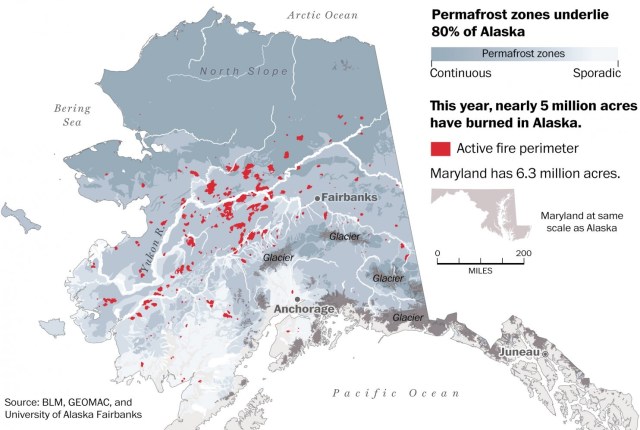
  • Alaska had its worst wildfire season in recorded history in 2015, and has experienced its three worst wildfire seasons in the last eleven years. This is remarkable not only because Alaska has 17% of the forests in the United States and over 5 million acres burned in 2015, but because the extent of these fires causes additional permafrost melting.
Alaska wildfires as of July 26, 2015 in relation to permafrost areas. Source: Washington Post

Alaska wildfires as of July 26, 2015 in relation to permafrost areas. Source: Washington Post

Oil drilling in the Arctic Ocean
This is the context for the controversial issue of drilling for oil and natural gas in the Arctic Ocean. On August 17, the Interior Department issued a permit to Shell to drill an exploratory well into oil-bearing zones in the Arctic Ocean, providing the company a long-sought victory. The permit infuriated environmentalists, escalating a long battle with President Obama over his administration’s climate and energy agenda.

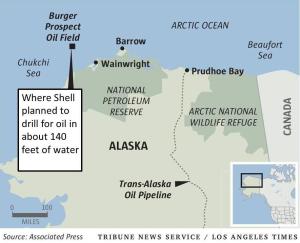
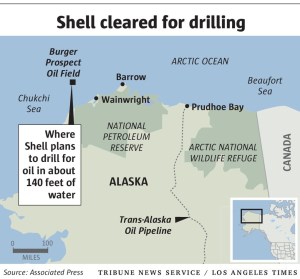
Location of Shell permits. Click to enlarge

Location of Shell permits. Click to enlarge

If Shell discovers oil or natural gas, it must apply for additional permits to produce the oil, a process that could take a decade or more. Shell has been pursuing drilling in the Arctic Ocean since 2007, though hasn’t yet discovered any oil or natural gas.

The potential benefits of drilling are substantial. The Arctic Ocean, including both the Chukchi and Beaufort seas, is estimated to contain 34 billion barrels of reserves, at least 20% of the world’s undiscovered crude oil and natural gas. These reserves are relatively close to the surface. More than 50% of the Chukti Sea is less than 200 foot deep. Further, Arctic reserves could replenish a diminishing supply from the shale fields of North Dakota, Texas, and other US fields, which will begin declining over the next decade.

But the dangers are great. The Chukchi Sea is one of the most dangerous places to drill for oil in the world. A spill there could be even more disastrous than the Deepwater Horizon in the Gulf of Mexico in 2010.

If a spill were to occur, it would be very difficult to reach. The closest U.S. Coast Guard base is 1,000 miles away from where Shell is exploring. There are no roads. The nearest deepwater port is hundreds of miles away. In winter, a spill would be even more disastrous. Winter storms, frigid waters and 50-foot-high waves are common in the area. Oil trapped beneath the ice might migrate long distances. There would be virtually no way to clean up or contain the spill.

Department of Interior regulations of Arctic Ocean drilling
The regulations established by the Department of the Interior before the exploratory permit was granted are rigorous:

  • All phases of Shell’s offshore Arctic program – preparations, drilling, maritime and emergency response operations – must be integrated and subject to strong operator management and government oversight, as detailed in Shell’s Integrated Operations Plan;
  • A shortened drilling season is established in the regulations to allow time for open-water emergency response and relief rig operations late in the drilling season before projected ice encroachment;
  • The capping stack must be pre-staged and available for use within 24 hours;
  • A tested subsea containment system must be deployable within eight days;
  • Shell must have the capability to drill a same season relief well;
  • The must be a robust suite of measures to avoid and minimize adverse impacts to marine mammals and their habitat, impacts to Native subsistence activities, and other environmental impacts; and
  • Drilling units and their supporting vessels must depart the Chukchi Sea at the conclusion of each exploration drilling season.

Interior will also overhaul federal oversight by restructuring to provide independent regulatory agencies that have clear missions and are better-resourced to carry out their work, while keeping pace with a rapidly evolving industry.

President Obama explains his rationale for supporting Arctic drilling
In his weekly address over the weekend, President Obama spoke directly to the difficulty of this choice. He acknowledge the dramatic pace of climate change in Alaska:

This is all real. This is happening to our fellow Americans right now. In fact, Alaska’s governor recently told me that four villages are in “imminent danger” and have to be relocated. Already, rising sea levels are beginning to swallow one island community.Think about that. If another country threatened to wipe out an American town, we’d do everything in our power to protect ourselves. Climate change poses the same threat, right now.

He discussed the importance of moving to clean energy, and described his administration’s efforts in that area. But he emphasized that we’re not there yet, and we need to continue to rely on fossil fuels, which is why, he maintains, we need to drill in the Arctic Ocean.

Now even as we accelerate this transition, our economy still has to rely on oil and gas. As long as that’s the case, I believe we should rely more on domestic production than on foreign imports, and we should demand the highest safety standards in the industry – our own. Still, I know there are Americans who are concerned about oil companies drilling in environmentally sensitive waters. Some are also concerned with my administration’s decision to approve Shell’s application to drill a well off the Alaskan coast, using leases they purchased before I took office. I share people’s concerns about offshore drilling. I remember the BP spill in the Gulf of Mexico all too well.

(We have) made it clear that Shell has to meet our high standards in how they conduct their operations – and it’s a testament to how rigorous we’ve applied those standards that Shell has delayed and limited its exploration off Alaska while trying to meet them.”

Address transcript

Regardless of where you stand on this issue, you can recognize the difficulty of the choice even if you don’t agree with the decision.

Why this is relevant to the Beartooth Front
Along the Beartooth Front, we do not have the choice to make about whether or not to drill. Although some would prefer on ban on drilling, this is simply not possible, given the importance of traditional sources of energy to the Montana economy and the nature of Montana’s institutions regulating oil and gas.

But this area, like the Chukchi Sea, is a critical environment. A major accident could permanently damage critical rivers, aquifers, or other sources of water. A spill could damage the ecosystem for important species. The area’s economy, which depends on agriculture and ranching, could be threatened.

Just as it would be unthinkable to allow drilling in the Chukchi without substantial regulation, it is unimaginable to consider allowing drilling along the Beartooth Front without safeguards for water, soil, air, and the protection of the livelihoods of our residents.

Appropriate regulation would include:

  • The establishment of setbacks from wells to occupied dwellings or sources of water;
  • Regular testing of water sources near wells for contamination
  • Regular testing of soil near wells;
  • Regular testing of air near wells for fugitive gases;
  • Requirements for well design that would minimize the possibility of spills or seepage of toxins into soil;
  • Noise abatement to reduce noise pollution

These requirements are not built into any Montana regulation. Local regulation through citizen initiated zoning is the only way to get this done.

Posted in Fracking Information | Tagged , , , , , , | 1 Comment

Where is Montana’s “man on the moon” leader?

The power of leadership
On May 25, 1961, President John Kennedy, before a special joint session of Congress, announced the dramatic and ambitious goal of sending an American to the moon before the end of the decade. That speech remains one of the great historical examples of the use of the Presidential bully pulpit.

Kennedy felt great pressure at the time to overtake the Soviet Union in the “space race,” and seized the opportunity to capitalize on excitement over the first American space flight of Alan Shepard a few weeks before.

The speech was a leap of faith. At the time, there was no clear technological path to accomplishing this ambitious goal.

But his leadership brought with it a single-minded governmental dedication to achieve it. NASA projects Mercury, Gemini and Apollo were designed to execute on Kennedy’s vision, and on July 20, 1969, just eight years after Kennedy’s speech, Neil Armstrong stepped off the ladder of a lunar module, declaring, “That’s one small step for a man, one giant leap for mankind.”

The effort it took for Armstrong to descend that ladder ranks with the building of the Panama Canal in peacetime and the Manhattan Project during World War II as the greatest mobilizations of resources for a single project in US history.

Hawaii: Applying the man on the moon principle to energy transformation
The ability of governmental leadership to establish a vision and mobilize resources to carry it out remains a powerful way to achieve important but elusive goals.

This is how it needs to be with the critical goal of transitioning our energy base from fossil fuels to renewables. It is something we must do quickly to curb carbon emissions and prevent climate change. Yet the kind of government resolve required to negotiate the transition from traditional energy sources to modern ones typically gets derailed by conflicts between old industries and new ones.

That’s why it is so exciting to see what the state of Hawaii is accomplishing. Led by the vision of Governor David Ige, the state in May passed House Bill 623, which mandates that Hawaii’s power grids must deliver 100 percent renewable electricity by the end of 2045, just 30 years away.

Hawaii Governor David Ige signs a bill that requires the state's power grid to deliver 100% renewable energy by 2045

Hawaii Governor David Ige signs a bill that requires the state’s power grid to deliver 100% renewable energy by 2045

This week Ige upped the ante by declaring that his administration will not use LNG (liquefied natural gas) to replace the state’s petroleum-fueled electricity plants, but will instead shift entirely to renewables. What’s more important, he was able to make the decision based on the economic argument that LNG will be a more expensive fuel over time, given the plummeting prices of renewables. With that decision, the state can invest in the transition to green energy instead of putting money into retooling electric plants to run on gas.

Like the vision of a man on the moon, Governor Ige’s vision is a leap of faith, driven by a combination of economic, social, and environmental factors:

  • Historically, the state has developed a strong reliance on imported diesel fuel, which means that Hawaiians pay about three times the mainland rates for power.
  • Hawaii has abundant renewable energy resources, including wind, solar, geothermal, hydro, and ocean power.
  • The state will be among the first to feel the devastating impacts of global warming. Most of Hawaii’s economic development has occurred near the water, and projections show that Waikiki, the largest economic driver in the state, will be submerged within a century.

Says Peter Crouch, a power grid simulation expert and Dean of Engineering at the University of Hawaii, “Today I don’t know if we can do it, but without a goal, Hawaii will never get real and grapple with the issues that it needs to in order to get this done.”

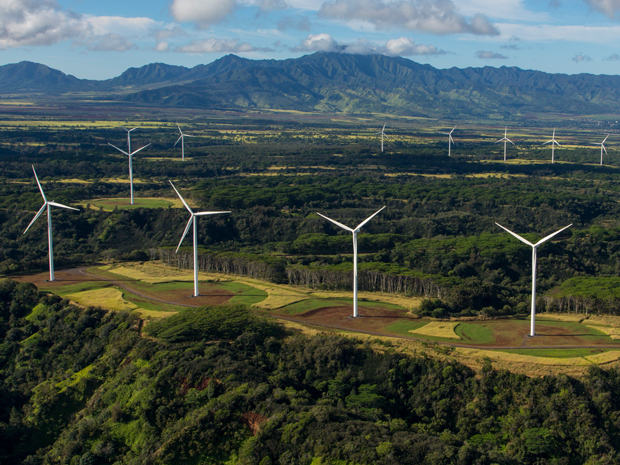
Photo: Douglas Peebles, Corbis

Photo: Douglas Peebles, Corbis

Montana: Man on the moon leadership needed
I’m not going to argue that Montana should be where Hawaii is. All you have to do is step outside your front door on December 25 to know that it’s not Mele Kalikimaka. Hawaii is uniquely positioned to be a first mover on energy. In Montana, fossil fuel extraction has been an essential element of the economy for over a century, and a transition plan as abrupt as Hawaii’s may be too jarring.

But while Montana’s institutions of government are doing everything they can to protect the fossil fuel industry — establishing unnecessary tax holidays, promoting coal exports, protecting the rights of oil companies against Montana citizens — where is the leader who is setting a man on the moon vision?

What we hear from Montana’s leaders are platitudes regarding “all of the above” energy policies without specific plans for the necessary transition of the state’s energy economy.

  • Governor Steve Bullock: ““It’s pretty safe to say it will be an all-of-the-above strategy and making sure that we’re doing it in a way that’s as predictable as possible for energy, but also as responsible as possible for what we enjoy about Montana.”
  • Steve Daines: “Coal, oil and natural gas will continue holding a critical role in powering the world for the foreseeable future. Rather than dismissing this reality, the United States should be on the cutting edge of technological advances in energy development and leading the way in promoting the use of clean, affordable American energy.”
  • Jon Tester:”We need to take effective action on this nation’s energy crisis right way. Specifically, we need to drill more in places where it makes sense like the Bakken Field, crack down on speculators driving up the price of oil and invest now in alternative energy and conservation for the long haul.”

That’s not visionary leadership.

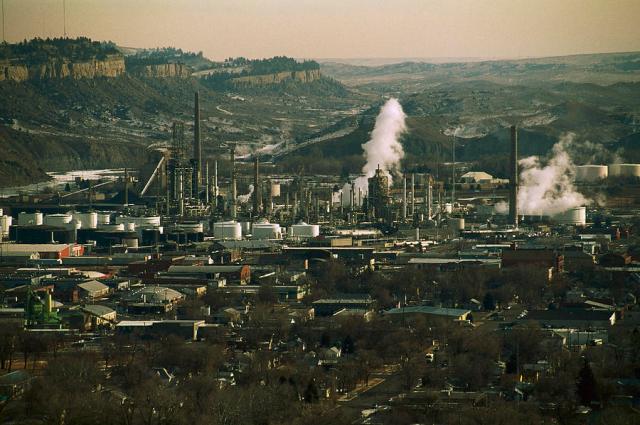
ExxonMobil's Billings refinery has been in operation for the last 65 years. Photo: Gordon Wiltsie

This Laurel  refinery has been in operation for the last 65 years. Will it be in operation in another 50? Photo: Gordon Wiltsie

We need a vision that explains to Montanans how the state will make the required transition from coal, oil and gas to renewables over time. We need a leader who will put a stake in the ground saying what Montana will look like in 20, 30, or 50 years.

That means ruffling feathers. That means offending Big Oil and Big Coal. That means having a grown up conversation within the state about the future of energy.

If that doesn’t happen, where will Montana be in 30 years when Hawaii’s entire power grid is run by renewables? Will we still be propping up dying industries while the state’s economy lags behind?

Where is Montana’s man on the moon leader?

Posted in Community Organization, Politics and History | Tagged , , , , , | 6 Comments

We now have comprehensive data on how much water is required to frack wells. It’s probably more than we have

There were 263,859 oil and gas wells drilled in the United States between 2000 and 2014. Until now we have not had comprehensive data on how much fresh water has been required to drill them.

Click to read article

Click to read article

But now, thanks to a peer-reviewed US Geological Survey study accepted for publication in Water Resources Research, we have comprehensive data on how much water is used to drill hydraulically fractured horizontal wells.

You can read the study by clicking on the graphic at right.

What we now know is that the amount of water required varies widely. The research found that water volumes for hydraulic fracturing averaged within watersheds across the United States range from as little as 2,600 gallons to as much as 9.7 million gallons per well.

The map below shows the average water use in hydraulic fracturing per oil and gas well in watersheds across the United States.

FrackingWaterUseTo read the map I pulled out my handy dandy water measurement converter, and determined that one cubic meter of water = 264.17 gallons. The dark blue category can be read as 2.6 million – 9.7 million gallons. The lighter blue category represents 260,000 – 2.6 million gallons. Nearly all wells drilled in Montana fall into those two categories.

According to the study, the amount of water used to drill wells is steadily increasing. From 2000 to 2014, median annual water volume estimates for hydraulic fracturing in horizontal wells had increased from about 177,000 gallons per well to more than 4 million gallons per oil well and 5.1 million gallons per gas well. Meanwhile, median water use in vertical and directional wells remained below 671,000 gallons per well.

The map below shows the percentage of wells in in oil and gas producing regions that use horizontal drilling. As you can see nearly all of the wells drilled in the Bakken, Powder River Basin, and most other areas of Montana are horizontally drilled.

horizontal_well_percentage_tn

Drilling consumes a lot of water
To summarize what this tells us about water usage for oil drilling in Montana:

  • The large majority of wells in Montana are hydraulically fractured. Based on activity in the surrounding areas and expectations set by drilling companies, we can expect that new drilling activity along the Beartooth Front will involve wells that are most intensive for water use.
  • Hydraulically fractured wells in surrounding areas require substantial amounts of water, in the range of 2.6 million gallons per well.
  • The amount of water required per well is increasing over time.

The next question to consider is whether there is sufficient water availability to meet this demand, should there be a substantial increase in the number of wells.

Water conditions in Montana
While the answer to this question depends in part on the source of water for drilling, there is good public information available on drought and water conditions in the area and throughout the West.

Most of the western United States is experiencing some level of drought. You can see by clicking on the map at right that California and Western Nevada are mired in a long-term exceptional drought, and that extreme drought stretches throughout Oregon, Washington, Idaho and into western Montana.

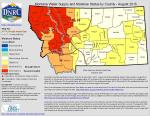
Drought conditions in Montana are most extreme in the western part of the state, but you can see by clicking on the map at left that much of the state is unusually dry. According to meteorologist Mike Rawlins of Great Falls, “60% of the state of Montana is now facing some level of abnormally dry or drought conditions, with 16% in a ‘severe drought.’ This is a dramatic change from one year ago when only 2% of the state was ‘abnormally dry.'”

Stillwater and Carbon counties along the Beartooth Front are not technically in a drought. But water resources along the Beartooth Front remain scarce.

The Surface Water Supply Index (SWSI) is a more complex measure that incorporates both hydrological and climatological features into a single index value for river basins. It includes snowpack, streamflow, precipitation, and reservoir storage into a single number centered on zero, with a range between -4.2 and +4.2. The map below, from the state of Montana web site, depicts the SWSI for all river basins in the state.

Surface Water Supply Index_Aug 15As you can see, the SWSI explains why residents along the Beartooth Front are so concerned about water availability. Both the Stillwater and Clarks Fork Yellowstone basins are extremely dry, with SWSI indexes of -3.8 and -3.6 respectively. (To see this, click on map to enlarge, and look at legend on left. Stillwater is 44, Clarks Fork Yellowstone is 46.)

What it means for the Beartooth Front
We now have clear documentation that shows how much water fracking consumes. It is a large amount, and wells are getting thirstier and thirstier over time.

This has huge implications for the American West, much of which is experiencing some level of drought. In California, which sits on the Monterey Shale and has huge potential oil reserves, the current extraordinary drought, which in parts of the state are the greatest in history, the lack of available water may be enough to scuttle fracking plans.

Montana is experiencing extreme drought also, and the toll on our river basins is significant. As our planet warms, we can expect these drought conditions to get worse.

We also know, based on data from the Bakken and Powder River, that we can expect new wells drilled in the area to be hydraulically fractured. A rough guess, which I invite someone with more expertise to refine, is that new wells drilled along the Beartooth Front would each require about 2.6 million gallons of fresh water.

So when a John Mork comes to Billings and announces plans to drill 50 wells along the Beartooth Front, what he’s saying is that he’s going to need to find 130 million gallons of fresh water to get that done.

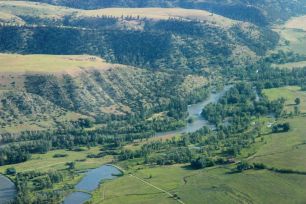
The Stillwater River from my deck. It needs to be protected.

The Stillwater River from our deck. The water level is low.

Now I don’t know where he would get that much, and I doubt he does either. But I would think that knowing where the water’s coming from should be a major factor in determining whether he ought to be allowed to drill the wells.

We’ve learned that the Montana Board of Oil and Gas Conservation, which issues well permits, is not going to ask that question. The Montana Department of Natural Resource Conservation, which controls water rights, will not proactively make that determination.

What needs to happen is that local communities, to protect their water supplies, must regulate how much local water is used to support fracking operations.


Posted in Fracking Information | Tagged , , , , , , , | 1 Comment