Guest editorial by Bonnie Martinell: “Protecting property rights in Montana: You have to do it yourself.”

An edited version of the following guest editorial by Bonnie Martinell of Belfry appeared in the Billings Gazette on Tuesday, August 25. The editorial was also reprinted by Last Best News on August 25.

This month the Montana Board of Oil and Gas Conservation (BOGC) decided not to make rules regarding setbacks of oil wells from occupied buildings. Also this month, a group of my neighbors and I appealed to the Montana Supreme Court to overrule the Carbon County Commissioners and allow us to protect our properties against unregulated oil and gas drilling in the only way possible in Montana, through citizen initiated zoning.

The two are directly related.

The reason, and the ugly truth, is that there is no government agency in Montana that is willing to protect citizen rights if it means standing up to the oil companies. If you want to protect your property in Montana, you’ve got to do it yourself.

Let’s take the BOGC decision not to make rules about setbacks as an example. Montana is pretty much the only oil-producing state not to require setbacks to keep wells from being drilled too close to homes, schools, hospitals and sources of water. Wyoming has them. So do most of the other oil and gas states — North Dakota, Pennsylvania, West Virginia, Texas, Louisiana, Arkansas, Illinois, Michigan, Ohio and many others.

The Board of Oil and Gas deciding to do nothing. Photo: Casey Page, Billings Gazette

The Board of Oil and Gas deciding to do nothing. Photo: Casey Page, Billings Gazette

Steve Durrett, who represents the oil and gas industry on the BOGC says Montana doesn’t need setbacks because in Montana, unlike other states, “anyone can protest any well for any reason, or no reason at all.”

Here’s what that means in reality.

In 2013, Energy Corporation of America CEO John Mork announced his company planned to bring “a little bit of the Bakken” to the Beartooths, and filed for a well permit just a few hundred yards from my home. Weeks in advance of the hearing, working with Carbon County Resource Council, my neighbors and I hand-delivered, mailed and faxed notices to the BOGC that we planned to protest. But the hearing was canceled at the last minute by the BOGC, and the permit was granted.
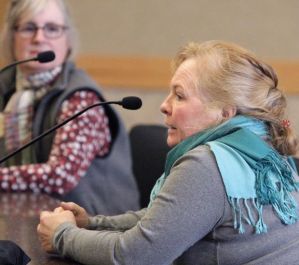
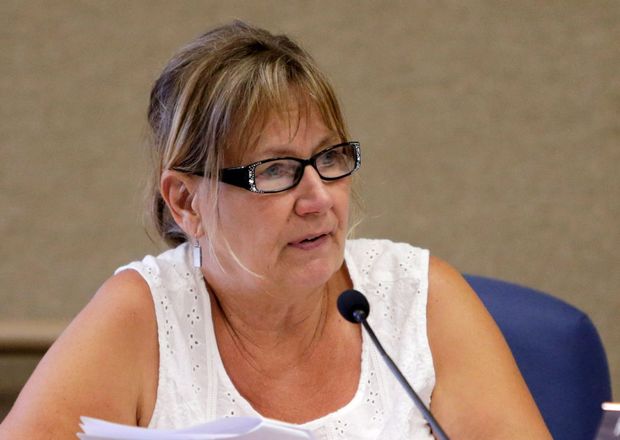
Bonnie Martinell testifying before the Board of Oil and Gas. Billings Gazette photo

Bonnie Martinell testifying before the Board of Oil and Gas. Billings Gazette photo

We had to file suit just to get the permit revoked and a hearing scheduled.

At the hearing, ten of my neighbors testified about their concerns. They provided expert testimony about the risks of the well design. They testified about their concern that the well was being drilled in a stream bank and asked that the well be moved 150 feet from the proposed site. We weren’t asking to stop the well. We just wanted it done right.

The protest fell on deaf ears. One of the BOGC members took us aside after the meeting and told us that we needed to “put up with a few inconveniences” to support US energy independence.

Durrett went on to say that ”the vast, vast, overwhelming majority of these issues are resolved through negotiation between the landowner and the company.” Not really. I have personally witnessed the BOGC use the eminent domain process of forced pooling to require a landowner who owned both surface and mineral rights to accept drilling on his property.

But the BOGC is not by any stretch of the imagination the only branch of government that has no interest in individual property rights.

In the 2015 session, the Montana Senate refused to consider SB177, which would have required setbacks of at least 1000 feet between wells and homes, water wells or surface water. The bill didn’t make it out of committee.

And local governments are no better.

Determined to protect our properties, my neighbors and I took advantage of the provisions in state law allowing landowners to establish zoning districts to protect private property from incompatible commercial and industrial activity. We planned to create rules to establish setbacks, make sure that our water, air and soil were tested regularly to determine if they were contaminated, and require closed loop well design that would protect our property from runoff of dangerous waste.

In compliance with state law, we gathered the signatures of 68% of the landowners in the zone, and presented them to the Carbon County Commissioners, who accepted them and voted to move forward with the zone “in the interest of public welfare, safety, and convenience”. Then, when a minority of our neighbors protested, the Commissioners rescinded their approval, using a provision of law nearly identical to one for another type of zoning that has already been declared unconstitutional. We are hopeful that the Supreme Court will rule in our favor and allow us to set reasonable rules for drilling on our own properties.

One thing we’ve learned over the last 20 months is that protecting your property rights from unregulated oil and gas drilling in Montana takes time, and protections can’t be put in place over night. We certainly can’t depend on any institution of Montana government to protect us. We’ve got to protect ourselves if we’re going to get this right. We’re in this for the long haul, and the time to act is now.

Bonnie Martinell
Belfry, Montana

Posted in Community Organization, Politics and History | Tagged , , , , , , | 5 Comments

Announcing the latest winner of the Rex Tillerson Fracking Hypocrite Award

Rex Tillerson Fracking Hypocrisy Award

The Rex Tillerson Fracking Hypocrisy Award

We here at Preserve the Beartooth Front are pleased to announce the latest recipient of the Rex Tillerson Fracking Hypocrite Award. The Award is a 160-foot water tower, engraved with Rex Tillerson’s photo, delivered to the recipient’s front yard.

We’ve written often about Rex. He’s the CEO of ExxonMobil who publicly complained that “dysfunctional regulation of hydraulic fracturing is holding back the American economic recovery, growth and global competitiveness,” and then joined with his neighbors in a lawsuit to block construction of a large water tower, to be used to support fracking operations, next to his Texas home.

Our first winner was Aubrey McClendon, the ethically challenged former-Chairman and CEO of Chesapeake Oil, who actually stole from farmers to finance capital acquisitions. McClendon later shared the next award with Jeff Wojahn, CEO of Encana Oil and Gas, for a scheme to collude to drive down the price of oil leases in Michigan.

Today’s winner
According to Physics World, a new study shows that increased solar activity has nothing to do with global warning:

A recalibration of data describing the number of sunspots…on the surface of the Sun shows that there is no significant long-term trend in solar activity since 1700, contrary to what was previously thought. Indeed, the corrected numbers now point towards a consistent history of solar activity over the past few centuries, according to an international team of researchers. Its results suggest that rising global temperatures since the industrial revolution cannot be attributed to increased solar activity.

This should be important to Senator Steve Daines, Montana’s highest ranking global warming denier and winner of today’s Rex Tillerson Fracking Hypocrite Award.

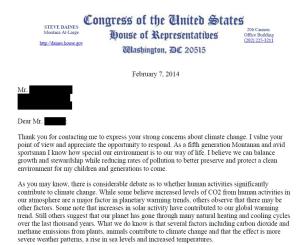
Steve DainesYou see, Senator Daines was thinking maybe warming was caused by the sun. He says in a letter to a Montana voter,  “As you may know, there is considerable debate as to whether human activities significantly contribute to climate change. While some believe increased levels of CO2 from human activities in our atmosphere are a major factor in planetary warming trends, others observe that there may be other factors. Some note that increases in solar activity have contributed to our global warming trend. (Click above to read full letter.)

Senator Steve Daines

Senator Steve Daines

I’ve sent the Physics World article off to Senator Daines. Maybe now he can come to terms with the human causes of climate change, and get to work passing legislation that will reduce carbon emissions and help transition our economy to renewable energy.

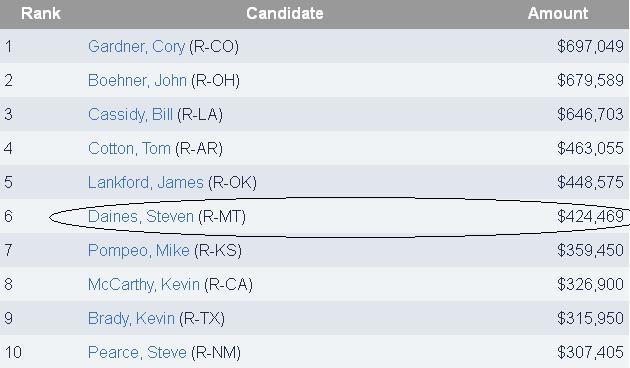
Unless of course Senator Daines’ confusion about the causes of climate change has less to do with the science and more to do with the fact that, according to OpenSecrets.org, of the 435 members of the House of Representatives, now-Senator Daines ranked sixth in amount of contributions received from the oil and gas industry in the 2014 election cycle.

Oil and gas political contributions

Come on, Senator Daines. Fess up. It’s not really about the science. It’s about the money,  isn’t it?

Senator Daines’ hypocrisy is out of step with the vast majority of Americans. According to a Reuters poll taken earlier this year, 66% of Americans said that our leaders are morally obligated to take action to reduce CO2 emissions. And 72% said they were “personally morally obligated” to do what they can in their daily lives to reduce emissions.

“When climate change is viewed through a moral lens it has broader appeal,” said Eric Sapp, executive director of the American Values Network, a grassroots organization that mobilizes faith-based communities on politics and policy issues. “This makes it more about us, our neighbors and about doing the right change.”

Which makes it all the more galling that Senator Daines uses his personal morality to disguise the reasons for his climate change denial. When Senator Daines denies that climate change exists, and says he doesn’t know if man or solar activity is responsible, he’s abdicating his moral responsibility for leadership.

There’s plenty of room for political debate about which course of action is best to address climate change, and most in the public would welcome a real exchange between Democrats and Republicans on how we can reduce carbon emissions in a way that will improve our economy and protect the planet.

There’s too much at stake for this kind of hypocrisy. Senator Daines, please let us know where you’d like us to deliver your award.

Related: A debate between Pope Francis and Montana Senator Steve Daines on climate change


Posted in Community Organization | Tagged , , , | 4 Comments

Montana Board of Oil and Gas refuses to take up setbacks

At its meeting on Wednesday, the Montana Board of Oil and Gas Conservation (BOGC) decided not to take up rulemaking for setbacks. Instead, they created a review panel to consider the issue. This is another example of a Montana state agency running roughshod over the rights of surface owners, whose only recourse is local regulation.

Keep in mind that the vote was not about setback limits themselves, but about whether the BOGC should even consider setting rules on the the minimum distance between a well and occupied property.

“We’re just finding out the issues a little more, clarifying issues before we would go into rule-making,” said Linda Nelson, BOGC chair. Nelson said the committee, made up of landowner, oil industry and legal representatives, could have some information at the next meeting.

Don’t hold your breath.

According to the Billings Gazette, “Not one official voiced support Wednesday for board member Peggy Ames-Nerud’s call for a vote to begin working on setback rules.”

The Board of Oil and Gas deciding to do nothing. Photo: Casey Page, Billings Gazette

The Board of Oil and Gas deciding to do nothing. Photo: Casey Page, Billings Gazette

What this means is that Montana landowners are left with no protection from having wells placed next to occupied property. What’s worse, they can’t even prepare for the disruption. Oil and gas companies don’t have to provide more than 48 hours notice when they are going to hydraulically fracture a well.

Montana is the only oil producing state in the area that has no setback rules. Wyoming, North Dakota and Colorado have put setbacks in place long ago.

Why setbacks are important
There are several reasons setbacks are important:

  1. The division in property rights between surface and mineral estates is fundamentally unfair to surface owners.
  2. Drilling activity that is too close to water supplies can result in the contamination of water used for agriculture, ranching and drinking.
  3. There is considerable scientific evidence that proximity to oil and gas activity negatively affects human health and safety.
  4. Drilling reduces property values for homes close to oil wells.

I have written extensively on this topic on this site, and encourage you to read this article for background.

The BOGC exists to protect mineral interests
It should come as no surprise to anyone that the BOGC has no interest in taking up setbacks. It is an organization designed to protect mineral interests, not surface interests.

The primary mission of the BOGC is threefold:

  1. To prevent waste of oil and gas resources,
  2. To conserve oil and gas by encouraging maximum efficient recovery of the resource,
  3. To protect the correlative rights of the mineral owners, i.e., the right of each owner to recover its fair share of the oil and gas underlying its lands.

That makes it pretty clear. The word “conservation” is not about conserving natural resources, but about conserving oil and gas, and protecting the rights of mineral holders.

Horizontal well, Richland County. BOGC photo.

Horizontal well, Richland County. BOGC photo.

However, the board “also seeks to prevent oil and gas operations from harming nearby land or underground resources.” It does this in a number of ways, including “establishing spacing units, issuing drilling permits, administering bonds (required to guarantee the eventual proper plugging of wells and restoration of the surface), classifying wells, and adopting rules,” and regulating injection wells.

When a company wants to drill a well, the oil & gas operator has to apply for a permit , providing specific data about the company and other required information. BOGC staff performs a technical review of the proposal, which also goes through a public notice and hearing process. Then, the BOGC can issue, modify, or deny the permit; regulate the volume and characteristics of the fluids to be injected; and impose operational requirements or limitations for the well.

Composition of the board
Part of the issue for landowners is way the board is structured. According to its rules, the board consists of seven members, as follows:

  • Three members “shall be from the oil and gas industry, and have had at least 3 years’ experience in the production of oil and gas,”
  • Two of the members shall be landowners from oil producing areas of the state but not actively associated with the oil and gas industry.
    • one of these two owns both mineral and surface rights, and
    • one of these two owns surface rights only
  • Two at-large members, one of whom must be an attorney

This structure is a problem. With three members coming from the oil and gas industry and one a mineral rights holder, you start with four votes from members who have a financial interest in the expansion of oil and gas drilling. If the governor is not careful in the appointment of the other three, there is a danger of a runaway board that acts only in the interest of the industry.

Current board members
Current members, with city of residence, classification and date of term expiration:

Rancher and BOGC board member Peggy Ames Nerud. Billings Gazette photo

Rancher and BOGC board member Peggy Ames-Nerud. Billings Gazette photo

Industry representatives
Wayne Smith, Valier, Vice Chair, 1/1/17
Steve Durrett, Billings, 1/1/19
John Evans, Butte, 1/1/19

Landowners
Linda Nelson, Chair (with minerals), Medicine Lake, 1/1/17
Paul Gatzemeier (without minerals), Billings, 1/1/19

Public members
Ronald Efta (attorney), Wibaux, 1/1/19
Peggy Ames-Nerud, Circle, 1/1/17

This is not a board that is going to look out for landowner rights. Three members from the oil and gas industry and one mineral rights holder, and Paul Gatzemeier, the landowner without minerals, has spent his career as an oil company executive. Ronald Efta is a second-term member who has shown no interest in protecting landowner rights.

Of this group only Peggy Ames-Nerud, a rancher and member of Northern Plains Resource Council, has environmental credentials.

No setbacks, but a toothless protest provision
BOGC member Steve Durrett, an industry representative, justifies the board’s failure to act this way:

“Other states do have setback rules, but what Montana has that other states don’t have is the ability to protest. Anyone can protest any well for any reason, or no reason at all. This is also clearly a solution in search of a problem. The vast, vast, overwhelming majority of these issues are resolved through negotiation between the landowner and the company.”

Perhaps Mr. Durrett can say this with a straight face because he is a new BOGC member. Anyone with a memory will recall the 2013 fiasco in which landowners from Belfry tried to protest a well and had to sue to get a hearing, and then were completely ignored by the BOGC.

And the notion that issues of setbacks can be fairly negotiated between sophisticated oil companies and landowners, who can’t possibly know all the risks of oil and gas drilling, is preposterous. This is exactly why regulations are required.

If you are interested in background on what’s wrong with the Montana Board of Oil and Gas Conservation, I encourage you to read my earlier post on this subject.

A pattern of Montana government refusal to protect landowners
In the last year, Montana landowners have been shut down over and over by government agencies

  • In January, the Carbon County Commission rejected a petition by Belfry landowners to establish the Silvertip Zoning District, which would include nearly 3,000 acres of agricultural land. The Commission’s rejection was based on the opposition of certain neighboring landowners under a provision of the law that landowners argue is unconstitutional.
  • In June, Judge Blair Jones rewarded the Carbon County Commissioners for failing to follow their own procedures by dismissing the Silvertip landowners’ lawsuit in a narrow ruling that didn’t consider the constitutional issues involved. The landowners have appealed to the Supreme Court.
  • In February the Montana Senate rejected SB177, which would have prevented oil and gas drilling within 1,000 feet of a home, water well or surface water. Current law gives operators discretion over where to place a permitted well, regardless of how close it is to occupied structures. The bill didn’t even get out of committee and onto the floor for a vote.
  • In August, the Board of Oil and Gas refused to even consider rulemaking for setbacks, instead punting the issue to a committee of members who don’t believe it is necessary.

Local regulation is the only answer
The record speaks for itself. Governmental agencies in Montana have no interest in setting up reasonable protections for landowners from oil and gas drilling. It is up to local landowners to do it themselves, using provisions for citizen initiated zoning established in Montana law.

In Carbon County, landowners have gone through the zoning process and met all legal requirements to do so, only to be rejected by the County Commissioners. They have appealed to the Montana Supreme Court to protect their rights.

In Stillwater County, landowners are in the process of collecting signatures for a large zone that consists of about 600 properties. They will be presenting these signatures to the County Commissioners later this year.

Local regulation is the only available path to protect landowner rights. These groups are doing a tremendous amount of work, and deserve your thanks, for fighting against all odds to protect your rights.

Posted in Community Organization, Politics and History | Tagged , , , , , , , | 1 Comment

Energy Corporation of America Stillwater drilling permit expires

Energy Corporation of America (ECA) has allowed the company’s permit for the Holman Morse 1-H well in the Dean area of Stillwater County to expire, according to the Montana Board of Oil and Gas Conservation (BOGC). For those familiar with the area, the well is across Nye Road from Montana Jack’s, which has also expired.

Aerial view of ECA well pad across from Montana Jack's in Dean

Aerial view of ECA well pad in Dean. The permit for the well has now expired.

The well was originally permitted on October 31, 2013, just after ECA CEO John Mork announced his plans to horizontally fracture 50 wells along the Beartooth Front and bring “a little bit of the Bakken” to the Beartooths. The six-month permit was renewed on May 1 and again on October 30 of last year.

However, the permit was not renewed before it expired on April 30. Any further oil and gas activity on the site will now require a new permit.

According to the BOGC web site, a letter was sent to BOGC field inspector Jerry Fraser on July 27. I spoke to Mr. Fraser, and he said he will inspect the well to make sure there is “no surface disturbance.”

ECA also abandoned the Hunt’s Creek 1-H well in Belfry, sending a letter to the Carbon County Commissioners last December announcing the decision.

The well history from the BOGC database is pictured below. You can find it yourself by searching on the site.

Holman well statusWhat it means for the Beartooth Front
While this is certainly welcome news in the short term, it shouldn’t change our resolve to put in place meaningful local regulation of oil and gas. ECA’s abandonment of wells in Carbon and Stillwater counties is a reflection of the current price of oil, not a lack of resolve by oil companies to extract everything they can from the Beartooth Front.

As prices increase and fracking technology improves, they will be back.

It is important for citizens working on zoning efforts in this area to feel urgency to complete their work.

Related: Previous post on this well.

Posted in Fracking Information | Tagged , , | 1 Comment

Silvertip landowners appeal to Montana Supreme Court

Belfry landowners have appealed a ruling in a lawsuit they filed to assert their rights to protect their land against the harmful effects of oil and gas drilling. The appeal will go to the Montana Supreme Court.

In February of this year, the landowners filed a legal challenge to the Carbon County Commission’s decision to reject their petition to establish the Silvertip Zoning District, which would include nearly 3,000 acres of agricultural land north of Belfry. The Commission’s rejection was based on the opposition of certain neighboring landowners under a provision of the law that the plaintiffs argue is unconstitutional. In a narrow ruling, Judge Blair Jones on July 8 dismissed the lawsuit without ruling on the merits of the landowners’ legal challenge.

Martinell quoteMontana law empowers land- owners to initiate the develop- ment of zoning regulations for the protection of their land and community by petitioning their county commissioners to establish planning and zoning districts. “We as landowners, ranchers and farmers have a right to safeguard our property and livelihoods from the destructive impacts of oil development through citizen zoning,” said Bonnie Martinell, one of the plaintiffs. “The ability of neighboring landowners to unilaterally strip us of that right will remain an obstacle to local control throughout Montana unless the state Supreme Court decides this important issue.”

Beartooth Front viewed from the Silvertip Zone
Beartooth Front viewed from the proposed Silvertip Zone

The Silvertip landowners sought the protections of citizen zoning after Energy Corporation of America announced plans in October 2013 to hydraulically fracture 50 wells along the Beartooth Front, an area that includes Carbon and Stillwater counties in Montana and forms the northeastern flank of the greater Yellowstone ecosystem. Mork boasted that ECA hoped to bring “a little bit of the Bakken” to the Beartooths.

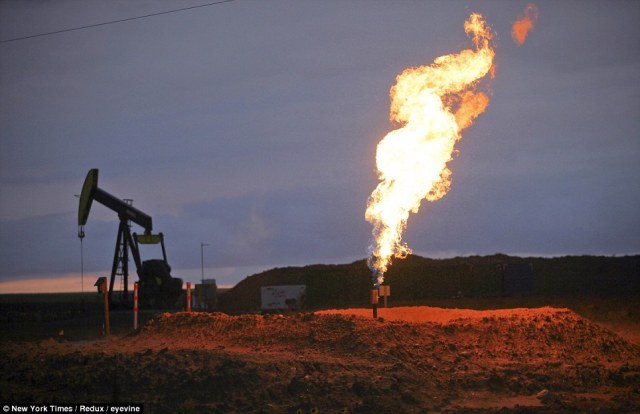
A little bit of the Bakken
A little bit of the Bakken (New York Times photo)

Although interest in large-scale oil and gas development in Carbon County has waned with the drop in oil prices over the last several months, Martinell said the zoning designation remains necessary to protect landowners when oil and gas development picks up again. “Through this process we’ve learned that developing regulations takes time and protections can’t be put in place over night. If we’re going to get this right, now is the time to act.”

Landowners in Stillwater County plan to bring petitions requesting a similar zone to the Stillwater County Commissioners later this year.

Earthjustice, an environmental nonprofit law firm, is representing the Silvertip landowners in their appeal.

Background information:
Citizen initiated zoning: a way to restore fairness to oil and gas drilling in Montana
Frequently Asked Questions about the Silvertip citizen-initiated zone
Exciting news from Carbon County: Commissioners move forward on Silvertip Zone
Unbelievable. Carbon County Commissioners defy will of majority to deny Silvertip Zone
Commissioners action in denying Silvertip Zone clearly illegal
Why Silvertip landowners filed suit against the Carbon County Commissioners
Breaking: Decision in Silvertip Zone case
(includes timeline of events)
Judge Blair Jones’ ruling

Posted in Bakken, Community Organization, Politics and History | Tagged , , , , , , , | 3 Comments

Time for the Montana Board of Oil and Gas to step forward on setbacks

The Montana Board of Oil and Gas Conservation (BOGC) will take up the issue of whether to begin rulemaking on establishing oil and gas setbacks — the minimum distance between oil and gas wells and homes or other occupied buildings — on Wednesday, August 12 at 2:00pm in the Hearing Room at the BOGC office at 2535 St. Johns Avenue in Billings.

The public is encouraged to attend. If you can be in Billings for the meeting, please go. It is important for the BOGC to feel public pressure to move toward oil and gas regulation.

Montana is one of the few oil and gas producing states that has no mandated setbacks. Earlier in 2015, the Montana Legislature failed to take action on a bill to require setbacks. Montana remains well behind other states on basic water protection.

Action to implement setbacks is long overdue. You can read a detailed discussion of the reasons why it is critical for the BOGC to act here.

The map below shows setback requirements by state as of June 2013. Since the map was created Wyoming has extended its setback requirement to 500 feet, and Colorado has extended to 1000 feet in some circumstances.

Source: Resources for the Future, "The State of State Shale Gas Regulations," June 2013

Source: Resources for the Future, “The State of State Shale Gas Regulations,” June 2013

On Thursday, August 6, the Billings Gazette published the editorial below urging the BOGC to take action:

Put some distance between oil wells and Montana homes

Doing oil and gas development right means treating the neighbors right.

Next week, the Montana Board of Oil and Gas should take a stand to protect the neighbors of future oil and gas wells. The board, meeting Wednesday in Billings, is scheduled to vote on whether to commence rulemaking to require a minimum distance between oil/gas wells and homes or other occupied buildings.

Montana’s neighbors, Wyoming and North Dakota, have setback requirements from inhabited structures, but Montana has none.

Sen. Mary McNally, D-Billings, sponsored a bill in the 2015 Legislature that would have prevented drilling within 1,000 feet of a home. Senate Bill 177 drew both strong support and strong opposition in a hearing before it died in Senate Natural Resource Committee.

The Board of Oil and Gas has been asked to address setbacks administratively. The issue is championed by the Northern Plains Resource Council, which at a hearing last month argued for “a dynamic rule that establishes different setbacks for various categories of inhabited buildings, public spaces, and well types,” including “a 1,320 foot setback from inhabited homes.”

With many variables in drilling, land and mineral ownership and spacing of residences, a setback rule may not be simple. But we believe it is worthwhile.

As it stands now, when the estate is split, mineral ownership trumps surface ownership. Surface landowners may protest a drilling plan at the board, but development may move forward on the property, even without the surface owner’s consent.

A setback rule would give the surface owners a minimal guarantee that their property interests will be considered.

Wyoming rules
The number of oil and gas wells drilled next to homes in Montana has been small, so far. Wyoming and North Dakota oil boards have recognized the importance of dealing with setbacks after drilling commenced in the vicinity of homes. Those states are no more populous than Montana.

The Wyoming Oil and Gas Commission this spring increased the setback from 350 feet to 500 feet from “occupied structures,” defined as “a building that was specifically constructed and approved for human occupancy such as a residence, school, office or other place of work or hospital” and not sheds, barns or garages.

North Dakota also has a 500-foot setback. Colorado’s rule can require a setback from occupied structures of more than 1,000 feet.

There’s considerable scientific evidence that living or working day after day close to oil wells can cause adverse health effects. But the Wyoming commission in April concluded that there was no “definitive science” to provide “clear guidance on setbacks”.

There is, however, the matter of folks being secure on their home property. Having an oil well in the backyard can significantly reduce property value.

Noise, trash and dust
Bainville cattle rancher Robert “Pat” Wilson, who has oil development on his property, said it brought unexpected problems of heavy truck traffic during the drilling and fracking, lots of trash (including milk jugs filled with truckers’ urine), dust and ongoing noise from the pump. Wilson, who owns and leased his mineral rights, told the Board of Oil and Gas about his concerns that prolonged exposure to volatile organic compounds in the minerals may increase risks of cancer and other serious health problems.

Dale Nelson, a Homestead farmer, told the board that a 1,000-foot setback would protect his family from the potential dangers of oil wells near his property. A veteran firefighter, Nelson described fighting oil well fires sparked by lightning: “The toxic smoke that comes out with a fire, there’s nothing you can do with it. Do you want your grandkids around something like that?”

Jim Halvorson, administrator for the board, noted that there have been few conflicts in Montana between drillers and homeowners and when there were, an agreement usually worked out.

The next boom could be different. What if oil development moves toward a more populous area? Let’s not wait until the crisis is at hand. It’s better to make a good rule now.

Be proactive
Halvorson points out that surface owners already may protest a development plan. That can be helpful, but it puts the burden on the landowner, who probably knows a lot less about the board and its rules than the oil developer does. Providing the landowner with a minimal setback protection helps level the playing field.

Any new rule should allow the property owner to waive or reduce the setback requirement. The rule should allow the property owner to petition the board for a greater setback if they can show that the particular circumstances of their property and the proposed development warrant a variance. Those are the kind of details — along with setback distance — that need to be addressed in a reasonable rule.

We call on the seven citizens who serve on the Board of Oil and Gas to vote Wednesday to begin the three- to five-month process of crafting a rule.

Other state oil and gas boards have administratively created setbacks to protect homeowners. Montana should take a cue from its neighbors and do likewise. Future conflicts between residents and resource development can be reduced if the Board of Oil and Gas seizes this opportunity to be proactive.

One final note: Jim Halvorson‘s notion expressed in the editorial above that “surface owners already may protest a development plan” assumes that we have all forgotten what happened when Belfry owners tried to protest a development in their community. The BOGC attempted to block the protest, had to be sued to allow the protest, and then ignored every argument made by concerned citizens. Read all about it here.

Posted in Community Organization, Politics and History | Tagged , , | 9 Comments

Important documents for Thursday’s meeting on the Stillwater River Road closure

Reminder: There will be a public meeting to discuss the Stillwater River Road closure at the Nye Fire Hall on Thursday, July 30 at 6:30pm. All three Stillwater County Commissioners are expected to be in attendance.

Click on graphic to read full document

Click on graphic to read full document

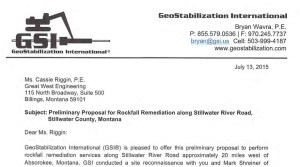
The Stillwater County Commissioners released two documents to the Billings Gazette yesterday that they will be presenting at the meeting. These include a “geotechnical reconnaissance” and risk assessment prepared by SK Geotechnical of Billings and received by the County Commissioners on June 15, and a preliminary proposal for rockfall remediation by Geostabilization International (GSI) of Grand Junction, CO, dated July 13. The two documents were prepared for Great West Engineering of Billings, which presumably is being considered as the contractor for the project. The two documents have been combined into one, and are a total of eight pages. I strongly recommend you read them if you are going to the meeting. You can download them by clicking on the graphic at right.

Key points from the risk assessment
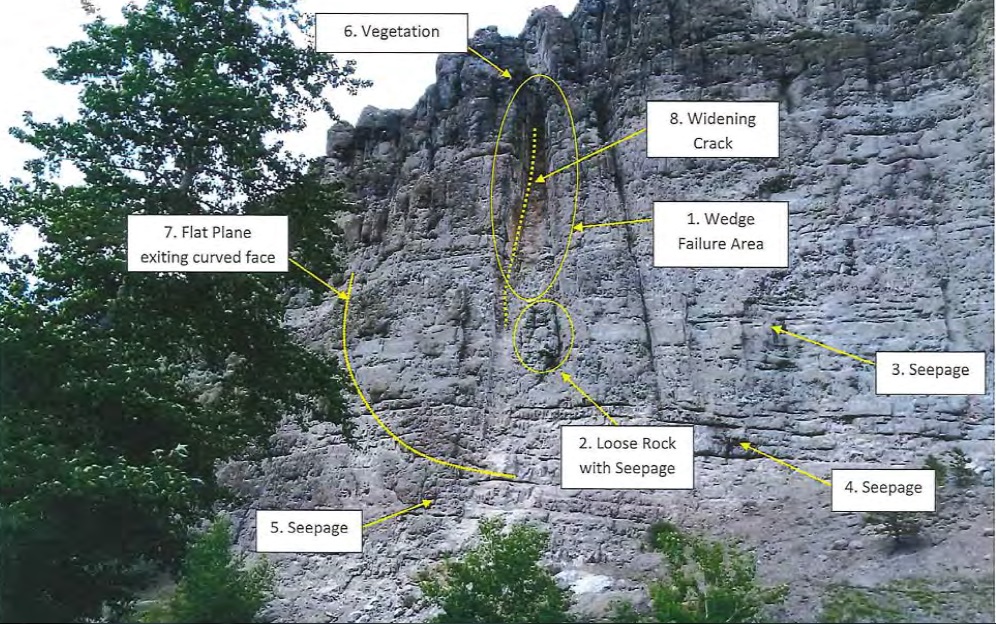
The risk assessment includes two photos (pages 7 and 8) that highlight the situation as of June 15. Key points:

  • “Numerous areas…appear to be unstable. In the vicinity of label 2 (see photos below), several suitcase-sized rocks were observed which appeared to be relatively loose. Outside of the immediate wedge failure area, other portions of the rock face appear to have a high risk of wedge failures in the future. Areas #9 and #10 have discontinuities that intersect to create a wedge. They appear to be relatively stable when compared to the loose rocks in area #2, but the risk of failure still exists. A large rock is defined by the discontinuity shown with lines labeled #7 and #8. These discontinuities represent failure planes, and although no active movement was observed, there is a risk of future failure.

Stillwater River Road rockslide photo1
As to the question of the amount of risk, the report is somewhat equivocal. It states that there is clearly risk, but “the rock face has always had a risk of failure and subsequent hazardous conditions. The risk of failure increases seasonally with the highest risk coming in the spring with heavy snow melt and spring rains. A seismic event (earthquake) is one of the highest risks for rock slides to occur along the rock face. It is our opinion the rock face is currently at a slightly higher risk of failure than it was one day before failure due to the visible seeps. When these seeps are no longer visible, then it is our opinion the risk of failure is basically the same as it was before the recent rock slide. Assuming some risk is acceptable, then it is our opinion the road can be cleared and opened when the visible seeps are no longer apparent.

Stillwater River Road rockslide photo1The question of risk should be a key area of discussion at the meeting.

Key points from the preliminary proposal
Scope of work
“The most critical portion of the slope is approximately 1/4 mile long, and can be separated into two remediation plans:

  1. The most dangerous part has loose rock, which can be mitigated by rock scaling to remove the loose rock.
  2. Installation of a temporary rockfall catchment system

A flexible rockfall barrier is recommended for the remaining 1/4 mile.

“It is further recommended that the rockfall remediation budget contain an allowance for rock dowel/deadbolt installation…to anchor rock formations that can not be removed safely with scaling techniques, but are too large to be arrested by the flexible rockfall barrier.”

Cost
The estimated cost of the proposal includes:

  • Mobilization of the company                          $  20,632
  • Rock scaling to remove loose rock                 $322,061
  • Rock bolt/dowels (30)                                      $154,830
  • Flexible rockfall barrier                                    $999,557
    Total                                                                 $1,476,448

What is included in the cost estimate:

  • Mobilization
  • Manual scaling
  • Rock bolt installation
  • Flexible rockfall barrier

What is not included, and would presumably be the responsibility of the County:

  • Traffic control
  • Construction permits, if required
  • Hauling of debris
  • Construction surveying, if required

Timing
GSI indicates they can be on site within three weeks of signing a contract, and would do the work in one continuous effort. Scaling would take approximately 15 days.

GSI suggests  the placement of the flexible rockfall barrier could be deferred until a later time, which would reduce the cost of the work by a million dollars.

As I understand this, that means that, once the County contracts with these companies, it would take three weeks to get to work, and another few weeks to do the work. The total short-term cost would be about $500,000.

***

This is just an overview. I recommend that you read the documents before the meeting. There is much to discuss.

Posted in Community Organization, Politics and History | Tagged , | 2 Comments

Posted in error

To read post, go here.

Posted in Uncategorized | 1 Comment

Stillwater County residents: public meeting on Stillwater River Road closure this Thursday

Road closedThere will be a public meeting to discuss the Stillwater River Road closure at the Nye Fire Hall on Thursday, July 30 at 6:30pm. All three Stillwater County Commissioners are expected to be in attendance.

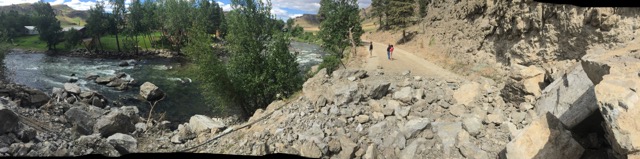
Stillwater River Road was closed by a rockslide on June 3 and has remained closed for the last eight weeks. Despite increasing public discontent, Commissioners have not revealed plans for when, if ever, the road will be reopened. A recent notice in the Stillwater County News indicated that Commissioners have received a $1.4 million bid for repairs.

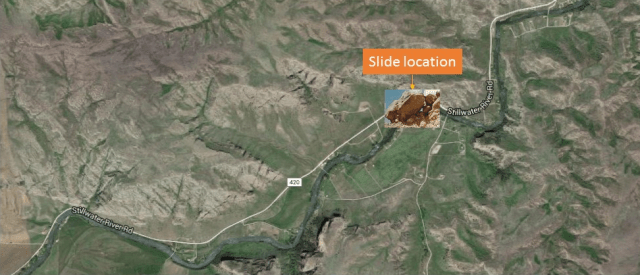
Location of rockslide on Stillwater River Road. Click to see on Google Maps

Location of rockslide on Stillwater River Road. Click to see on Google Maps

Stillwater River Road is an essential traffic artery, linking Absarokee to Nye and providing secondary access to the Stillwater Mine. It is critical that Commissioners hear from the public to make sure the road is reopened as quickly as possible, so please make plans to attend and send this notice along to friends and neighbors who might be impacted.

The rockslide and road closure are reminders of the fragility of our area, and how vulnerable we are to natural events. It is no coincidence that many of the residents impacted by the closure are also signers of a petition for a citizen initiated zone to protect the area from poorly regulated oil and gas drilling. That petition will be presented to County Commissioners later this year.

Stillwater rockslide looking upstreamQuestions you might consider asking the Commissioners (feel free to add others in comments):

  • What is the timetable for reopening the road: bids, work, completion?
  • What is the status of the rock wall adjacent to the road? What needs to be done to make it safe?
  • Why has it taken eight weeks to communicate plans to the public?
  • How will the County cover the cost of repairs? What options for state and federal relief have been explored?
  • Can the work be completed before winter?
  • If there are no plans to repair the road, what are the long-term implications for residents and County commerce?
  • If the Commissioners decide not to repair the road, how will residents be compensated for loss of property value, or loss of business?

Here is a video I shot this morning at the scene. Lots of wind and river noise in the background, so you can only hear on max volume.

Posted in Community Organization, Politics and History | Tagged , , , | 1 Comment

The resource curse: how dependence on oil and gas hurts communities in the long run

Two recent studies provide clear evidence of a well-understood fact: communities that base their economies on oil and gas may enjoy a short term boom, but they suffer in the long term in per capita income, educational attainment and crime rate.

Elizabeth Cascio

Elizabeth Cascio

Fracking boom increases high school dropout rate
The first study, by Elizabeth Cascio and Ayushi Narayan at Dartmouth University, is titled “Who needs a fracking education? The educational response to low-skill biased technological change” It documents that when a fracking boom hits a community,  high-paying low-skill jobs are created, mostly for young men. The result is that the dropout rate for 17 and 18 year old men increases significantly in those communities.

The study concludes that some students are hurting themselves in the long run by putting more weight on short-term higher income than the long-term benefits of education. As a result, those students wind up stuck at the bottom of the education and skills ladder, and their incomes will be reduced over the course of their lifetimes.

Wenlin Liu

Wenlin Liu

The impact of oil and gas on economic growth in Wyoming
The second study is a report by Wyoming state economist Wenlin Liu that shows the Wyoming economy is strong, except in counties that rely heavily on the oil and gas industry. The study looked at growth in different sectors from first quarter 2014 to first quarter 2015.

The report showed that every sector other than “mining,” which includes oil and gas, showed year over year growth, and that statewide unemployment has dropped to four percent. Personal income in the state grew 4.1% from year to year.

The mining sector showed a 2.4% loss of jobs, about 660 statewide.

“The simple reason was a dramatic decline in drilling rigs for oil and natural gas,” Liu told the Wyoming Tribune Eagle. “It’s not only oil prices, but natural gas prices too. And that’s directly affecting Wyoming’s economy.”

Counties that rely heavily on oil and gas saw large declines in taxable sales, with Niobrara County dropping 52.3%, Carbon County 14.7%, Sublette County 12.1% and Fremont County 9.6%.

“Hopefully these counties enjoyed the boom, and for budgeting purposes they don’t spend all their money when it booms,” Liu said.

By contrast, other counties with more diverse economies saw gains as high as 8.8%.

The long term impacts on communities
These studies should not come as a surprise. They are likely the first of many examples of the fallout from the decline in oil prices that began in June, 2014.

Six states

The study showed that in six states, including Montana, the longer the period of oil and gas exploration continues, the more negative the economic impact when it ends. You can see from the map that Carbon and Stillwater counties have primarily escaped these impacts, but we may not be so lucky during the next fracking boom.

The negative long-term impacts of increased reliance on oil and gas drilling are summarized in a study from the Headwaters Institute entitled   Oil and Gas Extraction as an Economic Development Strategy,” which looks at the longitudinal impacts of  drilling booms since the 1980s in six states, including Montana, from 1980 – 2011. The study was done at Montana State University.

The findings are stark. Counties that participated most heavily in the boom and specialized their economies most intensively in oil and gas saw greater declines in income, higher crime rates, and lower rates of educational attainment in the 1980 to 2011 period.

“The magnitude of this relationship is substantial,” the authors write, ” decreasing per capita income by as much as $7,000 for a county with high participation in the boom (greater than 8% of income from oil and gas) and long-term specialization (greater than 10 years) versus an identical county with only one year of specialization in oil and gas.”

This suggests that U.S. towns and counties that specialize too heavily in oil and gas development can indeed suffer from what’s known as the “resource curse.” They become too reliant on a single industry, and when the oil and gas stops flowing, the counties end up worse off than if they’d never enjoyed a surge of production in the first place:

  • For counties that experience increases in oil and gas production, per capita income declines with longer specialization.
  • The longer the duration of oil and gas specialization, the higher the crime rate.
  • Educational attainment declines with longer specialization.

We need to change the conversation
This data points clearly to the kind of local conversations we need to be having about oil and gas development. The lure of money flowing into a community is attractive — jobs, retail sales, rising home prices.

But for those who have an interest in maintaining the quality of life in a community for the long term — elected officials, families, local businesses — the conversation needs to go beyond the hell-bent pursuit of instant riches.

Communities cannot just allow development to occur based on the needs of oil and gas operators. The conversation needs to involve deciding how much, where, how quickly, with what limitations.

County Commissioners have this responsibility to lead this conversation through their power to set planning policies, through permitting and zoning. We need to insist that they do this. If not, citizens need to step forward to demand responsible policy making.

Posted in Fracking informaation | Tagged , , , , , , , | 3 Comments