Update: Fracking causes earthquakes (with video)

A couple of weeks ago I looked at the relationship between wastewater injection wells associated with hydraulic fracturing and earthquakes and concluded that not only is there overwhelming scientific evidence of a relationship, but man-made earthquakes related to fracking have been increasing rapidly as fracking has increased. The post featured a video interview with Dr. Elizabeth Cochran, co-author of a study that showed the relationship between injection wells and earthquakes in Oklahoma.

Oklahoma earthquakes graph

Oklahoma earthquake activity has increased over 1000 times since 2009 (click to enlarge)

Earthquake activity in Oklahoma due to fracking increased over a thousandfold between 2009 and 2013, as shown in the graph at left. But that’s not the end of the story. Now, in 2014, earthquake activity has spiked again over 2013 levels. In fact, in the last seven days, according to the Oklahoma Geological Survey, there have been 173 earthquakes in Oklahoma — over one an hour. If you extrapolate that over a year, that’s nearly 9,000 earthquakes! (Note that if you count, your numbers may not match mine because the site charts real time data for the last seven days.

Officials are being careful not to say
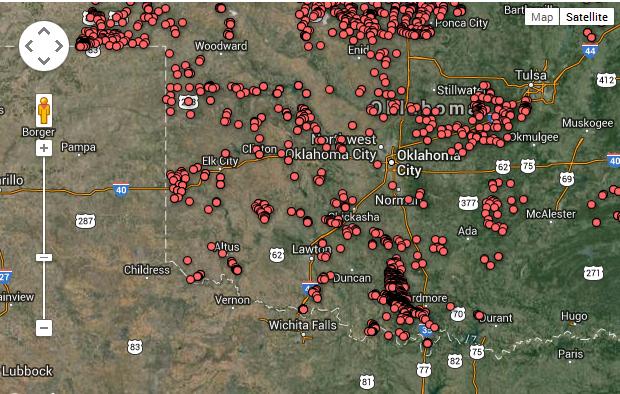
Map of Oklahoma injection wells (click to enlarge)

Map of Oklahoma injection wells (click to enlarge)

definitively that this new spike in earthquakes is related to oil and gas activity, but, since we’ve already established the relationship between injection wells and earthquakes in Oklahoma, and the number of earthquakes tracks exactly with the doubling of oil production in Oklahoma from 2010 to 2013, and since the state is full of the type of injection wells that have been associated with earthquakes (see map at right), it’s pretty safe to say that   2 + 2 = 4.

According to Dr. Austin Holland, a seismologist for the Oklahoma Geological Survey, it’s also possible we’ve reached a “geological tipping point” which has set off this spate of quakes. Who knows where it will lead?

If you’re imagining what it might be like to experience a minor earthquake in Red Lodge every hour, think beyond the sensation of getting a regular shake to the experience of cracking in your walls and home foundation, and to the loud “BOOM” that accompanies each quake. This news report gives a feel for what it’s like to experience regular quakes.

One more
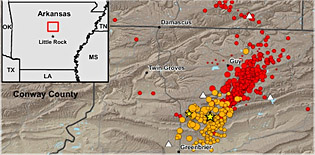
This came across my desk after I wrote the above. Two central Arkansas families have filed suit against Chesapeake Oil and Billiton Petroleum for causing “thousands of earthquakes” that damaged homes and caused the state’s largest earthquake in the last 35 years. The earthquakes were charted on the map at left. For more, follow the link.
Arkansas earthquakes

Map of “thousands” of earthquakes allegedly caused by two Arkansas drilling companes

Fracking by Chesapeake oil and Billiton Petroleum caused “thousands of earthquakes” that damaged homes and caused the state’s largest earthquake in the past 35 years, two Central Arkansas families claim in court.

And last, here’s a nice clear and short explanation of why injection wells cause earthquakes. Recommended for the non-technical. The language is cautious, but the meaning is clear: when we increase drilling using modern technology, we cause earthquakes.


Posted in Fracking Information | Tagged , , , , , | 6 Comments

Video: Big Oil and Bad Air on the Texas Prairie

Powerful reports today on the relationship between oil and gas drilling in Texas and air pollution.

First, a joint report by the Center for Public Integrity, the Weather Channel and Inside Climate News:

Deep in the heart of South Texas, new oil and gas wells are appearing seemingly everywhere. The region is called the Eagle Ford Shale and it’s the location of the largest energy booms in the world.

But it may be a bust for local residents who fear for their health.

In this original documentary, reporter Jim Morris of the Center for Public Integrity visits the people most affected by the boom and explains the science why they may be in danger.

The report highlights the stunning folly of rushing forward with new drilling technologies. It’s a story we run into over and over: we simply don’t know what we don’t know about the long-term effects on our health of a technology we’re deploying all over the country. And in Texas, as in Wyoming and North Dakota and Montana, public agencies are not taking responsibiliity for ensuring public safety before they chase the riches that fracking promises.

I strongly recommend you read and watch the report
http://vimeo.com/86979931

Rachel Maddow Coverage

Rachel Maddow Eagle Ford

Click to watch video

Rachel Maddow covered this story on her show last night, and interviewed Jim Morris, an editor at the Center for Public Integrity. Her report is also worth watching.

Posted in Fracking Information | Tagged , , , , , | Leave a comment

A personal story: Laura Amos, Encana Colorado

I feel for you, but you own the surface. We own the minerals, and we’re coming in to drill. Here’s the Surface Use Agreement. You can sign it, but you don’t have to. If you sign it, you get a check for $3,000. If you don’t sign, you get no financial reimbursement for any damages that may occur.”

-Laura Amos

Telling personal stories
The oil and gas boom has been underway for a number of years in many locations across the country, and there are now a lot of stories about individuals and families whose lives have been personally affected. This post is part of a regular series of those stories on this blog to help you envision what could happen if drilling expands along the Beartooth Front. Look for these once a week.

Today’s story comes from the booklet Shalefield Stories: Personal and Collected Testimonies, published last month by Steel Valley Printers of Pennsylvania.

Previous posts in this series:
Tim and Christine Ruggiero, Wise County, Texas

Laura Amos
Laura Amos, Larry Amos, and their daughter Lauren live south of Silt in the heart of Encana, the industrial wasteland in western Colorado.

They were among the first in their area to have natural gas drilling on their property. They

Laura and Lauren Amos

Laura and Lauren Amos

were also among the unfortunate who did not own the mineral rights under their property.

Encana sent a kind, older gentleman who sat at their kitchen table and told them more or less, “I feel for you, but you own the surface. We own the minerals, and we’re coming in to drill. Here’s the Surface Use Agreement. You can sign it, but you don’t have to. If you sign it, you get a check for $3,000. If you don’t sign, you get no financial reimbursement for any damages that may occur.”

In May 2001, while fracturing four wells on their neighbors’ property (less than 1,000 feet from their house on what’s known as the G33 pad), the gas well operator “blew up” the Amos’s water well. Fracturing created or opened a fracture or fault between their water well and the gas well, sending the cap of the Amos’s water well flying and blowing their water into the air like a geyser at Yellowstone. Immediately their water turned gray, had a horrible smell, and bubbled like 7-Up. Water production dropped drastically from 15
gallons per minute to nothing or near nothing. Tests of their water showed 14 milligrams (mg) per liter of methane. They were warned to make sure there were no closets or pockets in their home where the gas could build up and explode. They tested the water in the Amos’s well a couple more times that summer, ending in August 2001.

In the spring of 2003, Laura became very ill. She spent months in doctors’ offices and hospitals. She was eventually diagnosed with Primary Hyperaldosteronism, a very rare condition of a tumor in her adrenal gland. None of her doctors had any idea of how she could have acquired such a rare disease. The tumor and her adrenal gland had to be removed.

From August 2001 until January 2004, no testing was done on their water. Their daughter was only 6 months old when fracturing blew up their water well. Laura bathed Lauren in that water every day. She also continued breast-feeding her for 18 more months until she was 2 years old. During that time the tumor was developing in Laura’s adrenal gland. If there was a chemical in her body causing her tumor, Lauren was exposed to it as well.

Encana spokesman Walt Lowrey assured several of the Amos’s neighbors and the Amoses themselves that the toxic chemical 2-butoxyethanol (2-BE) was NOT used in fracking on their property. In addition, Lowrey told many reporters in western Colorado, Denver, and the Associated Press that 2-BE was not used on the pad or anywhere in this area. However, on January 31, 2005, Laura learned that the industry had not been telling the truth. They fractured 2,000 feet below the surface, and they DID use 2-BE.

According to newspaper accounts, the plaintiff’s lawyer obtained documents providing that  chemicals present in the drinking water were used in the defendant’s fracking fluids. Laura Amos now has a gag order, nondisclosure agreement and settled out of court in a lawsuit.

More information:
Denver Post article
Earthworks Action

Posted in Personal stories | 11 Comments

Simple, smart rules can make a big difference in ensuring sustainable water use.

In Nebraska, a state that is at the beginning of the hydraulic fracturing cycle, the legislature is considering a bill (LB 856) that  would require companies that draw groundwater to install meters to measure the amount of water used and the amount of fracturing fluid recovered. Measurements would be reported to the Department of Natural Resources.

The bill, which has received no organized opposition and is expected to pass, is sponsored by Senator Norm Wallman, who makes simple sense in describing the bill:

“I think we need to know where it’s going, nothing new, I think knowledge is the key. Don’t you want to know where your water is going? It’s already being monitored so I think it’s a good thing to put in the statute.”

Ken Winston of the Nebraska Sierra Club spoke of the importance of tracking water use in a state where drought is a significant consideration:

In an area where the water table is precious, it’s just commen sense to track water used and the amount of fracturing fluid that comes back. A bill like this imposes small costs on operators in exchange for a substantial community benefit that allows effective planning for sustainable water.

Why not do that in Montana?

Posted on by davidjkatz | Leave a comment

Beartooths mixer draws packed crowd in Billings

Report from an attendee at the mixer in Billings last night:

Nearly 100 supporters of the Beartooth Front packed the Fieldhouse Cafe in Billings on Thursday to protect the Beartooths against irresponsible oil and gas drilling. The event was sponsored by the Yellowstone Valley Citizens Council (YVCC).

Speakers included Deb Muth, chair of Carbon County Resource Council (CCRC); organic farmer and affected landowner Bonnie Martinell; and Stillwater Protective Association (SPA) member Jane Moses. The clear theme was the need to protect the economy and way of life of the area’s small towns and rural communities from an industry that has left irreparable damage in its wake in nearby Wyoming and North Dakota.

A number of attendees expressed surprise that the area is so poorly protected by state of Montana institutions. As an example, the Montana Board of Oil and Gas Conservation (MBOGC), which has become a rubber stamp for well permits, is comprised in large part of members who stand to gain financially from the expansion of oil and gas drilling. And once wells are permitted, the state has only six inspectors to oversee more than 43,000 wells.

Becky Mitchell of YVCC was the final speaker. She urged people in Billings to get involved by joining local organizations that are actively working on the campaign to demand corporate responsibility from Energy Corporation of America, which has a record of repeated violations and fines in other states.

She also urged people to attend the February 27 MBOGC hearing on the Belfry well permit. This hearing is taking place only because of a lawsuit demanding more transparency from MBOGC, and it’s important for people to express their concerns about expanded drilling.

The event was covered by KTVQ in Billings. You can see their video coverage here.

Posted in Community Organization, Politics and History | Tagged , , , , , , , , , | Leave a comment

Energy Corporation of America violations (actual report)

Last week I posted information about Energy Corporation of America and it’s record of violations and fines in Pennsylvania. I posted a link to a page on the Pennsylvania Department of Environmental Protection web site so you could generate the report yourselves.

Several people wrote and asked me to post the actual report, so, in the interest of transparency, I’m posting it today.

If you want to generate the report yourself, go to the Pennsylvania DEP web site. Be patient. The site is slow loading. I used the settings below to create the report, so you should be able to create exactly the same thing by using these settings (click to enlarge).

Report settings (click to enlarge)

Report settings (click to enlarge)

You can view the actual report I generated by clicking on the link below:
ECA PA Compliance_010108_013114

There’s a zoom function at the top of the page if you want to enlarge the type size.

Compelling stuff. One Carbon County resident told me, “It breaks my heart to see all the damage they caused.”

Posted in Community Organization, Politics and History, Fracking Information | Tagged , , , , | 4 Comments

The Northern Plains Resource Council will hold a mixer Thursday evening February 13 to talk about efforts to prevent oil and gas development in the Beartooth Front.

click to enlarge

click to enlarge

Called “For the Love of the Beartooths,” the mixer will be held at the Fieldhouse Cafe in Billings, 2601 Minnesota Ave., from 6:30 p.m. to 8 p.m. Thursday. An RSVP and a donation of at least $10 are encouraged.

The meeting is prompted by concerns over possible fracking in the Beartooth mountains.

“We are determined to defend the Beartooth Front from irresponsible oil and gas development that would deplete water supply, pollute groundwater and spoil the beauty of the place we love,” an NPRC statement said.

The meeting will include information on what other communities in the area are doing, speakers, how locals can get involved, appetizers and a cash bar.

To RSVP or for more information, email Alicia Pettys at alicia@northernplains.org or call 248-1154.

Posted on by davidjkatz | Leave a comment

A personal story: Tim and Christine Ruggiero, Wise County, Texas

“Surface right owners are a mere nuisance and are expendable.”          .
-Christine Ruggiano

Telling personal stories
The oil and gas boom has been underway for a number of years in many locations across the country, and there are now a lot of stories about individuals and families whose lives have been personally affected. I’m going to start a regular series of those stories on this blog to help you envision what could happen if drilling expands along the Beartooth Front. For now, look for these about once a week.

Today’s story comes from the booklet Shalefield Stories: Personal and Collected Testimonies, published last month by Steel Valley Printers of Pennsylvania.

Tim and Christine Ruggiero
Aruba Petroleum began drilling on a property adjacent to Tim and Christine Ruggiero’s home in Wise County, Texas in August 2009. On September 16, Aruba began drilling two wells on the Ruggiero property.

Since that time, they have experienced several spills, a possible methane seep where bubbles ignite, constant emissions from various stages of the extraction process and noise pollution. They have had several Texas Commission Environmental Quality (TCEQ) air studies as well as private testings that show toxins exceed standards, including benzene at 120 ppb.

Ruggiano appraisal

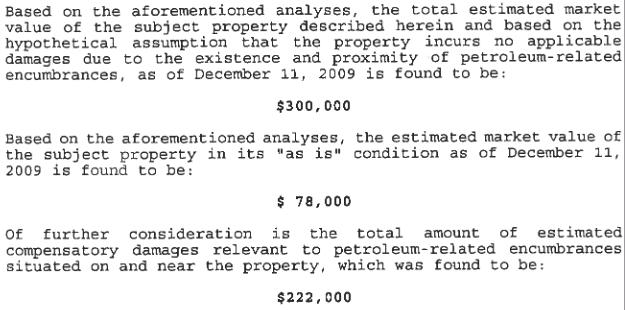
From a professional appraisal conducted on the Ruggianos’ property (link at bottom of this post)

The Ruggiero’s ten-year-old daughter has been diagnosed with asthma. Christine has experienced rashes, nausea and memory loss. Tim has loss of sensation in his extremities. Their home and 10-acre horse property have been devalued from $257,330 to $75,240. (There’s a link to the appraisal at the bottom of this post. It’s worth reading in detail if you want to understand how drilling can devalue your property.) Because they and their neighbor do not own the mineral rights under their land, Aruba was able to drill next to their neighbor’s home and under the Ruggiero’s property,  where they keep their horses, without consent or notice. In fact, the day they started

Ruggiero kitchen

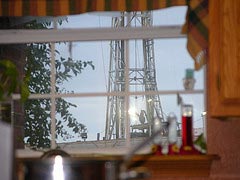
View from the Ruggieros’ kitchen

drilling the company cut down their fence where the horses were grazing. They were not told ahead of time that the company planned to drill there. Although Aruba put up a sound barrier, it is not long enough to cover the length of the house, so it does not help with the noise. They have a clear view of the rig and wastewater pit.

On the afternoon of October 29th 2009, Christine reports that while she was in the kitchen, she noticed a black smoky liquid shooting acrossthe pit onto the ground and into the neighbor’s trees. There was not an Aruba employee in sight, so Christine called the Texas Railroad Commission (TRC), and filed a complaint. Aruba only cleaned up the spill after the TRC arrived. Samples of the ground

Tim and Christine Ruggiero

Tim and Christine Ruggiero

were not taken until five days after the spill occurred, and Aruba had watered the area down for five days.

Christine was told that Aruba would conduct the tests and report the findings to the TRC. The TRC found problems with the pit that needed to be corrected. The TRC admitted that the areas should be tested for carcinogens, benzenes and hydrocarbons.

As Christine states, “Don’t self-report the spill and you don’t have to self-report what was in the spill, clean it up, and fill out all that paperwork. They [Aruba] exist for profit and profit only. Surface right owners are a mere nuisance and are expendable.”

Additional information:
Texas Monthly article
Copy of Ruggianos’ home appraisal
Earthworks Action

Posted in Personal stories | Tagged , , , , , | 9 Comments

Updates from topics covered in previous posts.

Fracking and fetal health
On a couple of occasions we’ve looked at scientific studies linking birth issues with a mother’s proximity to fracking wells.

On January 5, we looked at a study that examined Pennsylvania birth records from 2004 to 2011 to assess the health of infants born within a 2.5-kilometer radius of natural-gas fracking sites. They found that proximity to fracking wells increased the likelihood of low birth weight by more than half, from about 5.6 percent to more than 9 percent. The chances of a low Apgar score, a summary measure of the health of newborn children, roughly doubled, to more than 5 percent.

On December 16, we looked at another academic study that shows that exposure to frac water “could raise the risk of reproductive, metabolic, neurological and other diseases, especially in children who are exposed to EDCs [endocrine-disrupting chemicals].”

Today we have another study that looks at the connection between how close the mother is to natural gas drilling and birth outcomes in a study of 124,842 births in rural Colorado between 1996 and 2009. The study shows an association between density and proximity of natural gas wells within a 10-mile radius of maternal residence and an increase of as much as 30% in the prevalence of congenital heart defects.

Montana Cowgirl

Thanks to the Montana Cowgirl Blog, Montana’s #1 political blog, for putting us on her blogroll!      Click to check her out.

The oil and gas industry challenges all these studies, but let’s face it — that’s their style. If it doesn’t fit the “fracking is completely safe” narrative, they attack the messenger. These are credible scientific studies that either have been or will be reviewed by other scientists. The long-term impacts of human exposure to increased drilling in populated areas are the “unknown unknowns” that Professor Joe Ryan talked about on January 30.

Are we going to roll the dice on public health, or are we going to wait until the technology is safer and the health effects are known before we allow drilling to expand? The oil and gas in the shale isn’t going anywhere.

You can read a PDF version (471 KB) of the new study, and examine supplemental material (143 KB).

Railroad dangers
On January 21 we examined the dramatic increase in oil spills due to railway accidents and the vulnerability of Columbus to train disasters in the event of increased drilling along the Beartooths.

Today there’s some new data on shipments of oil by train that demonstrate our risk is increasing dramatically.

Shipments of crude oil by rail have exploded by more Rail shipments_oilthan 8,300 percent since 2006, effectively creating a new industry where one didn’t previously exist. As a result, regulators are now scrambling to figure out what to do about it.

As the chart indicates (click to enlarge), the United States is producing increasing quantities of crude oil and rail is the only viable shipping alternative. The gray line on the chart represents crude oil production in the United States; the green line shows rail car shipments of oil produced in the US.

There’s no help on the horizon, and as long as oil production continues to increase we’re going to see more accidents, more spillage and more danger in our community.

Last, here’s a link to a three part video series by WITV in Buffalo, New York, where rail safety is a substantial concern. Buffalo is a major railroad center, and much of the Bakken oil headed east goes through there. The report centers on the risks of leaks and explosions in a major metropolitan area. It highlights the DOT-111 tank car, which is part of an aging fleet with safety issues. If you watch the first video, the other two load in sequence.

And really really last, between the time I wrote this and posted it, a train from the Bakken spilled 12,000 gallons of oil between Winona and Red Wing, Minnesota. No major cleanup is planned.

Posted on by davidjkatz | 2 Comments

Energy Corporation of America (ECA), which recently announced plans to drill 50 wells along the Beartooth Front and promised to bring “the Bakken to the Big Horns [and the Beartooths] … and fundamentally change these areas the way it has changed other areas of the United States,” has been charged with dozens of violations by the Pennsylvania Department of Environmental Quality since 2008, and has paid over $50,000 in fines.

The majority of the violations involve three offenses:

  • discharging pollutional material into the local waters
  • failing to adhere to erosion and sediment (E&S) control standards
  • failing to restore or cap abandoned wells

ECA representatives have made a point in local meetings of touting the company’s safety record. I guess ECA CEO John Mork meant it when he said he was going to bring the Bakken to the Beartooths, but if fundamentally changing the Beartooth Front means spilling frac water into our rivers, count me out.

This information below was obtained from the Pennsylvania Department of Environmental Protection web site. This is what I have personally pulled out of the reports. I invite anyone to use the site to look more deeply, and I’ll be happy to publish new information.

ECA, I’m happy to give you space here on the blog to defend your safety record.

Date

Inspection type Nature of violation Penalty/
Fine
5/20/2008 Routine complete inspection Discharge of pollutional material to waters of Commonwealth $2400
7/14/2008 Routine complete inspection Excessive casing seat pressure Notice
8/7/2008 Complaint inspection Impoundment not structurally sound, impermeable, greater than 20” of seasonal high ground water table. Discharge of pollutional material to waters of Commonwealth; inadequate E&S plan $6000
9/3/2008 Compliance evaluation Discharge of pollutional material to waters of Commonwealth
3/17/2009 Routine complete inspection Discharge of pollutional material to waters of Commonwealth Notice
4/3/2009 Drilling alteration Failure to minimize accelerated erosion; fill side of pad not stabilized, primary sediment fence failing. Improperly installed sediment fence allowing runoff to flow freely. Runoff discharged into Little Trout Run. $3500
4/6/2009 Follow up inspection Deficiencies not corrected: accelerated erosion on fill side not stabilized; freeboard still not below 2 feet
5/15/2009 Routine complete inspection No E&S controls on site; the operator had disturbed approximately 2+ acres prior to this inspection without implementing E&S controls $4100
6/16/2009 Follow up inspection Failure to minimize accelerated erosion, implement E&S plan, maintain E&S controls. Failure to stabilize site until total site restoration
7/6/2009 Routine complete inspection Failure to minimize accelerated erosion, implement E&S plan, maintain E&S controls. Failure to stabilize site until total site restoration
7/7/2009 Routine complete inspection Failure to minimize accelerated erosion, implement E&S plan, maintain E&S controls, Failure to stabilize site until total site restoration. Potential for polluting substances reaching waters of the Commonwealth Notice
7/14/2009 Complaint inspection Failure to plug a well upon abandonment Notice
9/1/2009 Complaint inspection Failure to plug a well upon abandonment $6500
9/21/2009 Administrative file review Water sample from artesian flow of fluids revealed discharge of industrial waste to the ground. Fluid contained high levels of iron, manganese, aluminum. Fluids pooled around well head and production equipment and continued throughout a large portion of the site. It appears the artesian flow has been occurring for a long period of time.
11/18/2009 Complaint inspection Impoundment not structurally sound, greater than 20” of seasonal high ground water; potential for polluting substances reaching waters of the Commonwealth $19,950
3/1/2010 Routine Complete inspection Improperly lined pit ; Drilling w/in 100 ft of surface water or wetland w/o variance
3/16/2010 Routine Complete Completion Polluting substances allowed to discharge into waters of Commonwealth; failure to minimize erosion, maintain E&S controls, failure to stabilize site until total site restoration
6/2/2010 Complaint inspection Department observed multiple violations at the stream crossing location. Failure to minimize accelerated erosion, maintain E&S controls, failure to stabilize site until total site restoration; no E&S plan; polluting substances allowed to discharge into waters of the Commonwealth
12/1/2010 Complaint inspection Pumping and treating flowback/frac water at the site, and lost approximately 5 barrels of contaminated water. The water ran over the fill side of the site reaching the silt fence. Sediment has gotten through the E&S controls and needs to be addressed. $4239
12/2/2010 Compliance evaluation Discharge of pollutional material to waters of Commonwealth; failure to notify DEP of pollution incident; failure to properly treat residual waste; failure to adopt pollution prevention measures
12/6/2010 Routine completion Methane migrated to surface through cement in 9 5/8” annulus; failure to report defective, insufficient or improperly cemented casing w/in 24 hours or submit plan to correct w/in 30 days Notice
2/1/2011 Compliance evaluation Discharge of industrial waste to waters of Commonwealth without a permit Notice
2/3/2011 Compliance evaluation Discharge of industrial waste to waters of Commonwealth without a permit; recurring violation
2/8/2011 Administrative File Review Failure to submit well record within 30 days of completion of drilling $1000
4/1/2011 Routine completion Failure to restore well site within nine months after completion of drilling, failure to remove all pits, drilling supplies and equipment not needed for production Notice
11/3/2011 Follow up inspection Failure to implement and maintain BMPs in accordance with Chapter 102; failure to minimize accelerated erosion, implement an E&S plan, maintain E&S controls, failure to stabilize site until total site restoration Notice
12/5/2011 Complaint inspection Failure to restore well site within nine months after completion of drilling, failure to remove all pits, drilling supplies and equipment not needed for production Notice
4/11/2012 Routine inspection Residual waste is mismanaged
5/4/2012 Complaint inspection Failure to take all necessary measures to prevent spill, inadequate diking, potential pollution Notice
6/13/2013 Routine complete inspection Failure to adopt pollution prevention measures required or prescribed by DEP by handling materials that create a danger of pollution
7/16/2013 Routine complete inspection Discharge of industrial waste to waters of Commonwealth without a permit
7/17/2013 Routine complete inspection Discharge of industrial waste to waters of Commonwealth without permit
7/18/2012 Routine complete inspection Discharge of industrial waste to waters of Commonwealth without a permit $4239
8/29/2012 Routine complete inspection Failure to take all necessary measures to prevent spill. Inadequate diking, potential pollution
11/13/2013 Administrative file review No control and disposal/PPC plan or failure to implement PPC plan
1/14/2014 Routine/Partial inspection Failure to minimize accelerated erosion, implement E&S plan, maintain E&S controls, failure to stabilize site until total site restoration Notice
Posted on by davidjkatz | 15 Comments