A personal story: Helen Slottje, Ithaca, NY (with video)

“She changed the paradigm of human interaction with the oil and gas industry. As citizens we have the right to say no.”

Telling personal stories
The oil and gas boom has been underway for a number of years in many locations across North America, and there are now a lot of stories about individuals and families whose lives have been personally affected. This post is part of a regular weekly series of those stories on this blog to help you envision what could happen if drilling expands along the Beartooth Front, and what is possible to keep that from happening.

This personal story is different from the others we have presented. It is not the story of someone whose property or health was affected by drilling, but of a grass roots activist whose dedication changed the future for more than 170 towns in New York.

The lesson to be learned is that it is possible for individuals to stand up to the oil and gas industry and use the law to reclaim control over the future of their communities.

You can see other personal stories in this series by clicking here. Note that you can find more by clicking “Older Posts” at the bottom of the page.

Helen Slottje, Ithaca, New York
Helen Slottje is the deserving winner of this year’s Goldman Environmental Prize, which annually honors grassroots environmental heroes across the globe. She was awarded $175,000, the largest award in the world for environmental activists.
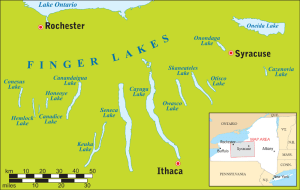
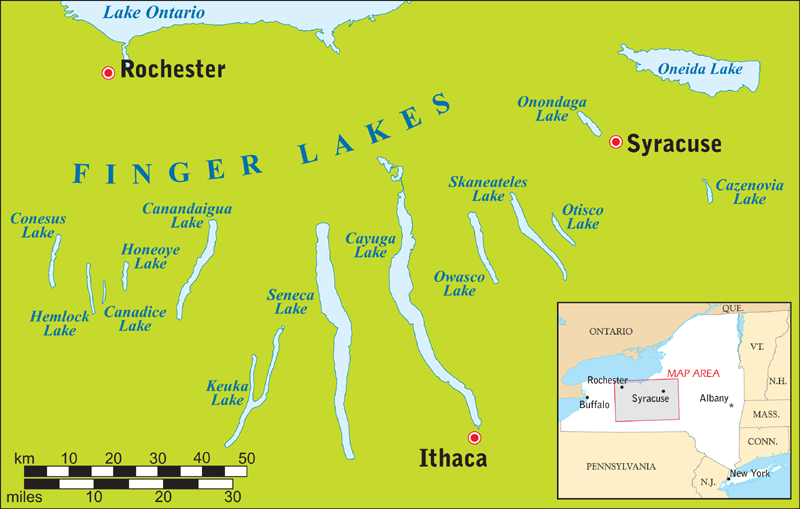
Finger Lakes (click to enlarge)

Her story is inspiring. She was working as a commercial attorney at a large Boston law firm when she met her husband David, a colleague at the firm. Slottje left her corporate practice and moved to Ithaca, New York, where David had moved to join a family business. They fell in love with the rustic, small-town charm of the Finger Lakes region and decided to stay for good.

One spring day in 2009, Slottje saw an ad in the local paper announcing a meeting about gas drilling organized by a local  community group. She remembered seeing gas leases on every single property when she was helping her brother-in-law find a home in Ithaca. Her curiosity piqued, she went to the meeting—and left horrified at the pictures she had seen.

Once pristine landscapes were scarred by construction, drilling equipment and waste pits. Families were left to deal with dirty water and air, suffering health problems as a result. Horror turned to resolve, and Slottje decided to stay in Ithaca to see this fight through.

Helen Slottje
Helen Slottje

Impact
Slottje’s first project as a volunteer was to build a legal case against a large industrial complex being built by a fracking company at a vacant former military storage facility in the nearby town of Horseheads. While the case ultimately went the industry’s way, Slottje gained insight into the importance of local zoning and land use laws to limit the adverse impacts of one property’s use on others. Further research led Slottje to conclude that in much the same way as local laws determine how much light and noise is permissible from activities in town, individual townships could use zoning laws to outright ban fracking within their borders.

Slottje first discussed this idea with a gas drilling task force in the town of Ulysses and, with her husband David, helped the group develop a local law to ban fracking. When community members learned of the task force’s work, they supported the committee by drafting a petition to ban fracking, and residents interested in signing it began flooding town hall with phone calls. Word spread to neighboring towns, and soon enough, citizens in towns around the state began to develop similar petitions of their own. Over the next several months, Slottje drove hundreds of miles from one town to the next, providing hundreds of hours of pro bono legal help at community meetings.

While most local citizens and town boards embraced this strategy, the gas industry openly ridiculed and threatened Slottje. Pro-industry individuals verbally assaulted her, followed her to her car late at night after community meetings, and attempted to intimidate her.

When Dryden’s town board unanimously passed a law banning fracking in 2011, the gas industry sued the town. The industry lost the battle in trial court, and following an unsuccessful appeal, the case is now before the state’s highest court.

More than 170 towns and cities throughout New York have passed local laws prohibiting fracking based on Slottje’s innovative legal framework. Many more, inspired by successes of small towns winning over powerful corporations, are working on bans—and informing grassroots organizations in states like California, Texas and Colorado where communities are also grappling with ways to regulate fracking.

The Future
Slottje said she’ll use the prestige and money that comes with the award to raise global awareness of her campaign. She believes

“Fracking is a symptom of a much larger problem in our society, an oligarchy, a complete separation of people making decisions and those whose lives they affect.”

Slottje, 46, also plans to take the California bar exam, since anti-fracking activists have gained ground in that state, in preparation for taking on a greater role there. A ban this week in Beverly Hills clearly borrowed directly from Slottje’s work, even though she was not contacted for that case.

And she says she’ll put more of her legal work online so that communities can use her local control argument in their own legal battles.

This short video provides a summary of what she accomplished, and gives us this inspirational quote:

“She changed the paradigm of human interaction with the oil and gas industry. As citizens we have the right to say no. “

The lesson for Montana
This is a powerful lesson for us in Stillwater and Carbon Counties. The conventional wisdom is that Montana law enables the oil and gas industry to do whatever they want, and communities are powerless to stop them. We have discussed this power over and over, and it is formidable.

But what Slottje discovered in New York is also true in Montana. Local communities have the right to stand up and say no. We need to organize at the grass roots level and work with our County Commissioners and Water Conservation Boards to protect landowner rights and preserve the Beartooth Front.
Posted in Personal stories | Tagged , , , , , , , | 5 Comments

Update: NPR on the personal story of Bob and Lisa Parr (audio)

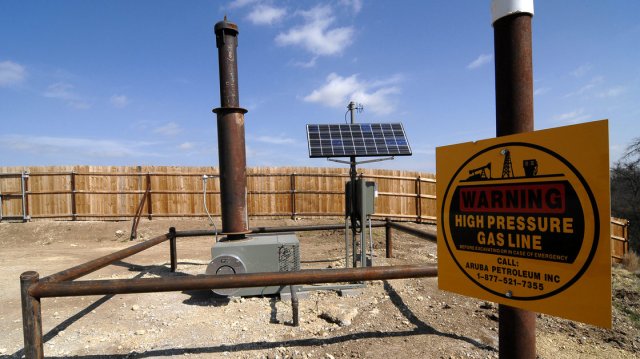
Equipment installed by Aruba Petroleum at a natural gas well near Decatur, Texas. Bob and Lisa Parr sued Aruba, calling its drilling sites a nuisance to the family's health. A jury awarded the family $2.9 million.

Equipment installed by Aruba Petroleum at a natural gas well near Decatur, Texas. Bob and Lisa Parr sued Aruba, calling its drilling sites a nuisance to the family’s health. A jury awarded the family $2.9 million.

Today we have an update from NPR on last week’s personal story of Bob and Lisa Parr, who last week were awarded a judgment of $2.9 million against Aruba Petroleum for creating a nuisance on their property.

If you are receiving this via email, or if the media player below doesn’t load, you can click here to listen to the update. This may take a minute to load.


Transcript follows:
A Dallas jury recently awarded nearly $3 million to a family who said they were poisoned by a natural gas drilling operation near their North Texas ranch. The verdict, reached on April 22, is being called a landmark by opponents of the drilling technique, called hydraulic fracturing or “fracking.”

Bob and Lisa Parr have been telling their story for a while. They even appeared in the anti-fracking documentary Gasland II. But since the verdict, Lisa Parr says it feels like she’s been telling it nonstop.

“I started feeling bad. I blew it off as flu,” she says. But months went by, and she kept feeling sick.

“I had a rash throughout my body,” Lisa Parr says. “My lymph nodes stuck out in my neck like the size of pecans. There was four of them on each side.”

Bob Parr and their daughter eventually developed symptoms as well, including dizziness, nosebleeds, rashes, stomach problems and difficulty breathing.

The doctors treating Lisa Parr decided the cause was something in the environment. The family talked to neighbors, one of whom kept a log of spills and leaks at nearby natural gas sites.

“When they showed me those dates, I flipped back, and those were the dates I was either in the emergency room or at a doctor’s office,” she says.

The Parrs sued several nearby drilling companies. Of those suits, all but one was dismissed or settled out of court. Bob Parr says one remaining company, Aruba Petroleum, never offered to settle. “They were kind of the main player there next to our house,” he says.

He believes Aruba was responsible for the family’s illness. Last week, a jury agreed.

“It is rare for any case to go to the jury in a civil case, just simply because most settle,” he says.

When it comes to drilling companies, those settlements often include gag orders, meaning the people involved can’t talk about their experiences.

“[Aruba Petroleum] apparently decided to draw the line, which as it turns out was not necessarily a very good decision,” McGarity says.

In a statement after the verdict, the company expressed its disappointment, saying it’s in compliance with Texas air quality rules. But that doesn’t necessarily matter, because the Parrs filed a nuisance claim. It’s the same kind of suit that’s sometimes brought against unruly neighbors, even if they haven’t been charged with a crime.

“The interesting aspect of the nuisance claim is that it is specifically in addition to the public law,” says professor Hannah Wiseman, who studies fracking regulations at Florida State University.

She says nuisance claims are increasing in parts of the country where oil and gas drilling happens near people’s homes.

“They allow this very broad argument that property use has been unreasonably interfered with, and I think they in part fill in what some people see as gaps in the regulatory regime,” Wiseman says.

She expects more nuisance claims, especially in places like Texas, where regulations are relatively lax. The Parrs’ lawyer is already getting calls from other property owners.

As for the Parrs, they say they never set out to fight fracking, just one irresponsible company. A judge still needs to sign off on the verdict. If that happens, Aruba Petroleum is expected to appeal.

Posted in Personal stories, Shared Letters and Posts | Tagged , , | Leave a comment

If you’re reading this blog, you probably follow environmental issues and see a lot of articles, videos and information every day: emails from friends, links on social media sites, alerts from various news sources. I always find it interesting to see which of these really excite people. Some articles show up in my inbox over and over, with comments demanding, “You have to read this.”

Krupp_BloombergOne article that was sent to me many times yesterday was an op-ed that appeared in the Wednesday New York Times. The authors were credible representatives of business and the environmental movement — former New York mayor Michael Bloomberg and Fred Krupp, President of the Environmental Defense Fund. The title of the articles was The Right Way to Develop Shale Gas.

In the article the two authors from contrasting backgrounds present reasoned balance between their points of view — business and economic development that fracking enables and the environmental havoc that it causes.

But what seems reasonable in the New York Times doesn’t have much relevance for southern Montana.

The argument
The arguments presented are not unreasonable. On the positive side they argue that the fracking boom has been a good thing because it is

lowering energy costs, creating new jobs, boosting domestic manufacturing and delivering some measurable environmental benefits as well. Unlike coal, natural gas produces minuscule amounts of such toxic air pollutants as sulfur dioxide and mercury when burned — so the transition from coal- to natural-gas-fired electricity generation is improving overall air quality, which improves public health. There’s also a potential climate benefit, since natural-gas-fired plants emit roughly half the carbon dioxide of coal-fired ones.

They also recognize the legitimate concerns of environmentalists, all of which we’ve talked about on this blog:

(The) opposition to shale gas development is driven by very real instances of localized air and groundwater pollution. Because of intensive shale-gas development, the small town of Pinedale, Wyo., has experienced smog concentrations comparable to those of Los Angeles. The industry asserts that hydraulic fracturing does not contaminate water supplies when fluids are shot at high pressure into shale deposits to release gas. But inspection records in several states show that mistakes or accidents in other phases of the process — poor well construction or surface spills, for example — have done so.

They argue that we can bridge the gap between the two sides through regulation, and provide examples of how methane emission can be reduced and groundwater contamination can be controlled.

This, they say, is “essentially a data management and acquisition problem.” Let’s measure and demand controls. In this way we can “make shale gas development safer…and help the industry regain public trust.”

This is an important article, written by two credible people and published in America’s national newspaper. It will have significant reach and be quoted by lots of people as a balanced approach to oil and gas drilling. It’s hard to disagree with their recommendations. We absolutely need to reduce groundwater contamination and emissions of methane and other pollutants.

Why this argument doesn’t work
Because the article is significant, it’s also important to clearly say what’s wrong with it.

Bloomberg and Krupp have a macro point of view. They argue that controlling airbone pollution and reducing the likelihood of spills and contamination is a good thing. Of course it is. All of us would applaud any regulation that reduces greenhouse gas emissions and makes it less likely that you’re going to get benzene in your well water.

But the notion that a straightforward compromise can achieve both a “safer” environment and the financial benefits of fracking is just hogwash. Maybe it somehow works at a 35,000 foot level (although I doubt it — a “safer” environment built on compromise is hardly a safe environment), but on the ground it just doesn’t work.

On the ground fracking involves bringing heavy industry into people’s back yards, and the two just don’t mix. That’s why fracking opponents are so angry. They have seen how well-funded corporations come in to communities and leave devastation in their wakes. That’s why they are voting for moratoriums.

Where we stand
Here’s where we stand in Carbon and Stillwater Counties:

  • We’ve got a serial polluter standing on our doorstep ready to drill 50 wells in an attempt to “bring the Bakken to the Beartooths.”
  • The EPA and the state of Montana currently offer no significant barriers to stop them from tearing up our land and water in the same irresponsible way they have drilled in other places. Congressman and would-be Senator Steve Daines, for example, is happy to tell you, “I will not support policies that would harm America’s economy while having an insignificant or uncertain benefit to the environment.”
  • ECA has the resources to drill these wells in a relatively short period of time, way before Washington or Helena can put any regulations in place to stop them, even if they were inclined to do so.
  • Individual landowners have no rights or ability to stop mineral rights holders from using their land to extract oil. The overlay of heavy industry on agricultural and ranch land will destroy property values and render the land unusable for its original purpose after the drillers leave.
  • There will be incidents of water contamination here, just as there have been in every other area where the oil and gas boom has taken place — Pennsylvania, West Virginia, Texas, Colorado, Wyoming, North Dakota and other parts of Montana. Our watershed is fragile. Contamination could be disastrous.

So thank you Mayor Bloomberg and Mr. Krupp. We applaud your efforts to promote rational debate, and we wish you success in your efforts to achieve significant policy change to reduce pollutants and protect water.

But forgive us if we don’t agree that this is a data management and acquisition problem. Sorry if we don’t wait around while it takes years to develop the laws and regulations you are promoting. We need to be in action to protect our water and property rights today. And we need to move like our hair is on fire to enact local ordinances that will protect our water, our property rights, and our way of life.

Update 5/10/2014: Two on-point letters to the editor in response to the Bloombert-Krupp op ed in the New York Times.

Posted on by davidjkatz | 8 Comments

An open letter from Lou Allstadt to Rex Tillerson

From time to time this blog reposts articles and letters that are relevant to our topic.

Rex Tillerson
Rex Tillerson: an icon of hypocrisy

Today we have a powerful open letter from Louis Allstadt to Preserve the Beartooth Front icon Rex Tillerson. I’m sure you remember Rex. He’s the CEO of ExxonMobil who publicly complained that “dysfunctional regulation of hydraulic fracturing is holding back the American economic recovery, growth and global competitiveness,” and then joined with his neighbors in a lawsuit to block construction of a large water tower, used to support fracking operations, next to his Texas home. We have even named the Rex Tillerson Fracking Hypocrite Award after him.

Lou Allstadt
Lou Allstadt

Allstadt is a former oil company executive. Up until his retirement in 2000, he was the executive vice president of Mobil oil, before it merged with Exxon. Over 31 years spent with the company, he ran its marketing and refining in Japan and managed its worldwide supply, trading and transportation operations. He knows about oil.

Since he retired Allstadt has become a vocal oppornent of fracking in New York state, and more recently a crusader in the fight to mitigate climate change. He says of fracking, “…you might be able to stop someone from drilling in your town, but the impacts are going to get everybody. It doesn’t matter where you live.”

Allstadt took the occasion of the announcement of Tillerson’s lawsuit in February to write this open letter to him. It is a strong statement about the impacts of oil and gas drilling and how it affects people and communities.

Here is the letter in its entirety:

Dear Rex,

We have never met, but I worked for your company for six months immediately after the ExxonMobil merger, the implementation of which I coordinated from the Mobil side. That was after thirty years with Mobil Oil Corporation, where just prior to the merger I had been an Executive Vice President and Operating Officer for Exploration and Producing in the U.S., Canada and Latin America. I now live in upstate New York.

For the past five years, I have been actively trying to keep your company and the rest of the industry from fracking here. I understand from several press articles that you have fracking issues of your own, with a fracking water tower and truck traffic possibly detracting from your view and the value of your home.

In response to the prospect of fracking ruining our communities, many New York towns have passed zoning laws that prohibit heavy industry, including any activities associated with drilling for oil and gas. Those laws, along with very little prospect for economic gas production in New York, mean that we probably will not have to look at fracking water towers, let alone live next to fracking well pads. I say probably, because your industry is still fighting those zoning laws in the courts.

Louis Allstadt quoteIronically, your reasoning at the Bartonville, Texas town council meetings is virtually identical to the reasoning that I and many other citizens used to convince our local town councils to pass laws that prohibit the very problem you have encountered, plus all of the other infrastructure and waste disposal issues associated with fracking.

No one should have to live near well pads, compression stations, incessant heavy truck traffic, or fracking water towers, nor should they have their water or air contaminated. You and I love the places where we live, but in the end, if they are ruined by fracking or frack water tanks, we can afford to pack up and go someplace else. However, many people can’t afford to move away when they can no longer drink the water or breathe the air because they are too close to one of your well pads or compressor stations.

My efforts to prevent fracking started over water — not the prospect of having to see a water tank from my home, but rather regulations that would allow gas wells near our sources of drinking water, in addition to well pads next to our homes, schools, hospitals and nursing homes. These issues are legitimate, but they are localized. I am now much more concerned with the greenhouse gas impacts of fossil fuels in general, and particularly the huge impact of methane emissions from natural gas production and transportation.  These are global problems that local zoning cannot protect against. Only a major shift toward renewable energy sources can begin to mitigate their catastrophic climate impacts.

Before closing, I should explain why I have referred to ExxonMobil as “your company.” For several years after retiring I thought of ExxonMobil as “my company.” I thought that the company’s rigor and discipline in investing in sound projects was as good as it gets, and ExxonMobil was my largest single investment. I no longer own any shares of ExxonMobil or any other fossil fuel company.  I would prefer to be an early investor in alternative energy for the 21st century rather than hanging on to dwindling prospects for investments in 19thand 20th century fossil fuels.

It is time that ExxonMobil started shifting away from oil and gas, and toward alternatives — both for environmental reasons and to protect the long-term viability of the company. Many large energy producers and consumers, including ExxonMobil, are building a carbon fee into their long-term planning assumptions.  Actively supporting the phase-in of a carbon fee would be one way to move the company into the 21st century. Recognizing that methane emissions disqualify natural gas as a “bridge fuel” is another.

Good luck with that fracking water tank. I hope you don’t have to move, and also that you will help a lot of other people stay in the homes they love.

Regards,

Lou Allstadt

Posted in Shared Letters and Posts | Tagged , , , , , , , , , | 2 Comments

A personal story: Bob and Lisa Parr, Wise County, Texas

Telling personal stories
The oil and gas boom has been underway for a number of years in many locations across North America, and there are now a lot of stories about individuals and families whose lives have been personally affected. This post is part of a regular weekly series of those stories on this blog to help you envision what could happen if drilling expands along the Beartooth Front.

You’ll know of today’s story if you’ve been following the news for the last week. It’s the story of the couple who won a $2.9 million judgment against an oil & gas company for “creating a private nuisance.” Our story today gets into the detail of what was behind the judgment.

There are three things that you should note as you read this. First, the couple did not have a well on their property. They did not have a contract or receive any payments. They just had the great misfortune to live near a bunch of wells that ruined their health, the nearest one over an eighth of a mile away.

The second thing follows yesterday’s post about the environmental and health impacts of the oil and gas boom. They are real, they are more significant than people want to believe, and there are going to be more people whose health is going to be ruined as drilling expands into their neighborhoods.

And the third is the familiar refrain on this blog of the helplessness or unwillingness of state and federal agencies to step in and stop a serious problem.

These are lessons we need to take to heart along the Beartooth Front. Oil and gas drilling affects everyone in a community, it will have a significant impact, and government agencies will not help us. If we want to keep this from happening, we will need to take the responsibility to stop it ourselves.

You can see other personal stories in this series by clicking here. Note that you can find more by clicking “Older Posts” at the bottom of the page.

Bob and Lisa Parr, Wise County, Texas
Bob and Lisa Parr were neighbors of Tim and Christine Ruggiero in Wise County, Texas in 2008 when drilling began in their neighborhood. We told the Ruggieros’ story on this blog a few months ago. They were the family whose property was devalued from $257,330 to $75,240 because of damage done to their property during drilling

Bob, Lisa and Emma at the wedding

In May 2008, Lisa had married Bob Parr on golden colored stone steps at his country home in east Wise County in  Allison, Texas. The back porch overlooks a picturesque  setting. Horses and cows graze lazily in a green pasture. Denton Creek winds along the back of the property, bringing with it a lush river of trees along either side.

It seems impossible that such an idyllic scene would become the backdrop for the poisoning of the Parr family by a laundry list of industrial neurotoxins. But the impossible would quickly come to pass. Lisa first felt sick in fall 2008. As the immense trees across her 40 acre homestead dropped pecans, she began to experience a host of unexplained ailments. The typical remedies didn’t work.

‘I had nine rounds of steroids in six months.’ she said. “It just blew me up and didn’t get rid of the problem.”

Lisa was treated by eight different doctors over the course of a year. A source of the  sickness was never determined. In June 2009,  exhausting everything he knew medically, her internal specialist suggested that something in the  environment might be causing her various ailments.

In early fall 2009, she visited an environmental doctor who conñrmed the presence of  neurotoxins in her blood that matched chemicals used in natural gas production.

Medical tests confirmed the toxins in Lisa’s system matched toxins found in the  atmosphere in an air quality investigation conducted by the Texas Commission of Environmental Quality (TCEQ) at a nearby well site.

A strong odor
On the evening of July 25, 2010, the Parrs smelled a strong odor emanating from a frac tank at a site operated by Aruba Petroleum of Plano, Texas. They reported it, and investigators arrived within hours to capture air samples.

Odors were detected up to a quarter mile from the well site. Investigator Damon  Armstrong reported that a “plume”  from the tank was “visible with the naked
eye.” The petroleum-like odor was so intense the investigator himself felt sick in the short time he was there, noting dizziness and a sore throat.

The analysis found  five compounds that exceeded safe values for short-term health  and another 20 exceeded safe levels for long-term effects.

The investigation found elevated levels of ethane. pentane, hexane. octane, xylene and nonane, all potentially toxic chemicals.

Four days later, a medical test  discovered the same chemicals in Lisa’s body.

‘The environmental specialist ran numerous tests on me.” Lisa said. “l had about 20 of the chemicals they use ín the oil and gas industry in my tissues and in my blood system. Never in my life had I been so sick.

Aruba was the operator for many of the wells surrounding the Parr home. TCEQ received  dozens of odor, spill and nuisance complaints from Allison residents in the community, and, according to a 2010 news article, enforcement actions were pending against two nearby Aruba sites, one for nuisance and another for violations without authorization.

The company had been fined more than $30,000 in the year prior to the 2010 article by the TCEQ. Those of you who have followed this blog will note that ECA, which is drilling wells in Belfry and Dean, has a similar track record in Pennsylvania, where they have 66 inspections with violations, 90 separate violations, and 55 enforcement actions with fines totaling over $80,000; and 70 more violations in West Virginia.

A perfect location to attract chemicals and toxins
While the Parrs had no wells on their property, their location makes it a natural pocket for collecting heavy toxins.

“We live below a ridge in a little valley,” Bob said. “At night when the wind dies down, anything down here sits and settles. Some of these chemicals and toxins are heavier than the air.“

Lisa’s symptoms continued to worsen. “l was pretty much losing my memory,” she said. ‘I couldn’t walk straight and I kept falling down. I started shaking uncontrollably. My face  blew up. I was stuttering very bad.”

At one point the lymph nodes on her neck swelled as big as pecans. A doctor suspectd she had lymphatic canœr, but it turned out to be only a reaction to the toxins.

“Waiting on those results was two days of emotional trauma.” she said.

Bob and their seven-year old daughter Emma felt sick as well.

Bob and lisa parr_emma“My daughter began having severe nosebleeds,” she said.  “She’d wake me up at 6am crying, covered in blood.”

Emma was diagnosed with asthma. She’d never had any respiratory problems. She also started breaking out in rashes and having stomach problems.

bob parr nosebleedBob also suffered from nosebleeds. “I’m 50 years old and probably  had no more than three or four nosebleeds in my entire lifetime,” Bob said. “All of a sudden I’m getting them three times a week. It was odd.”

“I hired someone to do water and air sampling at the home,” Lisa said. “The methane level in my daughter’s  room was at asphyxiation levels, barely lower than what it was outside our home.”

She showed the results to her doctor. who told her to leave her home within 48 hours.

“The doctor told me right then,” she said, pausing as her voice cracked and a tear streamed across her left cheek. “I had to move immediately because if I did not, we would have to  spend more time and money on hospitalization, on chemotherapy and morticians for my whole family.”

On Saturday, Aug. 28, 2010, they said goodbye to what was once their dream home and moved into Bob’s office.

Not the sickly type
Bob and Lisa Parr aren’t  the sickly type. Bob built his home in 2001. He’s enjoyed a long career in stone masonry and raising cattle. His home reflects the rugged outdoor lifestyle he enjoys. Walls bear the trophies of big-game hunting in the wilds of Alaska. Black bear, mountain lions and elk are mounted on high wooden walls.

“We love it here,”  Lisa said. “We’re secluded, private. We just wanted to be  alone, and  we’ve been run out of our house. It’s  not right. What’s even more not right is we thought
TCEQ would come out and help us — they would clean up this mess.”

“We had no help. We have someone who is contaminating our air. It has affected our cattle. We‘ve lost pets. We’ve lost chickens. We all got sick, and we got no help,” she said.

Tony Walker regional  director for TCEQ, said, “We don’t have the authority to shut down (a facility), but if we have to we can contact the attorney general and ask them to step in.”

The Parrs file suit
In 2011 the Parrs had had enough. They filed suit against Aruba.

The common practice in a case where the evidence is as clear as it is in this one is that the drilling company will settle, and one of the provisions of the settlement will be a gag order that prevents the damaged family from talking about the details of the settlement for the rest of their lives. This leaves the rest of the world in the dark about what the company admitted to and what the nature of the damages is.

But in this case, perhaps for the first time in history, Aruba took the case to trial. It wasn’t because they felt they were blameless or there weren’t damages, but they felt that because there were other drilling companies in the area, and because Aruba had met state standards, there is no way they could be held at fault.

Bob and Lisa today
Bob and Lisa interviewed after the jury awarded them $2.9 million

 But a jury disagreed. By a 5-1 vote, the jury awarded the Parrs $2.9 million in damages. The jury decided that Aruba “intentionally created a private nuisance,” awarding $275,000 for losses of property value, $2 million for past physical pain and suffering, $250,000 for future physical pain and suffering, and $400,000 for mental anguish.”

The verdict was less than the Parrs had sought in their complaint, which was $66 million in damages. This is because the jury rejected the Parrs’ claim that Aruba acted with malice, therefore denying their bid for exemplary damages, according to a Law360 report (login required).


Posted in Personal stories | Tagged , , , , , , , , , , , | 15 Comments

When we look at the impacts of the oil boom on environment and health, it is important to note that the rise of fracking technology is a relatively recent phenomenon. The Bakken boom that so dominates the news today was just getting started ten short years ago. It takes time for the environmental outcomes to develop, and it takes time to study and measure what those outcomes are. As we study, the outcomes will begin to be known over time.

So we should take note that three separate studies released last week point to three very different dangers of oil and gas drilling. The first two have to do with the large quantities of poisons we are releasing into our air, water and earth; and the third, a review of peer-reviewed studies, concludes that fracking is just not safe.

Methane emissions
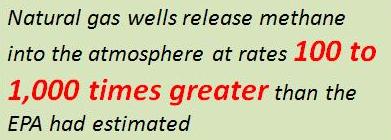
The first report, released last Monday, delivers the disturbing news that natural gas wells in southwestern Pennsylvania released methane into the atmosphere at rates that were 100 to 1,000 times greater than federal regulators had estimated.

pulloutaScientists found that drilling activities at seven well pads in the booming Marcellus shale formation emitted 34 grams of methane per second, on average. The Environmental Protection Agency has estimated that such drilling releases between 0.04 grams and 0.30 grams of methane per second.

The researchers point out that previous EPA research has largely been subject to the whims of the industry, which has a say over where and when the agency has access to drilling sites. The new report, from Purdue University, used a plane equipped with technology to measure greenhouse gas levels in the air above the sites..

The Los Angeles Times reports that “the study, published Monday in the Proceedings of the National Academy of Sciences, adds to a growing body of research that suggests the EPA is gravely underestimating methane emissions from oil and gas operations.”

Radioactive waste
On Tuesday,  a detailed report published in Environmental Health Perspectives (EHP), a peer-reviewed scientific journal backed by the National Institutes of Health, is particulary troubling for the Beartooth Front, which depends on a fragile ecosystem for its waters.

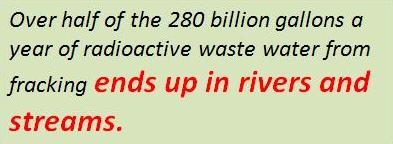
pulloutbThe study concludes that after a decade of fracking, oversight of the industry’s radioactive waste is so lacking that over half of the 280 billion gallons a year of radioactive waste water from fracking ends up in rivers and streams.

The most common form of radioactivity in shale waste comes from radium-226, which has a half-life of roughly 1,600 years, which means that we are creating a permanent radioactive emission problem.

What’s worse, the radium often winds up accumulating on the surfaces it comes into contact with – dirt, pipes and holding tanks. Combined with other elements like barium or strontium, the radium can form radioactive flakes on metal pipes used to transport the wastewater.

In filters, like the ones recently discovered illegally dumped in the Bakken, the radioactive materials can also start to build up.

This is a familiar story — the oil and gas industry is not being regulated and they’re doing what they can get away with.

Health effects
The third study, released Wednesday, was conducted by the Physicians Scientists & Engineers for Healthy Energy, who compiled “the first systematic literature review” of peer-reviewed studies on the effects of fracking on public health and found the majority of research points to dangerous risks to public health, with many opportunities for toxic exposure.

The study concluded that fracking likely produces public health risks and “elevated levels of toxic compounds in the environment” in nearly all stages of the process.

pulloutdAccording to the “near exhaustive review” of fracking research, environmental pollution is found “in a number of places and through multiple processes in the lifecycle of shale gas development,” the report states. “These sources include the shale gas production and processing activities (i.e., drilling, hydraulic fracturing, hydrocarbon processing and production, wastewater disposal phases of development); the transmission and distribution of the gas to market (i.e., in transmission lines and distribution pipes); and the transportation of water, sand, chemicals, and wastewater before, during, and after hydraulic fracturing.”

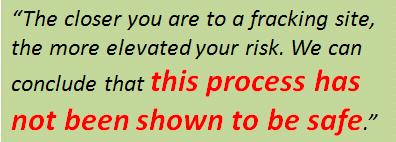
“It’s clear that the closer you are [to a fracking site], the more elevated your risk,” said lead author Seth Shonkoff, from the University of California-Berkeley. “We can conclude that this process has not been shown to be safe.”

Drilling must be done responsibly or not at all
So there you have it. Three studies in three days. One says we’re releasing, by a factor of at least 100 times, more methane, a greenhouse gas, into our atmosphere, through oil and gas drilling. The second says that half of the radioactive waste produced in fracking winds up in our rivers and streams. The third says that fracking causes negative health effects at every stage of the process, and the closer you are to a fracking well, the greater your risk.

We have a responsibility to our community and our way of life to make sure that any drilling done in southern Montana is done responsibly. That is the bottom line. If that’s not possible, then our primary responsibility is to preserve our community.

Posted on by davidjkatz | 4 Comments

Billings Gazette Guest Opinion: Mary E Fitzpatrick

Good neighbor agreements take 2 sides

Reprinted from the April 27, 2014 edition of the Billings Gazette
by Mary E Fitzpatrick

Thanks, Gazette editorial board (Getting along with Beartooth neighbors, April 3), for highlighting a solution that could resolve community concerns around oil and gas development on the Beartooth Front: a happy medium where a healthy environment and industrial development can coexist, similar to the Good Neighbor Agreement with the Stillwater Mining Company. But it’s essential to remember that the Good Neighbor Agreement did not happen by itself. Nor was it simply the result of altruism by the Stillwater Mining Company.

The Good Neighbor Agreement is a negotiated settlement between the Stillwater Mining Company and three citizen-run conservation groups, whereby two platinum-palladium mines, deep in Stillwater and Sweet Grass counties, bus in their workers each day, allow citizen oversight of mine activities, and meet water quality standards that exceed state regulations. The agreement is a national model of how an extractive industry can work with local citizens concerned about increased traffic, noise, and the quality of air and water.

3 citizens groups
While SMC deserves a lot of credit for its part in the GNA, its proven environmental record and for being willing to promote it to other mining companies, the GNA was made possible by the dogged determination of the local grassroots citizen organizations Stillwater Protective Association, Cottonwood Resource Council and Northern Plains Resource Council. Frequently the citizens’ side of this agreement goes unrecognized, but it really does take all four parties to work.

The many shortcomings of laws and regulations, and the agencies that are supposed to enforce them, often leave communities to deal on their own with the consequences of irresponsible developers only seeking profit. Anyone interested in ensuring that the Energy Corporation of America is a “good neighbor” should understand that educated, organized citizens are essential in making that happen. ECA has piled up over a hundred environmental violations in other states; we cannot just expect better behavior here. In fact, John Mork, ECA’s CEO, has threatened to make our area look like the Bakken.

If the oil and gas industry wants to become a responsible part of our communities, they need to communicate with citizens who live here. If they’re willing to come to the table, there could be a way to work out a favorable agreement, but only if they’re willing to negotiate, take local concerns seriously, and be accountable for how they operate.

Concerned about ECA
So far, the ECA hasn’t shown the slightest interest in the community. Citizens have been ignored, shut out of the process, and slighted by the company’s attorney. On top of that, the Board of Oil and Gas Conservation is doing its best to keep ECA happy and unaccountable to its neighbors. Living with the oil and gas industry in Carbon, Stillwater and Yellowstone counties is going to take a great deal of coordination and cooperation between citizens and operators. We have already seen that ECA is not going to do it if it doesn’t have to.

If our communities want to end the “culture of conflict” between citizens and the oil and gas industry, we should expect nothing less from ECA than the type of commitment made by Stillwater Mining Company through the Good Neighbor Agreement. It will take from us citizens nothing less than the effort and doggedness shown by SPA, CRC and Northern Plains members — and the support of our communities in doing so.

Mary E. Fitzpatrick, PhD, of Billings is a member and former chair of Northern Plains Resource Council.

Posted in Shared Letters and Posts | Tagged , , , , , , , , | 1 Comment

Billings Gazette Letter to the Editor: Pete Dronkers

The following letter to the editor appeared in the Billings Gazette on April 18. As the letter makes clear, ECA is just another company out to exploit oil reserves without concern for the impact they have on the local community. Their track record shows this. In Pennsylvania,  66 inspections with violations, 90 separate violations, and 55 enforcement actions with fines totaling over $80,000; 70 more violations in West Virginia. As the letter writer says, “It’s time to demand better.”

To the Editor:

When I contacted Energy Corporation of America — one of the companies hoping to develop shale oil along the Beartooth Front — I asked if they’d notify area landowners of the whereabouts of their recently purchased leases, give an idea of what they hope to do and ask for feedback. I also suggested they set up a website and post information and lease maps so people can learn about hydraulic fracturing and understand what type of infrastructure may be needed.

When the company responded, they provided a prewritten letter about how they’ve been around a long time and are good environmental stewards. But nothing changed. People on the Front still don’t know what’s going on. Although it’s possible to tediously track down federal lease information if you already know how, the company’s dealings with non-federal leases is a mystery, and could be far more acreage than all their federal holdings. Even when a permit to drill is filed, ECA still hasn’t agreed to inform people that live nearby or post info on their website.

This shows ECA’s total lack of transparency regarding their intentions. Many of us have a lot to lose, like the quality of our groundwater or having to live next to 20-foot-high flames of flared gas and toxic fumes. We want to know where ECA is cutting deals and where we need to be on alert before the drill rigs show up. By then, it’s too late to have a seat at the table.

It seems this company will tell us they’re good neighbors, but their actions have told us otherwise. It’s time to demand better.

Pete Dronkers

Note: Pete wrote an excellent piece about drilling along the Beartooth Front for Earthworks last December. I’ve been meaning to link to it for some time, so this is an opportunity. Recommended reading.

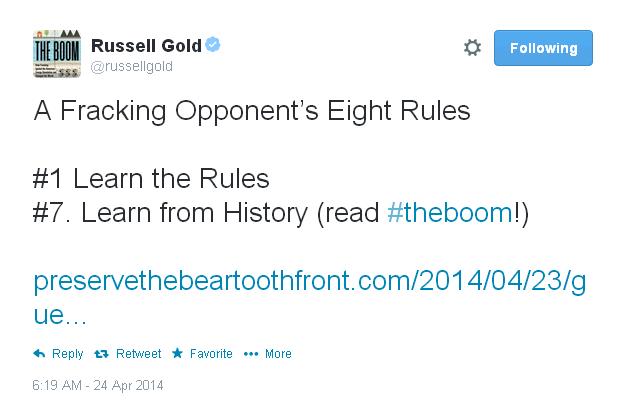
Last note for the week: Our recent guest post from Ralph Kisberg of Pennsylvania, who provided hard-learned lessons about fighting against expanded oil and gas drilling, was picked up on Twitter by Russell Gold, senior energy reporter for the Wall Street Journal and author of the best selling book The Boom: How Fracking Ignited the American Energy Revolution and Changed the World. A number of his 5000 followers checked in to the blog to take a look around, a welcome (if temporary) exposure to the larger world.
Russell Gold tweet

Posted in Shared Letters and Posts | Tagged , , , , , , , , , , | Leave a comment

Involuntary pooling: another way oil and gas companies take away your property rights

One of the consistent themes on this blog has been the ways in which uncontrolled oil and gas drilling takes away the rights of property owners. It threatens water supplies, creates noise, traffic and dust for which owners receive no compensation; and it reduces property values.

Today we’re going to discuss a legal process in oil and gas drilling that forces mineral rights owners to participate in oil and gas leasing. In Montana it’s called involuntary pooling or compulsory utilization. The process is also generally known in the oil and gas industry as  forced pooling. This mutation of eminent domain enables a forced legal taking of your property for the benefit of oil and gas drillers.

This post covers my understanding of the process, but it’s complicated and I am not an attorney. If someone who has personal experience with the process either as a landowner or attorney wants to provide more detail, clarification or correction, I’d welcome the participation.

Spacing units
To drill a well, the oil and gas operator needs to acquire, through purchase, lease, or agreement, the right to extract the oil and gas accessed by the well.  But what if there is one mineral owner in that area who does not want to allow drilling?  Then the operator has the ability to apply to the Montana Board of Oil and Gas Conservation (BOGC) for involuntary pooling for the non-complying owner. This allows the well to go forward. Laws regarding this practice are found in the Montana Oil and Gas Code, Section 82-11-202.

Before an operator can pool an area, the area must be included into a spacing unit.  To create a spacing unit, the BOGC, according to Montana Code 82-11-201, may “differ in size and shape…but may not be smaller than the maximum area that can be efficiently and economically drained by one well.”

When there are multiple owners within a spacing unit, then “the persons owning those interests may pool their interests for the development and operation of the spacing unit.” (82-11-202). They then apply to the BOGC for a pooling order, the process for which is spelled out in this section.

involuntary poolingOnce the spacing unit has been established, an affected mineral owner has four different options:

  • sell the mineral rights,
  • lease the minerals,
  • consent to voluntarily pool the mineral interest with the others and participate financially in the drilling operation, or
  • be a “non-consenting” owner and be involuntary pooled.

If you are a non-consenting owner, or if the owner of one of the tracts in the spacing unit cannot be located, the BOGC issues an involuntary pooling order. The non-consenting owner then pays his share of the costs, plus significant penalties, out of the revenues from the well.

How involuntary pooling works
Once the BOGC issues an involuntary pooling order, which they can do if over 50% of the owners consent, there are three consequences for the non-consenting owner:

  • The property of the non-consenting owner is pooled into the lease and drilling is allowed to go forward.
  • The owner will get a 1/8 (12.5%) share of the royalty payment due him from the beginning of production until all costs are paid
  • The other 7/8 of the mineral interest payments are withheld to pay the costs of the well as stipulated in 82-11-202.

If the mineral owner owns 100% of the minerals under a parcel of land, the operator will not be able to locate the well or facilities on that parcel without the rights owner’s permission.

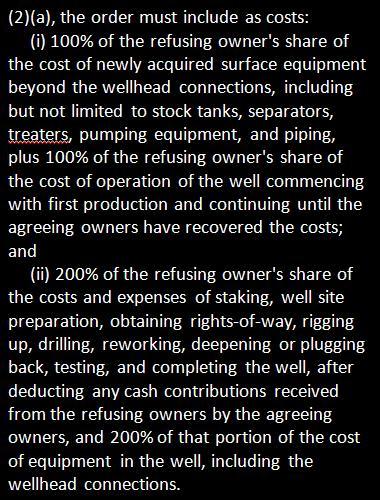
Costs charged the involuntary pooled owner include:

  • 100% of the non-consenting owner’s share of the cost of newly acquired surface equipment beyond the wellhead connections, including but not limited to stock tanks, separators, treaters, pumping equipment, and piping, plus
  • 100% of the non-consenting owner’s share of the cost of operation of the well commencing with first production and continuing until the agreeing owners have recovered the costs; and
  • 200% of the non-consenting owner’s share of the costs and expenses of staking, well site preparation, obtaining rights-of-way, rigging up, drilling, reworking, deepening or plugging back, testing, and completing the well, after deducting any cash contributions received from the refusing owners by the agreeing owners, and
  • 200% of that portion of the cost of equipment in the well, including the wellhead connections.

A fictional example of how this works
Here is a completely made up example of how this would work. Let’s say that a fictional involuntary pooled mineral rights owner (Bob) owns 25% of the pool for a well.

  • Bob receives 1/32 of the production proceeds from the well as a royalty (calculated as 1/8 of the owners 25% share). He receives this from the beginning of production.
  • The other 7/8 of Bob’s proportionate income is held in escrow to pay his proportionate costs of annual operation (25% of the total), and double the proportionate costs of well set up and equipment (50% of the total).
  • Bob would receive an annual check for any revenues above the amount held in escrow. In an actual scenario, it would likely take Bob several years to pay off his share of the cost before he receives any royalties, and at that point the well’s production would have dropped considerably.

So you’re stuck. If you own a portion of your mineral rights, or you’re a small property owner who owns part of a spacing unit, you have no choice but to voluntarily pool with others. If you don’t you get hit with 200% of a significant amount of the proportional share of costs. It is a law that pits neighbor against neighbor, family member against family members, and oil and gas drillers against rural property owners.

And if you just own the surface rights in a split estate, you don’t even get to have a say in the conversation.

Post Script
It’s worth noting that the provision requiring involuntary pooled owners to pay 200% of costs is much more oppressive than the forced pooling statute in North Dakota, which only stipulates a risk penalty.

The oil and gas industry has a real interest in keeping the 200% provision in there, because it gives them tremendous leverage against rights owners. In fact, in the last legislature Montana House member Austin Knudsen, who represents a district in the Bakken, sponsored a bill that would bring Montana involuntary pooling law into line with North Dakota’s.

Not only did the bill not make it out of committee, but Knudsen was fired from his position as partner at the O’Toole Law Firm for proposing the bills. The Firm is one of only a handful of law firms in the state that handles complex oil and gas cases before the Board of Oil and Gas Conservation, representing many clients in the oil and gas industry.

Knudsen, once considered a rising star in Montana politics who was selected to give the rebuttal to Governor Bullock’s state of the state speech, made the mistake of valuing property owners over the oil and gas industry.

“There a lot of oil and gas exploration going on in my district. My family has had to deal with these issues. I’ve got neighbors and constituents who have had to deal with these issues. There gets to be a lot of tension and a lot of landowner problems,” Knudsen said.

The oil and gas industry opposed the bill because they feared “it would become an incentive for mineral rights owners to not sign reasonable lease offers from developers,” according to Dave Galt, executive director of the Montana Petroleum Association.

Stop me if you heard that one before.

Last note: You can compare forced pooling laws by state here.

Posted in Community Organization, Politics and History | Tagged , , , , , , , , , , , , , | 3 Comments

Guest post: Lessons learned from oil and gas drilling in Pennsylvania

One of the great things about writing this blog has been the opportunity to meet people from all over the US and beyond who are engaged in the same battle to preserve a way of life from uncontrolled oil and gas drilling. People who have experienced the power of the industry to threaten their property rights, water and health are eager to help others who are experiencing the same thing.

One such person I met through an acquaintance is Ralph Kisberg, a founding member of the Responsible Drilling Alliance in Williamsport, Pennsylvania. I recommend a visit to their site — it’s full of interesting and informative material.

Here’s how they describe their work:

The Responsible Drilling Alliance (RDA) is an education and advocacy coalition based in the heart of the Marcellus shale region of Pennsylvania. RDA was founded in 2009 by a group of seven residents concerned with both the lack of objective information and the lack of public debate in their region on the large scale changes they saw occurring. Through  outreach programs, events, public forums, advertisements and an e-news letter with over 1,200 subscribers, RDA seeks to educate its members, and the public, on the ramifications of shale gas development. Along with other conservation organizations at state, national and local levels, RDA advocates for regulations needed for our environment, health, safety,
economic well-being, and quality of life.

RDA’s founding group and membership include people with gas leases and those adamantly opposed to the development in one of the largest core forest ecosystems in the eastern United States, as well as other ecologically special or inappropriate places. Protection of vital sources of clean water and air, and places for rejuvenation now, and for those who
follow, drives RDA to be a small part of a large movement for clean energy
and an ecologically and economically just society.

I asked Ralph if he would distill his experiences into a summary of lessons learned in fighting the fight in Pennsylvania and share them with us. He graciously agreed, and, after a good deal of thought, provided this list. When you read it, you’ll appreciate the hard-earned wisdom that it represents. Take a minute to read and think about what it means for us. We can all stand to benefit from the RDA’s experience.

A scene from the Marcellus Shale. Photo credit Terry Wild
A scene from the Marcellus Shale.
Photo credit Terry Wild
  1. Learn the rules:. By the time you are aware your area is threatened, the industry will have figured out your state’s laws and permitting processes, as well as how to exploit those rules and work toward getting more favorable legislation enacted. Get a clear understanding of how it all works from the state, local, and federal level as soon as you can. Learn the regulatory agency processes, legislative and rule making processes, and the role of local government. Then try not to get overwhelmed by just how well the road has been paved for what you don’t want to happen and get involved in those processes.
  2. Focus. Look to who is holding off the Fracking Army so far: New York state and the Delaware River Basin communities, along with a handful of others around the country. Why? Because they had processes in place to delay permitting, along with large numbers of committed activists who have the support of a good deal of the public, and some wise political leaders who figured out that many of their constituents have far more to lose than the value of the benefits others stand to win.
  3. In most states, decision makers perceive the invasion will lead to large number of winners vs. a few inconsequential losers. How do you change that perception? Begin by understanding it. Tax revenues will go up significantly. Inflated job numbers will be drummed into the public with remarkable persistence, and regions of the state long written off as a drain on revenue are suddenly looked to as rainmakers for state coffers. Resistance to these arguments by politicians on all levels is rare.
  4. Locally, the fight is among a small number of winners versus many who will lose. But chances are, those benefitting have been disproportionally influential long before shale exploitation came to town. Among the general public, many will buy into industry and chamber of commerce arguments of local benefits and national interest justifications. Look at what is spent to insure that. Eventually, public perception in local, directly impacted areas will change, that has been studied and well documented for decades, but it takes time. Time your area does not have. Focus on what can win where you live and in your state. Is it property value issues, health concerns, quality of life impacts, water use or water quality? Get a realistic grip on what is winnable and what is not, given your state and local area’s situation.
  5. The public has a limited attention span and you’ll easily use up your turn at holding it. Concerned citizens will throw out all kinds of good, logical reasons why hurrying down the shale road is a horrible idea, but the public and their representatives soon tire of hearing too much thrown their way: water use, quality and disposal issues, air quality threats, regulatory exemptions, radiation concerns, quality of life issues, negative social impacts, property devaluation concerns, toxic trespassing, earthquakes, too many Texans rushing around, and the overarching climate devastation arguments. Repeated enough, most folks begin to tune it all out. Environmental arguments are hard to prove definitively and are often only won after damage gets so extensive it cannot be ignored.
  6. Once the industry is in, it is time to switch tactics. When the Fracking Army has begun overrunning your territory, let other people fight the war. Assist them as much as you can, but in the place that you love it’s time to start winning some local and regulatory battles. There is a lot of shale in the nation. What is economically exploitable in your specific area, or most likely even your state, is not necessary for achieving any loftier goal than corporate profits. But from a nationwide perspective, it is hard to win arguments against shale resources in terms of economic benefit and national security. Nationally, climate arguments over shale are not yet winnable. Will it work in your area to pursue these arguments? Standing up for a way of life, a quality of life that you love, is nothing to be ashamed about. A tranquil, slow paced area with clean air and water resources and remarkable beauty is reason enough to fight against the massive, invasive footprint of shale development. Such development doesn’t need to be everywhere it can possibly be, now or in the near future. Most everyone needs places of respite from the stresses of civilization. Places where the natural world dominates, places for healing, relaxation, re-creation, or just to immerse the self in natural beauty or solitude. Many just need to know such places still exist.
  7. Learn from history. Theodore Roosevelt and Gifford Pinchot fought hard for the concept of conservation of natural resources, to establish the need for preserving the nation’s forests and fresh water, “the most vital internal question of the United States” and for the perspective that, “There is nothing more practical in the end than the preservation of beauty…” For inspiration read of the origin of these quotations of Roosevelt’s in, “The Big Burn: Teddy Roosevelt and the Fire that Saved America” by Timothy Egan or, “The Wilderness Warrior: Theodore Roosevelt and the Crusade for America” by Douglas Brinkley. Read Russell Gold’s “The Boom” for knowledge of the history, problems and benefits of shale resource development. Investigate the work of Thomas Linzey and the Community Environmental Legal Defense Fund (CELDF) to learn exactly how money interests have subverted democracy and how communities can begin the process of taking it back.
  8. Remain friends with the enemy of your enemy. It has been noted by many that powerless groups turn on each other. It is human nature. This is quite beneficial and amusing to invaders and their collaborators. You may find it necessary to fight among yourselves to keep your sanity and it may get ugly, but do your best to keep these debates and disagreements out of the public eye. Lighten up on your allies; remember that you are all being driven batty by the injustices, waste and regret of the takeover. Remember, a Fracking Army invasion is only a piece of a bigger fight, one that requires multiple strategies and may take decades to win.
Posted in Community Organization, Politics and History, Shared Letters and Posts | Tagged , , , , | 4 Comments