Billings Gazette Editorial: Montana can’t stake its future on coal

There was an interesting and unexpected editorial in this morning’s (January 21) Billings Gazette, entitled “Montana can’t stake its future on coal.”

The central argument of the editorial is that US coal-fired power generation will continue to decline and be offset by an increase from renewable sources, so it makes no sense for Senator Daines and others to accuse the Administration of “killing coal,” as Daines did this week in Billings. Instead,

“Montana must look forward….We don’t want anyone to lose jobs, but in a dynamic economy jobs are lost and new jobs are created. Any Montana workers who will be displaced by changes in the coal and electrical industries deserve training and support to land good, new jobs.

“Our state has been creating jobs steadily. There will be new jobs, regardless of what happens to coal.

“Montana’s leaders in government and business should host summits on energy diversification. Let’s figure out how to provide what energy customers want and how to best transition out of the energy they don’t want.”

Click to enlarge.

Click to enlarge.

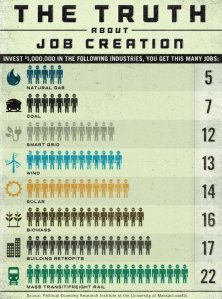
This is an argument that we have been making on this site for years. Montanans need to recognize that the battle to prop up fossil fuels is lost. The transition to a clean energy economy may play out over years or decades, but it is time for the state’s leaders to step forward to put Montana at the forefront of that transition, not, as Senator Daines would have it, trying to beat a dead horse. Recent data shows that clean energy jobs are already here, and, according to the Political Economy Research Institute at the University of Massachusetts, a million dollars invested in wind or solar will produce twice as many jobs as a million dollars invested in coal or natural gas, as shown in the chart on the right.

In the meantime, local citizens need to work with their elected representatives to ensure that local laws protect citizens and ensure the preservation of rural and small town life as the transition occurs.

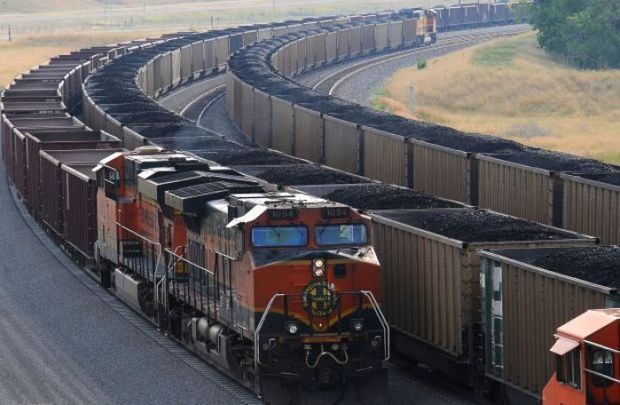
Coal trains represent Montana's past, not its future. Photo: Billings Gazette

Coal trains represent Montana’s past, not its future. Photo: Billings Gazette

Posted in Clean energy | Tagged , , , | 1 Comment

Congratulations! You’ve just lived through the hottest year on record. Again.

Stop me if you’ve heard this before

According to the National Oceanic and Atmospheric Administration, in a press release issued today:

During 2015, the average temperature across global land and ocean surfaces was 1.62°F (0.90°C) above the 20th century average. This was the highest among all years in the 1880-2015 record, surpassing the previous record set last year by 0.29°F (0.16°C). This is also the largest margin by which the annual global temperature record has been broken. Ten months had record high temperatures for their respective months during the year. The five highest monthly departures from average for any month on record all occurred during 2015. Since 1997, which at the time was the warmest year on record, 16 of the subsequent 18 years have been warmer than that year.

The animated gif below shows how the 2015 annual average surface temperature compared to the 1981-2010 average, and then cycles through the monthly maps for January-December 2015.

2015_global_temp_recap_animation_620In the United States, the year was the second-warmest on record, culminating in a December that was both the hottest and the wettest since record-keeping began. According to the New York Times, one result has been a wave of unusual winter floods coursing down the Mississippi River watershed.

“The whole system is warming up, relentlessly,” said Gerald A. Meehl, a scientist at the National Center for Atmospheric Research in Boulder, Colo.

Climate change and presidential politics
The issue of global warming has taken on increasing importance in this presidential election year, since the candidates hold widely divergent positions on whether warming actually exists, and, if it does, what humans should do about it.

global warming chartCandidates who deny climate change exists rely on an argument that says climate change has “paused” after the the last powerful El Niño, in 1998. This is demonstrably false. “Is there any evidence for a pause in the long-term global warming rate?” said Gavin A. Schmidt, head of NASA’s climate-science unit, the Goddard Institute for Space Studies, in Manhattan. “The answer is no. That was true before last year, but it’s much more obvious now.”

It is particularly disturbing when a leading candidate for the nomination from a major party like Ted Cruz can say with a straight face that “climate change is not science, it’s religion”:

The science is clear, and becomes clearer with each passing month. Those of us with a vote should make sure that the next president understands the science, and is ready to take action. (Read: “Comparing the 2016 presidential candidates on climate change.“)

Posted in Climate change | Tagged , , , | 1 Comment

We’ve reached a tipping point: there are now more solar jobs than oil jobs

For local communities, the most compelling argument for the growth of oil and gas operations is the promise of jobs. But, as we’ve learned from the boom and bust in the Bakken over the last two years, explosive growth can occur, but oil jobs are not sustainable over the long term.

By contrast, the solar industry is growing at 20% per year, and this growth is likely sustainable, driven by substantial reductions in the cost of installation since 2010 and demand for alternative energy sources. As a result, solar is now an affordable energy source. And solar growth is not subject to the same booms and busts as oil extraction, because it is not dependent on volatility in the price of an external energy source.

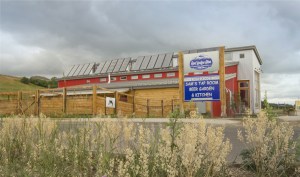
Red Lodge Ales solar installation

Red Lodge Ales solar installation. Click to enlarge

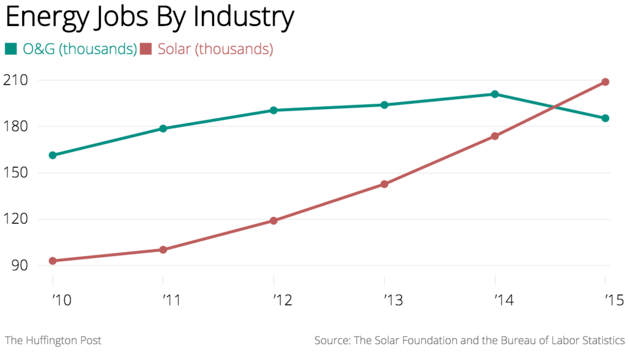
In fact, according to the annual National Solar Jobs Census published this week by The Solar Foundation, solar jobs now exceed the number of oil and gas extraction jobs in the United States, and are unlikely to look back.

  • As of November 2015, the solar industry in the United States employs nearly 209,000 solar workers, representing a growth rate of 20.2% since November 2014, the third consecutive year of 20% growth. Over the next 12 months, employers expect to see total employment in the solar industry increase by 14.7% to approximately 240,000 solar workers.
  • By contrast, as of December 2015, there are 184,500 jobs in oil and gas extraction in the US, a decline of 7.6% from the previous December, according to the Bureau of Labor Statistics.

The contrast in growth curves is unmistakable:

energy jobs by industry_0115

The growth in solar jobs is driven by demand for solar energy systems over the last decade. Since 2010,   the   year   the Solar Foundation began taking an annual census, the growth in annual solar capacity installed has grown from 929 megawatts to 7,430 megawatts, an eightfold increase.

What’s important about these jobs, by contrast to oil and gas jobs, is that they are permanent, full time jobs. According to the Solar Foundation, of the 35,000 new soar workers in the last year, 83% are new positions, and 90% are totally dedicated to solar. As we’ve learned from the Bakken oil bust, oil and gas positions are temporary, driven by the boom and bust cycle of the industry.

The solar jobs that are being created are in large part new installation, as you can see from the chart below:

solar job growthIn 2015, 65% of the new jobs created were installation jobs, and what’s important about that is that jobs are local — eight in 10 solar installation firms report that their customers are located within the state.

You can download a copy of The Solar Foundation census by clicking here.

Implications for the Beartooth Front
The implications for local communities are clear, and elected officials in Carbon and Stillwater Counties would do well to take heed. The long-term impacts of a boom economy in oil and gas are not worth the short-term gains to the local economy. It is well documented that local economies that are heavily invested in oil and gas are left with higher crime rates, lower education rates, and hard hitting busts when the booms end.

What local officials should be concerned with is not chasing unrealistic dreams of riches, but managing the long-term preservation of a way of life. This means making sure that local oil and gas activities are well regulated in a way that protects the real economic backbone of the area: agriculture and ranching, tourism, and the natural resources that make a way of life possible.

This is why it is important for local officials to work with citizen groups that seek to establish local regulation of oil and gas. By managing the booms, the local way of life can be preserved and the local economy can be positioned to take full advantage of the steady growth of a different kind of economy.


Posted in Clean energy | Tagged , , , | 3 Comments

Important new study shows link between fracking chemicals and reproductive and developmental toxicity

A new study from Yale University released this week shows that a large number of chemicals found in fracking fluid and wastewater are associated with reproductive and developmental toxicity.

The study, “A systematic evaluation of chemicals in hydraulic-fracturing fluids and wastewater for reproductive and developmental toxicity,” was published in the Journal of Exposure Science and Environmental Epidemiology on January 6, 2016. In the study, the authors systematically evaluated 1,021 chemicals identified in fracking fluids, wastewater, or both for potential reproductive and developmental toxicity to identify those with the potential for human health impacts.

They researched each against a database, and discovered the following:

  • Toxicity information was lacking in the database for 781 chemicals (76%).
  • Of the remaining 240 substances, evidence suggested reproductive toxicity for 103 (43%), developmental toxicity for 95 (40%), and both for 41 (17%).
  • Of the 157 chemicals associated with toxicity, 67 either already have or have been proposed for a federal water quality standard or guideline.

Why this is important
There have been a number of studies that have associated proximity to fracking wells with adverse reproductive and developmental health impacts. We have reported on several on this site:

  • A 2013 Colorado study showed that exposure to frac water “could raise the risk of reproductive, metabolic, neurological and other diseases, especially in children who are exposed to EDCs [endocrine-disrupting chemicals].”
  • A 2014 Pennsylvania study looked at birth records to assess the health of infants born withina 2.5-kilometer radius of fracking sites. They found that proximity to fracking increased the likelihood of low birth weight by more than half.
  • A 2014 Colorado study examined the connection between how close a mother is to natural gas drilling and birth outcomes in a study of 124,842 births in rural Colorado between 1996 and 2009. The study shows an association between density and proximity of natural gas wells within a 10-mile radius of maternal residence and an increase of as much as 30% in the prevalence of congenital heart defects.

What this new study does is look at specific chemicals to identify the potential causes of the outcomes identified in the previous studies. This enables future studies to examine potency, chemical properties, and environmental concentrations to further hone in on what specific chemicals are causing adverse human health outcomes.
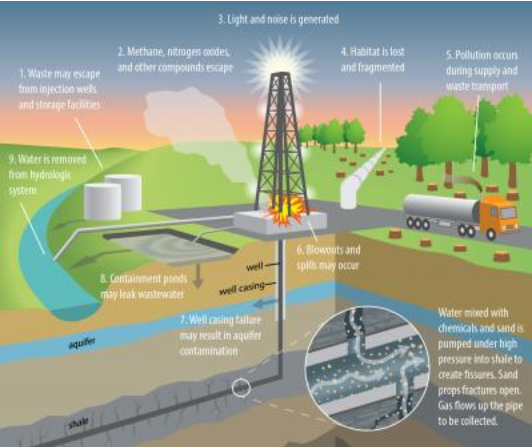
Potential adverse impacts of oil and gas drilling

Potential adverse impacts of oil and gas drilling

What it means for the Beartooth Front
These studies do not provide a smoking gun that explains exactly how chemicals found in oil and gas drilling adversely affect humans. We are honing in on the exact linkage, but we have to keep in mind that the fracking boom began just a few years ago and it will take science many years to catch up with the human health impacts.

In the meantime, it is essential for local residents to demand that safety measures be put in place. The scientific information gathered in this study and the ones that preceded it argue strongly for the following types of local regulations:

  • Setbacks of wellheads from occupied buildings
  • Regular testing of water, air and soil for contamination. This testing should occur before drilling occurs, regularly during drilling, and for years after drilling is complete.
  • Well design specifications to make sure that fracking waste cannot migrate into aquifers and groundwater.
  • Regular testing of cement casings to make sure they are not leaking.
  • Limitations on flaring.

Communities cannot wait for science to catch up. They need to take strong action to protect the health of their citizens.

If you want to know more about the impacts of oil and gas drilling
Comprehensive databases of scientific studies on the impacts of oil and gas drilling now exist. Two that we have discussed on this site include:

  • The third edition of the Compendium of Scientific, Medical, and Media Findings Demonstrating Risks and Harms of Fracking was published by two organizations: the Concerned Health Professionals of New York and Physicians for Social Responsibility (PSR) last October The compendium is a fully referenced compilation of the evidence outlining the risks and harms of fracking, bringing together findings from the scientific and medical literature, government and industry reports, and journalistic investigation.
    Click to download the Compendium.
  • Physicians, Scientists and Engineers for Healthy Energy Database
    This is a database of peer-reviewed articles maintained by an organization called Physicians Scientists & Engineers for Healthy Energy. The database can be sorted by topic, author, or date, and you can pull up the articles by topic by clicking on the links below:

Study citation
Journal of Exposure Science and Environmental Epidemiology advance online publication 6 January 2016; doi: 10.1038/jes.2015.81. “A systematic evaluation of chemicals in hydraulic-fracturing fluids and wastewater for reproductive and developmental toxicity”

Authors: Elise G Elliott1,2, Adrienne S Ettinger2,3, Brian P Leaderer1,2, Michael B Bracken2,3 and Nicole C Deziel1,2

1.     1Department of Environmental Health Sciences, Yale School of Public Health, Yale University, New Haven, CT, USA
2.     2Center for Perinatal, Pediatric, and Environmental Epidemiology, Yale University, New Haven, CT, USA
3.     3Department of Chronic Disease Epidemiology, Yale School of Public Health, New Haven, CT, USA

Correspondence: Dr Nicole C Deziel, Yale School of Public Health, Yale University, 60 College Street, New Haven, CT 06520, USA. Tel.: +1 203 785 6062. Fax: +1 203 737 6023. E-mail: nicole.deziel@yale.edu

Posted in Health impacts | Tagged , , , , , | 2 Comments

The first electric car for the masses is here. It’s time to start planning for a renewable energy future.

For those of you who have missed me, I’ve been taking some time off enjoying holidays with an expanding family. Number one son is getting married, and I’ve already got a “World’s Greatest Father-in-Law” coffee cup. If I’d known it was this easy, I’d have skipped the son and gone straight to the daughter-in-law.

Lots is happening on the energy/climate front, and I’ve got a number of posts started, but I saw something today that really brought home how fast the world of energy is changing.

Whenever I write something remotely negative about the oil and gas industry, I’m sure to get at least one email that says something like, “If you hate oil and gas so much, why don’t you get rid of your car and start walking?” I usually resist the urge to respond, although I’ve got some good comebacks up my sleeve.

What got me so excited is that, at the Consumer Electronics Show in Las Vegas today, Chevrolet announced that it has won the race to produce a truly affordable electric car. It’s called the Chevy Bolt, ready for sale later this year.

Chevy BoltPriced at about $30,000 after a federal rebate, it’s got a range of 200 miles. That’s less than the average price of a car in the United States. This makes it the first electric car ever produced to get excellent range at a great price. It is truly “the electric car for the masses.”

Tesla is expected to follow up with a similar offering this spring.

It’s not going to replace your truck this year, but we’re pretty much reaching the point where I can actually give up my oil-consuming car and replace it with one that hardly uses any at all. And if that’s the case in 2016, it probably won’t be much past 2020 before you can replace your gas guzzling pickup with an affordable electric replacement.

Vehicle consumption currently accounts for about 70% of our oil usage in this county. The Chevy Bolt is like the first robin of spring. There are many more that will follow.

It’s time to start planning for a renewable energy future.


Posted in Clean energy | Tagged , , , , | 3 Comments

Steve Daines joins the carbon reduction bandwagon! Wait a minute…

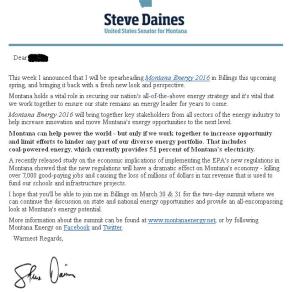
No sooner did we get the exciting news from Paris about the international climate agreement than my good friend Steve Daines sent me an invitation to attend the third annual Montana Energy Conference in Billings on March 30-31. According to Senator Daines, it’s an opportunity to “continue the discussion on state and national energy opportunities and provide an all-encompassing look at Montana’s energy potential.”

Steve Daines

Steve Daines

I was really excited to see that our junior Senator has jumped on the bandwagon to transition Montana’s energy portfolio from fossil fuels to clean energy. This kind of leadership is exactly what’s required to help us meet the treaty’s ambitious goals for reducing carbon emissions.

I went over to the event web site, where I discovered that the conference will have a “fresh new look and perspective,” and that “energy professionals, policy and decision makers at all levels” will take “an all-encompassing look at Montana’s energy potential.”

This is exactly what we need!

The letter from Steve Daines. Click to read.

The letter from Steve Daines. Click to read.

I checked out the list of current sponsors, and was kind of surprised to see that, in addition to Senator Daines, it includes the Montana Chamber, the Montana Petroleum Association, the Montana Contractors’ Association, and the Montana Coal Council.

I guess they haven’t contacted the Montana Renewable Energy Association, the National Resource Defense Council, Montana Green Power, Northern Plains Resource Council, or the Montana Environmental Information Center.

No doubt they’ll be on the list shortly.

Or maybe not. As I dug a little deeper, I noticed that the conference will be an opportunity to “limit efforts to hinder any part of our diverse energy portfolio. That includes coal-powered energy, which currently provides 51 percent of Montana’s electricity.”

And then I saw that the EPA’s new regulations will “kill over 7000 good-paying jobs and causing the loss of millions of dollars in tax revenue that is used to fund our schools and infrastructure projects.” That’s the same nonsense the coal and gas people have been spewing for months.

That’s when it hit me. This conference has nothing to do with the Paris climate agreement. It has everything to do with propping up dying industries while the rest of the world heads in a completely different direction. And Steve Daines is still working for the same groups that have always bought and paid for his services.

Never mind. I guess I won’t be attending.

Related:
A debate between Montana Senator Steve Daines and Pope Francis on climate change
Announcing the latest winner of the Rex Tillerson fracking hypocrite award
Rex Tillerson admits humans cause climate change; Steve Daines doesn’t get the message
Montana elected leaders’ response to Keystone XL decision is unanimous, but not visionary
Where is Montana’s “man on the moon” leader?
Congress is very busy doing absolutely nothing about regulating oil and gas
From Washington to Helena, we subsidize the most profitable oil companies with billions of dollars of unnecessary tax breaks and direct subsidies

Posted in Community Organization, Politics and History, Uncategorized | Tagged , , , , , , , , , , | 6 Comments

Delegates reach historic climate agreement in Paris

Representatives of 195 countries, representing more than 95% of global greenhouse gas emissions, have reached a landmark climate agreement that will, for the first time, commit nearly every country to lowering planet-warming greenhouse gas emissions to help stave off the most drastic effects of climate change. The goal of the agreement is to limit global temperature rise to less than 2° Celcius, along with a stretch goal of 1.5°.

Delegates applaud as the agreement is announced. Photo: Getty images

Delegates applaud as the agreement is announced. Photo: Getty images

According to the New York Times:

“At the heart of the new draft text is a breakthrough on an issue that has foiled decades of international efforts to address climate change. Traditionally, such pacts have required developed economies, such as the United States, to take action to mitigate greenhouse gas emissions, but they have exempted developing countries, such as China and India, from such action.

The new accord changes that dynamic by requiring action in some form from every country, rich or poor….Scientists and world leaders have said the talks here represent the world’s last, best hope of striking a deal that would begin to avert the most devastating effects of a warming planet.”

Key provisions of the agreement include:

  • To peak greenhouse gas emissions as soon as possible and achieve a balance between sources and sinks of greenhouse gases in the second half of this century.
  • To keep global temperature increase “well below” 2C (3.6F) and to pursue efforts to limit it to 1.5C
  • To review progress every five years
  • $100 billion a year in climate finance for developing countries by 2020, with a commitment to further finance in the future.
United Nations Secretary-General Ban-Ki Moon, French President Hollande and delegates raise their arms in triumph. Photo: Reuters

United Nations Secretary-General Ban-Ki Moon, French President Hollande and delegates raise their arms in triumph. Photo: Reuters

Broad agreement across the globe is a necessary first step, but now the real work begins. Even if every nation meets its target, we will not reach the warming reduction goal. Nations will need to do more over time, and technology must improve if we are to get there. In the United States, the familiar political hurdles must be overcome if we are going to take a leadership position in the world.

The decisions that need to be made about shifting from fossil fuels to clean energy will ultimately have a huge impact on the future of the Montana economy, and will require a more rapid shift than we are currently planning for. The days of coal must end, and we will need to shift quickly from oil and gas to solar, wind, electric, and other clean sources.

But this is a great day, and a time for celebration.

Background:
Paris climate talks: the future of the planet is at stake

Posted in Climate change, Uncategorized | Tagged , , , | 9 Comments

The oil market just gets worse and worse.

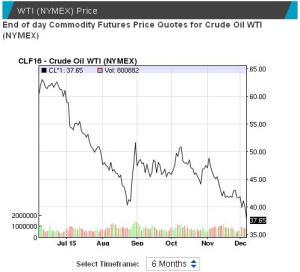
From time to time we check in on the state of the oil industry to determine whether we are approaching a time when it might become profitable to drill along the Beartooth Front. We’re far from it. As of the  close of business on Monday, the price of oil touched a seven-year low as active rig counts dropped to their lowest levels since 2010, and pump prices in the area stayed at low levels.

The price of crude reached a seven-year low. Source: NASDAQ

The price of crude reached a seven-year low. Click to enlarge. Source: NASDAQ

Oil at 7-year low
Oil closed Monday at $37.60 a barrel, driven by a meeting last week of the Organization of Petroleum Exporting Countries (OPEC). At the meeting members failed to reach a decision on a ceiling for oil production. Analysts said that OPEC would likely maintain its production around current levels of 31.5 million barrel per day. In addition, new volumes will come to the market once US sanctions against Iran are lifted in 2016, contributing to an excess of supply over demand of around a million barrels per day. Some analysts see the price of oil dropping as low as $20 a barrel.

When we last checked in on May 12, oil had risen to $59.14 after crashing to $48.59. In June of 2014, at the height of the Bakken boom, oil was hovering around $105 per barrel.

North American rig counts. Click to enlarge. Source: Baker Hughes

North American rig counts. Click to enlarge. Source: Baker Hughes

Active rig counts at a 5-year low
As a result of the price decline, North American rig counts dropped to 737 at the end of last week, a decline of seven from the previous week, with a total decline of 1,183 rigs from a high of 1.920 a year ago.

In North Dakota, the active rig count has fallen to 64 from 191 in the last year, and state officials say they expect it fall even further after the OPEC meeting. North Dakota has 1000 permitted wells waiting to be fracked, but no operators willing to drill in the current environment.

Year-over-year oil exploration in the US is down 64.7%. Gas exploration is down 44.2%. The weekly average of crude oil spot prices is 38.8% lower than last year and natural gas spot prices are 41.7% lower than last year.

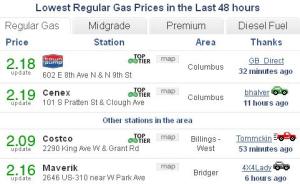
Gas prices_120715Local gas prices remain low
It’s a bleak picture for the industry, although it means a holiday bonus for those of us who purchase gas locally. You can pump gas at Costco in Billings for $2.09 a gallon, $2.16 at Maverik in Bridger, $2.18 at the Town Pump in Columbus, and $2.19 at the Town Pump in Red Lodge and the Cenex in Columbus. Those prices could be lower by Christmas.

The bottom line is that nobody is going to be drilling along the Beartooth Front very soon. But we should all be aware that when the oil companies come knocking with promises of economic growth and plenty of jobs, that promise is only as good as an oil market that we have no control of.

Stacked rigs sit idle at a depot in Dickinson, ND. Photo: Reuters/Andrew Cullen

Stacked rigs sit idle at a depot in Dickinson, ND. Photo: Reuters/Andrew Cullen

What we can control locally are the terms under which we allow oil companies to drill when they are ready. The state of the market is a bit of a reprieve for us, but we need to be ready when the market changes and the rigs return. That’s why landowner groups in Stillwater and Carbon counties are working on establishing citizen initiated zones to make sure that when the next boom is over, our way of life is maintained.

Related:
Falling gas prices and the uncertain future of the Shale Boom – November 14, 2014
The price of oil: drilling will continue for now, but we need to keep our eyes on the future – January 12, 2015
Checking in on the price of oil, gas, and declining rig counts – May 12, 2015


Posted in Fracking Information | Tagged , , , | 1 Comment

Silvertip landowners’ Supreme Court case receives boost from University of Montana amicus brief

Belfry landowners attempting to form the Silvertip Zone in Carbon County received a significant boost in their Montana Supreme Court case last week when the prestigious Natural Resources and Land Use Clinic at the University of Montana School of Law filed an amicus brief in the case. An amicus brief is a legal opinion offered by a person or group not connected with a case to make sure that important legal concerns affecting the broad legal implications of a case are introduced.

Carbon County Commissioner John Prinkki. Click to read amicus briefPhoto credit: James Woodcock, Billings Gazette

Carbon County Commissioner John Prinkki. Click to read amicus brief. Photo credit: James Woodcock, Billings Gazette

The brief, which you can download by clicking on the photo at right, is worth a read. It is easily understandable for a non-attorney, and includes a thorough discussion of the history of zoning in Montana. It deals with two primary issues:

  • The Carbon County Commissioners, in reversing their decision to approve the Silvertip Zone, relied on a protest provision in Montana law that states, “If real property owners representing 50% of the titled property ownership in the district protest the establishment of the district within 30 days of its creation, the board of county commissioners may not create the district.”

However, in August, 2013, in the case of Williams v Board of Commissioners of Missoula County, the Montana Supreme Court affirmed that the “protest provision” was an unconstitutional delegation of legislative power because it failed to provide “standards or guidelines to inform the exercise of the delegated power” and contained no legislative bypass. The Williams case referred to Part 2 zoning, while the Silvertip case refers to citizen-initiated, or Part 1 zoning. The amicus brief asks the court to extend Williams to Part 1 zoning.

You can read a discussion on this, and watch video of the meeting where Commissioner Prinkki ruled, “Regarding this petition and the vote we’re about to take, the petition fails. As you know, under Section 5, because of the protest, we couldn’t move forward with this if we wanted to. It fails for that fact alone.”

  • After a discussion of the history and law regarding different types of zoning in Montana, the brief “asks the Court to find that Part 1 zoning is suitable and important for protecting the agriculture areas of our state.”

From the brief:

“The clinic urges the Court to hold that the Part 1 zoning protest provision, MCA § 76-2-101(5), is an unconstitutional delegation of legislative authority. This holding is a natural extension of the Court’s decision in Williams invalidating the Part 2 zoning protest provision, MCA § 76-2-205(6). Both provisions, passed by the 1995 Montana Legislature, suffer from identical infirmities. Specifically, neither provides standards or guidelines for the application of the delegated power, nor a legislative bypass to return the original zoning resolution back to the governing body. Further, consistent with the decades-old practice of Montana counties, and the overall statutory scheme of Montana zoning, we ask the Court to find that Part 1 zoning is suitable and important for protecting the agricultural areas of our state.”

The filing of the brief pushes back the timeline of the case. The defendants’ deadline for filing their response briefs has been pushed back 30 days to January 19. The Silvertip landowners will then have until February 4 to file a response.

We’ll post additional documents as they become available

More on this case:
Carbon County landowners file Supreme Court brief
Montana Supreme Court agrees to hear Silvertip zoning case

Silvertip landowners appeal to Montana Supreme Court
Decision in Silvertip zoning case (video)
Belfry landowners file legal challenge to commissioners’ rejection of Silvertip Zone
Commissioners’ action in denying Silvertip Zone clearly illegal


Posted in Legal, Uncategorized | Tagged , , , , , , | 3 Comments

The Montana Board of Oil and Gas Conservation does not protect citizens from the damage done by oil and gas drilling. Here’s what local communities can do about it.

A small item on the Board of Oil and Gas Conservation (BOGC) docket for the organization’s December 9 meeting (p.5) provides just a hint of major problems with the BOGC:

HearingBy itself, this doesn’t look like a particularly significant item. Stealth Energy USA is an apparently small company working out of Billings, doing business in Musselshell and Stillwater Counties. According to the docket item, they have failed to file required reports on a timely basis, which will cost them $160. Not much.

According to the site epa-sites.findthedata.com, the company has one prior report indicating non-compliance, but “has returned to compliance with its permit conditions, either with or without issuance of an enforcement action.”

When you click on the link for the compliance report, you get a “server not found” error message.

So Stealth Energy (perhaps appropriately named) is a company doing business in Stillwater County that has not filed BOGC-required reports, and has at least one prior compliance issue, but we can’t easily determine what it was.

Maybe not a big deal, but maybe it is. The public has a right to know.

But it does point to a much larger issue: the Montana Board of Oil and Gas Conservation does not adequately enforce its existing laws and regulations with regard to oil and gas, and the problem has worsened as the Bakken oil boom has increased demands on that agency. If Montana residents want to protect themselves from the damage caused by oil and gas operations, they need to create their own local regulations.

The Board of Oil and Gas Photo: Casey Page, Billings Gazette

The Montana Board of Oil and Gas. Photo: Casey Page, Billings Gazette

Oil and gas drilling damages property, water, air, soil and health
Make no mistake about it, drilling is a dirty business. And improvements in drilling technology that enabled the oil and gas booms in the Bakken and elsewhere have changed the relationship between communities and oil and gas operations. The harm done by drilling is now well documented.

The third edition of the Compendium of Scientific, Medical, and Media Findings Demonstrating Risks and Harms of Fracking has just been published by two organizations: the Concerned Health Professionals of New York and Physicians for Social Responsibility (PSR). The compendium is a fully referenced compilation of the evidence outlining the risks and harms of fracking, bringing together findings from the scientific and medical literature, government and industry reports, and journalistic investigation.

Click to download the compendium

Click to download the latest edition of the compendium

According to a statistical analysis of the data in the compendium done by PSE Healthy Energy:

  • 69% of the studies on water quality found potential for, or actual evidence of, water contamination
  • 88% of studies on air quality found elevated air pollutant emissions
  • 84% of studies on human health risks found signs or indication of potential harm

The Compendium’s final conclusion (p. 151):

“All together, findings to date from scientific, medical, and journalistic investigations combine to demonstrate that fracking poses significant threats to air, water, health, public safety, climate stability, seismic stability, community cohesion, and long-term economic vitality. Emerging data from a rapidly expanding body of evidence continue to reveal a plethora of recurring problems and harms that cannot be averted or cannot be sufficiently averted through regulatory frameworks.

Montana regulatory agencies do not adequately monitor and enforce existing laws and regulation
There is considerable evidence that the BOGC is insufficiently staffed to monitor and enforce existing oil and gas regulation, and do not have adequate procedures in place to ensure compliance.

A performance audit of the BOGC conducted by the Montana legislature in 2011 concluded that the “Board of Oil and Gas Conservation must improve its inspections and enforcement processes to more effectively regulate the state’s 17,600 active oil and gas wells.” Key findings of the audit:

  • Division management should generally provide more formalized direction to division staff for inspection and enforcement activities.
  • For the regulatory processes, the division’s permitting and abandonment processes appear sound, while improvements are necessary for the inspections and enforcement processes.
  • Although faced with a large number of wells to inspect, audit work found the division lacks a formalized approach to their work.
  • The division should create formal inspection priorities, develop documented inspection procedures, improve inspection documentation, and consistently document field deficiencies and violations.
  • When inspectors identify a violation, the board and division collaborate with the operator to gain compliance. The division could improve its compliance rate, and lessen the number of unresolved violations, by applying existing compliance timelines and creating additional ones.
  • The division could improve management of the Oil and Gas Information System in the areas of segregation of duties, security planning, password policies, and disaster recovery planning.

But that was 2011, and the problem has gotten worse. According to “Law and Order in the Oil and Gas Fields” a 2013 report by the Western Organization of Resource Councils, Montana monitoring and enforcement of state oil and gas activity has not kept up with the increase in the number of oil and gas wells in the state over time. Specific findings:

  • The number of active oil and gas wells in Montana increased by over 50% from 1999 to 2011 (p. 7)
  • During the same period, the number of field inspectors increased by one, from 6 to 7 (p.10)
  • The average state inspector does about 600 well inspections per year. At that rate, it would take about 2.5 years to inspect every active well in the state once. (p. 7, 11, 13)
  • While Montana increased the number of notices of violation from 234 to 517 from 2003 to 2011, the number of actual enforcement actions is miniscule – just $10,000 statewide in 2010 (p. 18, 21). The $160 fine to Stealth Energy is an example of toothless regulation.

What local communities can do
Montana law provides a way for local communities to take action to protect themselves. Montana counties have authority to create special zoning districts that can impose rules for extraction activities.

The process is called citizen initiated zoning, as set forth in Montana law in MCA 76-2-101. Landowners in Carbon and Stillwater counties are currently working through processes to put this kind of zoning in place. These zones would not prohibit oil and gas drilling, but make sure that it is done as safely as possible.

Here are examples of the kinds of rules that communities can put in place:

  • Setbacks that establish a minimum distance of wellheads from occupied dwellings
  • Well design requirements that require the safe handling of fracking waste and the regular testing of cement casings for integrity to prevent leakage.
  • Regular testing of water, air and soil to make sure that no contamination has occurred
  • Increased bonding to make sure that operators are financially responsible for any damage they cause

The Montana Constitution establishes a right to a “clean and healthful environment.” The BOGC does not guarantee that. It makes good sense for local citizens to demand it for themselves.


Related:
What’s wrong with the Montana Board of Oil and Gas Conservation?
Time for the Montana Board of Oil and Gas to step forward on setbacks
Montana Board of Oil and Gas sued for shutting out public
Guest editorial by Bonnie Martinell: Protecting property rights in Montana: You have to do it yourself

Posted in Community Organization, Politics and History | Tagged , , , , , | Leave a comment