Academy Award nominee “White Earth,” a story of the Bakken told through the eyes of children

J. Christian Jensen was so certain his short documentary White Earth wouldn’t be selected for an Academy Award nomination, he didn’t even wake up to see the awards nomination announcement on the morning of January 15.

But his film, a haunting look at life in a hardscrabble North Dakota Bakken oil town as seen through the eyes of its children, was one of five films selected from 60 nominees in the short documentary film category.

Jensen spent nine months working on the brooding 20-minute piece in and around the small town of White Earth, which has experienced population growth from 60 to 500 amid the oil boom.

“It’s a ‘Grapes of Wrath‘ scenario, with families pouring into town to live in trailers and hunt for work,” said Jensen. “They come for the money they think they can make. Some make it, some don’t. The economics are brutal.”

James McClellan

James McClellan

The story centers around 13-year-old James McClellan, who doesn’t much care for the oil industry. He’s left alone to amuse himself while his father works in the oil fields. When the film was made, he was not attending school because his father moved from trailer to trailer and they never had a permanent residence.

“As soon as I met him, I knew I had my narrator. He’s the film,” said Jensen. “He’s so smart and compelling and he has very strong criticisms about oil. Although he is also aware that some day he may have to go to work in the fields himself.”

Jensen says that White Earth “is not an issue film, but I wanted to give people a more empathetic look at this world. The film can be bleak, it can be harsh, because it’s about the worst of the American dream, but there is light in it as well.”

Here is a two-minute trailer from the film, which, at 20 minutes, is the shortest of the films nominated in its category. If you’d like to see the entire film, you can rent it for $3.99.

Other short documentary film nominees include Joanna, from Poland; Our Curse, also from Poland; Crisis Hotline: Veterans Press 1, from the United States; and La Parka (The Reaper), from Mexico.

Jensen’s bio, from his web site:

J. Christian Jensen

J. Christian Jensen

Christian entered the media profession as a journalist – a passion that lead to work as a documentary filmmaker.  Early in his career he worked on a variety of non-fiction productions including ones for National Geographic Film & Television, PBS FRONTLINE and American Experience.  He also worked on a film at a remote leprosy (i.e. Hansen’s Disease) colony on Kalaupapa, Hawaii.  While studying media arts as an undergraduate at Brigham Young University, Christian wrote and directed a broadcast-length documentary called Sou da Bahia [I’m from Bahia] about art and Afro-Brazilian identity in Northeastern Brazil.  He co-curated a multiple medium art exhibit by the same name to accompany the film’s premier throughout the U.S. and Latin America.

Having lived or worked in Brazil, China, and India Christian is interested in films that explore stories in newly industrialized nations. He is also fascinated by topics of spirituality, science, technology and their collision with modern society.  He has worked in a variety of production roles over the years but his most recent professional work has been as a non-fiction editor and producer for television and web outlets.  Christian has shot and directed several documentary shorts over the past two years at Stanford University where he recently completed his graduate studies in the MFA Program in Documentary Film & Video.
Posted in Bakken | Tagged , , , | 1 Comment

Billings Gazette Editorial: Landowners deserve protection before drilling starts

Published January 29, 2015

Most Montanans support responsible energy development, valuing clean air, water and land as well as the oil and gas that powers our travel and heats our homes. Where we often disagree is on the definition of “development done right.”

This week, the Senate Natural Resources Committee heard three bills that attempt to define doing development right on a level that considers the neighbors.

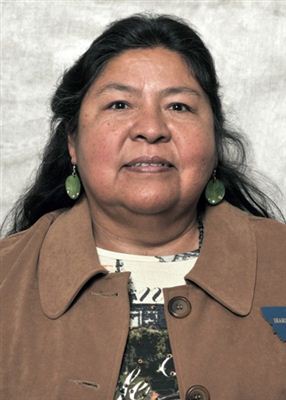
  • Sharon Stewart Peregoy

    Sharon Stewart- Peregoy

    Senate Bill 172, sponsored by Sen. Sharon Stewart-Peregoy, D-Billings, would require oil and gas developers to pay for baseline water tests of groundwater before any development activity starts at a site. The bill would also require water testing after a well is plugged.

  • Senate Bill 173, sponsored by Sen. Christine Kaufmann, D-Helena, would revise fees and require oil and gas developers to post surety bonds for each well drilled.
  • Senate Bill 177, sponsored by Sen. Mary McNally, D-Billings, would prevent oil and gas drilling within 1,000 feet of a home, water well or surface water.

There’s a fourth bill also intended to protect surface landowners:

  • Virginia Court

    Virginia Court

    House Bill 253, sponsored by Rep. Virginia Court, D-Billings. Court’s bill would require oil and gas developers to use a “closed-loop system” to reuse and recycle mud fluids in the drilling process as an alternative to creating earthen pits or ponds. The bill aims to reduce the risk of leaking waste fluids by minimizing the volume of fluids used in the process and avoiding the risk of leaking retention ponds.

A major reason why the Montana Legislature needs to look at these bills is the conflict created by split estate. More than a century ago, when the U.S. government granted lands for homesteading, it retained mineral rights under much of that land. As a result, today the government owns millions of acres of minerals under surface that’s in private ownership. The government leases its oil and gas minerals for development, and the company that does the developing has rights to access those minerals. Mineral and surface rights also may be split between private owners.

Another factor is the water table, which doesn’t end at property lines. In semi-arid Montana, water is our most precious resource.

Montanans sure don’t want unnecessary regulation. But clear rules can give a greater measure of certainty to surface and mineral owners. Instead of fearing that gas wells can be drilled in their backyard, homeowners should know that there is a setback requirement. Instead of worrying that development will contaminate their water, farmers ought to be assured of what is in the water before development starts and be able to find out what changes, if any, drilling caused. Ranchers should be able to know that reasonable precautions will be taken to prevent drilling mud from leaking onto their land. And everyone should be confident, that if a problem does occur, the driller who caused the problem will be accountable to fix it.

With the Montana Board of Oil and Gas issuing about 315 drilling permits per year, these are real concerns.

The details of landowner protection may be revised as these bills are considered. But they should be seriously considered. Montana must carefully balance the interests in valuable minerals and precious surface land.

Posted in Community Organization, Politics and History | Tagged , , , , , , , , , , , , , | 2 Comments

Poplar Pipeline spill another reminder that we need to keep fighting for the long-term sustainability of our communities

The Poplar Pipeline spill
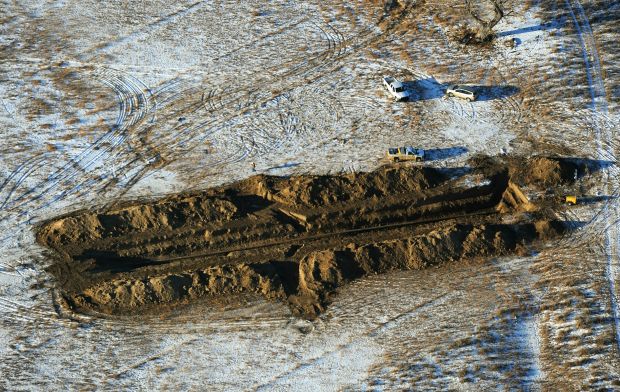
Last Saturday’s massive pipeline break and oil spill in the Poplar Pipeline near Glendive is a disaster that has leaked carcinogens into the Yellowstone River and left Glendive’s residents without water. It is another in a long list of recent oil leaks and spills that endanger our way of life.

The line was carrying Bakken crude oil at the time of the spill. According to Bridger Pipeline LLC, the owner of the pipeline, an estimated 40,000 gallons have been released.

The city of Glendive draws its public drinking water supply from an intake structure about 14 feet under the surface of the Yellowstone River seven miles downstream from the Poplar Line release. Testing of the Glendive water indicates the presence of volatile organic compounds (VOCs), specifically benzene, and residents have been put on alert to not use the water for cooking.

Product sheen has been observed on the river almost to Sidney, and oil has been seen as far downstream as Williston.

Crews work to clean up spill near Glendive. Photo: Larry Mayer, Billings Gazette

Crews work to clean up spill near Glendive. Photo: Larry Mayer, Billings Gazette

This is not the first spill from a pipeline owned by Bridger Pipeline LLC. In recent years, a pipeline called the Parshall Gathering System has leaked 125 barrels, or about 5,250 gallons, just south of Stanley, N.D., according to incident reports filed with the North Dakota state health department. Stanley is located between Williston and Minot.

Just one in a long list
The Poplar spill is yet another in a long list of recent disastrous leaks and spills.

Broken Silvertip Pipeline sticks above water. Photo: Mike Trombetta, DEQ.

Broken Silvertip Pipeline sticks above water. Photo: Mike Trombetta, DEQ.

In July, 2011, ExxonMobil’s Silvertip pipeline, buried just below the Yellowstone River, was torn apart by debris flowing down the flooded river near Laurel. The pipe broke in two and pumped 1,509 barrels of oil — more than 63,000 gallons —  into the river before the flow was shut off, 200 miles upstream from where this week’s spill occurred. The result was miles of oil-soaked shoreline, acres of oil-smeared crops and oil rings painted on everything from trees to birds’ bellies to houses.

The spill required a $135 million cleanup, and resulted in $1.6 million in state fines for Exxon and a pending lawsuit against the company by a group of landowners affected by the spill.

The Silvertip Pipeline begins in Elk Basin, just above the site of the Hunts Creek well in Belfry.

In August of last year, a breach in a tailings pond from an open-pit copper and gold mine sent 1.3 billion gallons of slurry gushing into a creek in British Columbia. The slurry contained chemicals such as arsenic, mercury, and sulfur, and left hundreds of people without water. You can see the breech in the video below.

In January, 2014, 7500 gallons of liquid containing chemical foam and glycol ethers leaked from a tank into the ground near the Elk River in West Virginia, leaving 300,000 people in the Charleston area without potable water. The chemical spill was the third chemical accident to occur in the Kanawha River Valley within the last five years, and on June 12, 2014, another spill of containment water occurred at the same site.

Who can forget the spectacle of this Freedom Industries executive drinking bottled water while the people of Charleston had no water at all?

Overall, since 1986, pipeline accidents have caused at least 550 deaths, 2500 injuries, and $7.7 billion in damages.

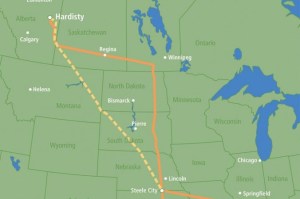
The Keystone XL Pipeline would cross the Yellowstone and Missouri Rivers. Click to enlarge.

The Keystone XL Pipeline would cross the Yellowstone and Missouri Rivers. Click to enlarge.

Next stop: Keystone XL
And, of course, Montana’s senators just cast votes in favor of the Keystone XL Pipeline. “The State Department has affirmed the safety of Keystone XL pipeline,” said Steve Daines, who was joined in his support by Jon Tester. “It’s important that this job-creating project is approved.”

Keystone XL would cross the Yellowstone about 20 miles upstream from the current spill.

What Daines and Tester didn’t say is that many of the jobs might be created in the bottled water industry and in oil cleanup crews.

Pipeline safety
One key issue is aging pipeline infrastructure and the number of inspectors available to determine their safety. According to the US Department of Transportation, over half the existing pipeline infrastructure was in place prior to 1970.

The agency’s Office of Pipeline Safety has roughly 150 inspectors overseeing 2.6 million miles of gas, oil and other pipelines.

That number is slated to increase by another 100 inspectors under a $27 million budget increase approved last year. That would still leave inspectors stretched way too thin given the mileage of pipelines.

Jeff Farrells, 62, the executive director of the Pipeline Association for Public Awareness, said that while new pipelines are safer than old ones, they are far from infallible. “Nothing’s perfect. I wish it was,” he said. “Is it worth the risk? The answer to that question in the past in this country has always been yes.”

What it means for us
The answer shouldn’t be an automatic, “Yes.” The question of whether it is “worth the risk” is a decision we need to make in a thoughtful way that doesn’t pit economic growth against the rights of citizens.

Senators Tester and Daines should know better. To vote for the Keystone XL without adequately addressing the issue of pipeline safety is irresponsible. Calling the Keystone a job creator and at the same time jeopardizing the health, safety and way of life of Montana residents is not leadership.

Along the Beartooth Front we need to keep fighting for landowner rights, for the protection of health and livelihood, and for the longtime viability of our community. It’s a long-term fight involving local regulation, reform in Helena, and responsible federal legislation.

Posted in Fracking informaation | Tagged , , , , , | 6 Comments

Pennsylvania trade secret rule in jeopardy, thanks to one committed physician

We’ve often discussed how state laws are tilted in favor of oil and gas companies, but some laws are so outrageous they need to be held up to special public scrutiny. When such laws are passed, it becomes a civic responsibility of citizens to challenge them.

In 2012 Pennsylvania passed Act 13, an overhaul of the state’s oil and gas law. One of the key provisions of the law is that it allows oil and gas companies to claim “trade secrets,” and keep information about the chemicals they use from being released to the public.

This is true in federal law and in other states, but the provision of the Pennsylvania law that goes beyond the pale is the “doctor gag rule” that requires physicians to sign a non-disclosure form in order to see a full list of drilling chemicals for the purpose of treating patients. But the language in the law also prohibits them from sharing that information with their patients and other doctors.

Imagine that. We now have a substantial amount of information that links drilling to negative impacts on human and animal health. Yet, in Pennsylania at least, doctors are prohibited by law from telling their patients or the doctors who treat them what is making them sick. The law in question is Section 3222.1(b)(10) and (11) of Title 58 of the Pennsylvania Consolidated Statutes.

In July of last year, the Pennsylvania Commonwealth Court upheld this “doctor gag rule” with a majority of the judges ruling that physicians have nothing to worry about when it comes to treating patients who may be exposed to fracking chemicals.

Dr. Alfonso Rodriguez

Dr. Alfonso Rodriguez

This law has been challenged in a suit by Dr. Alfonso Rodriguez, who, in his latest appeal, argues that this law violates his rights under the First Amendment to disclose information regarding fracking fluids to his patients and the remainder of the medical community. The suit has been dismissed twice by the US District Court, which ruled that Dr. Rodriguez lacked standing to challenge the law.

The Pennsylvania Department of Environmental Protection (PDEP) has filed a brief in response, requesting dismissal. They say Rodriguez’s claims are hypothetical because he has never requested the protected information or been denied the information. (Click here to read PDEP brief.)

We should applaud Dr. Rodriguez’ commitment to getting rid of this ridiculous law. There are times when citizens need to stand up to challenge laws that are fundamentally unfair.

Posted in Fracking informaation, Uncategorized | Tagged , , , | Leave a comment

Tuesday, January 20 in Red Lodge: screening of Backyard, plus panel of well-known environmental activists from Wyoming and Montana

Backyard screening and panel discussion
An interesting and timely event coming up this Tuesday, January 20 at the Pollard Hotel in Red Lodge at 7pm — a screening of the short documentary film Backyard by Bozeman filmmaker Deia Schlosberg, and an opportunity to hear from activists who have dedicated their lives to protecting the area’s natural resources.

The event is intended to inform and provoke a lively discussion, so come prepared to listen and participate. It is timely because the Carbon County Commissioners last week illegally rejected an effort by local citizens to control oil and gas drilling on their own properties.

I first wrote about Schlosberg a year ago when her film premiered at the Wild & Scenic Film Festival. As you can see from the trailer below, the themes of the film are similar to those we have explored often on Preserve the Beartooth Front. Backyard tells the stories of five people in four states. They all have very different backgrounds and perspectives, but all are at odds with the extraction occurring around them. Despite their differences, unnerving similarities emerge from their shared experiences.


One of the characters is from eastern Montana, and another, Jacki, is from North Dakota. We told Jacki’s personal story on Preserve the Beartooth Front last year.

Following the half-hour film you’ll hear from well-known activists who have fought to protect land, water, and property rights in Wyoming and Montana.

The panelists
Deia SchlosbergDeia Schlosberg has an MFA in Science & Natural History Filmmaking from Montana State University in Bozeman and runs Pale Blue Dot Media, which focuses on stories at the intersection of human rights and environmental issues. She was awarded a 2008 National Geographic Adventurer of the Year award for a two-year, 7800-mile through-hike of the Andes Mountains, and has subsequently lectured around the U.S. on the lessons in sustainable living she learned over the course of her journey.

John FentonJohn Fenton is a farmer from Pavillion Wyoming who has been living with the effects of the gas industry for many years: ground, water, and air pollution; surface degradation, property devaluation and other significant impacts. John and his wife Catherine have 24 gas wells on their farm. We told John’s personal story last March, and have done several follow up posts about how Pavillion has become a political lightning rod for the relationship between drilling and water contamination.

John has become an effective spokesperson for personal and landowner rights, and has advocated for these causes all over the world. Most recently he has focused on advocacy for environmental testing through an organization called Shaletest.

Gloria FloraGloria Flora is founder and Director of Sustainable Obtainable Solutions, an organization dedicated to the sustainability of public lands and of the plants, animals and communities that depend on them. At the U.S. Forest Service, Gloria became nationally known for her landmark decision to prohibit natural gas leasing along the 356,000-acre Rocky Mountain Front.

Gloria recently co-authored a report on how Montana can become energy self-reliant through renewable energy, energy efficiency and conservation. She serves on the Montana Climate Change Advisory Committee and works throughout the U.S. with the Center for Climate Strategies in assisting states develop climate change action plans.

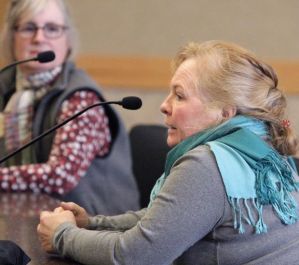
Bonnie Martinell testifying before the Board of Oil and Gas. Billings Gazette photo

Bonnie Martinell testifying before the Board of Oil and Gas. Billings Gazette photo

Bonnie Martinell is an organic farmer from Belfry, Montana. She spearheaded a group of local landowners who spent a year putting together the Silvertip Zone, a citizen initiated zone that would have regulated oil and gas activity within the zone.

Despite receiving signed petitions from 68% of the landowners within the zone, the petition was rejected last Thursday by the Carbon County Commissioners in a stunning rebuke to the will of a majority of landowners who sought to protect their health, their water, and their way of life.

The event is sponsored by Community Empowerment Project-Montana, a joint effort of the National Resource Defense Council and Pale Blue Dot Media, which linked up to initiate a community-based coalition addressing the growing concerns over energy development in Montana.

Posted in Community Organization, Fracking Information | Tagged , , , , , , , , | 1 Comment

Commissioners action in denying Silvertip Zone clearly illegal (video)

When the Carbon County Commissioners acted last Thursday to rescind their motion to go forward on the Silvertip Zone because of landowner protests, they chose to ignore a recent Montana Supreme Court decision that clearly makes such protests illegal.

You can watch the proceedings yourself. The audio is a little low, so make sure you turn the volume up to the highest level or use headphones. The video begins at 0:56.

You will note at 18:30, Commissioner John Prinkki claims that the Commissioners have no choice but to disallow the zone because of the protest:

Prinkki: Regarding this petition and the vote we’re about to take, the petition fails. As you know, under Section 5, because of the protest, we couldn’t move forward with this if we wanted to. It fails for that fact alone.

John Prinkki. Photo credit: James Woodcock, Billings Gazette

John Prinkki. Photo credit: James Woodcock, Billings Gazette

What Commissioner Prinkki is referring to is MCA 76-2-101(5), which states, “If real property owners representing 50% of the titled property ownership in the district protest the establishment of the district within 30 days of its creation, the board of county commissioners may not create the district. An area included in a district protested under this subsection may not be included in a zoning district petition under this section for a period of 1 year. ”

However, in August, 2013, in the case of Williams v Board of Commissioners of Missoula County, the Montana Supreme Court affirmed that the “protest provision” was an unconstitutional delegation of legislative power because it failed to provide “standards or guidelines to inform the exercise of the delegated power” and contained no legislative bypass. Since there was no mechanism whereby a County Commission could override the protest, the Court found that it could give “a small number of agricultural or forest landowners, or even a single landowner . . . absolute discretion to make the ultimate determination concerning the public’s best interests with no opportunity for review.”

That, of course, is exactly what happened in Belfry. A single landowner who owns a very large piece of land was essentially able to undercut the will of 68% of the landowners in the zone to determine what should happen on their own land.

What the Commissioners did is not only illegal, it is undemocratic.

You can read an excellent analysis of the Williams case written in layman’s terms by Ross Keogh of the University of Montana School of Law by clicking here.

Posted in Community Organization | Tagged , , , , | 3 Comments

Unbelievable. Carbon County Commissioners defy will of majority to deny Silvertip Zone.

In a stunning reversal that ignored the will of the majority for the opinion of a small minority, the Carbon County Commissioners today withdrew their motion to accept the petitions to form the Silvertip Zone.

The Commissioners had voted on December 15 to move forward on the zone because it is   “in the public interest and convenience for public health, safety and welfare, and for the public infrastructure.”

The petitioners represented 68% of the landowners in the district, well above the 60% required to form a citizen initiated zone. According to a Carbon County official, the Commissioners received protests from six landowners in the area to be covered by the zone.

The Commissioners cited the protests as a reason for withdrawing their motion.

The agenda item was short, with little opportunity for public comment.

More to come. I’ll post the video as soon as I have it.

The illegal taking of water at site of Belfy well.

The illegal taking of water at site of Belfy well last June.

Posted in Community Organization, Politics and History | Tagged , , | 17 Comments

A personal story: Kelly, Shrewsbury Township, Pennsylvania

This personal story is one of a series on Preserve the Beartooth Front chronicling the impact of the oil and gas boom on the lives of people all over North America. You can see other personal stories in our series by clicking here.

Attendance neededThe story comes from an organization called the Responsible Drilling Alliance (RDA) in Pennsylvania, a grassroots group of dedicated citizens who seek to educate themselves and the public about deep shale gas drilling, and to advocate for necessary regulations. RDA has been very encouraging of our efforts along the Beartooth Front, and former board member Ralph Kisberg wrote a guest post for Preserve the Beartooth Front about lessons learned after many years of drilling in Pennslyvania.

Today’s personal story was published in the RDA’s most recent newsletter. It is written in the first person by a woman who identifies herself as Kelly, a resident of Shrewsbury Township, located in southern Pennsylvania, about midway between Harrisburg and Baltimore.

The story’s lesson is clear. When an operator or landman comes to your door, don’t sign anything until you’ve consulted with a land use attorney. The story begins below the photo.

Gas pipeline. Photo: Jonestownship.com

Gas pipeline. Photo: Jonestownship.com

Lease Regrets
This is for all the people out there who are just waiting for the gas wells to go in so they can start collecting big bucks. Well, let me tell you a little about the big bucks.

We live in Lycoming County, on 43 acres. We were first offered $2 an acre to allow the gas company to “explore” our land. Next, they told us that there was gas under our land and that we would be able to collect royalties. They said we could see almost $1000 per acre in royalties that would last up to 50 years. $1,000 x 43 x 50 = over 2 million! That sounded great! We thought we were going to be rich, and never have to worry about money again.

We were in a hurry to get the money so we were in a hurry to sign the lease as quickly as possible, in spite of the fact that the contract was really long and confusing and full of big words. We signed a lease for 10 years, but didn’t realize they could automatically renew it for another 5 years, which they did.

After the first 10 years, we wanted out. The company we signed with had changed hands three times, cleared 3 miles of old growth trees, dug up our land, put in 3 wells and a pipeline, and ruined our roads. The traffic was awful: big, loud diesel trucks running up and down our roads all day and night. Trucks also leaked contaminated fluids into the nearby creek.

It’s been 15 years since we signed. Now, they’ve shut down all the wells around us because they aren’t producing. We spent money on a lawyer (trying to get out of the lease) and more money on tires and alignments for our vehicles because of the potholes and road conditions. We lost many of our trees, and the wildlife we used to have here is nearly all gone. Our lawyer told us we should continue to have our drinking water tested several times a year to make sure it’s safe to drink, and those tests are expensive.

And where’s all the royalty money they said we would receive? There is none! We are left with abandoned wells, no royalty money, and the land all but destroyed. They promised they would restore the land and put it back the way it was, but we haven’t seen a single tree replanted. I’m 42 years old, I’ll be six feet under before the land ever looks like it did before the gas company showed up.

I hope this helps some of you who are eager to sign and see the money start to roll in. Maybe you’ll be one of the lucky ones to receive royalties, but you need to know that you’re sacrificing your water, your land, your animals, and your health – and nothing will be the same for the rest of your life. So think before you sign. We learned the hard way: the gas industry makes promises it can’t keep – and money isn’t everything.

You can sign up to receive RDA’s newsletter via email.

Posted in Fracking Information | Tagged , , , , , | 3 Comments

Please attend: Carbon County Commissioners Meeting Thursday, January 15

The final step in the process of establishing the Silvertip Zone occurs this Thursday, January 15, at the next Carbon County Commissioners meeting. The meeting will be held at the County Administration Building at 17 West 11th Street in Red Lodge, and this item is on the agenda for 10:30am.

The new petition addresses concerns raised by County Attorney Alex Nixon. Click to read the petition.

Click to read the petition.

The meeting is the last part of the required process to determine that the zone is in the “public interest and convenience,” as voted by the Commissioners last month. It is expected that the Commissioners will hear comments from landowners inside the zone who did not sign the petition. It is important to note that 68% of the landowners within the zone boundaries signed the petition submitted last month.

The meetings in this process have been characterized by good attendance by supporters of the zoning petitioners. Since this is the end of the process, it is absolutely critical to continue this level of support. This is an opportunity to show your support for the petitioners — please attend.

I’ll report on the discussions after the meeting.

Click to read latest draft of Carbon County Growth Plan

Click to read latest draft of Carbon County Growth Plan

The Commissioners should approve the Silvertip Zone. The petitioners have followed every step of the legal process to put the zone in place. The citizen initiated zone is consistent with the Carbon County Growth Policy that will be adopted by the Commissioners next month.

If you click on the draft growth policy by clicking on the graphic, you’ll find citizen initiated zoning listed as part of the natural resources development goal on Page 52:

5.2.A. Coordinate with landowners to enable citizen-initiated zoning districts (enabled through MCA 76-2-101) to mitigate potential impacts from natural resource development.

Once the Commissioners reaffirm their vote from last month, the next step will be establishing a planning and zoning committee, which will establish the rules for the zone.


Posted in Community Organization, Politics and History | Tagged , , , | 1 Comment

The price of oil: drilling will continue for now, but we need to keep our eyes on the future

gas prices_010915

The price of gas in Red Lodge, January 9, 2015

The price of oil has collapsed since fall. One result is the steep decline of the price of gas at the pump. When I first looked at falling prices on November 10, the pump price was $2.97 in Red Lodge and $2.99 in Columbus. On December 3  when I discussed the reasons for the price decline, the pump price had dropped to $2.77. By last Friday, as you can see from the graphic at right, the price was down to $2.04, the lowest level since May, 2009.

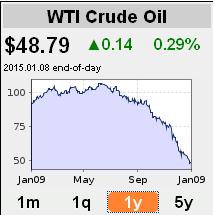
oil price_010915Falling fuel prices are of course driven by the plummeting price of oil. Last June it was $105 a barrel. In November it was $77 a barrel. In December, just after a pivotal OPEC meeting, it was down to $62. As of Friday, the price had collapsed to $48.79, a drop of about 54% since June, and roughly equivalent to the price a decade ago when the hydraulic fracturing boom was in its infancy.

Not surprisingly, we’ve recently seen Energy Corporation of America decide to walk away from the well in Belfry “for now.” (You can read the letter from ECA to the Carbon County Commissioners here.) This decision is undoubtedly related to the economics of oil production, which are worth looking at in some detail.

Components of the cost of oil production
There are two components of cost in producing oil from a well: the fixed cost of finding the oil, drilling, and generating the initial output, and then the variable cost of keeping the well going over time. Fixed costs include primarily equipment costs and labor, and variable costs are mostly labor and electricity.

When an operator is making a decision in advance about whether to drill a well or not, he looks at the total of both fixed and variable costs to determine whether it is going to be profitable to drill the well. Profit over time is the difference between expected revenues and the total of fixed and variable costs.

Photo credit: Getty Images

Photo credit: Getty Images

But once the decision is made to drill a well and the well starts producing, the fixed cost is spent. From that point on, the decision about whether to keep operating the well is based on whether the revenues are greater than the variable cost of production.

According to Shawn Tully of Fortune Magazine, with conventional wells, production declines by only about 2-5% per year, so they can produce for 20 years or longer. After several years, the variable cost can be as low as $20-$30 per barrel, so in the case of the kind of price drop we see today, these wells can go on pumping. Operators will only stop drilling when the sales price goes below the variable cost, which rarely happens.

“What drives the business is the marginal (variable) cost, not the total cost,” says Ronald Ripple, a finance and energy business professor at the University of Tulsa. “Even at low prices, the production is still contributing something to cover the upfront investment.”

How fracking cost differs from conventional well costs
But the equation for unconventional wells is different. Unlike conventional wells, the production from fracked wells drops off very quickly and the wells have a relatively short life. In the Bakken, production declines by 72% in the first year of production. By the end of the second year, the well’s reserves are 50% depleted, and the annual production is very small. To keep increasing revenue, producers need to keep drilling new wells because existing wells have such a short life.

That poses a problem for the fracking industry, because new wells require additional fixed costs. And the decision to drill a new well means a higher breakeven cost.

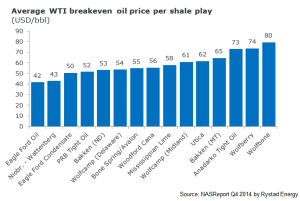
Click to enlarge

Click to enlarge

According to a study by Rystad Energy, the total (fixed plus variable) breakeven oil price for a new well in the Bakken is $53 in North Dakota and $65 on the Montana side. It’s important to note that these breakeven prices are just averages, since companies with an established presence will be able to leverage their initial investments to reduce the breakeven price.

What we are now seeing in the field is that the number of wells is declining quickly in the face of these price declines.

Click to enlarge

Click to enlarge

According to Baker-Hughes, the number of active rotary rigs in the United States, after increasing dramatically throughout 2014, has taken a precipitous drop of about 8% since December (click on chart at left).

However, we shouldn’t expect huge declines to continue. The bottom line here is that, even with the very large drop in oil prices, most existing wells will continue to operate, at least in the short term, because their variable costs are covered. However, if the price continues to stay low for an extended period, we may see a significant decline in production in shale plays because of the constant need for new wells.

All of this is extremely volatile. Last June, the oil industry was on top of the world, and we were looking at wells being drilled in Belfry and Dean. Factors that we don’t anticipate, such as increased demand in China and India, or a decision by OPEC to reduce production, could change everything again in a few months.

We need to focus on our long-term future
Along the Beartooth Front, it is important for us to keep our eye on ensuring the long-term viability of our community. Oil booms will come and go, and producers will find us more or less attractive depending on the price of oil and the cost of extraction.

What we need to focus on is making sure that drilling is done in a way that preserves our rights, our water, and our way of life. Even as market volatility changes the short-term outlook, we need to stay busy working on our long-term future.

Posted in Fracking informaation | Tagged , , , , , , , , | 3 Comments