A shocking story out of Oklahoma tells of the death of oil executive Aubrey McClendon, who was killed in a violent car crash yesterday, just one day after he was indicted in federal court for violations of anti-trust laws.
Aubrey McClendon. Photo: Sean Gardner, Reuters
While no cause of death has been declared, it appears McClendon drove his SUV at a high rate of speed directly into a wall. According to police, “There was plenty of opportunity for him to correct and get back on the roadway, and that didn’t occur.” McClendon was not wearing a seatbelt at the time of the crash.
McClendon was accused of orchestrating a scheme between two large oil and gas companies to not bid against each other for leases in northwest Oklahoma from December 2007 to March 2012, the Justice Department said Tuesday in a statement. His “actions put company profits ahead of the interests of leaseholders entitled to competitive bids for oil and gas rights on their land”.
McClendon is a legendary figure in the fracking boom over the last decade, and we’ve written about him several times on this site. He made billions in fracking at the expense of property owners, pushing to drill every possible well with little regard for environmental impact.
Illegal deductions from royalty payments
In March of 2014, we described a scheme in which McClendon overcharged for payments to his pipeline company for the transport of gas to market, and deducted the charges from royalties due to landowners, including Pennsylvania farmer Joe Drake,
“I got the check out of the mail… I saw what the gross was,” said Drake, a third-generation Pennsylvania farmer whose monthly royalty payments for the same amount of gas plummeted from $5,300 in July 2012 to $541 last February. This sort of precipitous drop can reflect gyrations in the price of gas. But in this case, Drake’s shrinking check resulted from a corporate decision by Chesapeake to radically reinterpret the terms of the deal it had struck to drill on his land. “If you or I did that we’d be in jail,” Drake said.
McClendon’s death came just as jail was about to become a reality for him.
This practice has generated a flood of lawsuits across several states. Hundreds drag on in North Texas alone. One Fort Worth law firm alone filed 435 lawsuits on behalf of 22,443 plaintiffs after rounding up clients through a media blitz, the Fort Worth Star-Telegram reported last month.
Illegal price fixing of leases
In May of 2014, we described a scheme in which McClendon directed executives at Chesapeake Oil to collude with Encana Corporation to drive the price of oil leases in Michigan from $1413 per acre to just $13 per acre by reaching an agreement in which the two companies would never bid against each other for the same lease. While McClendon was never indicted for this scheme, it appears similar to the Oklahoma scheme for which he was indicted this week.
An object lesson in community preservation
The point here is not to drag a dead man through the mud. McClendon’s apparent decision to end his life rather than face the consequences of his actions is sad and requires no embellishment from me.
The point is to caution landowners that the circumstances of McClendon’s death should remind us all that oil companies care about profits, not the rights of landowners. If you want to protect your rights, it is critical to set the terms upon which drilling occurs on your property. Mechanisms exist in the law to do that, but you have to be vigilant and act together as community to make it happen.
Landowners in Carbon and Stillwater counties along the Beartooth Front are currently engaged in battles to do this. The fight is long, but the goal — long-term preservation of a way of life — is worth the effort.
The documentary film “Makoshika,” about life in the Bakken oil fields, will have its Billings premiere this Sunday at 7pm at the Babcock Theater, and will also be shown at the Art House Pub and Theater on March 4-6 and 9-10.
“Makoshika” is a beautifully shot film, moving at a relaxed pace from interviews with longtime residents of the area, to the impacts of the boom, to the bitter winter of concern.” (Director Jessica Jane) Hart said the goal was to examine the economic boom-and-bust cycles of the Western economy without taking a stand for or against oil production.
“I’m not pro- or anti-oil at all,” she said in Billings last week. Rather, she sees the film as a portrait of humanity.
For residents along the Beartooth Front considering how to prepare for a future oil boom, the film offers much to consider. From Makoshika’s web site:
Our story begins in summer 2014, when unprecedented development was in full swing, and concludes the following winter, as falling oil prices foretell a possible end to the boom. In this setting, small towns where residents once left their doors unlocked are overrun with workers vying for jobs in the oil fields, camper trailers sprawl across rural landscapes, and tight-knit farming communities inflate into boom towns. Competing interests and contrasting lifestyles of the characters weave together as they cope with the challenges and hopes of their environment.
Examining both the present boom and those since passed, Makoshika alternates between intimate first person narratives and historical commentary, asking viewers to look at the present through the lens of history. The film is a dialogue on the delicate balance between economic development and environmental and social justice from a diverse range of voices, and a portrait of a fascinating American region in transition.
With mild spring weather forecast for Billings this weekend, we recommend the journey.
It’s something we take for granted, but a recent study by a team of researchers from the US Geological Survey (USGS), including two based in Montana, found that changes in climate directly and consistently influence trout populations worldwide.
In the study, titled “Impacts of Climatic Variation on Trout: A Global Synthesis and Path Forward,” lead author Ryan Kovach and his colleagues provide the first global literature review of trout responses to climate change over time.
Ryan Kovach
Key patterns emerged from the existing data. In particular, lower summer streamflows were associated with reduced growth, survival, and abundance across trout species, locations, age classes, and even continents. As global warming brings diminished winter snowpack, lower summer streamflows and increased temperatures, the impact on local trout populations will be significant.
Measuring surface water
Summer streamflow is a matter of significant concern along the Beartooth Front.
The Surface Water Supply Index (SWSI) is a complex measure that incorporates both hydrological and climatological features into a single index value for river basins. It includes snowpack, streamflow, precipitation, and reservoir storage into a single number centered on zero, with a range between -4.2 and +4.2. The map below, from the state of Montana web site last summer, depicts the SWSI for all river basins in the state as of August 1, 2015.
As you can see, both the Stillwater and Clarks Fork Yellowstone basins are extremely dry, with SWSI indexes of -3.8 and -3.6 respectively. (To see this, click on map to enlarge, and look at legend on left. Stillwater is 44, Clarks Fork Yellowstone is 46.)
Continued low streamflows and increased temperature due to climate change will have a sustained impact on the viability of trout populations in our rivers.
Natural resource management is critical
“The key message is that climate does have a strong influence on trout populations, and this is something we have observed over time,” said Kovach in a recent interview with the Flathead Beacon. “We’ve seen that year-to-year variations in streamflow and temperature can have an impact on trout populations. This highlights that climate and climate change is not speculative, it is realized. It is something that we need to confront now in terms of natural resource management, but also from a societal perspective.”
With regard to climate change, there are many things we can’t control and some we can. Our rivers are going to be lower and water temperatures will be warmer over time. This will inevitably impact the rainbows, browns and cutthroats in our rivers. It is essential that we do everything we can to protect those waters from negative outside influences, including mineral extraction.
This article looks at possible impacts of the death of Supreme Court Justice Antonin Scalia on the federal Clean Power Plan (CPP) and the Paris climate change agreement, particularly in Montana. Scalia died on Saturday, February 13.
Historic agreement depends on US leadership and commitment
Last December in Paris, representatives of 195 countries, representing more than 95% of global greenhouse gas emissions, reached a landmark climate agreement that will, for the first time, commit nearly every country to lowering planet-warming greenhouse gas emissions to help stave off the most drastic effects of climate change. United States leadership was key to passage, with President Obama committing to significant cuts in carbon emissions.
From a policy perspective, the key to the US commitment was the Administration’s Clean Power Plan (CPP), which will require power plants to make significant reductions in emissions. The CPP’s standards limit the amount of carbon pollution released for every power plant covered by the rule, and they are the same for every plant in every state. The cuts would have their biggest impact on coal power.
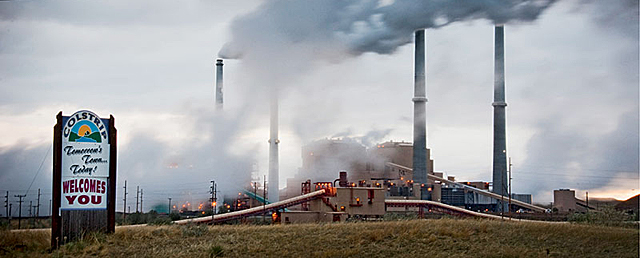
Coal power plant in Colstrip, Montana. Photo: Sierra Club
The viability of the Paris agreement was threatened last week when, in one of the final decisions in which Scalia participated, the Court voted 5-4 to temporarily block the CPP. Scalia voted with the majority.
CPP failure could cause Paris agreement to come apart
If the CPP is permanently blocked, other countries, particularly major polluters such as India and China, might regard this as a failure of leadership on the part of the US and back out of the Paris deal.
“If the U.S. Supreme Court actually declares the coal power plant rules stillborn, the chances of nurturing trust between countries would all but vanish,” said Navroz K. Dubash, a senior fellow at the Center for Policy Research in New Delhi. “This could be the proverbial string which causes Paris to unravel.”
The Supreme Court decision was a response to lawsuits from the energy industry and 29 states, including Montana, to block the new rules. It was not a final blow to the CPP, since the US Court of Appeals for the DC Circuit will hold oral arguments on the plan in June, which means that, even before the Supreme Court decision, neither the industry nor the states would have had to come into compliance for at least two years.
Justice Antonin Scalia
What impact will Scalia’s death have on the CPP?
The DC Court of Appeals is likely to rule in favor of the CPP, which would bring it back to the Supreme Court on appeal.
However, last week’s Supreme Court decision is a source of concern for the Administration, since it signals that five judges had problems with the plan.
The Republican leadership in the Senate, which must approve Obama’s Supreme Court nominee, has vowed not to approve any nominee until a new President is elected. Whether they hold to this pledge or not, the likely result will be favorable to the CPP and the Administration, although a negative result is possible.
If Scalia’s seat remains vacant and the DC Court of Appeals rules in favor of the CPP, the likely 4-4 Supreme Court vote would leave the DC ruling in effect, and the CPP would go forward.
If Scalia’s seat remains vacant and the DC Court of Appeals rules against the CPP, the likely 4-4 Supreme Court vote would affirm the DC ruling and the CPP would be canceled.
If Scalia’s seat is filled, the new justice would probably be the deciding Supreme Court vote, and, if an Obama nominee, would almost certainly vote in favor of the CPP, leaving it in force.
Impact on Montana
In Montana, the CPP has been highly controversial, with opponents claiming the standards will cost thousands of jobs and provoke a financial calamity for the state. These claims have been debunked by credible sources, and, according to the EPA, “Montana has one of the least stringent state goals, compared to other state goals in the final Clean Power Plan.”
Beyond the CCP, the biggest impacts on Montana’s coal plants will be a long-term reduction in global market demand for coal, which is being replaced by natural gas and clean energy.
The Stillwater County Commissioners appear to be so out of touch with their constituents that they can’t be bothered to respond to residents on issue after issue. Several recent examples show a pattern of inadequate communication as well as failures in planning, budgeting and executing complex projects.
Stillwater County Commissioners (L To R): Dennis Shupak, Jerry Dell, Maureen Davey
Stillwater County oil and gas district
Last November 11, Stillwater County landowners presented over 360 signatures to the Commissioners petitioning to establish the Stillwater County Beartooth Front Zoning District. The petitioners are landowners who want to protect their properties from potential damage caused by oil and gas activity, in accordance with Montana law. The petition was the result of two years of work on oil and gas issues, and the enthusiastic residents packed the Commissioners’ meeting room on the day the signatures were submitted.
Burt Williams of Nye presents map of proposed oil and gas district to Commissioners
Local regulations would address issues that are not part of Montana law. Examples include:
Minimum distances, or setbacks, between wellheads and occupied residences
Regular water testing before drilling begins and periodically afterwards to protect landowners against possible contamination
Specifications for well design to reduce the probability of toxic wastewater leakage.
The next step in forming the district is for the County Clerk and Recorder to validate these signatures against public records so that the Commissioners can determine that the district is in the “public interest and convenience.” Once that happens, a planning and zoning commission can be formed to work on creating the district.
Here’s where we are, three months after the petitions were submitted: the County has made no progress. There have been no signatures validated. After not hearing from the Commissioners since the petitions were submitted, the petitioners asked that a progress report be given as an agenda item at the February 9 Commissioners meeting. At the meeting the Commissioners stated that they are looking for direction from other counties on a process for signature validation, but offered no timetable for action.
You can view the November 11 Commissioners meeting and signature presentation below:
Stillwater River Road rockslide
Last June 3, a rockslide on Stillwater River Road closed it to through traffic. This County road is a significant thoroughfare that connects Absarokee to Nye and is a secondary connector to the Sillwater Mine and Custer National Forest. The closure is a matter of great concern to local residents who depend on the road for commerce, to employees at the Mine who use it to travel to work, and to those who want to enjoy the Stillwater River or Custer National Forest for recreation. In addition, with memories of the devastating 2006 Derby Fire fresh in residents’ minds, the importance of maintaining multiple clear paths to safety is a paramount concern.
In June and July the County engaged with engineering firms SK Geotechnical of Billings to do a risk analysis and Geostabilization International of Grand Junction, CO to do a preliminary proposal for rockfall remediation. The initial proposal included rock scaling, the insertion of metal rods to hold the rock wall in place, and a mesh fence to protect the area below from falling rock. A rough cost, according to the preliminary proposal, was $1.5 million, which could be phased over time.
In November, after a formal bid process, the County contracted with Shannon and Wilson, an engineering firm from Denver, to do a time and materials contract to determine a plan of action and cost of repairs.
According to the Stillwater County News, Shannon and Wilson submitted a 23-page report in December that dismissed previous mitigation suggestions as too costly and offered four new solutions including rock scaling and various kinds of fencing, including one option in which rockfall would automatically close a gate on the road to traffic. These proposals were similar in concept, although reduced in scope, from the original estimate submitted in July.
A subcommittee comprised of the three Stillwater County commissioners, Road & Bridge Superintendent Mark Schreiner, County Attorney Nancy Rohde, and Disaster & Emergency Services Director Carol Arkell has decided more study is required.
According to Rohde, Shannon and Wilson’s dismissal of earlier mitigation proposals as “economically infeasible” was “too conclusory.”
“We’re probably no further ahead than we were,” she said about the draft report.
Rock wall above rockslide. Photo: SK Geotechnical
Commissioner Jerry Dell hosted a public meeting at the Nye firehouse last July to provide an update and listen to resident concerns. At the meeting, Commissioner Dell responded to complaints about lack of communication by promising regular updates from the County to residents. These updates have stopped. There have been no updates since November 30, no Commissioner meeting minutes posted since October 27, and the Shannon and Wilson report has not been posted to the County website.
Here’s where we are, eight months after the rockslide: the road is still closed, and the County has communicated no budget or potential sources of funding for the repairs, no timeline, and no plan on how to move forward. The Commissioners have stopped communicating with local residents regarding this issue, either through an email list of property owners or on the County website.
Although the County claims that FEMA has denied funding for the project, it is clear that there has not been a systematic examination of potential federal and state funding sources for repairs. Several local residents have commented that, after six months of being “no further ahead than we were,” after the July preliminary proposal, the Commissioners seem to be in over their heads and unable to evaluate possible options or funding sources.
Prospects for getting the road opened in 2016 appear slim at this point.
Stillwater County Courthouse upgrade
For the last several years, the Commissioners have been considering what to do with the County Courthouse. The process has been a communications debacle, marked by changing stories, inconsistent statements and public confusion about the Commissioners’ intent.
Stillwater County Courthouse. Photo: Stillwater County News
The Commissioners contracted with Spectrum Group Architects of Billings sometime before January 2013 and paid over $70,000 to look at County service needs. After public allegations that the Commissioners were only looking at remodeling the old hospital (an option for which there was little public support), the contract was amended to include a feasibility study for four options.
In ealy 2015 the Commissioners held public meetings presenting the four alternatives marked by active and sometimes hostile exchanges. These alternatives created substantial community concern for a number of reasons: inadequacy of the hospital building, public safety issues, lack of attention to modern standards for courtrooms and judicial chambers, and, for the general public, a refusal to consider utilizing the historic courthouse building, the only substantial civic building in Stillwater County eligible for listing in the National Register of Historic Places.
During this process Spectrum was involved in a nasty dispute with the Lame Deer School District, and wound up paying $300,000 in a settlement in which an independent audit found a Spectrum design was “unremarkable,” contract documents were “not clear, correct or well-coordinated,” and that Spectrum “charged the school district considerably higher fees…than industry standard.” After this dispute was made public, the Commissioners did not react publicly or issue a comment.
After a May public hearing showing overwhelming support to preserve the historic Courthouse, the Commissioners’ intentions are completely unclear. The issue has been well covered by the Stillwater County News, which reported last July that the Commissioners had delayed active pursuit of the Courthouse project to work on other issues. “As time permits…we’ll get back to the courthouse,” Commissioner Maureen Davey said at the time.
After a lengthy process of planning and public input, here’s where we are: in limbo. The Commissioners have gone silent. There is no existing plan, no budget, and no timetable. Once again, the Commissioners have failed in planning, budgeting and execution of a major project.
Tree cutting on Fiddler Creek Road
On January 31, the Billings Gazette ran an article about a controversy regarding tree cutting along Fiddler Creek Road between Rosebud and Nye. According to the article,
“Some of the residents said they felt like their comments — as well as a petition signed by more than 30 locals — have never been heard. They also said they were upset that they were never informed prior to the tree clearing along Fiddler Creek Road — which in spots extends 150 feet from the road, according to one resident’s account.”
Since that story ran, local residents report that County workers were out in West Rosebud last week, taking down more trees. Residents report that mature trees are being taken with younger ones, and that trimming crews are ignoring right of way restrictions.
This is a dispute that has gone on for several months. For more, see the Stillwater County News.
And what is the County’s position on this? It’s impossible to tell since Commissioner Dell refused to comment, saying the issue has been “hashed out.” It is clear that residents in the area don’t think so.
One of several trees cut on Fiddler Creek Road. Photo: Virginia Cross
Who do the Commissioners think they report to?
Stillwater County is small and rural, with about 9,000 residents spread over 1,800 square miles — a population density of about five people per square mile. 3,126 voters participated in the last County Commissioner election in 2014. With people so spread out, communication is difficult and organization almost impossible.
So when nearly 400 people spend two years organizing to protect their land against the harmful effects of oil and gas drilling, you would expect their elected representatives to take that seriously enough to respond to the effort. Or when hundreds of residents and the area’s economy are affected by a County road closure, you would think that a responsive County government faced with difficult options would be able to develop a plan and communicate clearly about how they propose to fix it. Or when there are millions of dollars at stake in upgrading the only substantial civic building in the County that is a historical landmark, you would demand that Commissioners engage in an open process to develop a plan on a public timetable. Or when nearly 50 residents sign petitions and care enough to attend meetings regarding the preservation of the trees around their properties, you would want the County to care enough to make a public comment that explains their actions.
You would expect. You would think. You would demand. You would want. Apparently not in Stillwater County. Who do the Commissioners think they report to anyway?
Stillwater County voters would do well to take note of term expirations. Change is needed, and it is up to voters to make sure competent candidates who are responsive to the voters who elected them are put in office:
Commissioner Jerry Dell’s seat is up for election in 2016. Dell has announced his retirement, so it is important for a local resident to step and declare for this office.
It is often important for communities to understand macroeconomic trends in making local decisions regarding business development and growth. This is certainly true in the energy sector, where long-term trends are becoming increasingly clear. Along the Beartooth Front, these trends are particularly important in light of what has transpired over the last two years.
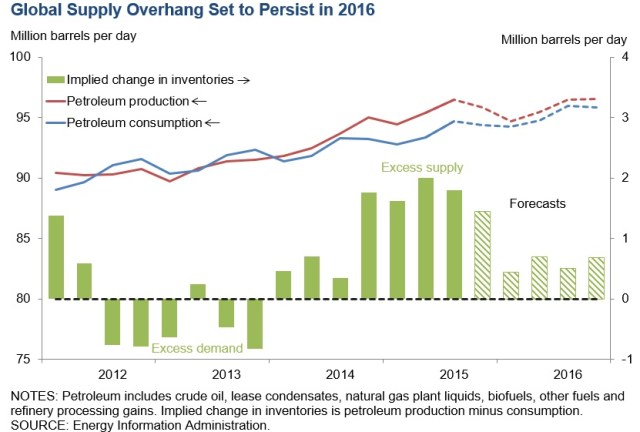
The chart below shows that global production is expected to exceed consumption in 2016, resulting in excess supply and increased inventories, and continued poor performance in the sector.
Clean energy surging
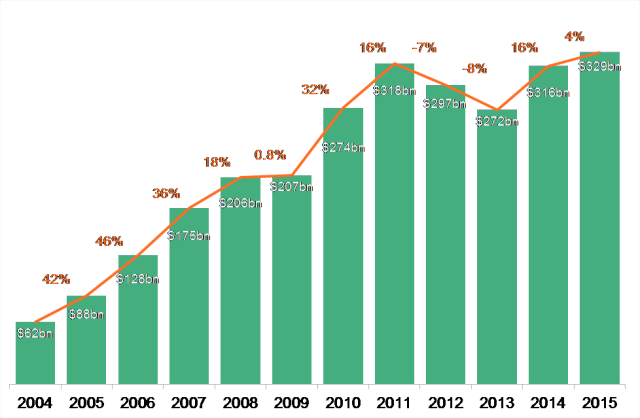
While the oil and gas industry is deeply depressed, the clean energy industry is growing quickly. According to Bloomberg New Energy Finance clean energy investment surged in 2015 to a record high of $328.9 billion, up 4% from 2013 and 3% from the previous record set in 2011. Global investment in clean energy has grown by nearly six times in dollar terms since 2004, despite several factors that work against that growth:
The cost of solar cells is declining, which means that more capacity can be installed for the same price;
The US dollar is strong, reducing the value of investments made in other currencies.
The European economy is weak. European demand has been a prime driver of clean energy growth.
Low oil and gas prices, which means clean energy is growing despite the fact that gas is cheap.
This chart from Bloomberg shows the continuing 10-year surge in clean energy investment.
Globally, the largest investor by far in clean energy is China, which grew 17% in 2015 to $110.5 billion. The US is second, with 8% growth to $56 billion. Growth in Europe and Brazil slowed, but several emerging markets picked up the slack: Mexico, Chile, South Africa and Morocco.
According to Michael Liebreich, chairman of the advisory board at Bloomberg New Energy Finance:
“These figures are a stunning riposte to all those who expected clean energy investment to stall on falling oil and gas prices….Wind and solar power are now being adopted in many developing countries as a natural and substantial part of the generation mix: they can be produced more cheaply than often high wholesale power prices; they reduce a country’s exposure to expected future fossil fuel prices; and above all they can be built very quickly to meet unfulfilled demand for electricity. And it is very hard to see these trends going backwards, in the light of December’s Paris Climate Agreement.”
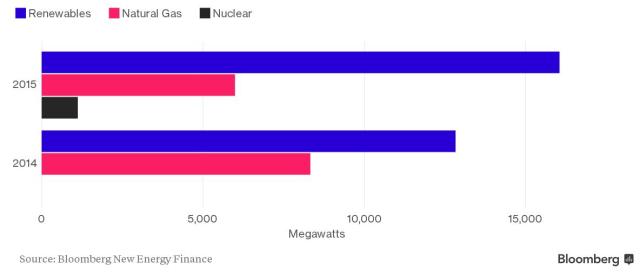
The biggest growth came from wind farms, with 8.5 gigawatts of new turbines installed as developers sought to take advantage of a federal tax credit that was due to expire at the end of 2016; Congress extended it in December.
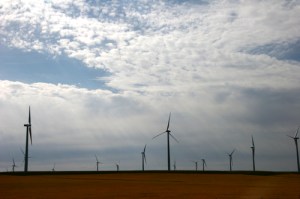
Wheatland County wind farm. Photo: Johanna Abzug
“This is a long-term trend,” said Colleen Regan, a New Energy Finance analyst who follows North American power markets. “System costs have really come down for renewables, which makes the case for installing them a lot stronger.”
“(The pace of renewable growth) is not enough: coal-fired generation is slowly being phased out, but the process needs to go much faster, and while replacement of coal with natural gas could in principle be a net positive — less carbon, more hydrogen — in practice the leaks associated with fracking make that highly doubtful.
“But the point you should take is that really dramatic reductions in greenhouse gas emissions are well within reach, requiring only moderate incentives rather than a complete teardown of the existing system.”
Why this is important to the Beartooth Front These trends are clear. Clean energy is replacing coal, oil and gas. The pace is gradual today, but market forces and government action will accelerate the change over the next two decades.
The oil market will probably recover in the short term, and there will probably be another boom. Another oil developer will come knocking on our doors along the Beartooth Front, promising jobs and riches.
But we shouldn’t be fooled. In the last two years we have seen boom turn to bust and the plans for wells disappear as quickly as prices fell. In the future, the booms will be smaller and the busts will be bigger as solar and wind gradually replace coal, oil and gas. Everything points in this direction, from last year’s Paris agreement to the economic trends described above to the increasing evidence that oil and gas drilling is harmful to public health. The markets for coal are drying up; the displacement of oil and gas will take longer. But as Krugman points out, increased government incentives would speed the process.
So when the oilman comes knocking, we should be resolute in making sure that any fossil fuel activity that takes place leaves our community intact. It needs to take place on our terms, not the oil industry’s. Sensible regulations need to be put in place before any drilling occurs. These rules need to protect our water and air, farming and agriculture, and our way of life.
All briefs have now been filed in the Carbon County case before the Montana Supreme Court. In the case, Belfry landowners have challenged the Carbon County Commission’s rejection of their petition for land use regulations to protect their private properties from the harmful effects of oil and gas drilling.
The Supreme Court has previously agreed to review the case. The Court will now decide whether to schedule a hearing or make a decision after reviewing the briefs.
The landowners collectively seek to establish the “Silvertip Zoning District” to cover nearly 3,000 acres of agricultural land north of Belfry, Montana. Creation of the district is the first step to establish solid protections for land, air and water quality, giving landowners an essential voice in the development of oil and gas on their properties.
The Carbon County Commissioners held multiple public meetings before approving the zone in December 2014. They then decided to reject it in January 2015.
Earthjustice, an environmental nonprofit law firm, is representing the Silvertip landowners in their appeal out of the firm’s Livingston office. The Commissioners are represented by Doney Crowley PC of Helena and Carbon County attorney Alex Nixon, and the protesting landowners are represented by Raymond Kuntz of Red Lodge
You can read the briefs that have been filed in the case by clicking on the links below:
Why this is important Montana law affords few protections to landowners against damages that can occur when oil and gas activity takes place near their homes:
The prevalence of split estates means that landowners frequently have no say over what happens on their property.
The Montana Board of Oil and Gas Conservation, which is the primary state regulatory agency for oil and gas activity, is structured specifically to favor industry over landowners. The result is that there are no restrictions over how close wellheads are placed to occupied buildings, water is not sufficiently protected, air quality is not protected.
Citizen initiated zoning (CIZ) is one of the few opportunities Montana citizens have to establish local regulations to protect their properties. It has been used effectively in places like Bozeman and Great Falls to establish regulations to protect citizens.
Yet that process is badly flawed. The Silvertip zoning case currently before the Supreme Court exposes some of the problems with the process. Silvertip landowners worked to meet all CIZ requirements. Their petitions were accepted by the Carbon County Commissioners, who then made the decision, after multiple public hearings, that the zone was “in the public interest and convenience,” as required by law.
Subsequent events that led the Commissioners to reverse their decision exposed some significant ambiguities in the process that will affect landowners in other counties. Cases like the current one can help to make the CIZ process more clearly defined in law so that the Silvertip landowners, as well as landowners in other communities, can take advantage of CIZ provisions to protect their properties.
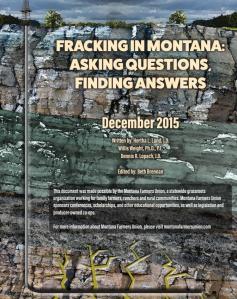
The Montana Farmers Union (MFU) has released a whitepaper addressing issues related to the use of fracking in oil and gas operations in Montana. Entitled “Fracking in Montana: Asking Questions, Finding Answers,” the paper outlines concerns of farmers, ranchers and landowners regarding fracking operations on or near their property. The paper also covers a variety of environmental issues, including water and air quality impacts.
Click to download a copy of the whitepaper
The paper was commissioned in 2014 by the Cooperative Education Corporation (CEC), a charitable affiliate of MFU. Authors include:
Bozeman lawyer Hertha Lund, who has represented landowners in a variety of resource disputes;
Willis Weight, Ph.D., P.E., hydrogeologist and professor at Carroll College
Helena lawyer Dennis Lopach, who works with public policy issues including utility regulation.
The paper was edited by Missoula lawyer Beth Brennan. You can download a copy by clicking on the graphic at right.
MFU became interested in fracking when members began questioning how the procedure will impact their farms and ranches. “The effects of fracking on Montana agriculture is a subject worth exploring,” said MFU President Alan Merrill. “The end product of this collaboration is a great example of our commitment to education, and will provide members and the public with neutral and peer-reviewed information. Members can then make up their minds as to the role of fracking in Montana.”
MFU representative Chris Christiaens told KFBB-TV of Great Falls that farmers have concerns. “What we want to make sure doesn’t happen is some of the fluids or the waste that comes from an oil exploration doesn’t get just dumped down a coulee, that it is handled by good environmental standards.”
Key topics discussed in the whitepaper include water quantity and quality, produced water and fracking fluid, oil and gas regulation, seismic activity, emissions and air quality, local vs. state control, and answers to a variety of questions asked by farmers and ranchers.
In a move that exemplifies how cozy the oil and gas industry is with the state legislature, the Montana Petroleum Association (MPA) has named Alan Olson, a Havre native, to replace Dave Galt as its executive director.
Alan Olson
Olson served two terms as a state senator and four terms as a representative. Most recently, he was chair of the Senate Energy and Telecommunications Committee.
According to the Havre Daily News, Olson has been in the petroleum industry for 38 years. He started his career with Halliburton Corporation in Havre and was transferred to Glendive and later Roundup. Olson left Halliburton in 1989 and went to work for the Montana Board of Oil and Gas Conservation as a field inspector, a position he maintained for 19 years. For the last seven years he has worked for Sanjel Corp, an energy services company covering Montana, the Dakotas and Wyoming.
The MPA is the leading advocate for the state’s oil and gas industry.
Olson’s appointment is a classic example of “revolving door” politics, in which industry hires people out of government to gain personal access to government officials; seek favorable legislation, regulation and government contracts; as well as get inside information on what is going on in government.
Olson retired from the legislature in 2013, which means he complies with Montana state law, which prohibits lobbying by an individual within 24 months of serving as a state legislator. But there is no question that his legislative contacts are key to his value to the MPA.
His agenda is clear:
“Federal, EPA and BLM rules are doing everything they can to stifle oil and gas development,” Olson said.
“A year from now, we’ll have a new president and we’ll have to see what will happen. The state elections will also have an effect on drilling in the state, but I’m not going to make any predictions on how that will come out,”
The issue is an important one. The Montana Constitution guarantees each citizen the right to a “clean and healthful environment”. This is a fundamental right that has existed for over 40 years.
Tom Livers, the current head of DEQ, was appointed by Governor Bullock in 2014. He has been with the agency since it was formed in the 1990s, is skilled at working with the Legislature, and has a credible record of being an advocate for the environment.
There is no other agency in the state that protects citizen rights against the oil and gas industry. The Montana Board of Oil and Gas Conservation, which has primary responsibility for permitting oil and gas wells, is structured as an arm of the industry, and has a long history of favoring operators at the expense of landowners.
So when a candidate for Governor says he’s going to turn the one agency that protects citizens into a “customer service” arm for the oil and gas industry, it should be a cause for alarm.
Gianforte’s campaign is just getting started, and his position on the DEQ may change. But Montanans should be wary of electing a Governor who is going to undercut citizen rights. And local citizens along the Beartooth Front should increase their urgency in working with county government to create local regulations that build necessary protections at the local level.















 Preserve the Beartooth Front