“I have just finished my daily reading of the Gazette on line. In the last 24 hours there have been a number of articles related to wonderful progress:
“When this first happened, it pretty much consumed my life. Now I don’t even want to think about it.”
-Linda Monson
Telling personal stories
The oil and gas boom has been underway for a number of years in many locations across North America, and there are now a lot of stories about individuals and families whose lives have been personally affected. This post is part of a regular series of those stories on this blog to help you envision what could happen if drilling expands along the Beartooth Front. Look for these once a week.
Today’s story comes from the Bakken area in North Dakota, near the Montana border. It’s an area where, as the story tells it, “nobody’s interested in anything but drilling everything faster, quicker, in the mad rush for money.”
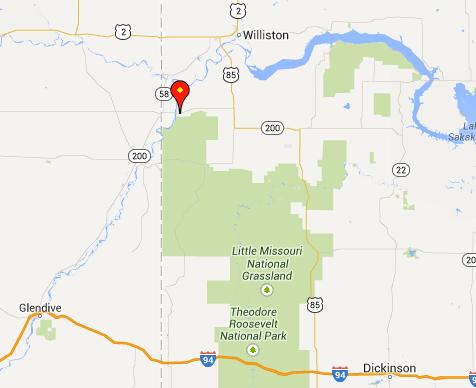
Linda Monson, McKenzie County, North Dakota For as long as anyone can remember springs have fed into Charbonneau Creek west of Alexander, North Dakota. Named for the husband of Sakakawea, who guided Lewis and Clark through the region two centuries ago, the fresh water of the “crick” has always supported cattle ranchers in that part of McKenzie County as it flows 18 miles northwest into the Yellowstone River.
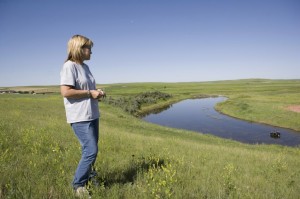
Linda Monson looks out over Charbonneau Creek. Photo by Eric Hylden, Grand Forks Herald
The spill sent salt water, which is a normal waste product of oil production and is about 20 times more saline than seawater, flowing over the ground across Monson’s property and along a drainage ditch into a dry stock dam, before overflowing a beaver dam. As it cascaded down a hill and into Charbonneau Creek, which cuts through Monson’s pasture, the spill deposited metals and carcinogenic hydrocarbons in the soil. The toxic brew wiped out the creek’s fish, turtles and other life, reaching 15 miles downstream.
The pipeline was a new one that was serving an oil field development off the Jack 1-29 H well, southwest of Alexander. After suing Zenergy, the oil company that owns the line, Monson reached a settlement that restricts what she can say about the incident. “When this first happened, it pretty much consumed my life,” Monson said. “Now I don’t even want to think about it.”
Cows still don’t like the water
The response to the spill didn’t start out well.
Linda Monson’s ranch (click to enlarge)
According to documents in Monson’s dropped lawsuit, Zenergy had spilled saltwater on her land once before. The company’s first response was to offer her a few hundred dollars in exchange for her signing away rights to hold Zenergy liable for anything that happened on her land ever again, according to her lawsuit.
Zenergy said in its response in court documents that it denied all such allegations by Monson, although it agreed that its spill had damaged her property.
She and her neighbor each had sued Zenergy for more than $75,000. Their attorney, Derrick Braaten of Bismarck, said he can’t discuss it, except that obviously if his clients weren’t satisfied with the settlement, he wouldn’t have advised them to sign on.
After the first months, the company was responsive, she says, watching as a Zenergy employee drives in to check on a watermonitoring well.
“Since this has happened, they have been good to us,” she says. “I can’t say they haven’t.”
But Monson says the water in Charbonneau Creek was well-liked by her cattle before the spill. Although the health department says the water is back to “pre-spill conditions,” her cows still haven’t shown much interest.
“Problems waiting to happen”
Every oil well has underground pipelines taking the saltwater to nearby tanks for such disposal. Those are problems waiting to happen, says Donny Nelson, a rancher from Keene, ND, who visited Monson’s ranch to see the damage from the spill.
Nelson says state and federal regulators don’t do enough to make sure such accidents don’t happen or to compel action by oil companies when they do.
A saltwater spill “sterilizes the soil,” he says, and by comparison, an oil spill in the Williston Basin is easily cleaned up. Recently Nelson found a small saltwater leak from an underground pipe on his land near the Blue Buttes east of Keene. The oil company didn’t even know the pipeline was there, he said.
The company cleaned up the spill, hauling in top soil it bought from Nelson to replace the soil wrecked by the saltwater. But there’s still a bare spot of several hundred square feet where nothing will grow, Nelson said.
It’s another example of a larger potential problem, dating to the beginning of oil production here in the 1950s, he said.
“You wouldn’t believe the number of pipelines through here,” Nelson tells visitors, pointing out a nearby area that includes some of his land. “In about a mile and three quarters, they ran 87 pipelines and they only knew about 50 of them. Many of them were abandoned.”
Nelson can show visitors sites on his land where lengths of old rusty pipe or other oilfield equipment lay half-hidden in this year’s rich grass. In one quiet valley where he winters his cattle, two huge old oil tanks sit, battered, half fallen in.
“They’ve been out here since the 1960s,” he said. The original oil company is long gone and now it seems like nobody is responsible for cleaning up the mess, Nelson said.
He’s had a calf get stuck inside an oil company’s fence around an old, abandoned well head, Nelson said.
“Now in the mad rush of the boom, nobody’s interested in anything but drilling everything faster, quicker, in the mad rush for money.”
Nelson and others have pushed to get state and federal agencies to increase bonding levels required of oil companies to match the cost of cleaning up spills.
“The oil industry gets away with stuff no other industry does,” Nelson said. “They haven’t kept up with inflation. They put up a $250,000 bond and they can drill as many wells as they want.”
Residents along the Beartooth Front will nod knowingly as they read about a referendum being held today in Johnson County, Illinois. It’s a familiar story of community dynamics.
The question voters will consider is:
Shall the people’s right to local self government be asserted by Johnson County to ban corporate fracking as a violation of their rights to health and safety?
A grassroots citizen group called Southern Illinoisans Against Fracking Our Environment (SAFE) was responsible for collecting the signatures to get the proposed measure on the ballot, supported by the Pennsylvania-based Community Environmental Legal Defense Fund (CELDF). A coalition opposing the measure is led by one of the elected County Commissioners, and has significant support from the oil and gas industry.
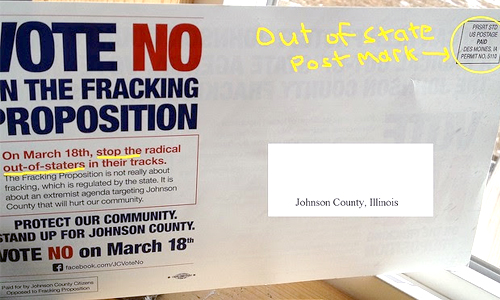
Pro-fracking mailer (click to enlarge)
We won’t get too deep into the community politics here, except to point out a potential nominee for the Rex Tillerson Fracking Hypocrite Award. The opposition is claiming that the initiative is being led by “out of state interests,” so they sent out a mailer demanding to “Stop the radical out-of-staters in their tracks.” Trouble is, the postmark on the mailer is from…out of state.
We’ll report on the outcome of the vote as soon as we get it, but the main reason I wanted to post this is to show the power of taking the out-of-staters out of the campaign and making it about personal appeals from local voters to each other. The video below, recorded by local resident Tony Gerard, has gone viral in the area. It’s a very powerful statement — not slick or professional, and probably too long, but honest and heartfelt.
It’s a lesson we can all learn about the power of social media to persuade through personal appeals in rural and small town environments. Beartooth residents, take heed.
“I believe North Dakota yesterday declared itself to be an energy sacrifice zone.”
-Clay Jenkinson
Clay Jenkinson
I’ve been looking for an opportunity to write about Clay Jenkinson, a Dickinson, North Dakota native and one of the state’s great non- petroleum natural resources. Since 2005 he’s been Director of The Dakota Institute through The Lewis & Clark Fort Mandan Foundation, Chief Consultant to TheTheodore Roosevelt Center through Dickinson State University, Distinguished Humanities Scholar at Bismarck State College, and a columnist for the Bismarck Tribune. He also does wonderful impressions of Thomas Jefferson and Theodore Roosevelt
I’ve become familiar with his columns, and for my money he’s the best at using rich colorful language to tell it like it is about the Bakken oil boom. The first column I encountered talks ruefully about the changes that have occurred in North Dakota over the last 10 years. An excerpt to give you the flavor of his writing:
Last Sunday, Minot police arrested five men alleged to be operating a prostitution ring in the Magic City. It need hardly be said that these crimes — brought to light by deliberate sting operations — are merely the tip of the prostitution iceberg. That such activity is one of the “growing pains” of the oil boom goes without saying. Is all this your idea of North Dakota?…
Words matter. To call these things growing pains is a form of economic and linguistic obscenity.
Last Best News
So I was pleased to note that Last Best News covered an appearance by Jenkinson last week.
Many of you are familiar with Ed Kemmick, most recently of the Billings Gazette, a highly regarded newspaper reporter, editor and columnist with deep Montana chops over the last 30 years. He’s left the Gazette and last month started Last Best News, an independent news website that covers the culture, people and places of the Billings area and Eastern Montana, with occasional forays into other parts of Montana and neighboring states. Ed promises that drilling along the Beartooth Front is a story he’s going to be covering over the next months. If you’re a Gazette reader who’s missing Ed, you might want to sign up for email updates from the site.
With Ed’s permission, I’ve reblogged the entire piece below. It’s a rueful tale of Clay Jenkinson’s attempts to protect North Dakota against the ravages of the oil boom, and his frustration at how oil and gas industry influence has undermined his efforts.
Here’s the story from Last Best News, written by Pete Tolton and Stan Parker (video at end of story):
N.D. speaker tells of lessons learned from Bakken boom When the CEO of a Denver energy company announced last fall that he’d like to “bring something like the Bakken, maybe something a little more orderly” to the Beartooths, many residents scrambled to head off what they feared would forever change their scenic landscape.
Just last week, when Energy Corporation of America received the go-ahead from the Montana Board of Oil and Gas to begin drilling for oil and gas near Belfry, it was seen as a major blow by many conservationists concerned about the development’s impacts.
What is now beginning in the Beartooths is a story all too familiar to their neighbors to the east. Tuesday evening in Dickinson, N.D., a town expanding rapidly in the midst of the oil boom, a small group of citizens gathered to hear a hometown celebrity speak on a heavy topic: the future of their state.
The mood that hung over the crowd was one of both unity and conservation. Clay Jenkinson, the keynote speaker, addressed the future of North Dakota and its “unparalleled natural resources.”
Jenkinson, a Dickinson native, lends a familiar voice to the cause. He is known across the state as a lecturer at North Dakota universities, a director of the Dakota Institute and a columnist for the Bismarck Tribune. He has even been known to impersonate Thomas Jefferson, in which guise he appeared on “The Colbert Report” in 2006.
The event was intended to educate and rally people around a ballot measure that would allocate 5 percent of the revenue garnered by the state’s existing oil and gas tax towards conservation efforts. But another issue upstaged the ballot measure at times: North Dakota’s proposed Extraordinary Places Initiative.
North Dakota’s Attorney General Wayne Stenehjem put forth the initiative in January to inventory certain treasures in the state’s landscape — 18 places in all — and enact an automatic notification system that would kick in when developers want to drill near these areas.
Plans to develop within a 2-mile buffer zone of these areas would be subject to a higher level of environmental scrutiny and a public comment period.
Developers and mineral rights owners groups came out against the proposal, saying it would violate private property rights and needlessly hinder oil and gas development.
Stenehjem said that’s not the case.
“Nothing is proposed to be off-limits,” he told Forum News Service on Monday. “It simply says if you’re going to have a well there, come in with a plan to minimize the impacts.” He said the Industrial Commission would still have the final say over drilling sites.
Jenkinson pointed to the ways conservationists and drillers have worked together in the past to mitigate effects of development, especially in the area around Theodore Roosevelt National Park. He said measures like redirecting roads to protect viewsheds are examples of what can be achieved through cooperation.
On Monday, state lawmakers removed all private lands from the umbrella of the proposed Extraordinary Places Initiative. In many places, the Badlands is a checkerboard of private and public lands. Jenkinson called that move a serious setback to the initiative’s usefulness.
“I believe North Dakota yesterday declared itself to be an energy sacrifice zone,” he said.
In his Jan. 26, column in the Bismarck Tribune, Jenkinson referred to the proposal as “the defining moment of North Dakota life in the 21st century.”
He went on to predict what would happen if the initiative failed: “It will be an unmistakable sign that nothing is sacred in North Dakota anymore, that everything is for sale, with the least resistance, to the highest bidder. It will be a license to the oil companies that they may have their way with us, because we are insufficiently committed to our own sacred landscape to make reasonable requests about how it should be stripped of its oil reserves.”
The Tuesday gathering was hosted by the North Dakotans for the Clean Water, Wildlife and Parks Amendment. Keith Trego, head of the North Dakota Natural Resources Trust, introduced Jenkinson and later explained the details of the amendment to the crowd.
Despite his obvious sympathy for conservation efforts, Jenkinson was quick to clarify his stance on energy development in his home state.
“I’m not one of the antagonists. I’m actually a supporter of the oil boom,” Jenkinson said. “I just think it needs to be done with more intelligence.”
His speech centered around what he called myths about North Dakota’s oil boom. The first myth, he said, is “this is just another big oil boom.”
He explained that this boom is drastically different from those of the past, and not just in magnitude. He said that with drills hitting oil 99-100 percent of the time, what is going on in his state is “not oil drilling, it’s oil mining.”
Jenkinson said he had no plans to write about conservation and development issues when he returned to North Dakota.
“I didn’t come home eight years ago to write about this,” Jenkinson said. “Frankly, I wouldn’t have come here if I’d known this was going to happen.”
He said his North Dakota was a land of “buttes, cottonwood trees, the Little Missouri River, creeks, the wind on a September day, nighthawks, lying in the Badlands looking at stars, listening to coyotes.”
His mother, Mil Jenkinson, 82, still lives in Dickinson. He said she’s thinking about leaving because her town has changed so much. She complains of the rudeness and the traffic. Jenkinson caught a few laughs when he explained that Mil plans her routes so she only has to make right-hand turns to avoid the long waits to turn left.
Another myth, Jenkinson said, was that of the oil boom’s “light environmental footprint.” Despite what he called “very good” reclamation laws, he mourned the lack of regulators and the cumulative effects even well-regulated drilling has on North Dakota’s land, communities and people. Even if any given pad site is a great example of environmental stewardship, he said, the combined effect of thousands of them isn’t taken into account.
He also quoted the late Arthur Link, who, as governor of North Dakota, pushed for strong regulation and taxation from energy companies who were reaping what he called a “one-time harvest” of the state’s minerals.
Trego followed Jenkinson to the microphone to advocate for the Clean Water, Wildlife and Parks Amendment. The amendment is a ballot measure intended for the November 2014 ballot. It would dedicate 5 percent of the existing oil extraction tax to fund projects that protect clean water, improve natural flood controls, establish fish and wildlife habitat and expand parks and recreation areas.
“It’s time for us to think long-term, big-picture — to dig deep and find what North Dakota needs to be,” Trego said.
So, what can Montanans learn from North Dakota?
“The more you do now, the better off you’ll be,” Trego said.
Jenkinson offered this advice to Montanans:
“Think about it now, because when it comes, you won’t be able to think about it. You’ll just be reacting. And reacting isn’t enlightened.”
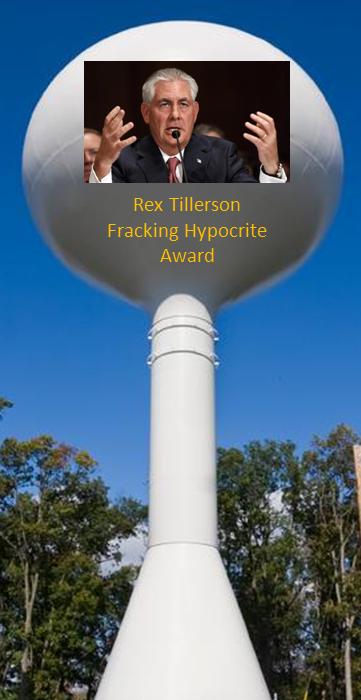
We here at Preserve the Beartooth Front are pleased to announce the first recipient of the Rex Tillerson Fracking Hypocrite Award. The Award is a 160-foot water tower, engraved with Rex Tillerson’s photo, delivered to the recipient’s front yard.
You remember Rex. He’s the CEO of Exxon who publicly complained that “dysfunctional regulation of hydraulic fracturing is holding back the American economic recovery, growth and global competitiveness,” and then joined with his neighbors in a lawsuit to block construction of a large water tower, used to support fracking operations, next to his Texas home.
First award recipient
Today we’re presenting the Rex Tillerson Award to Aubrey McClendon, the former Chairman and CEO of Chesapeake Oil, once named by Forbes “America’s most reckless billionaire.”
McClendon earned riches and industry fame when, in 2008, he rescued Chesapeake from disaster. After extreme leverage, aggressive financing and plunging oil and gas prices had combined to crush Chesapeake shares by 80%, McClendon executed a series of deft maneuvers to not only pull the company from the brink of disaster, but elevate it to new heights.
How did he do it? According to ProPublica, McClendon raised nearly $5 billion by gouging rural landowners out of royalty payments they were supposed to receive in exchange for allowing the company to drill on their property.
Aubrey McClendon, winner of the first Rex Tillerson Award (click to enlarge)
The practice that McClendon invented has now become a common industry practice. In lawsuits in state after state, private landowners have won cases against oil and gas companies for stiffing them on royalties they were due. Federal investigators have repeatedly identified underpayments of royalties for drilling on federal lands, including a case in which Chesapeake was fined $765,000 for “knowing or willful submission of inaccurate information” last year.
Last month, Pennsylvania governor Tom Corbett sent a letter to Chesapeake’s new CEO saying the company’s expense billing “defies logic” and called for the state Attorney General to open an investigation.
Landowners paid for McClendon’s riches
The victims were landowners in Pennsylvania and elsewhere who leased their land to Chesapeake and saw their hopes of cashing in on the gas-drilling boom vanish without explanation.
People like Joe Drake.
“I got the check out of the mail… I saw what the gross was,” said Drake, a third-generation Pennsylvania farmer whose monthly royalty payments for the same amount of gas plummeted from $5,300 in July 2012 to $541 last February. This sort of precipitous drop can reflect gyrations in the price of gas. But in this case, Drake’s shrinking check resulted from a corporate decision by Chesapeake to radically reinterpret the terms of the deal it had struck to drill on his land. “If you or I did that we’d be in jail,” Drake said.
How McClendon gouged money from landowners
Here’s how ProPublica describes the scheme McClendon used:
When energy companies lease land above the shale rock that contains natural gas, they typically agree to pay the owner the market price for any gas they find, minus certain expenses.
Federal rules limit the tolls that can be charged on inter-state pipelines to prevent gouging. But drilling companies like Chesapeake can levy any fees they want for moving gas through local pipelines, known in the industry as gathering lines, that link backwoods wells to the nation’s interstate pipelines. Property owners have no alternative but to pay up. There’s no other practical way to transport natural gas to market.
Chesapeake took full advantage of this. In a series of deals, it sold off the network of local pipelines it had built in Pennsylvania, Ohio, Louisiana, Texas and the Midwest to a newly formed company that had evolved out of Chesapeake itself, raising $4.76 billion in cash.
In exchange, Chesapeake promised the new company, Access Midstream, that it would send much of the gas it discovered for at least the next decade through those pipes. Chesapeake pledged to pay Access enough in fees to repay the $5 billion plus a 15 percent return on its pipelines.
That much profit was possible only if Access charged Chesapeake significantly more for its services. And that’s exactly what appears to have happened: While the precise details of Access’ pricing remains private, immediately after the transactions Access reported to the SEC that it collected more money to move each unit of gas, while Chesapeake reports that it also paid more to have that gas moved. Access said that gathering fees are its predominant source of income, and that Chesapeake accounts for 84 percent of the company’s business.
What’s more, SEC documents show, Chesapeake retained a stake in the gathering process. While Chesapeake collected fees from landowners like Drake to cover the costs of what it paid Access to move the gas, Access in turn paid Chesapeake for equipment it used to complete that process, circulating at least a portion of the money back to Chesapeake.
Lessons for Montanans
Once again, congratulations to Aubrey McClendon on his stunning achievement. Others have learned from his double dealing, and it could happen here. Things you should be doing:
Find an attorney who can help you negotiate with the landman representing ECA or another oil company. This may not be your family attorney — it should be someone who has experience in surface use agreements.
DON’T sign anything the first time it is presented to you and without legal representation.
Oil and gas companies are in business for one reason: to make money. Be warned. McClendon just raised $2.2 billion to start a company that will drill on the Utica Shale. He may be here next.
The town of Pavillion, Wyoming is in many ways unremarkable. It sits southeast of Yellowstone Park, just 200 miles due south of Red Lodge. The 2010 census puts its population at 231 in 95 households.
But Pavillion sits at the center of a controversy that threatens the future of the hydraulic fracturing industry. At least 32 of those households, including John Fenton‘s, have been forced to get their water not from their wells, but from free plastic cistern tanks provided by the state of Wyoming, using a grant from the oil company Encana. The cisterns are required because their aquifer is contaminated by chemicals associated with oil and gas drilling.
Timeline of events in Pavillion, Wyoming
1960: First natural gas drilling in the Pavillion area
1990s: Extensive natural gas drilling began in the area. Starting at about the same time, residents began to complain of physical ailments and said their drinking water was black and tasted of chemicals.
2008: EPA begins to study drinking water in Pavillion with the aim of determining whether the water is safe to drink.
August 2009: EPA conducts initial testing of groundwater in Pavillion, and concludes there is a presence of groundwater comtamination
January 2010: The EPA conducted four rounds of sampling, first testing the water from more than 40 homes and later drilling two deep wells to test water from layers of earth that chemicals from farming and old oil and gas waste pits were unlikely to reach.
November 2011: EPA releases the latest data from its monitoring wells in Pavillion at a public meeting. Officials say they will prepare a report on their findings.
December 2011: EPA releases a draft report with analysis of its ground water investigation in Pavillion, Wyoming. According to the report:
EPA’s analysis of samples taken from the Agency’s deep monitoring wells in the aquifer indicates detection of synthetic chemicals, like glycols and alcohols consistent with gas production and hydraulic fracturing fluids, benzene concentrations well above Safe Drinking Water Act standards and high methane levels. Given the area’s complex geology and the proximity of drinking water wells to ground water contamination, EPA is concerned about the movement of contaminants within the aquifer and the safety of drinking water wells over time.
December, 2011: Wyoming Governor Matt Mead sends a letter to the EPA, calling on the agency to conduct more testing to determine if there is a link between natural gas development and groundwater contamination. In doing so, he called for cooperative approach between state and federal government investigators but also criticizes the EPA for releasing findings before the peer review process is completed.
March 2012: EPA and the state of Wyoming agree to conduct further tests in Pavillion in an effort to end disputes between over the findings in the December report. The two entities announce that two more rounds of testing will be conducted at monitoring wells that were installed in 2010. The peer-review process for the initial report is also put on hold.
December 2011 – June 2013: EPA comes under attack for their testing methods at Pavillion and becomes concerned that their results would not hold up under peer review. Following public hearings and analysis by other government agencies, the EPA is accused of making some of the same drilling mistakes that they were trying to prevent in industry.
For example, according to the Wyoming Department of Environmental Quality (DEQ), the EPA did not case their monitoring wells correctly. According to the DEQ, EPA drillers, in a contradiction of their own regulatory requirements, did not line their two deep test wells with stainless steel casing Because the casing was carbon steel rather than stainless steel, it was susceptible to corrosion and thereby to affecting the chemical content of groundwater and fluids in the well.
June 2013: The EPA announces it will not make a final report on their findings in Pavillion and says it will turn responsibility for the report over to the state of Wyoming. Wyoming announces that it will accept a $1.5 million grant from Encana Corporation to fund the study. Encana has taken a clear position that the EPA study is invalid.
September 2013: Idaho Dept. of Lands Oil and Gas Program Manager Bobby Johnson, who formerly worked for the groundwater division of the Wyoming State Engineer’s Office, which has taken the lead role in the Pavillion contamination investigation, says in a public meeting that the hydraulic fracturing industry is responsible for the contamination in Pavillion, He pointed to a faulty cement casing in a natural gas well as a key factor in the case, describing EPA data showing pollution was caused “by a bad cement job on an Encana well that was drilled in 1985.”
February 2014: Johnson recants his comments after a conversation with Grant Black, Wyoming Oil and Gas Conservation Commission supervisor, convinced him he was “dead incorrect” to attribute pollution to industry. As John Fenton of Pavillion put it, “It appears that the state has already reached conclusions about the investigation of Pavillion area groundwater contamination before they’ve released findings or even hired experts to review their analysis.”
The final report on the cause of the Pavillion contamination is due out later this year.
Politics: incompatible with science
What a mess. There is truth at the bottom of the wells in Pavillion, but, in a familiar refrain these days, politics has created a roadblock that prevents it from coming out.
There’s plenty of blame to go around. The EPA did a thorough study, but made critical errors. But science has a way of dealing with this. It’s called peer review. Staying the course on peer review would have revealed what in the report was correct and what was flawed, and charted a course for continued scientific study.
This is par for the course for the EPA. Over the past two years the agency has backed away from taking any position that will make a definitive assessment of the dangers of fracking:
Closed an investigation into groundwater pollution in Dimock, Pa., saying the level of contamination was below federal safety triggers.
Abandoned its claim that a driller in Parker County, Texas, was responsible for methane gas bubbling up in residents’ faucets, even though a geologist hired by the agency confirmed this finding.
Sharply revised downward a 2010 estimate showing that leaking gas from wells and pipelines was contributing to climate change, crediting better pollution controls by the drilling industry even as other reports indicate the leaks may be larger than previously thought.
Failed to enforce a long-standing statutory ban on using diesel fuel in fracking until last month, after the use of diesel has become obsolete in the industry.
The state of Wyoming has given up any semblance of credibility for taking money to fund their study of Pavillion from the company that is accused of polluting it. What were they thinking? They can argue as long as they want that Encana has no involvement in the study. Financial relationships remove impartiality. And having a member of the Board of Oil and Gas take Bobby Johnson aside to correct his perception about the cause of the pollution is a joke. No matter how thorough their ultimate report is, the outcome will get lost in political controversy.
There is truth in the EPA report. You just need to look for it.
What’s sad here is that a good portion of the truth lies in the EPA data, but it has been obscured by attacks on their methodology. In addition to its disputed deep water testing, the study also found pollution of shallow groundwater with oil and gas compounds near wastewater disposal pits1.
Pavillion drilling configuration
According to all current reports, these results are based on reliable test methods and indicate a need for safer and more effective waste disposal methods by drilling companies. Futhermore, both the well casings and local geology made for risky drilling. Logs and completion reports for local wells showed sporadic bonding in intervals of casing. Casings were also extremely shallow, with some extending as little as 110 meters underground—actually shallower than some local domestic wells.
The victims in this political debacle are not only the residents of Pavillion, who have been permanently injured by the failure to get at the truth, but also the residents of other communities who won’t have the benefit of a clear understanding of what happened in Pavillion so that they can benefit from those lessons.
The Lesson for Montanans Here’s the important thing to understand for residents of Carbon and Stillwater counties: the lack of government protection that has caused the innocent victims in Pavillion to wind up drinking their water out of cisterns instead of wells is the same in Montana as it is in Wyoming.
When contamination occurs, we won’t get help from the EPA. The Montana Board of Oil and Gas Conservation has clearly demonstrated that it represents corporations, not the people of Montana, so there will not likely be any help in the permitting process.
If the area along the Beartooth Front is going to be protected from water contamination, from air pollution, from devaluation of the land, the local community is going to have to look out for itself.
One of the exemptions is to the Clean Air Act (CAA) of 1970, which regulates air emissions. While CAA allows for the aggregation of multiple wells operated in the same area by a single operator, it exempts oil and gas wells, and in some instances pipeline compressors and pump stations, from aggregation. This exemption allows the oil and gas industry — which often operates many small facilities in one area — to not report from these individual facilities. As a result, operators can pollute while largely unregulated by the CAA.
In January Wyoming Public Radio did a report on how this creates a problem for many residents in the state. Many landowners with oil and gas wells on their property complain about emissions affecting their air quality and health. But though there may be a lot of wells, they’re considered small facilities, so their cumulative effects are never counted up and regulations are more lax than for large emitters.You can listen to the report, which features an interview with John Fenton of Pavillion, the subject of yesterday’s personal story, and Deb Thomas, of the Powder River Resource Council, below.
Wyoming Public Radio, January 17, 2014, 5:47 Small emission sources could mean big pollution, but no one’s counting
From the report:
Some sources in the area are so small that their emission rate is not high enough to even warrant controls. Control means emissions have to be reduced by 98-percent or better, usually through a flare or some other capture or combustion process. If the facility is below the control threshold, it can just release pollutants into the air. The threshold is quite low.
According to the DEQ, there are nearly 300 small, uncontrolled sites around Pavillion. WPR requested emissions data from several wells in that region. If we assume that their emissions are about average, that means in aggregate the uncontrolled wells in Pavillion are releasing over 500 tons of volatile organic compounds per year all told. That’s more than five major sources would emit. To put this into perspective, that’s nearly twice as much as Wyoming’s largest coal power plant emitted in 2010. And that’s only for volatile organic compounds. There are other pollutants, too.
It’s a common theme here, but it bears constant repeating. The lack of federal protection from emissions means communities need to take control themselves to protect their air, their water, their land and their way of life.
“We have really no power, no control of them coming or over what they do, where they do it or when they do it so you know it was a pretty rude awakening for us.”
-John Fenton, Pavillion, Wyoming
Telling personal stories
The oil and gas boom has been underway for a number of years in many locations across North America, and there are now a lot of stories about individuals and families whose lives have been personally affected. This post is part of a regular series of those stories on this blog to help you envision what could happen if drilling expands along the Beartooth Front. Look for these once a week.
Today’s story centers on one of the most troubled spots in the history of fracking: Pavillion, Wyoming. It’s the story of John Fenton, whose life was completely disrupted by gas drilling on his farm. He’s dedicated his life to telling his story, which he has done all over the world. It’s always best to hear directly from the storytellers themselves, and today we’ve got a multimedia version, with audio and video interviews with John.
We’ll tell the story of Pavillion in another post later this week.
John Fenton, Pavillion, Wyoming
John Fenton is a farmer from Pavillion Wyoming who has been living with the effects of the gas industry for many years: ground, water, and air pollution; surface degradation, property devaluation and other significant impacts. John and his wife Catherine have 24 gas wells on their farm.
In 2008 the US Environmental Protection Agency investigated discolored ground water in Pavillion. In 2010, after it found the water contaminated with dangerous chemicals and methane caused by fracking, the EPA warned Pavillion residents not to drink the water and use a fan when bathing or washing clothes to avoid the risk of explosion. Later the EPA was pressured to end their investigation.
The gas company now trucks in drinking water for local farmers. Some eat from paper plates because they cannot wash dishes without contamination, and they must open their windows when they have a shower. The water flowing out of the bores and taps smells like diesel and can be lit if contained in a jar. Several people in the district have developed neuropathy or other health ailments. Animals have also become sick.
John Fenton has a gas well situated only 100 yards from his house and the snow melt irrigation district has 200 gas wells dotted over the farm land.
Other local farmers in the Pavillion area also suffer from industrial land use clashing with agriculture with well pads, access roads, pipelines, truck visits and compressor stations all affecting farm operations.
John has become a leading spokesperson for the effects of unconventional gas. He has a great story to tell and is an effective and authentic communicator.
Audio and video interviews
Here is an interview John did with a radio station in Australia. It describes in his own words the devastating effects of gas exploration in Pavillion (12 minutes).
From the 1960s to the 1990s the United States had a national conversation about how, as we expanded in population and industrialization, we would make sure that our natural resources were protected. This resulted in a series of landmark laws, passed under Republican and Democratic administrations, that protected our land, air, and water.
That’s the good news. The bad news is that, ever since, the oil and gas industry has been successful in carving out exemptions that took the teeth out of these laws, and left communities vulnerable to polluters. This should not be a surprise to those who follow the impact of oil and gas industry contributions on federal legislation, but it is disturbing nonetheless.
Gutting these acts in favor of oil and gas polluters puts the burden squarely on local communities if they are going to protect themselves from companies that have no incentive to watch out for their local resources. This is not strictly an environmental issue — it’s a matter of protecting a way of life.
This post lays out how this has happened for several major pieces of federal legislation. Later this week I’ll be looking at the specific impacts of these carveouts.
Clean Air Act (CAA), 1970 The Clean Air Act (CAA), adopted in 1970, is the comprehensive federal law that regulates air emissions from area, stationary, and mobile pollution sources. The CAA established limits for major pollution sources called the National Emission Standards for Hazardous Air Pollutants (NEHAPS) . NEHAPS must be met by installing the Maximum Achievable Control Technology (MACT) for each source. I will have a post later this week on the specific impact this is having in Wyoming.
Oil and Gas Exemption:
While CAA allows for the aggregation of multiple wells operated in the same area by a single operator, CAA exempts oil and gas wells, and in some instances pipeline compressors and pump stations, from aggregation. This exemption allows the oil and gas industry — which often operates many small facilities in one area — to pollute while largely unregulated by the CAA.
In addition, in 1991 hydrogen sulfide was removed from the list of Hazardous Air Pollutants under the CAA. This elimination has remained despite a 1993 EPA study, Hydrogen Sulfide Air Emissions Associated with the Extraction of Oil and Natural Gas, which clearly concludes that accidental releases of hydrogen sulfide during oil and gas development are a serious air quality concern and pose a great risk to public health. Common symptoms of exposure to low levels of hydrogen sulfide can include headache, skin complications, respiratory problems and system damage, confusion, verbal impairment, and memory loss.
National Environmental Policy Act (NEPA), 1970 NEPA (NEPA) establishes the broad national framework for protecting our environment. NEPA s ensures the federal government gives proper consideration to the environment before undertaking any major federal action (including involvement in industrial projects) that significantly affects the environment.
Oil and Gas Exemption:
The Energy Policy Act of 2005 stripped NEPA’s strong requirements for public involvement and environmental review when it comes to several oil and gas related activities. It stipulated that they should be analyzed and processed by the Interior and Agricultural Departments under a much narrower and weaker process known as a Environmental Assessment (EA) or Environmental Impact Statement (EIS) required under NEPA. In addition, a CE does not allow for any public comment. In 2006 and 2007, the BLM granted this exemption to about 25 percent of all oil and gas wells approved on public land in the West.
Federal Water Pollution Control Act (FWPCA), 1972 The FWPCA,commonly known as the Clean Water Act (CWA), establishes the basic structure for regulating discharges of pollutants into the waters of the United States. The CWA made it unlawful to discharge any pollutant from a point source into navigable waters, unless a permit was obtained.
Oil and Gas Exemption:
In 1987, Congress amended the CWA to require EPA to develop a permitting program for stormwater runoff but exempted oil and gas production.
The 2005 Energy Policy Act also amended the CWA to redefine sediment as a nonpollutant. This redefinition broadened the existing exemption for stormwater discharges to oil and gas construction. These exemptions leave streams and rivers in high oil and gas areas unprotected from sediment run-off caused by the construction and operation of well pads, pipelines, drill rigs, and other infrastructure.
Safe Drinking Water Act (SDWA), 1974 The SDWA was established to protect America’s drinking water. It authorizes the EPA to set national health-based standards for drinking water to protect against both naturally-occurring and man-made contaminants. US EPA, states, and water systems then work together to make sure that these standards are met.
Oil and Gas Exemption:
The Energy Policy Act of 2005 exempted hydraulic fracturing from SDWA oversight, leaving drinking water sources in the 34 oil and gas producing states unprotected from the toxic chemicals used during fracking. Also known as the Halliburton Loophole, this law turns over control of water quality to the oil and gas companies, which do not have to tell us what chemicals they use in the fracking process.
Resource Conservation and Recovery Act (RCRA), 1976 RCRAis the principal federal law that governs the disposal of solid and hazardous wastes. The law takes a cradle to grave approach to ensure that wastes are handled properly from the point of creation to transport to disposal.
Oil and Gas Exemption
In 1980, Congress exempted oil field wastes (which includes waste from natural gas production) from RCRA until EPA proved they were a danger to human health and the environment. Rather than make this determination, EPA eventually ceded authority to regulate these wastes to the states.This exemption leaves produced water, drilling fluids, and hydraulic fracturing fluids from oil and gas production unregulated under the nation’s premier hazardous waste law. This allows unsafe handling of toxic substances, including their conventional transport on roads and treatment in municipal rather than specialized facilities.
Superfund, 1980
The Comprehensive Environmental Response, Compensation, and Liability Act (CERCLA), commonly known as the Superfund law, establishes liability for a spill or release of a hazardous substance.In addition, Superfund allows Potentially Responsible Parties to be held liable for clean-up costs for a release or threatened release of a hazardous substance.The list of hazardous substances includes benzene, toluene, ethylbenzene, and xylene (Btex), chemicals found in crude oil and petroleum.
Oil and Gas Exemption: CERCLA exempts these substances from liability requirements if they are found in crude oil and petroleum, which are also used in natural gas production. The definition of hazardous substance also excludes natural gas, natural gas liquids, liquefied natural gas, and synthetic gas usable for fuel.This exemption creates no incentive for oil and gas companies to clean up hazardous waste, or to minimize leaks and spills.
The Toxic Release Inventory of EPCRA (1986)
The Toxic Release Inventory (TRI) was created by section 313 of the Emergency Planning and Community Right-to-Know Act (EPCRA) of 1986. It requires most industries to report significant of toxic substances to the EPA, which then aggregates and disseminates the information to the public.
The information on chemical use and release includes point and fugitive onsite air releases, water releases, on and off-site land releases, underground injection, transfers (for definitions, see here) to a Publicly Owned Treatment Works (POTW) or waste management facility (including the name and address of the facility), and the use of specific on-site waste treatment and management practices.
Oil and Gas Exemption:
Oil and gas facilities are not required to report to the TRI. This exemption leaves communities in oil and gas producing areas in the dark about what chemicals are being released — making it difficult to attribute responsibility and seek remedy for resulting health and environmental problems.
In previous posts we’ve looked at the tremendous increase in railway traffic involving crude oil over the last five years, the outmoded nature of tank car stock and the particular vulnerability of Columbus to increased railway traffic related to increased drilling along the Beartooth Front.
Today we have a positive development on this front.
The U.S. Department of Transportation (DOT) and the Association of American Railroads (AAR) have announced a rail safety initiative to institute new voluntary operating practices for moving crude oil by rail. These practices include:
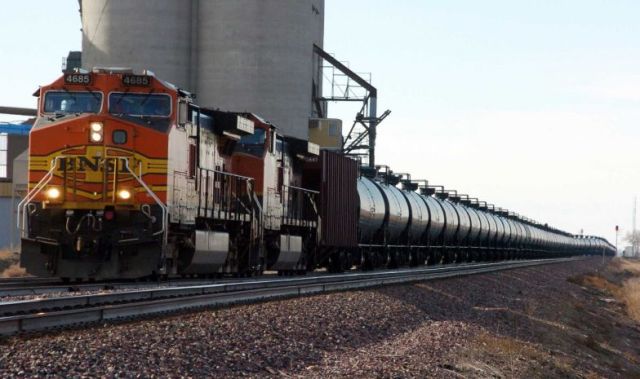
A train hauls crude oil west of Wolf Point, Montana
Increased track inspections: Beginning March 25, 2014, the railroads will perform at least one additional internal-rail inspection per year above those required by new Federal Railroad Administration (FRA) rules on main line routes over which trains moving 20 or more carloads of crude oil travel. The railroads will also conduct at least two high-tech track geometry inspections each year on main line routes over which trains moving 20 or more car of crude oil are moving. Current federal regulations do not require high-tech track geometry inspections.
Braking systems: No later than April 1, 2014, the railroads will equip all trains with 20 or more carloads of crude oil with either distributed power or two-way telemetry end-of-train devices. These technologies allow brakes to be applied from both ends of the train.
Use of rail traffic routing technology: No later than July 1, 2014, the railroads will begin to use the Rail Corridor Risk Management System (RCRMS) to help determine the safest and more secure rail routes for trains with 20 or more cars of crude oil.
Lower speeds: No later than July 1, 2014, the railroads will operate trains with 20 or more tank cars carrying crude oil that include at least one older DOT-111 car no faster than 40 miles-per-hour in the federally designated 46 high-threat-urban areas as established by the Department of Homeland Security. In the meantime, railroads will continue to operate trains with 20 or more carloads of hazardous materials, including crude oil, at the industry self-imposed speed limit of 50 miles per hour.
Community relations: The railroads will work with communities through which crude oil trains move to address local concerns.
Increased trackside safety technology: No later than July 1, 2014, railroads will begin to install additional wayside wheel bearing detectors every 40 miles along tracks with trains carrying 20 or more crude oil cars.
Increased emergency response training and tuition assistance: The railroads have committed to provide $5 million by July 1, 2014, to develop specialized crude by rail training and tuition assistant program for local first responders.
Emergency responsive capability planning: By July 1, 2014, the railroads will develop “an inventory of emergency response resources for responding to the release of large amounts of crude oil along routes over which trains with 20 or more cars of crude oil operate. This inventory will include locations for the staging of emergency response equipment and, where appropriate, contacts for the notification of communities.
It’s important to note that this plan doesn’t include recommendations for two key areas that need to be addressed:
Federal tank car standards.
The proper classification and labeling of crude oil moving by rail.
Both these issues are critical, since the oil being shipped from the Bakken, Marcellus and Eagle Ford is extremely volatile. It needs to handled correctly and shipped in cars designed to protect this flammable cargo. The agreement includes a plan for the DOT to work with their rail customers to address these issues. The sooner the better.
A step in the right direction to be sure, given the dramatic increase in railway oil shipments, but still more to be done. Watch this space for future developments.
*****************************
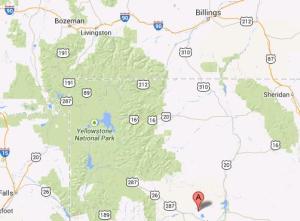
Correction: A small but significant correction for those of you who get these posts via email. In my last post on the location of the recently-permitted Belfry well, I got the location slightly wrong. The actual location is here (marker A on the map), and it has been corrected in the post. The reason this is significant is that, as I am told by people who live in the area and as you can see when you look closely, the well is located in a drainage area, which makes it all the more hazardous. Thanks to sharp-eyed readers.





 The town of


 Preserve the Beartooth Front