Comments on ECA presentation at Carbon County Commission, 9/8/14: Part 2

This post is part of a series analyzing the ECA presentation at the Carbon County Commission this week.

As I see it, the interaction between a company that is planning major industrial operations and the community in which they plan to operate comes down to mutual respect, trust, and legal protections. That is the lens I am using to look at the interaction.

The series:

  • Thursday: ECA commitment to the Beartooth Front community
  • Today: ECA’s poor compliance record in other states, and the company’s response to the issue at the meeting
  • Next week: Regulation (how much, what governments and organizations are responsible), the reason for the Silvertip Zone, and the role of the County Commissioners

If you haven’t seen it, here’s the video of ECA’s appearance before the County Commission on Monday, September 8.


On the ECA safety record in other states:
Regular readers know that we have made a big deal out of ECA’s poor compliance record in other states on the blog, and ECA’s response in the meeting underscores why that is important.

To refresh your memory, ECA has a publicly documented record of serious violations in Pennsylvania and West Virginia. Specifically, ECA has had 66 state inspections with violations, 90 separate violations, 55 enforcement actions and fines of over $80,000 in Pennsylvania, and 70 more violations in West Virginia.

In the meeting, here’s how the conversation about those violations went (watch it yourself starting at 10:26):

John Grewell: Can either of you comment on, you’ve had issues in Pennsylvania?

Jennifer Vieweg: Yeah, that’s something that is not well understood. It’s very different from anywhere else and here’s why:

Jennifer Vieweg: "There was a lot of misunderstanding with regard to the regulations."
Jennifer Vieweg: “There was a lot of misunderstanding with regard to the regulations.”

The industry changed dramatically in Pennsylvania in about 2007-2008. Regulations changed constantly, regulators weren’t even quite sure what the regulations were. The industry, because the regulators didn’t know what the regulations were, it was hard for the industry to know what the regulations were, they were constantly changing so it was very hard to remain in compliance. All of that’s evened out over the last three years or so. Things have evened out. The industry understands what the regulations are, the regulators understand what they are, and, as such, you don’t see any of the same kind of issues as when it was constantly changing. There was a lot of misunderstanding with regard to the regulations.

John Grewell: So I guess in layman’s terms, were the rules changing?

Jennifer Vieweg: Yes. The rules were constantly changing. So once the legislature put together a consistent, they call it Act 13. Once they put that body together it’s been far easier for the regulators and for those in the industry to make sure we stay in compliance.

Let’s be as clear about this as we can, because the Commissioners should not allow the company to get away with telling a story that can be checked so easily, and that can be proven to be completely false. ECA has a very poor compliance record in Pennsylvania. I urge you and the Commissioners to read the report for yourself.

Violations during the “misunderstanding” period
Here are some examples of violations that occurred in the period 2008 – 2010, which Jennifer dismisses as “misunderstandings”:

  • August 7, 2008: 78.56PITCNST. Impoundment not structurally sound, impermeable, 3rd party protected, greater than 20″ of seasonal high ground water table; 401 CSL. Discharge of pollultional material to waters of Commonwealth; 102.4INADPLN – E&S (erosion and sediment control) plan not adequate. Fined $6,000.
  • April 3, 2009: 102.4. Failure to minimize accelerated erosion, implement E&S (erosion and sediment control) plan, maintain E&S controls. Failure to stabilize site until total site restoration under OGA Sec 206(c)(d); 8.56FRBRD. Failure to maintain 2′ freeboard in an impoundment; 401 CSL. Discharge of pollutional material to waters of Commonwealth; 401 CSL – Discharge of pollutional material to waters of Commonwealth, sediments discharged to Little Trout Run. Fined $3,500.
  • September 1, 2009: 210UNPLUG – Failure to plug a well upon abandonment. Fined $6,500.
  • March 16, 2010: 102.4. Failure to minimize accelerated erosion, implement E&S plan, maintain E&S controls. Failure to stabilize site until total site restoration under OGA Sec 206(c)(d); 401CAUSEPOLL. Polluting substance(s) allowed to discharge into Waters of the Commonwealth. Fined $5,750.

Folks, these are not misunderstandings:

  • Dumping wastewater into Little Trout Run is not a “misunderstanding.”Did ECA imagine that it was ok to dump produced water into a trout run? Did the trout misunderstand that they were getting industrial sludge dumped into their local habitat?
  • Failure to cap an abandoned well is not a “misunderstanding.” Open, uncapped wells can cause air and water contamination.
  • Having an impoundment that is not structurally sound is not a “misunderstanding.” A leaky impoundment means water seeps into the ground, where it can contaminate water wells, ditches and streams.

Violations after things “evened out”
But giving ECA the benefit of the doubt for a moment, since they say that in the last three years they now understand the law, let’s look at some violations from their file over the last three years, when they say things have “evened out.” Here are some violations over the last three years:

  • April 11, 2012: 6018.301 – Residual Waste is mismanaged.
  • May 4, 2012: 210UNPLUG – Failure to plug a well upon abandonment
  • July 17, 2013: 307CSL. Discharge of industrial waste to waters of Commonwealth without a permit.
  • July 22,2013: 307CSL. Discharge of industrial waste to waters of Commonwealth without a permit. Fined $4,238
  • January 14, 2014: 102.4. Failure to minimize accelerated erosion, implement E&S plan, maintain E&S controls. Failure to stabilize site until total site restoration under OGA Sec 206(c)(d)691.401WPD. Failure to prevent sediment or other pollutant discharge into waters of the Commonwealth.

I’m not an expert in these things, but those look like pretty much the same laws and the same violations as in the period when everybody misunderstood the law. These practices have nothing to with understanding, but with shoddy practices that put landowners at risk of water contamination.

Why this is important
The reason why this is particularly important is that Pennsylvania is unique in the detail of records they make available to the public. It is the one place we get a real window into public data about how an individual operator has complied with the law.

In Montana, by contrast, there are no inspection results available online. In fact, last month Northern Plains Resource Council sued the Montana Board of Oil and Gas Conservation (BOGC) demanding that they uphold the Montana State Constitution by making information regarding the impacts of oil and gas drilling available to the public.

What’s more, the BOGC does not have the resources to protect the safety of citizens of Montana even if it had the inclination. Right now the BOGC has only seven inspectors for the entire state — two in Billings, two in Shelby, and one each in Miles City, Sidney and Plentywood. According to the a study done by the Western Organization of Resource Councils (WORC), this number has grown by only one inspector since 1999. while the number of active wells in Montana has grown by 54% during that time.

Enforcement is also a problem. While the number of violations issued by Montana state inspectors more than doubled from 2004-2011, there’s no teeth in it. According to the WORC study, there were only 26 fines issued in the state over the four-year period from 2007-2010, with total fines issued of $18,950 over those four years (page 18).

So when Justin Noble and Jennifer Vieweg say ECA has an exemplary recordin Montana  (“as far as I know”), there’s no way to tell whether that’s true or not. What is publicly available about their safety record for the five wells they currently operate in Roscoe? Nothing.

A matter of trust
This brings us back around to the issue of trust. This is a company that has a terrible compliance record in the one state that publishes those records for the public. They won’t tell us their plans for the Beartooth Front. They won’t commit to design specifications. They won’t tell the truth about their poor record of compliance in Pennsylvania.

Should the residents of the Silvertip community trust them with their land and water? Would you?

The Commissioners have access to this report. They should read and understand that this is a key reason why we need a citizen initiated zone, as the residents of the Silvertip area have requested. They should ask hard questions, and demand real answers, not carefully planned evasions dreamed up by a PR guru from West Virginia.
Posted in Community Organization, Fracking Information | Tagged , , , , , , | 11 Comments

Comments on ECA presentation at Carbon County Commission, 9/8/14: Part 1

The video of Monday’s Carbon County Commission meeting is very revealing and worth looking at in detail. I’m going to do three posts commenting on Energy Corporation of America’s (ECA) presentation at the meeting, providing my interpretation of what was said and not said. As I see it, the interaction between a company that is planning major industrial operations and the community in which they plan to operate comes down to mutual respect, trust, and legal protections. That is the lens I will be using to look at the interaction.

The topics I will discuss:

  • Today: ECA commitment to the Beartooth Front community
  • Friday: The ECA presentation at the meeting and the company’s response to the issue of their poor compliance record in other states
  • Next week: Regulation (how much, what governments and organizations are responsible, the reason for the Silvertip Zone, and the role of the County Commissioners

If you haven’t seen it, here’s the video of ECA’s appearance before the County Commission on Monday, September 8.


ECA involvment in the Beartooth Front community

ECA has not been publicly forthcoming about its plans for the Beartooth Front. Since CEO John Mork and Director Peter Coors came to Billings to announce the opening of an office there, we have heard nothing publicly from the company about what its specific plans are.

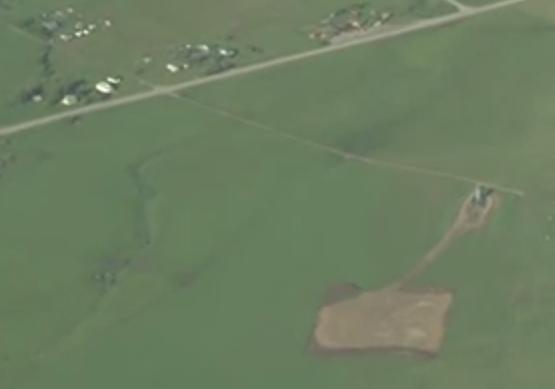
Aerial view of ECA well pad across from Montana Jack's in Dean

Aerial view of ECA well pad across from Montana Jack’s in Dean

The company did not appear at a hearing of the Montana Board of Oil and Gas regarding the permit in Belfry. They have built a large well pad in Dean, and have provided no information about what they intend to do with it. In June, when they were drilling the Belfry well, we heard publicly from the company only to issue a denial that they had done anything illegal.

So it was big news among local landowners when they agreed to come to the County Commissioners meeting on Monday to provide an overview of their plans. Local residents are very concerned about this issue. They’ve been studying and organizing for a year in response to the company’s one single announcement last October. A lot of them showed up to find out what the company had to say, and the video of the meeting is already one of the most popular posts on this blog. People want to know.

At a big event like this, the company sends strong signals about its importance by its choice of who to send to make the presentation. If it is an important event, like the opening of an office in Billings, the company sends John Mork and Peter Coors.

Jennifer Vieweg

Jennifer Vieweg

I don’t want to demean the two people the company sent to this meeting in any way. Seth Nolte, the Project Manager for the Belfry well, did a good job with what he had to work with. He is local, and, according to Internet profiles, was a star student in high school and college who flew out to West Virginia to join ECA three years ago. He was poised and as open as he was allowed to be in his presentation. Jennifer Vieweg is an ECA community relations representative who flew out to the meeting from the company’s Charleston, West Virginia office.

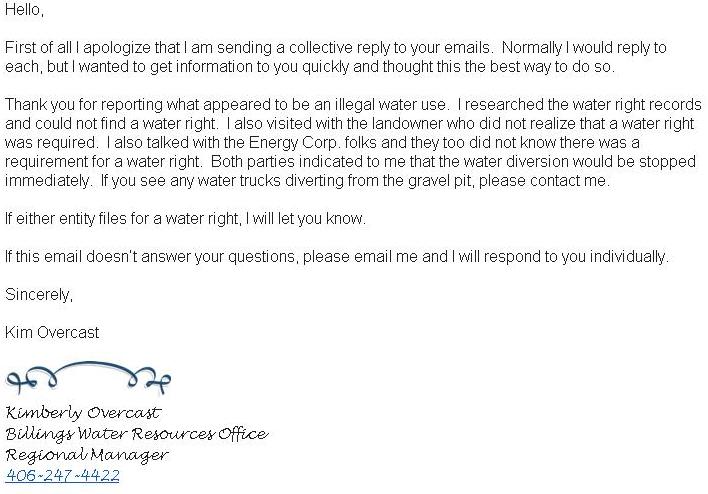
We’ve heard from these two before. They were central players in the dispute with local landowners over water use at the Belfry well site in June. In a nutshell, Seth hired a local contractor to haul water to the site. The contractor took water without a right from a local gravel pit. Neighbors complained to the Montana Department of Natural Resources, Jennifer issued a statement denying ECA was doing anything wrong, and the DNRC quickly shut the contractor down, leaving Seth to ask, “What am I supposed to do?” You can read all about it here.

DNRC email. Click to enlarge.

email update from Kim Overcast, Regional Director of Montana DNRC. Click to enlarge

So, our only interaction with two people asking us to trust their company with our precious water involves their complete misunderstanding of Montana water law.

This is not their fault.

However, it is ECA’s fault that they didn’t send someone senior and knowledgeable who could discuss the company’s plans and answer questions. The person they should have sent is Peter Sullivan, the company’s Vice President of Exploration. Mr. Sullivan would have been familiar with all these issues and could have been open and specific about every question raised.

Bringing local residents out to a public meeting and sending representatives who are unable to provide any detail, especially after the company has been silent for nearly a year after announcing big plans, is disrespectful. If you’re going to engage, you should have enough respect to give community members the information they want. Showing respect establishes trust and forms the basis for a fair legal relationship.

What signals is the company sending? It’s pretty obvious they don’t want us to know what they’re up to. This is not a position that inspires trust.

ECA’s “local” philanthropic commitment
At the outset of his presentation Seth touted ECA’s commitment to the community. He highlighted the ECA Foundation’s $100,000 grant to ACE Scholarships Montana (ACE). ACE scholarships fund private school tuition for needy K-12 students. Julie Mork, Managing Director of the ECA Foundation, says that this is “indicative of our commitment to the communities where we operate.”

John and Julie Mork

John and Julie Mork

There is a problem with this. To my knowledge, there are no K-12 private schools in Carbon or Stillwater Counties. So this demonstration of commitment is certainly wonderful for some needy students in Montana, but it won’t matter a lick to residents along the Beartooth Front.

To confirm this, I called the Montana ACE office and talked to Sarah Laszloffy, who told me that ACE gave out scholarships to 658 Montana students last year and hopes to give out over 700 this year. Locations of students receiving the scholarships? Here’s a complete list: Libby, Whitefish, Kalispell, Polson, Missoula, Hamilton, Helena, Butte, Manhattan, Bozeman, Belgrade, Livingston, Billings, Great Falls, Havre, Glendive and Miles City.

Zero local impact.

You have to wonder about a company so tone deaf that its top officers don’t even know enough about the Beartooth Front to recognize that its awesome philanthropic commitment will mean nothing to local residents.

It doesn’t have to be this way.

American Petroleum Institute “good neighbor” standards
The American Petroleum Institute (API) has defined “good neighbor” standards for its members in dealing with local communities. The standards outline key principles for communication, including:

  • Promote education, awareness and learning;
  • Provide clear, concise information to all key stakeholders including community members and local authorities and regulatory agencies in addressing challenges and issues that can impact them.
  • Provide structured forums for dialogue, planning, and implementation of projects and programs affecting the greater regional area. Involve neighboring operators and those sharing adjacent properties or leaseholds in opportunities to work cooperatively on engagements.
  • Establish a process to collect, assess, and manage issues of concerned stakeholders. Inform stakeholders on the preferred methods for communication, perhaps providing national toll-free phone number, or by offering contact information for the local field office or corporate personnel responsible for community/stakeholder relations.
  • Design and carry out a communication strategy that addresses the community, cultural, economic, and environmental context where a project occurs, and that considers the norms, values, and beliefs of local stakeholders, and the way in which they live and interact with each other.

If you read these, you can see that ECA has not followed a single standard. The company has no interest in being a good neighbor according to the standards of its own industry organization. Their interest is in getting their oil out, and holding the community at bay until they’re done.

Being a good neighbor means something along the Beartooth Front
The concept of corporate good neighbor policies has great meaning along the Beartooth Front. The Good Neighbor Agreement with the Stillwater Mining Company is a legally binding contract that has established a process for citizens to regularly meet with company representatives to address and prevent problems related to mining impacts, reclamation, wildlife, and other issues. It set aside land in conservation easements, instituted a program to reduce traffic on winding valley roads, and provided for independent environmental audits.

The Stillwater Mine

The Stillwater Mine

The Good Neighbor Agreement has demonstrated that it’s possible to run a responsible, profitable mining operation while protecting natural resources. The reason the community was able to negotiate this agreement is that, unlike ECA, the Mine is in the community for the long term. They have a small number of locations, their employees live in the community and send their children to local schools, and as a result the company and its employees have to live with the consequences of the way they run their business. It makes sense to work with the community as good neighbors.

It’s all about respect and trust
These are all little things, you say? These little things say a lot. They all add up to a lack of ECA respect for the community. If this community were important to ECA, they would send a senior executive. They would be transparent. They would abide by API good neighbor guidelines, and they would commit to the community in a meaningful way, not by throwing a small portion of their expected profit into a fund that has zero local impact.

Despite this, what they are asking us to do, in effect, is trust them with our most precious possessions — our land, our water, our air, our health.

Why would we do that?

The whole point of the Silvertip Citizen Initiated Zone is to establish necessary legal protections against ECA’s lack of concern for our welfare. A legally binding approach is exactly what has worked so well in Stillwater County. This kind of approach doesn’t keep them from getting their oil. It keeps us from becoming a victim of their lack of respect. As Ronald Reagan once said, “Trust, but verify.”

It’s much easier to trust when you establish a sound legal basis for doing so.

Tomorrow: The ECA presentation and the issue of the company’s poor compliance track record in other states.

Posted in Community Organization, Politics and History | Tagged , , , , , | 15 Comments

Video: ECA presentation at Carbon County Commissioners meeting, September 8, 2014

Yesterday Energy Corporation of America representative Seth Nolte made a presentation at the Carbon County Commissioners meeting in Red Lodge. All three Commissioners and a good crowd of local citizens were on hand.

I just received this in the middle of the night so I haven’t had a chance to review it. I know people want to see it so I’ll post it now and make comments later in a separate post.

Posted in Community Organization | Tagged , | 12 Comments

Reminder: ECA at Carbon County Commission on Monday, September 8 at 10:00 am (with John Mork video)

A reminder that Energy Corporation of America (ECA) will be making a presentation in Red Lodge on Monday morning, September 8, at 10am. Please attend if you can. It is important to hear what they have to say. More information here.

We’re not going to hear from ECA Chief Executive Officer John Mork on Monday, but to give you a sense of where ECA is coming from, I found this lecture given by Mork at the West Virginia University College of Business last fall. The speech was given just a few weeks before he arrived in Billings to announce that ECA was going to “bring the Bakken” to the Beartooths.

The speech is mostly unremarkable. It’s one of those “work hard and get ahead” kinds of speeches, but it’s also revealing in what it tells about the company and Mork’s views about energy.

In the first 25 minutes he talks about the development of ECA and how he went from flat broke to running what he says is the 39th largest oil and gas operation in the country. It’s a glowing picture of a company that has a small number of employees in whom they invest, and who show tremendous loyalty in return. He is clearly a successful entrepreneur wiho has put his personal stamp on ECA and become very wealthy building the company from scratch.

As he progresses, he gets into a description of the Marcellus Shale, above which WVU sits. He describes it as the second biggest gas field in the world, and “only about five percent developed.”

He describes the fracking revolution, and confirms that it’s really not the fracking that has “changed the world,” but horizontal drilling, which enables much more extraction in a smaller space:

“We are contacting way more surface area. It’s about contact” through horizontal drilling. Comparing an old well in West Virginia vs. a new well horizontally drilled, you get about 50 times the gas for about 12 times the cost.”

Description of the impacts of fracking
What I recommend you listen to is his description of the impacts of fracking on the environment. It starts at 28:47, and runs until about  31:20. I’ve done my best to transcribe the relevant sections below:

“What we do, we inject fresh water and sand into the ground with some chemicals that reduce friction…, we inject 4 million pounds of sand and 3-4 million gallons of water, and less than 5% chemicals….The chemicals we use in fracking are petty simple….We use a surfactant to reduce the friction. That would be the same thing you use to wash your hands with, soap you washed your hands with this morning, washed your dishes with last night, We use an anti-bacterial agent to kill the bacteria in the water that is naturally near the surface, that would be the Purell you use on your hands, and we use a guar gum…to thicken things up a little bit so it’ll carry the sand….That is actually the product that thickens your yogurt….

“And if any of you want to see exactly what chemicals we put in these things you go on the Internet because we post everything…that (we) pump in the ground.

“Another statistic that I love to tell, we have fracked over 10,000 times and never had an environmental problem…Statistically we are so far ahead on this that this is just not a question to us.

“One of the reasons we’re so sure, we cement 3/4 of an inch, three strings of heavy steel pipe between the fresh water and where we’re fracking so we’ve got multiple barriers, and we monitor all that,…and the fracking, we’re down at 5,000 feet, and everybody says, ‘Maybe you’ll frack into the fresh water at 100 feet.’  We’re really lucky if we frack 200 feet from the well bore.

“So for me, this is just a non-item.”

He says all this with a straight face, like it’s actually true.

When I listen to a guy like John Mork say things that are so demonstrably false, I wonder whether he is just lying, or he has somehow convinced himself that they are true. He obviously knows his business inside and out. If he thinks about these things, he knows they’re not true. Maybe he just doesn’t think about them.

Examining the truth
But it’s our mission here to make sure you know the truth, so let’s parse some of these statements and make sure you know why they are wrong:

  1. “If any of you want to see exactly what chemicals we put in these things you go on the Internet because we post everything…that (we) pump in the ground.” He’s talking here about FracFocus, where ECA does indeed post information about what chemicals they put into their wells.But a recent Harvard study exposed a number of issues with the accuracy of fracfocus information, most notably that “FracFocus gives operators sole discretion to decide when they can withhold information they claim is a “trade secret.” The study identifies three important aspects of laws which ensure that only legitimately confidential information is kept secret – substantiation, verification, and opportunity for public challenge.  FracFocus offers none of these procedures.” So Mork would have you believe that all they put in their wells is soap and guar gum. A word to the wise — don’t wash your hands with frac water.
  2. We have fracked over 10,000 times and never had an environmental issue.” Readers of this blog know this is a whopper. Click here to look at an online report from the Pennsylvania Department of Environmental Protection. It provides detail on the 66 state inspections with violations, 90 separate violations, 55 enforcement actions and fines of over $80,000 in that state. You don’t have to read far to find lots of environmental problems. You can find 70 more violations in West Virginia too.
  3. “We cement 3/4 of an inch, three strings of heavy steel pipe between the fresh water and where we’re fracking so we’ve got multiple barriers.”   If you look inside the Pennsylvania DEP report mentioned above, you can find clear examples of failures of the cement casing Mork describes. Here are two:Violation 572332, 10/13/2009: Water sample was taken on 8/25/09 from artesian flow of fluids from 8 5/8″ surface casing hanger./ Administrative review of sample results revealed the following:/ 1) Discharge of industrial waste to the ground./ Sample results report the discharged fluids on the well site contained high levels of iron (26.0 mg/L), manganese (2.855 mg/L), and aluminum (0.977 mg/L)./ A ph of 5.3 was also reported./ These fluids were pooled around the well head and production equipment, and continued throughout a large portion of the site./ Based on the amount of fluids present, and the conditions on site, it appears as though the artesian flow has been occurring for a long period of time./ Since the initial inspection on 8/25/09, myself and oil & gas inspector Rick Hoover have consulted with operator representatives who indicated this well will be plugged” (page 13)

    Violation 60075, 12/10/2010: “Failure to report defective, insufficient, or improperly cemented casing w/in 24 hours or submit plan to correct within 30 days.” (page 22)

  4. “So for me, this is just a non-item.” Actually, this is probably true. And shame on you, John Mork for not recognizing how the wells you drill impact the people who live near them.

So we won’t see John Mork on Monday, but now we certainly know the ECA company line. Come on out on Monday at 10am to hear their version of the truth, but don’t expect it to match yours. And don’t be afraid to ask them questions to try to determine what they really plan to do along the Beartooth Front.

Posted in Fracking Information | Tagged , , , , | Leave a comment

A personal story: Jaime Frederick, Coitsville, Ohio

This personal story is one of a series on this blog chronicling the impact of the oil and gas boom on the lives of people all over North America. You can see other personal stories in our series by clicking here.

Some of the most compelling stories come unfiltered from the people affected. Today’s post comes from a speech given by Jaime Frederick on January 10, 2012 in Columbus, Ohio. You can read the story, which is a transcription of the speech, or watch the video at the end of the post.

Jaime’s tale of the complete violation of her privacy, her rights, and her health by a system designed to protect the rights of the oil and gas industry at the expense of individuals is terrifying, and worth paying attention to as we look at the possibility of expanded oil drilling along the Beartooth Front.

A personal story: Jaime Frederick, Coitsville, Ohio

Jaime Frederick

Jaime Frederick

My name is Jaime Frederick and I’m from Coitsville, Ohio. Shortly after moving into my home in Coitsville outside of Youngstown, three years ago, I began to get seriously ill. I started vomiting on a regular basis and had intense abdominal pains everyday. After numerous trips to six different doctors, and several emergency room visits, test revealed that my gall bladder had completely failed. No gallstones, it had just stopped working, and no one could tell me why. I had my gall bladder taken out but continue to have what seems to be a never ending intestinal flu. It became so bad, that I soon developed an infection in my intestine, as large as a grapefruit, that ate through to the outside of my skin.

When I was finally admitted to the hospital, doctors said that I would have been dead in a few days if I had not come in when I did. They were baffled, and could only tell me this should not be happening to a healthy 30-year-old woman, and that this condition is typically only found in third world countries. Over the course of the next two years, I underwent a series of five more surgeries in an attempt to repair the damage that had been caused by the infection. I continued to get violently ill, and had elevated kidney and liver numbers, kidney infections, pain throughout my body, trouble breathing, rapid heartbeat, and many other unexplained symptoms.

I continue to search for answers, seeing 18 different doctors in total, who continue to misdiagnose and scratch their heads. Some told me that I was just stressed out, and that when you are stressed out you dehydrate and that I should drink as much water as possible. I know now that this advice nearly killed me. As we burned through our savings with thousands of dollars of medical bills, the answers never came as to why this was happening to me.

It wasn’t until a few months ago when the convoys of trucks and drilling equipment began rolling down our once lonely, quiet road, did the answers to my medical mystery unfold. The neighboring property owner, who lives out of town, had signed a gas lease before we even moved there, and never bothered to tell us. Out of the 62 acres signed off by my neighbor, that the best place to drill would be right by my home, about as close as the law would allow them.

As we scrambled to learn all that we could about what was happening to us, what rights we had, or didn’t, and how to stop it, we discovered that a special type of water test, a Tier 3 test, would have to be done to establish a baseline before the drilling began, and that we would have to pay for it ourselves. The cheapest test offered was $500. We managed to get the test done only two days before they started drilling. Our baseline tests revealed high levels of contaminants that are a result of the hydraulic fracturing and drilling process, such as high levels of barium, strontium, toluene and several others that I will not try to pronounce. The mystery was now solved. This was why I had been so sick for so long, and my dogs as well. At the time when I was most sick, I was drinking over two gallons of this water unfiltered each day.

As we dug deeper, we discovered that several wells had already been drilled and were tucked quietly away in the woods that surrounded our home and other properties. This was never disclosed to us when we bought the house. My husband never got sick because he hardly ever drank the water at home. I always bugged him to drink more water, and I’m glad now that like most husbands, he never listened to me. It’s hard to say which one of the 10 wells within a half-mile, 15 within a mile, actually caused the contamination. It only takes one bad well to poison a water table that can sometimes stretch out for over a mile. In some places that’s a lot of homes. As bad as this all sounds, the worst has yet to come.

Living through the drilling and fracking phase of the most recent well was a truly terrifying experience. We were given no notice whatsoever as to what was about to happen to us, and had nowhere to evacuate to with our three dogs and cats. We felt like we were trapped in someone’s idea of a sick joke. 24-7 nonstop, we were subjected to such unbelievable levels of noise that you can only understand if you’ve heard it for yourself. It would have been more peaceful to live on an airport runway. We couldn’t sleep for days at a time, and when we did it was only short naps in between explosions. We tried using earplugs, covered by these headphones, while listening to the radio, and could still plainly hear it. Worse yet, we could feel it, as a constant vibration through the house. That was just the drilling.

The actual fracking lasted about three days. Now that I get to live through Youngstown’s injection well earthquakes, I can tell you that is what it is similar to. Dishes rattling in the cupboards, pictures falling off the wall, cracking sounds in the basement. Like so many of you, I’m sure, I love my dogs with all my heart. I’ve never seen them so terrified, and hope I never will again. They cowered together in a corner, shaking uncontrollably for days. They would not go outside and they would not eat. I was unable to do anything to help them other than put a radio near them in hopes of masking the noise and calming them down.

The gas storage tanks, and radioactive toxic waste tanks… I refuse to call it brine, I’m sorry, because that was just a lie, that is not what it is. These tanks have been placed closer to my home than the well itself. They are right outside my bedroom window and just uphill from a fresh artesian spring on my property. The overflow hose that comes out of the radioactive toxic waste tank goes directly onto the ground and this is permitted because they get to lie and call it brine. I would not soak my pickles or my turkey in this. They are also permitted to bury to toxic wastewater pit on my neighbor’s property, just uphill from our home.

The gas storage tank is now hooked up and under high pressure. It regularly releases the pressure, putting the toxic fumes into the air and makes a lot of noise. It will do this for at least six more months. A smell similar to rotten eggs and diesel fumes hangs heavy in the air. ODNR tells me it is perfectly safe, and that I am in more danger breathing in the air in a parking lot. First of all, I don’t live in a parking lot. And secondly, when I do park my car in a parking lot it is not covered in an oily mist like now falls over our property and is seen easily on our house and car windows. I’m sure this is perfectly safe too, right ODNR?

Everyone asks me why I am not more upset with my neighbor and why I don’t sue him. I tell them because not only do we have no rights, but that I feel that he was taken advantage of by BoCor gas. They forced him to sign a lease when he was intoxicated, with no notary present. And they told him it would be no bigger operation than drilling a water well, and that the only thing left behind would be the size of a garbage can and surrounded by trees that they would plant. All lies, and there are still no trees. They also buried the radioactive toxic waste pit in the exact location where he told them he planning to build a home to retire in. BoCor also managed to rip him off to the tune of $300,000 in acreage payments. He said that if he knew then what he knows now, that he never would have signed and that he is very sorry. They have already destroyed the land that has been in his family for generations, dating back to the early 1800’s, and they are just getting started.

Our little house, in the middle of the woods, will soon be in the middle of a toxic wasteland, as they prepare to cut down the remaining trees to put in the pipelines and compressor stations that will eventually connect the wells. Our property value has been reduced from $125,000 to nothing, overnight. 47 wells, including injection wells, already cover the 12 square miles that is Coitsville, even surrounding the wildlife preserve.

We have already had a blowout of at least one well, a chemical spill, and a tear in a waste pit liner. And again, they are only getting started. I haven’t retested the water since the last well was drilled, but I have a feeling it didn’t make it cleaner. Even if I wanted to have it retested, we have nothing left, having spent every penny on water testing, water filtration equipment, medical bills, and renovating a home we thought we were going to raise a family in. We now check our faucets daily with a lighter, and we’re still hopeful because it hasn’t ignited, yet. I am feeling much better these days, and so are my dogs since we stopped drinking the water. My liver and kidney numbers have improved, though much damage has been done. I have developed kinetic tremors in my hands as a result of the neurological side effects of some of the chemicals.

But the worst side effect caused by the damage is my inability to safely carry a child, without the risk of hemorrhage or even death. Even if I could somehow still give birth, knowing the high risk of birth defects caused by the chemicals I drank. I will never take that risk. At the time when I was most sick, drinking the most water, I lay on the bathroom floor, night after night, thinking I would surely be dead soon. Throwing up until the blood vessels in my eyes and cheeks were burst. At that time, I did not know what fracking was, or that I was being deliberately poisoned. But I do now.

And I have a message for you Governor Kasic, and you Mr. Gasman, you may have taken my safety and my property value, you may have taken my gall bladder, and you may have taken my ability to have children, but you will not take my voice. And I will not stop until you stop. We will not stop until you stop.

Thank you.

Posted in Personal stories | Tagged , , , , , , , | 4 Comments

Action alert: Energy Corporation of America to present at Carbon County Commission on Monday, September 8

Here’s a rare opportunity to hear from the horse’s mouth what’s going on with oil drilling along the Beartooth Front.

Energy Corporation of America (ECA) is on the agenda for the Carbon County Commission meeting on Monday, September 8 at 10:00 am. The Commission agenda item describes their presentation as a “Carbon County/Beartooth Front Plan Brief.” 

The meeting will be held in the Carbon County Commissioners Hearing Room at 17 West 11th Street in Red Lodge.

John Mork, CEO of ECA, promised to "bring the Bakken to the Beartooths." Photo by Larry Mayer, Billings Gazette

John Mork, CEO of ECA, promised to “bring the Bakken to the Beartooths.” Photo by Larry Mayer, Billings Gazette

ECA is the Denver-based operator that announced last fall a plan to “bring the Bakken to the Beartooths” and drill 50 wells in the area. The first of those wells, near Belfry, was permitted by the Montana Board of Oil and Gas Conservation (BOGC) earlier this year, and is currently being evaluated for fracking

The well sparked considerable controversy in June when local residents caught an ECA vendor taking water from a local gravel pit without a water right and the Montana Department of Natural Resources had them shut down

You can read a history of ECA involvement with this well here.

ECA has a reputation for being a serial polluter in states where they have operated in the past. In Pennsylvania alone, according to the State Department of Environmental Protection, ECA has had 66 state inspections with violations, 90 separate violations, 55 enforcement actions and fines of over $80,000 (read the actual report here). The company has been cited for 70 more violations in West Virginia.  Pennsylvania recently released a list of 243 wells that have been contaminated by oil and gas operations. It is not yet known how many of these wells were contaminated by ECA.

Concerns about ECA and their plans to drill in Belfry led local residents to form the Silvertip Zone, a citizen-initiated special district that would develop, through a planning and zoning committee, special rules requiring ECA and other operators to adhere to highest and best management practices in conducting drilling operations.

This will be a rare public appearance by ECA, which has ignored American Petroleum Institute “good neighbor” standards, and has not interacted with local residents. The company has been publicly secretive about its plans for Carbon and Stillwater Counties.

We’ll provide information about the format of the meeting when we have it, but it’s important for residents of Carbon and Stillwater Counties to come out to show public concern for the damage that unregulated drilling will cause. Get your questions prepared and come on out. It’s an opportunity to show your support for the residents of Belfry and hear for yourself what ECA is willing to tell us about their plans.

Posted in Community Organization | 2 Comments

Article in The Local Rag uses half-truths, lies and plain stupidity to promote oil drilling

The Local Rag, a free monthly publication distributed in south central Carbon County, recently published a rather curious pro and con on fracking. It’s worth mentioning because it highlights the tricks that pro-drilling advocates use everywhere to advance their cause.

The article is split into three parts:

  • The Science and History of Fracking, by long-time Red Lodge resident and certified petroleum geologist Al Bloomer. Mr. Bloomer is a respected local voice. While I would quibble with points that he made and the conclusion, it is a reasonably balanced piece that is worth reading.
  • The Argument Against, by Carbon County Resource Council Chair Deb Muth. Ms. Muth is a long-time local activist who does her usual credible job of making a number of fact-based points, many of which have been discussed over the last several months on this blog. It is also worth reading.
  • The Argument in Favor, which is uncredited, and for a very good reason.– it is full of half-truths, outright lies and stupidity that are straight out of the oil and gas industry playbook.

Read all three, but I’m going to focus on the last section of the article here because it provides so many examples of the depths to which pro-drillers will stoop to make their arguments.

The basic premise of the pro-fracking piece is that “(o)pponents of fracking use a time-tested strategy for spreading propaganda; it’s called FUD, and it stands for Fear, Uncertainty, and Doubt. They realize that most Montanans have no idea what fracking actually is, so they have orchestrated a campaign of misinformation.”

After insulting the intelligence of most Montanans, the author, whoever he or she is, then proceeds to try to debunk this alleged FUD without offering a single fact to do so.

Here are some examples of the lies, half-truths and outright stupidity in the article:

  • “Fracking has been around since the 1940s, and has been used in millions of wells around the world.” True enough, but the technology that has revolutionized the industry and created the current oil and gas boom is horizontal drilling, which is much newer and has brought a number of risks that have been chronicled on this blog. The industry loves to trot out the time-tested technology argument in defense of fracking, but it leaves out the important fact that it is the recent innovation of horizontal drilling that has transformed the industry.
  • The anonymous author then trots out the tried and true quote from Lisa Jackson, former administrator of the EPA, who said, in testimony before Congress,

 “I am not aware of any proven case where the fracking process itself (bold added) has affected water, although there are investigations ongoing.”

Carol French displays her contaminated drinking water.

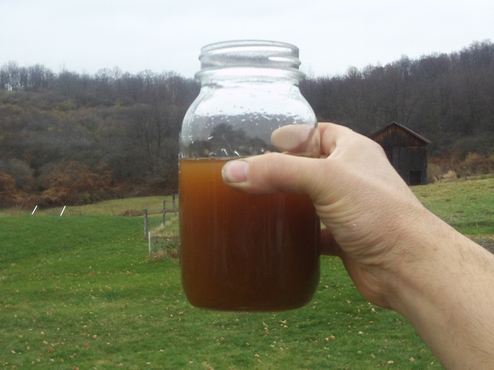
Carol French displays her contaminated drinking water. Click to get a better view of how discolored it is

We dealt with this one yesterday, but it’s worth touching on it again. It is very difficult to prove that the fracking process itself causes contamination, as explained here. But there are many, many documented cases of water contamination for fracked wells. You can find a list of 243 of them in Pennsylvania here.

If you’re really interested in reading scientific, peer-reviewed studies that document water contamination due to fracking, you can read 59 of them here (For those of you keeping score, note that scientific and peer-reviewed specifically means Not FUD.) Or, better yet, ask John Fenton. Or Carol French. Or Deb Thomas. Or Steve and Jacki Schilke. Or Terry and Teresa Jackson. Or Marilyn Hunt. Or Christine Pepper. Or Linda Monson. Or Diana Daunheimer. Or Laura Amos. Or the late Terry Greenwood.

  • Mr. or Ms. Anonymous then moves along to what he calls “uncertainty,” describing how fracking fluid is over 99% water, and less than 1% chemicals. “Think about this,” says the unnamed author. “The entire reason those rocks are being fracked is that they’re IMPERMEABLE! Water and chemicals can’t seep through them! The actual fractures are typically 100-200 feet long, so they don’t go anywhere near the aquifers.” I’m reluctant to use this word when describing the writings of others, because I’m sure it applies to mine from time to time, but this is just a stupid misunderstanding of the drilling process. The chemicals don’t just stay in the fractures. While most of the toxic fluid remains underground, a significant portion, the “flowback,” returns to the surface, where it is typically stored in open pits or tanks at the well site and must be disposed of. The chemicals used in fracking fluid have names like lead, mercury, uranium, mercury, ethylene glycol, radium, hydrochloric acid and formaldehyde.
  • Then he moves on to doubt, explaining that fracking opponents are just scaring people with claims about manmade earthquakes related to fracking. “There have been a couple of cases of tiny earthquakes attributed to fracking. Yes, I said “a couple.” As in two, the Author Without a Name claims. Well, I won’t say this is stupid. It’s just a lie. The people of Oklahoma are very clear about that.

There’s plenty of blame to go around on this. Expanded oil drilling along the Beartooth Front is an important issue that deserves to be debated in a public forum. We should all appreciate that The Local Rag took responsibility for doing this. But shame on them for failing to find a credible fracking proponent to advance that argument (or maybe there isn’t one). Shame on the author for not having the guts to sign his or her name to the article. And shame on the oil and gas industry for constantly accusing their opponents of putting forward FUD when they’re the ones who consistently lie and twist the facts.

Part of the purpose of this blog is to make arguments based on facts, which I try to link to. You can disagree with the conclusions I make, but, as the late Senator Daniel Patrick Moynihan once said, “Everyone is entitled to his own opinion, but not his own set of facts.”

How water contamination can occur. Click to enlarge. Source: The Checks and Balances Project

How water contamination can occur. Click to enlarge. Source: The Checks and Balances Project

Posted in Fracking Information | Tagged , , , , , , , , , , | Leave a comment

Let’s put one of the oil industry’s great lies to rest once and for all: a list of 243 water wells contaminated by drilling activity in Pennsylvania

You’ll find this quote from former EPA administrator Lisa Jackson in pretty much every pro-drilling article ever written:

“I’m not aware of any proven case where the fracking process itself has affected water.”

Pennsylvania contamination1If you’ve followed the EPA’s mishandling of the investigation of water contamination in Pavillion, Wyoming and their retreat from political attack on the matter, you’ll understand her unwillingness to comment. And, if you watch the video, you’ll note that she qualifies her remarks and limits them to “the fracking process itself,” not spills and pit lining leakage and the failure of concrete casings and all the other ways water gets contaminated at well sites.

But it’s good enough for defenders of oil drilling to say that oil drilling is absolutely safe.

If you Google that comment, you’ll see that the quote is the basis of dozens of articles saying drilling doesn’t cause water contamination.

When someone says this to you, look him or her in the eye and say, without fear of contradiction, “This is not true.”

Today we provide conclusive easy-to-use evidence that you can point to. Bookmark this, download it to your hard drive, print it out and keep it handy.

The Pennsylvania Department of Environmental Protection has just released a list of 243 cases of documented water contamination due to conventional and unconventional oil and gas drilling in that state.  According to the document:

The following list identifies cases where DEP determined that a private water supply was impacted by oil and  gas activities. The oil and gas activities referenced in the list below include operations associated with both conventional and unconventional drilling activities that either resulted in a water diminution event or an increase in constituents above background conditions.

Folks, that means contamination.

Pennsylvania contamination2For each of the 243 items on the list, there is a clickable link to the DEP order that defines the nature of the contamination, and how or whether the contamination has been addressed by the oil/gas operator (here’s an example).

You should be reminded also that the Pennsylvania DEP keeps a database on the compliance violations of each operator in the state. If you’ve followed this site, you know that Energy Corporation of America, the company that has promised to “bring the Bakken to the Beartooths,” has been charged with 66 inspections with violations, 90 separate violations, 55 enforcement actions and paid fines of over $80,000 in Pennsylvania alone, and has been cited for 70 more violations in West Virginia. You can see the Pennsylvania report for yourself by clicking here. In the report you’ll see specifically the kinds of violations that lead to water contamination: rips in pit linings, failure to cap wells, failure of cement casings.

Let’s put this all together:

Do these facts scare you? They should.

There is something we can do about it if we act together as a community. Follow this site to find out more.


Posted in Fracking Information | Tagged , , , , | 14 Comments

The EPA is not testing to see if injection fluids are contaminating our water. We need to take responsibility for doing it ourselves.

Your tax dollars at work…

Last month the federal Government Accounting Agency released a report on the Environmental Protection Agency (EPA) program to protect underground water sources from the injection of fluids associated with oil and gas drilling.

If you’re a regular reader you won’t be surprised by what they found out.

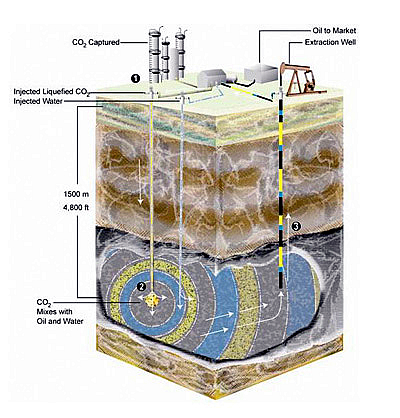
Injection well diagram

Injection well diagram

The EPA’s role
According to the report, the EPA’s role in the Underground Injection Control program is to oversee and enforce fluid injection into wells associated with oil and gas production, known as Class II wells. EPA has approved 39 states to manage their own class II programs, and EPA regions are responsible for managing the programs in the remaining states.

The study was conducted because

Every day in the U.S. at least 2 billion gallons of fluids are injected into more than 172,000 wells to enhance oil and gas production, or to dispose of fluids brought to the surface during the extraction of oil and gas resources. These wells are subject to regulation to protect drinking water sources under EPA’s UIC class II program and approved state class II programs. Because much of the population relies on underground sources for drinking water, these wells have raised concerns about the safety of the nation’s drinking water.

There were two major findings, from the report:

  1. EPA does not consistently conduct annual on-site state program evaluations as directed in guidance because, according to some EPA officials, the agency does not have the resources to do so. The agency has not, however, evaluated its guidance, which dates from the 1980s, to determine which activities are essential for effective oversight. Without such an evaluation, EPA does not know what oversight activities are most effective or necessary.
  2. To enforce state class II requirements, under current agency regulations, EPA must approve and incorporate state program requirements and any changes to them into federal regulations through a rulemaking.EPA has not incorporated all such requirements and changes into federal regulations and, as a result, may not be able to enforce all state program requirements. Some EPA officials said that incorporating changes into federal regulations through the rulemaking process is burdensome and time-consuming. EPA has not, however, evaluated alternatives for a more efficient process to approve and incorporate state program requirements and changes into regulations. Without incorporating these requirements and changes into federal regulations, EPA cannot enforce them if a state does not take action or requests EPA’s assistance to take action.

I’m about as shocked as Captain Louis Renault in the film Casablanca:

That the federal government is not doing its job shouldn’t shock you. Some time ago we revealed that the Bureau of Land Management, another federal agency, is failing to inspect high risk wells.

The takeaway for us
What’s the takeaway for us along the Beartooth Front? The oil and gas boom has exploded over the last 10 years. It’s growth has outstripped the ability of federal and state agencies to protect citizens against water contamination. It’s as true in Montana, which has only seven well inspectors for the entire state, as it is in North Dakota or anywhere else. In Montana, those seven inspectors are responsible not only for the 1,062 class II injection wells in the state, but also for the other 10,000 wells across the state.

There’s also no transparency in the way Montana does inspections. Just yesterday Northern Plains Resource Council sent a letter to the Montana Board of Oil and Gas Conservation (BOGC) demanding that they publish their data on the Internet. Right now you have to go into BOGC’s offices in Billings to research anything having to do with well inspections.

A view of the dry bed of a reservoir in Texas. Records show that environmental officials have granted more than 50 aquifer exemptions for waste disposal in that state. Courtesy of ProPublica

A view of the dry bed of a reservoir in Texas. Records show that environmental officials have granted more than 50 aquifer exemptions for waste disposal in that state. Courtesy of ProPublica

This is not just a record-keeping problem. Class II injection wells are responsible for substantial pollution across the country. The EPA has a long history of granting exemptions to oil and gas companies to pollute aquifers, often in drought-stricken Western states.

This may sound like a perpetual refrain, but there’s only one way to protect our water. It’s local regulation to demand that oil and gas operators use highest and best management standards when they are drilling in Carbon and Stillwater Counties. Here’s the kind of standard that would be built into those regulations:

Comprehensive water testing at least once every three months during the period of active well operation, and at least once a year for the next 20 years following completion for every water well within three miles of each well bore. The testing is to be done at the expense of the oil and gas operator, and the results must be provided to the County planning and zoning committee, which shall publish the results on a public web site. Testing must be conducted by an independent Montana state licensed engineer.

Our water, our responsibility
This is just good sense. It’s our water that’s at risk. We know that the EPA and the State of Montana are not going to do adequate testing. We should take responsibility for keeping our water clean. We should make sure the inspections get done, and we should make sure results are published so that everyone knows what they are.

We should set the rules for how oil and gas drilling occurs in our back yards, and we should set up enforcement mechanisms to make sure the rules get enforced.

Posted in Community Organization, Fracking Information, Uncategorized | Tagged , , , , | 4 Comments

Gas flaring is dangerous to our health and environment. There’s one way to stop it. Locally.

Gas flaring, the deliberate open-air burning of natural gas, is a practice common in the largest shale oil plays where natural gas is a byproduct of oil extraction.

There are some legitimate reasons to allow limited use of flaring. After a shale oil/gas well is drilled and hydraulically fractured, a temporary flare is used during well production testing. Testing is important in order to determine the pressure, flow and composition of the gas or oil from the well. Flaring at the well site can legitimately last for several days or weeks, until the flow of liquids and gas from the well and pressures are stabilized.

But once the flow is stable, the practice is dangerous and unnecessary unless required for safety reasons.

What’s wrong with flaring? Plenty:

  • Flaring releases methane, a greenhouse gas that, when released directly into the air, traps heat in the atmosphere. The process of flaring contributes directly to global warming.
  • Flaring has a substantial impact on the health and environment of landowners who live near a flared well. The methane release is smelly, noisy, and, according to the Natural Institute of Health, exposure causes “headache, dizziness, weakness, nausea, vomiting, and loss of coordination” in people and animals. It creates a 24×7 bright light, blocking out the night sky.
  • Flaring is a waste of a precious natural resource. In oil plays, where natural gas is an unwanted byproduct of oil extraction, flaring is common because oil is 30 times more valuable than natural gas. So rather than capture it and take it to market, it is destroyed — hardly an efficient way to treat precious natural resources.
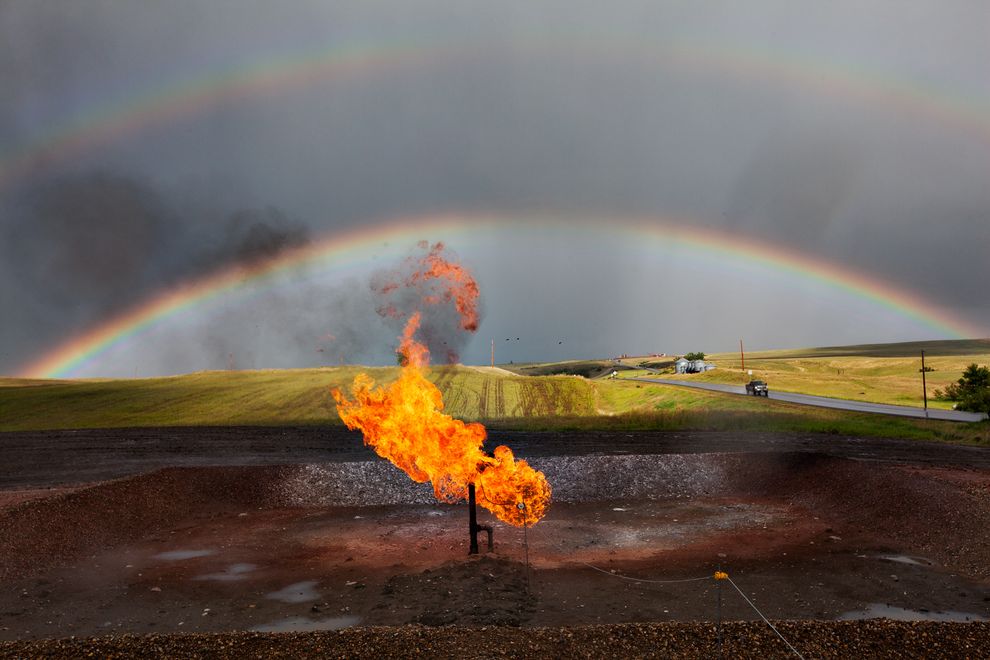
Gas flaring in the Bakken. Courtesy National Geographic

Natural gas flaring in the Bakken. Courtesy National Geographic

It’s also unnecessary. Technologies currently exist, and more are being developed, to capture natural gas at the wellhead, and natural gas can be used for purposes such as fueling generators at the well site.

This is a huge problem. In the Bakken, about a third of natural gas produced through the process of oil extraction is flared. According to a study released this month by Earthworks, $854 million in natural gas has been burned as waste in the Bakken since 2010, enough to pay for solar panel installations in almost every household in Fargo.  The 130 billion cubic feet of natural gas burned in just two oil plays — the Bakken and Eagle Ford Shale in Texas — has produced the equivalent of 1.5 million cars’ worth of carbon dioxide emissions.

What about state regulation?
So, problem identified. We just need states to regulate flaring to curb this practice, right?

If you’ve been reading this blog for awhile, you know the answer to that question. No.

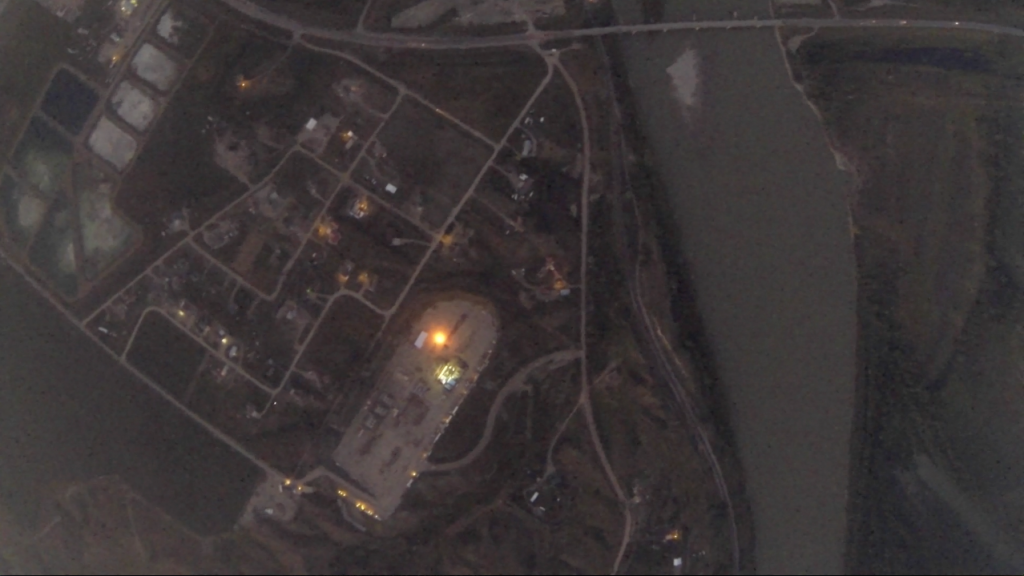
photo of a flared well in the Bakken, shot from a high altitude balloon. Courtesy of Skytruth. Click to enlarge.

Photo of a flared well in the Bakken, shot from a high altitude balloon. Courtesy of Skytruth. Click to enlarge.

The simplest and most direct way for states to regulate flaring might be to make companies pay taxes on the amount of gas they flare. In that way you can encourage them to move to wellhead methane capture. This isn’t done. North Dakota neither tracks how much companies pay in taxes on flared gas, nor independently tracks the volume of flared gas. Texas does not require producers to pay taxes on flared gas.

North Dakota put regulations in place last June that the state says will eventually reduce flaring to 10% of natural gas produced, but the outcome is not clear because North Dakota has such a poor record of monitoring oil operations. Companies can also seek exemptions to the law, which North Dakota has consistently granted in the past.

And Montana? You’ve got to be kidding. The residents of the Silvertip Zone in Belfry asked the Montana Board of Oil and Gas to prohibit flaring in the permit  for the Hunt Creek 1-H well earlier this year, but the plea was ignored. If that well is fracked, as most expect it will be, it (and others that follow) will almost certainly be flared.

There’s a way to deal with this locally
This is why local citizen-initiated zoning is critical. If John Mork is successful in his goal of bringing the “Bakken to the Beartooths,” the only way to protect local landowners from this dangerous and destructive practice is to install local regulations to limit its use. That won’t keep mineral rights holders from getting their oil. It will just require oil operators to use the highest standards in extraction to protect our property, our land, our water, and our way of life.

That’s not anti-business. That is not unnecessary government intrusion.

It’s just fair.

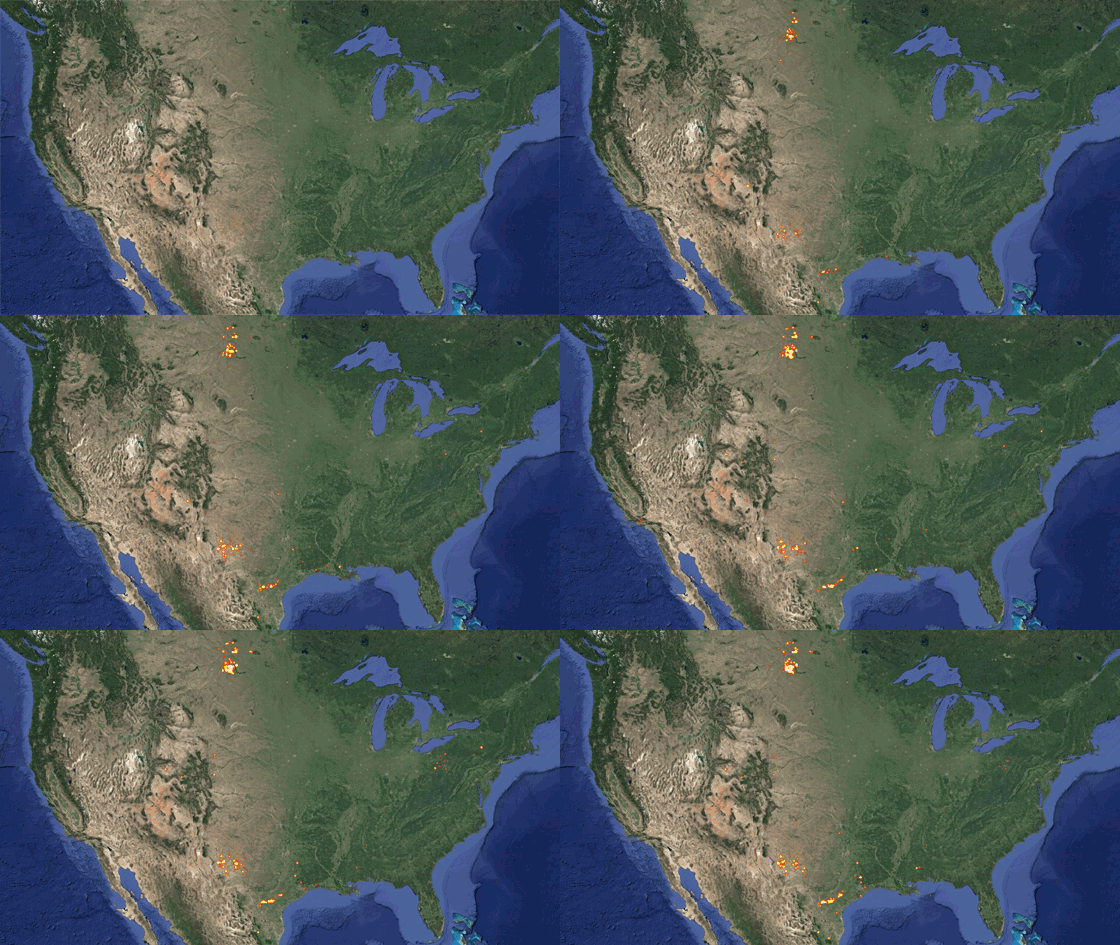
Skytruth has released an interactive map of flaring activity across the globe. Click to access the map

Skytruth has released an interactive map of flaring activity across the globe. Click to access the map


Posted in Fracking Information | Tagged , , , , | 9 Comments