CORRECTED. Action Alert: Public comment period for BLM leases on the Beartooth Front in northern Wyoming ends Monday, February 23

Apologies for sending this out twice, but I’ve made some important corrections to the material in my last post on BLM leases in northern Wyoming.

If you’re going to comment, please use the information in the corrected post.

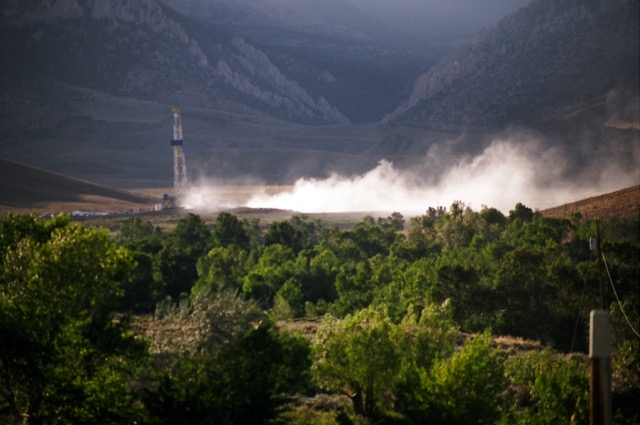
In 2006 this well blowout in Clark caused contamination that has not been mitigated to this day.

In 2006 this well blowout in Clark, Wyoming caused contamination that has not been mitigated to this day.

Posted in Uncategorized | Leave a comment

Action Alert: Public comment period for BLM leases on the Beartooth Front in northern Wyoming ends Monday, February 23

Last May a large number of public comments played an important role in the deferral of a Bureau of Land Management (BLM) oil lease in the Dean area.

While the BLM is not currently considering any leases in Stillwater or Carbon County, there is a lease being considered along the Beartooth Front in northern Wyoming, just over the Montana border south of Belfry, that you should be concerned about and may want to comment on.

Note that the deadline for public comment is Monday, February 23.

Why this should concern you
Any development of federal land along the Beartooth Front is a matter of concern, but this proposed lease sale hits particularly close to home. It includes land adjacent to the Clark Fork River, just upstream from areas of Carbon County. Any risk to this river endangers downstreamareas between there and the Yellowstone.

In 2006 this well blowout in Clark caused contamination that has not been mitigated to this day.

In 2006 this well blowout in Clark caused contamination that has not been mitigated to this day.

Even more frightening is that the proposed lease abuts areas that have suffered significant impacts from oil and gas drilling in the past. If you haven’t done so, read the personal story of Deb Thomas and the well blowout in 2006 that continues to adversely affect the area today.

Background: The BLM leasing process
The BLM leasing process is governed by a resource management plan (RMP) and associated environmental impact statement (EIS). Together they provide a framework for managing BLM-administered lands and federal minerals.

In the Cody field office of Wyoming, the RMP is currently being revised, as it is in Montana. Each revision is important, since the RMP is only updated every 25 years or so.

Leases on BLM land are put up for sale when there is a request from a company that wants to exploit mineral resources. The process is governed by the National Environmental Policy Act (NEPA), which requires federal agencies to integrate environmental values into their decision making processes by considering the environmental impacts of their proposed actions and reasonable alternatives to those actions.

To meet NEPA requirements federal agencies prepare a detailed statement known as an environmental assessment. EPA reviews and comments on environmental assessments prepared by other federal agencies, maintains a national filing system for all assessments, and assures that its own actions comply with NEPA.

The environmental assessment involves two steps:

  1. Public Scoping: This step involves the community in determining whether there are environmental impacts that need to be considered. These impacts might include:
  • Significant natural resources such as ecosystems and threatened and endangered species;
  • Commercial and recreational fisheries;
  • Current recreational uses of the land and waterways;
  • effects on water users;
  • Effects of potential controls on current lake and waterway uses such as flood risk management, commercial and recreational navigation, recreation, water supply, hydropower and conveyance of effluent from wastewater treatment plants and other industries; and
  • Statutory and legal responsibilities relative to use of land and water.

2. Preliminary environmental assessment: Public review of preliminary environmental assessment. This process takes 30 days before the final environmental assessment.

Directions for sending comments
Comments should be sent via email to: blm_wy_wrbbd_lease@blm.gov. They must be sent by Monday, February 23.

Comments should be referenced as:
RE: August 2015 Oil and Gas Lease Sale Parcel Environmental Assessment, BLM parcel WY-1508-237

and sent to:

Rita Allen
Resource Advisor – Energy
Wind River / Bighorn Basin District
101 S. 23rd Street,
Worland, Wyoming 82401
307-347-5100
blm_wy_wrbbd_lease@blm.gov

RE: BLM parcel WY-1508-237

Be sure to say that you support the deferral of parcel WY-1508-237, currently being considered for August, 2015 sale.

These are points you may want to make in your comments:

  • Parcel WY 1508-237 lies within greater sage-grouse general habitat and is within a four-mile buffer of an occupied lek.
  • Parcel WY 1508-237 provides seasonal range for bighorn sheep, elk, moose, mule deer, pronghorn antelope, mountain goat, and white-tailed deer.  It is habitat for black and grizzly bear, wolves, mountain lion, bobcat, and red fox. A broad diversity of bird life is also present in the area.
  • This parcel includes and is adjacent to public lands extremely important for hunting, fishing and recreation that includes hiking, biking, horseback riding, cross country skiing and snowshoeing.  These are uses that depend on clean air, clean water and a healthy outdoor environment.  These recreational activities bring important revenue to the area, the state of Wyoming and the region.
  • Leasing of mineral resources should not occur where people live WY 1508-237 includes privately held surface lands, including property in the Line Creek Wilderness Subdivision.  The rural residential subdivision consists of 90 lots that vary in size and include approximately 54 landowners.

We’ll keep you updated on developments regarding this lease.


Posted in Community Organization, Politics and History, Fracking Information | Tagged , | 2 Comments

Guest Post: Why Silvertip landowners filed suit against the Carbon County Commissioners

by Bonnie Martinell

I am one of a group of Belfry landowners who recently filed suit against the Carbon County Commissioners to vindicate our right to protect our property, health, and livelihoods through local action.

On February 13, seven landowners went to court to challenge the County’s decision to reject our petition to set up a zoning district in our neighborhood to address the effects of oil and gas drilling. The zoning district is the first step to enacting reasonable protections for our water and air and requiring that wells are a reasonable distance from our homes.

Oil and gas drilling has always been a part of our lives. The first well in Elk Basin, just a few miles up the hill from where we live, was drilled exactly 100 years ago. Big oil trucks regularly rumble down the dirt road that cuts through our properties, leaving a trail of dust that coats everything. The Silvertip Pipeline, which ruptured underneath the Yellowstone River three years ago, runs right through our land.

But when Energy Corporation of America announced plans to use horizontal drilling and hydraulic fracturing to “bring a little bit of the Bakken” to our community, everything changed. It meant that oil drilling would no longer be occurring a few miles up the hill where no one lives, but would take place right in our back yards.

No matter what the oil and gas industry tells you, drilling for oil and gas causes problems. It contaminates water, air and soil. There is no shortage of nearby examples: a well blowout in Clark, Wyoming; groundwater contamination in Pavillion, Wyoming and Poplar, Montana; regular stories of spills and leaks throughout the Bakken; pipeline spills under the Yellowstone River.

To be clear, we are not taking this legal action to ban oil and gas drilling. We are not trying to stop any of our neighbors who own mineral rights from realizing profit from their own property. We are just asserting our rights under Montana law to make sure that our water, our air, our soil and our way of life are protected if oil and gas drilling does occur.

We have done everything we can to work within Montana law to make this happen.

Bonnie Martinell testifying before the Board of Oil and Gas. Billings Gazette photo

Bonnie Martinell testifying before the Board of Oil and Gas Conservation. Billings Gazette photo

When ECA filed for a permit to drill near our homes, the Montana Board of Oil and Gas Conservation, the statewide permitting agency, refused to allow us to testify. Working with Northern Plains Resource Council, we had to file suit just to receive a hearing. Then they ignored our respectful requests for water protection, well design specifications, and setbacks from occupied residences.

We have also gone to Helena to testify for bills in the current legislative session. Those bills, endorsed by the editorial board of the Billings Gazette, would require water testing, setbacks from occupied residences, disclosure of the chemicals used in fracking, increased bonding from operators to cover potential damages, and safer well design. Not one of these bills made it out of committee, and they likely won’t be considered again until at least 2017.

We have been among just a few residents who have regularly attended meetings to develop Carbon County’s five-year growth plan, which will be approved soon. In its current draft, this plan will encourage residents to apply for special citizen-initiated zoning to protect their properties.

This is exactly what we have done. On two occasions, over two-thirds of the landowners in our community have signed petitions to establish the Silvertip Zoning District, in accordance with Montana law. This district would set up a planning and zoning board that would set rules for water, air, and soil testing; noise and light reduction, use fees and other regulations that would allow drilling to take place in a way that protects the rights of local landowners.

In December, the Commissioners approved the zone, stating it was “in the public interest and convenience for public health, safety and welfare, and for the public infrastructure.” But in January, after a handful of our neighbors protested, they rescinded.

We are left with no choice. The Montana Constitution guarantees every citizen a right to a “clean and healthful environment.” We are taking action to defend that right because our government will not.

Posted in Community Organization, Politics and History | Tagged , , , , , , , , , , | 4 Comments

Rachel Maddow: North Dakota oil train safeguards too little too late

By now you’ve probably read about the latest railway disaster involving crude oil transported out of the Bakken. A train carrying more than 100 tankers of crude oil derailed during a snowstorm in southern West Virginia on Monday, sending at least one tanker into the Kanawha River, igniting at least 14 tankers in all and sparking a house fire.

A local resident described the explosion as being “like an atomic bomb went off.” Explosions sent a fireball at least 300 feet into the air.

It’s yet another in a series of spectacular railway disasters involving the transport of Bakken oil: the explosion of train in Lynchburg, Virginia last April that spilled flaming oil into the James River; a spectacular explosion of a train in Casselton, North Dakota in December, 2013 that spilled 400,000 gallons of oil; a massive explosion in Lac-Mégantic, Ontario in July, 2013 that killed 47 people and wiped out much of the town.

These disasters have led to calls for increased train safety. Last March the US Department of Transportation Safety and the Association of American Railroads announced plans to phase out older, unsafe rail cars and reduce speeds through populated areas.

And Bakken oil, because it is “lighter”, turns out to be be much more volatile than oil from other regions, and more dangerous to transport.

Last night Rachel Maddow did a particularly good job of describing how North Dakota, while it has taken steps to make oil safer to transport, still does not meet standards for removing volatile compounds from oil before shipping that have been adopted in other states, notably Texas.

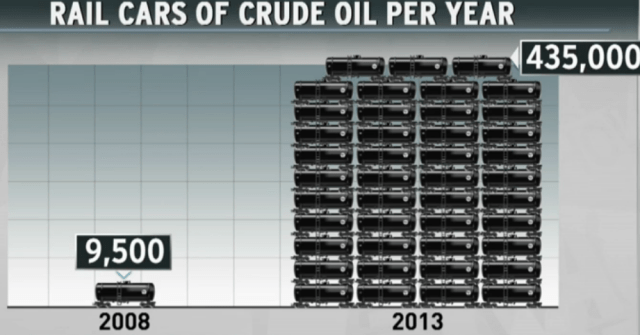
The segment is lengthy, about 20 minutes, but worth a watch. She reports in detail about the history of these disasters, about how slow North Dakota has been to put safeguards in place — new standards don’t even go into effect until next April — and how the standards are not enough to protect us from these disasters.

If you click on the graphic below, which shows the exponential increase in rail shipments of oil over the last seven years, you’ll be taken to the MSNBC page that contains the segment:

Click to view Rachel Maddow segment

Click to view Rachel Maddow segment

Related: Other posts on this site related to railway safety.

Posted in Bakken | Tagged , , , | 1 Comment

Timeline of events leading to legal action by Silvertip landowners

Last week landowners in the Silvertip area of Belfry filed a legal action to overturn the Carbon County Commissioners’ rejection of their attempts to form a citizen initiated zone

Here is a timeline of events leading up to this action:

October, 2013: John Mork, the CEO of Energy Corporation of America, announced the opening of an office in Billings and plans to hydraulically fracture 50 wells along the Beartooth Front in a move that would bring “a little bit of the Bakken” to the Beartooths. At about this time, ECA approaches a local landowner and offers a one-time payment of $4,500 for access to three acres of land to drill the well. The landowner was told they had no choice but to sign.
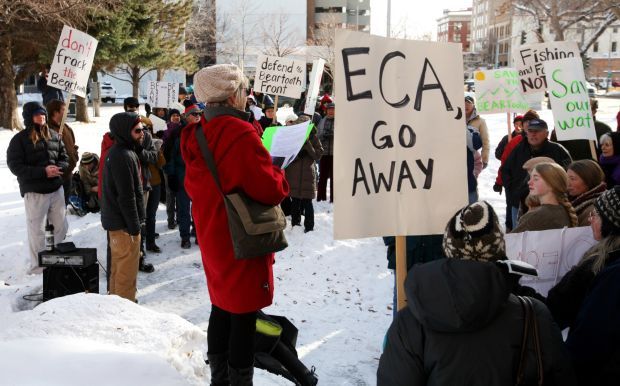
Protest in front of the Montana Board of Oil and Gas Conservation.

Protest in front of the Montana Board of Oil and Gas Conservation. Photo credit: Casey Page, Billings Gazette

December: The Montana Board of Oil and Gas Conservation (BOGC) refuses to hear the arguments of concerned citizens and grants ECA a permit for a well near Silvertip Road in Belfry.

January 8, 2014: Northern Plains Resource Council and its affiliate Carbon County Resource Council file suit against the BOGC, demanding a hearing on the well permit and reforms in the process by which the BOGC permits wells.

February 7: Analysis reveals that ECA has an abysmal safety record in Pennsylvania and West Virginia, with 66 inspections with violations, 90 separate violations, 55 enforcement actions, and fines totaling over $80,000 in Pennsylvania alone. You can download a copy of the actual report here.

February: BOGC accepts the demand in the lawsuit and grants a hearing on the well.

Well structure. Click to enlarge

Well structure. Click to enlarge

February 27: BOGC ignores public input and expert testimony, granting the permit as requested by a 6-1 vote.

March: Neighbors begin to discuss options to protect their land, water and way of life. Given the lack of protection from the BOGC and other state entities, they look specifically at options for local action.

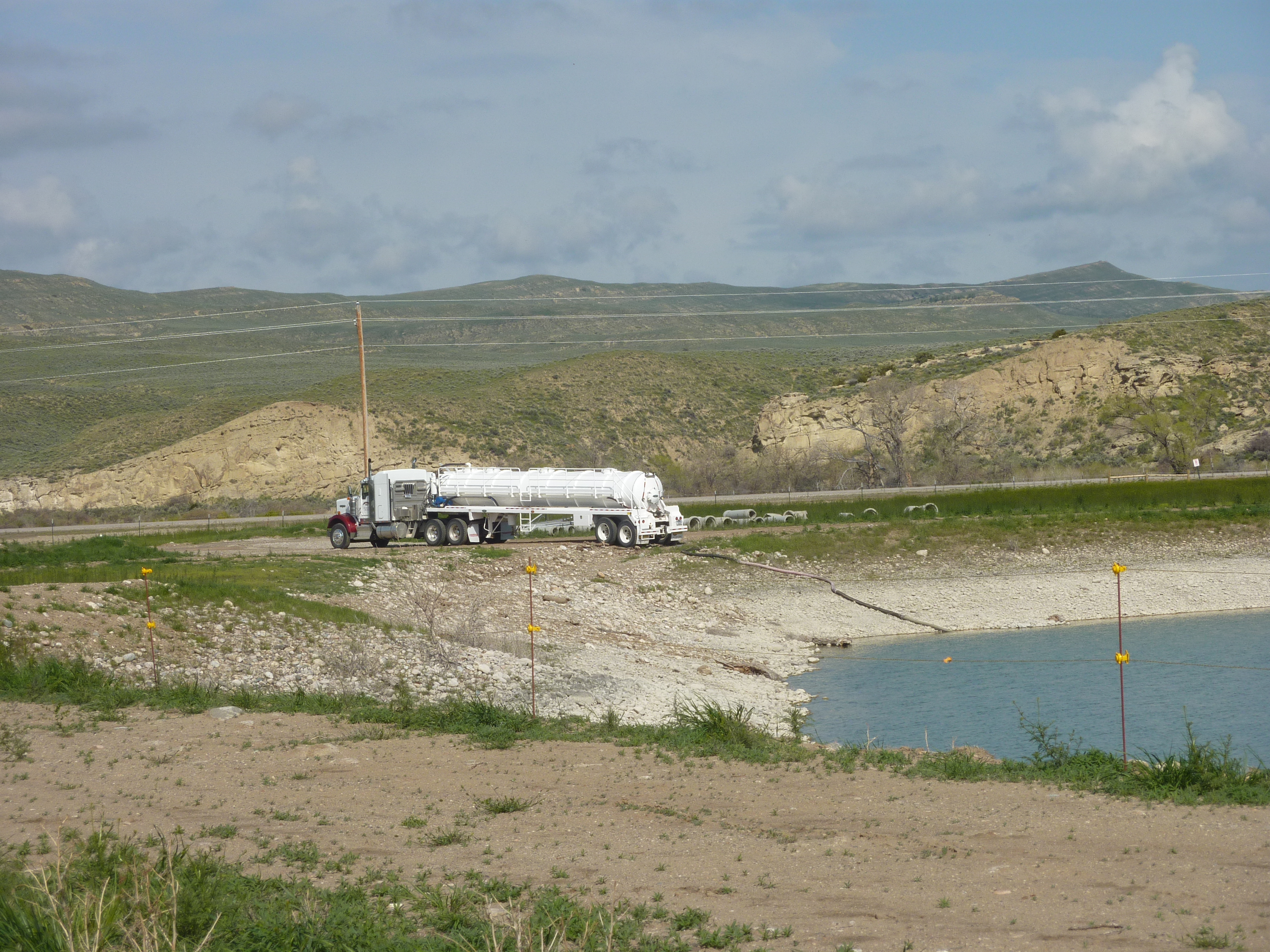
May 14: ECA begins work on the well. Residents immediately become concerned that the company’s contractors are illegally drawing water out of a gravel pit near the site. A water right is required, and none exists.

Tanker truck illegally removing water from well. Click to enlarge.
Tanker truck illegally removing water from well. Click to enlarge.

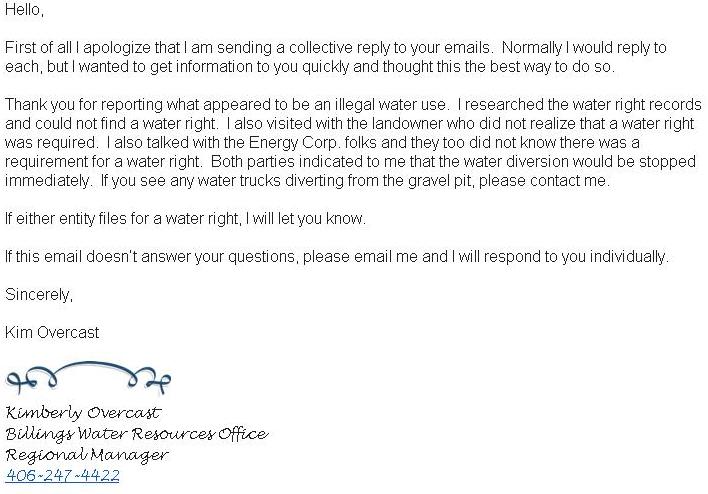
DNRC email. Click to enlarge.

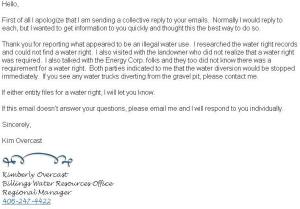
email update from Kim Overcast, Regional Director of Montana DNRC. Click to enlarge

May 21: After receiving a citizen complaint and dozens of calls and emails from local citizens, the Montana Department of Natural Resources shuts down the illegal appropriation of water from a local gravel pit without a water right.

May 23: The contractor makes a deal with the town of Bridger to get one truckload of water per day until June 10. The deal was made without a public hearing.

June, 13: ECA begins dismantling the well structure. Dismantling is complete on June 16.
Well head, July 18. Click to enlarge

Well head, July 18. Click to enlarge

July 7: ECA gives notice to the BOGC of “intent to perforate” the well. In addition they filed an “intent to stimulate or chemically treat the well.” Both of these are steps toward hydraulic fracturing.

According to Jim Halverson of the BOGC, ECA has told him that the company plans on monitoring the results of the perforations for 30 days, then will apply to frack if they want to move forward. Fracking requires 48 hours advance notice to the BOGC.

August 18: Landowners from the Silvertip area present petitions to the Carbon County Commissioners to establish a citizen initiated zone in their area. An overflow crowd supports the petitioners. You can view a video of the meeting below.

September 8: The Carbon County Commissioners invite ECA to speak before another packed meeting. Rather than send senior executives, the company sends the Belfry well project manager and a community relations representative based in West Virginia, who are unable to provide adequate answers to questions from the audience. Video of the meeting below, and my comments here, here, and here.

Click to view full letter

Click to view full letter

September 17: The Carbon County Commissioners hold an evening public meeting at Belfry School to allow public input into issues related to oil drilling in the area. ECA attorney Mike Dockery and the ECA project manager are invited in advance to speak, and Silvertip landowner Bonnie Martinell is asked to join them at the beginning of the meeting. Dockery makes a lengthy presentation in which he outlines ECA’s objections to the Silvertip Zone, detailed in a letter to the Carbon County Commissioners. You can read the letter by clicking on the photo at right.

The video below shows the entire meeting. It is a wonderful example of citizen involvement. There were many speakers with comments, questions and concerns. They represent different points of view, different levels of understanding, and personal experiences. It is exciting to hear people engage in the process.

Alex Nixon, Carbon County Attorney

Alex Nixon, Carbon County Attorney

September 18: County attorney Alex Nixon provides feedback to the Silvertip Zone petitioners on the legal standing of their petition.

He advises the County Commissioners not to take action on the petition for one primary reason: the law requires that the land in a citizen-initiated zone be contiguous, and the Silvertip Zone is not a single contiguous parcel.

He also indicates that he has concerns that the petition is not specific enough about what is to be zoned, even though supporting documents are much more specific.  He said that this concern by itself was not enough to keep the Commissioners from acting on the petition.

He says that legal shortcomings are common in petitions of this type, and that he has been involved with many that required multiple iterations to achieve approval.

He recommends that the petitioners redo the petition, define the zone properly and come back.

Video of the meeting:

Fall, 2014: Silvertip residents, working with the Carbon County Resource Council, regularly attend meetings to provide citizen input into the County’s five-year growth plan.

November 20: Silvertip landowners return to the County Commissioners with a new petition for a contiguous zone, signed by all but one of the original petitioners within the boundaries of the zone.

December 12: In a letter to the Carbon County Commissioners, ECA indicates tht they have “determine(d) that (the Belfry) well is not a good candidate for further development for ECA. Therefore, we do not have plans to further develop this well, or pursue additional wells in the area at this time.” Silvertip residents regard this as welcome short term news, and an opportunity to put needed protections in place before the next operator moves in.

December 15: At a well-attended meeting in Red Lodge, Carbon County Commissioners vote to move forward to create the Silvertip Zone in Belfry. The Commissioners agreed that the zone is “in the public interest and convenience for public health, safety and welfare, and for the public infrastructure.”

Meeting video:

In making this decision, the Commissioners rejected ECA attorney Mike Dockery’s argument that the BOGC was set up by the legislature as a “quasi judicial body” with the exclusive power to regulate oil and gas activities. Because this is an exclusive right, if the County sets up a zone to regulate oil and gas it will “usurp that right.”

Susan Swimley letter. Click to download complete letter.

Susan Swimley letter. Click to download complete letter.

Susan Swimley attorney for the landowners, successfully countered this argument by explaining that Montana counties not only have the authority to regulate oil and gas activities, but the responsibility to do so in order to protect the health, safety and welfare of its residents, as long as these regulations do not directly conflict with specific authority given to the BOGC by the State.

January 15, 2015: In a stunning reversal that ignored the will of the majority for the opinion of a small minority, the Carbon County Commissioners withdraw their motion to accept the petitions to form the Silvertip Zone.  Commissioner John Prinkki explained the move by saying, “The petition fails. As you know, under Section 5, because of the protest, we couldn’t move forward with this if we wanted to. It fails for that fact alone.” The rejection is clearly illegal, based on a recent Montana Supreme Court ruling.

Video of the meeting:

Silvertip landowner testifies for protections before a legislative committee in Helena

Silvertip landowner testifies for protections before a legislative committee in Helena

January 28: Landowners travel to Helena to testify on multiple bills in the current Montana legislative session that would provide protection against unregulated oil and gas drilling. These protections include mandatory water testing, setbacks from occupied residences, disclosure of the chemicals used in fracking, well design requirements, and increased bonding to protect against damage.

All of these bills were tabled in committee, and are presumed dead until at least the 2017 legislative session.

February 13: Stymied at every step by every possible state and local agency, Silvertip landowners file a legal challenge to the Commissioners’ ruling in state district court in Red Lodge.

Updated July 13, 2015:
June 4, 2015: Hearing in Red Lodge before Judge Blair Jones in the case of Martinell, et al,  v. Board of County Commissioners of Carbon County, et al.

Judge Blair Jones. Billings Gazette photo.

Judge Blair Jones. Billings Gazette photo.

July 8, 2015: In a narrow ruling that demonstrates how government at all levels conspires to deprive small landowners of their rights, Judge Blair Jones ruled that:

  • The Silvertip Zone petition did not meet Carbon County standards that had been established by the Commissioners in 2009, and
  • The Carbon County Commissioners actions in waiving their own requirements were illegal.

The practical result of these rulings is that all actions with regard to this petition are void, the suit is dismissed, and the petitioners need to either appeal the decision or start over once again and file new petitions that meet the County standards.

The landowners now have two options:

1. They can regroup, recollect petitions, and resubmit to the County Commissioners. Restarting the process would leave them open to the same sort of Commissioner misbehavior they have experienced the last time they submitted.

2. They can appeal Judge Jones’ decision, and go to the Montana Supreme Court to make sure that the legal protections against a small group of protesting landowners that are afforded in other types of zoning, are applied to citizen initiated zoning as well.

September 29, 2015: Montana Supreme Court agrees to hear Silvertip zoning case

December 4, 2015: Silvertip landowners attempting to form the Silvertip Zone in Carbon County received a significant boost in their Montana Supreme Court case last week when the prestigious Natural Resources and Land Use Clinic at the University of Montana School of Law filed an amicus brief in the case.

February 3, 2016: All briefs filed in Silvertip zoning case. The Montana Supreme Court will now decide whether to schedule a hearing or make a decision on briefs filed to date.

Posted in Community Organization, Politics and History | Tagged , , | 7 Comments

Belfry landowners file legal challenge to Commissioners’ rejection of Silvertip Zone

Red Lodge legal actionRed Lodge, MT – Today, seven landowners filed a legal challenge in state district court to the Carbon County Commission’s rejection of their petition for land use regulations to protect their private properties from the harmful effects of oil and gas drilling.

The landowners collectively seek to establish the “Silvertip Zoning District” to cover nearly 3,000 acres of agricultural land north of Belfry, Montana. Creation of the district is the first step to establish solid protections for land, air and water quality, giving landowners an essential voice in the development of oil and gas on their properties.

Although some oil and gas development has occurred in Carbon County for decades, the Silvertip landowners were pressed to take action in October 2013, when Energy Corporation of America (ECA) CEO John Mork announced plans to hydraulically fracture 50 wells along the Beartooth Front — an area that includes Carbon and Stillwater counties in Montana and forms the northeastern flank of the greater Yellowstone ecosystem. Mork boasted that ECA hoped to bring “a little bit of the Bakken” to the Beartooths.

Existing oil well near the Silvertip Zone
Existing oil well near the area proposed for the Silvertip Zone

“State and federal laws don’t protect us from the worst impacts of oil and gas drilling,” said farmer Bonnie Martinell, one of the plaintiffs. “There are few requirements for protecting our water or how far drilling must be set back from residences. This means we have to take local action to do what it takes to protect our way of life and our livelihoods.”

Montana law empowers landowners to initiate the development of zoning regulations for the protection of their land and community by petitioning their county commissioners to establish planning and zoning districts. “We as landowners and farmers have seen the destructive impacts of oil development in this area and we asked the County to let us safeguard our property and livelihoods by enacting these basic protections,” said Martinell. “Citizen zoning is our only tool to protect our land and we are just trying to use that right given to us under state law.”

Earthjustice, an environmental nonprofit law firm, is representing the Silvertip landowners in their appeal challenging Carbon County’s rejection of their petition. Energy Corporation of America is named as a defendant in the lawsuit along with the Carbon County Commissioners. The case was filed in state district court in Red Lodge.

“Across the country, individuals and local governments are responding to the lack of state and federal leadership on the impacts of oil and gas development by demanding local control,” said Earthjustice attorney Jenny Harbine. “This lawsuit is about allowing the Silvertip landowners to protect their land and their livelihoods when no one else will.”

Beartooth Front viewed from the Silvertip Zone
Beartooth Front viewed from Silvertip area

Oil and gas drilling in shale formations such as that underlying the Silvertip area is commonly accomplished through hydraulic fracturing, or “fracking,” which involves pumping millions of gallons of chemical-laced water and sand into the ground to release trapped oil and gas. After the well is fractured, substantial quantities of this contaminated water — which contains high concentrations of salt, drilling chemicals, heavy metals, and radioactive material — returns to the surface, where it is frequently stored in open containment ponds that pose substantial risks of leaks or failures.

As much as one-third of the contaminated water can remain underground after drilling is completed, threatening pollution of soil and groundwater. Numerous chemicals used for hydraulic fracturing are linked to serious human health problems, including respiratory distress, rashes, convulsions, organ damage, and cancer. However, neither federal nor Montana law restricts the use of these dangerous chemicals in hydraulic fracturing, requires pre-drilling notification to adjacent landowners or the public, or mandates surface or groundwater testing to detect contamination.

The Silvertip landowners have lobbied extensively before the Montana legislature and the state Board of Oil and Gas Conservation for protections from the adverse impacts of unregulated drilling, but those government bodies failed to take action. In Montana, several bills were introduced this legislative session that would have enacted basic safeguards on oil and gas development, but all have been tabled in committee and are unlikely to receive a full vote in either house.

Although interest in large-scale oil and gas development in Carbon County has waned with dropping oil prices in recent months, Martinell said the zoning designation remains necessary to protect landowners when oil and gas development picks up again.

“Through this process we’ve learned that developing regulations takes time and protection cannot be put in place overnight. If we’re going to get this right, now is the time to act.”

Earthjustice online version of press release

Coming up on Preserve the Beartooth Front:
Monday: Belfry well timeline
Tuesday: Q&A

Posted in Community Organization, Politics and History | Tagged , , , , , , , , , | 8 Comments

Milestone: Preserve the Beartooth Front passes 100,000 hits

Sometime this week the 100,000th reader will drop in here at Preserve the Beartooth Front. To me this is an amazing accomplishment, one I never imagined when I started writing about oil and gas fifteen months ago.

This site began as a way of educating myself and my extended family about oil and gas issues. I didn’t start with a preconceived notion of how I felt about it, but the more I read the more convinced I became that drilling is dangerous, and that the cards are stacked against local residents, who are mostly powerless when the oil industry comes to town. My interest has become a passion, and I’ve now written over 250 posts on the subject. I believe strongly that local citizens can make a difference if they inform themselves and work together.

About my readers
Over 94% of the hits on the site come from the United States, the large majority from Montana, and over 97% come from English speaking countries. But I’ve had visitors from 75 different nations, and I can only imagine how they got here. Were the four Saudis who dropped in oil magnates interested in my thoughts on oil prices? And how in the world did that one person from Rwanda possibly find me? It certainly sparks the imagination.

The largest single source of visitors is the No Fracking the Beartooth Front Facebook page, which has been a great partner in this endeavor. As content has built over time, more and more get here through Google searches.

Blogging is an unflinchingly democratic activity. Nobody has to read, and no one says, “I’ve got to read that” just to spare your feelings. People read if they think what you have to say is worthwhile, and take a pass if they don’t. Sometimes what I think is my best work gets a big ho-hum from readers, and sometimes a throwaway like What does David Letterman’s retirement mean to the Beartooth Front? (videos of David Letterman and Stephen Colbert ranting about fracking) brings in hordes of readers. And those who don’t agree can be much more vocal than those who do. I’ve been called some names that I had to look up.

Most read stories
But it’s interesting to look back at the posts that attracted the most readers, so I thought I’d share them. You might find one or two that you missed that are worth reading.

Here are the ten posts that attracted the most views:

  1. A visit to the front in the war on rural America – This post described the area around the Belfry well, and the battle that local landowners are waging to protect their properties, despite the overwhelming power held by the Montana Board of Oil and Gas Conservation and operators like Energy Corporation of America. I cross-posted this on Daily Kos and it made the recommended list there, a first for me.
  2. Unknown unknowns. The disturbing case of Vernal Utah – the story of mysterious public health issues in a Utah town where drilling has been the primary industry for the last 50 years. This one became a source of conflict on the town’s Facebook page.
  3. How to find out who owns the mineral rights to your land – A practical guide to land l ownership and how to determine mineral rights for your surface property. This is important information, as many readers along the Beartooth Front have to deal with split estates.
  4. Mortgage lenders increasingly worried about fracking – Documentation of how lenders increasingly consider properties close to fracking sites as high risk, which affects not only their willingness to lend, but also property values and the long-term economic outlook for communities impacted by oil and gas drilling.
  5. Click to view video

    Click to view video

    It’s here! The Preserve the Beartooth Front video – The culmination of two months of planning and fundraising, this post marked the pubic release of a locally-produced video about the need for local action to preserve Beartooth Front communities. Readers chipped in over $8,000 to produce the video, which has now received thousands of views over at my Vimeo site, where you can also find videos of a number of public meetings.

  6. What’s wrong with the Montana Board of Oil and Gas Conservation – An overview of the BOGC, the primary permitting agency for oil and gas in Montana, and how it is weighted against landowners in theory and practice. This topic became important when the BOGC refused to listen to testimony from local landowners before granting a permit in Belfry, and Northern Plains Resource Council filed suit to force them to grant a hearing.
  7. Action update. Tell the DNC about illegal water use in Belfry – In June, an ECA contractor was caught by neighbors illegally taking water from a gravel pit. They notified the Montana Department of Naturatl Resource Conservation (DNRC), as did dozens of readers. The DNC shut them down two days later.
  8. Comments on the ECA presentation at Carbon County Commission, 9/8/14. Part 1 – In September the Carbon County Commissioners invited Energy Corporation of America to present at one of their meetings. Local residents packed the meeting. The video of the meeting anc commentary got lots of passalong readership.
  9. Update. Fracking causes earthquakes (with video) – Fracking and earthquakes is a topic that gets people excited, but it’s surprising to me that there’s still a controversy about it. It’s not really fracking itself that causes earthquakes, but injection wells associated with fracking, and there can be no rational dispute about it at this point.
  10. Who pays for instructure? You do. The case of Sydney Montana – When oil and gas drilling expands rapidly, the unreimbursed cost to local communities for roads, public safety, sewage, education, health care, and other services can be very high. Sidney is a great example, and those who pay are not at all the people who benefit from the boom.

Personal stories
One feature of the site that has been particularly popular is the series that highlights the personal stories of people all over North America whose lives have been changed, often permanently, by oil and gas drilling. The stories below have attracted the most readers, and you can find links to all the stories here.

The Ship

Von Tiesenhausen’s property

  1. Peter von Tiesenhausen, Demmitt, Alberta This remarkable tale of an Alberta artist who used copyright laws to keep oil companies off his land continues to attract readers from all over the globe.
  2. Linda Monson, McKenzie County, North Dakota – A broken pipeline dumped 950,000 gallons of produced water onto a farm, requiring years of cleanup and an ongoing battle with the state agencies with responsibility for cleanup.
  3. Dustin Bergsing, Edgar Montana – The tragic story of the death of a Carbon County oil worker in the Bakken and subsequent cover up by the oil company that employed him.
  4. Michelle Thomas Williston, North Dakota – A young office worker is forced to work two jobs to keep up with rising prices in Williston, and eventually has to move back in with her grandmother in Bainville, Montana, commuting through oilfield traffic to get to work.
  5. The Mogen Family, Douglas, Wyoming – A family that moved to Wyoming to find a healthy environment for raising two children had their lives upended by a well blowout that poisoned the air and made their children sick. The experience turned Kristi Mogen into an environmental activist.
  6. Deb Thomas, Clark, Wyoming – A fourth generation Red Lodge native moves with her family to a property on a creek on the Wyoming side of the Beartooth Front. Soon afterward four gas wells appeared near her house. A well blowout, followed by years of battling with Wyoming officials, turned her into a professional activist for citizen rights.
  7. Helen Slottje, Ithaca, New York – The winner of the 2014 Goldman Environmental Prize developed the legal arguments that enabled 170 New York towns to ban fracking, and evenutally led to a ban on fracking in New York state.
  8. John Fenton, Pavillion, Wyoming – After groundwater contamination forced John and dozens of residents of Pavillion to get all their water from plastic cisterns, he became a global activist fighting for citizen protections from oil and gas drilling.
  9. Bob and Lisa Parr, Wise County, Texas – Very few legal cases against oil and gas companies ever go to court, but, after their air was poisoned by drilling near their home and their family got very sick, the Parrs won a $2.9 million judgment against the operator who drilled the wells.
  10. Jaime Frederick, Coitsville, Ohio – A first person account of the devastating personal health impact of living near wells.

There’s a lot of fight left. I’ll be around for awhile.

Why I write

Why I write

Posted in Shared Letters and Posts, Uncategorized | Tagged | 10 Comments

Stillwater County News Guest Opinion: Dave Grimland

This guest editorial by Dave Grimland of Columbus appeared in the February 5 edition of the Stillwater County News

Pipeline spills, this time in Montana
by Dave Grimland

Photo credit: Larry Myer

Photo credit: Larry Meyers

On Jan. 17, a pipeline upriver from Glendive broke, spilling, as of a Jan. 27 estimate approximately 30,000 gallons of petroleum from the Bakken oil fields into the Yellowstone River. The city’s water treatment plant was polluted, and trucks began hauling bottled water to residents but not to businesses (including restaurants). By Jan. 20 the leak had been found and the the cleanup is well underway but this incident serves as a cogent reminder.

Pipelines are the cheapest and safest way to send petroleum products to distant points. But pipelines are man-made and they, like any human construction can (and usually do) break. Now the question on most people’s minds is “If Congress overrides President Obama’s expected veto of the Keystone XL pipeline, when the pipeline leaks how big a disaster will result?”

According to the story in the Jan. 22 Billings Gazette, the route of the Keystone pipeline will cross the Yellowstone roughly 20 miles above the present pipeline break [now called the Poplar Hill spill] near Glendive. Again quoting the Gazette, Senator Jon Tester, noting that the pipe that broke was decades old, said “… we need to look at some of these pipelines that have been in the ground for half a century and are they still doing a good job?“

We need to understand that there is no such thing as a perfect pipeline, no more than there is a perfect washing machine or spaceship. But this pipeline has a special problem: the Canadian tar sands oil it will carry to Gulf of Mexico refineries is highly corrosive and regardless of promises by well meaning engineers, the Keystone pipeline will likely pose more of a danger in Montana than expected.

I’m familiar with the claims about the hundreds of jobs the pipeline will create. I also understand the counter arguments: the construction jobs will be temporary and the long-term financial benefits will go elsewhere.

Not only that, but the construction will only add to the problems already experienced in the area: man-camps and their resultant problems of drugs, prostitution, and the strain on local community resources. There will be a few longer lasting maintenance and administrative jobs, but little increase in tax dollars. So any long-term economic boost is unlikely to materialize.

Is it worth it?

Why should Montana be helping the economy of Canada and oil companies located elsewhere? Why should we endanger Montana’s water and land resources for the sake of only limited (and inadequate) short-term gains? These questions beg for answers and the responses vary with the politics of politicians as well as voters. Many folk, including me, don’t trust the answers provided by the same large corporations which stand to gain millions of dollars (many of which end up in eastern banks) by backing the Keystone.
Of course this isn’t the first recent pipeline leak in Montana. Less than four years ago, in 2011, an Exxon Mobile pipeline broke and spilled 69,000 gallons of oil into the Yellowstone River upstream from Laurel.

While Exxon cleaned up the mess and paid a hefty fine, the cleanup took about a month and although Laurel residents didn’t have to drink bottled water like those of Glendive, the Billings water plant went on alert and sucked out oil that would otherwise have ended up in that city’s drinking water.

Wake up, friends, and hopefully enjoy the smell of fresh-brewed morning coffee instead of freshly spilled petroleum fumes like the folks in Glendive.

Dave Grimland is a Columbus resident and former U.S. diplomat, having served as a press spokesman, cultural officer and public affairs officer in Athens, Greece, Cyprus, Turkey and Bangladesh. He was also the deputy director in New Delhi, India. His career with the American diplomatic service spanned about 25 years.

Posted in Fracking Information | Tagged , , , | 1 Comment

Satire: The pros and cons of fracking

Courtesy of The Onion, a little Friday humor:

Pros

  • Blasts tens of thousands of gallons of chemicals deep underground, out of harm’s way
  • Prompts important conversation about whether or not people have a right to clean water
  • Chemical balance of breathable air getting a little staid
  • Fact that shale well blowout could happen at any moment emphasizes ephemeral beauty of life
  • Cancer research could use few more confounding variables
  • Those hardest hit will be the voiceless

Cons

  • Dilutes perfectly good chemicals
  • Family history providing enough birth defects as it is
  • Class action lawsuits always take forever and are super boring
  • Noise of drilling day and night could keep up the oh-so-precious rural farmers who live nearby and need all the sleep their sweet little heads can get
  • Fewer excuses to spend time with oil-rich dictatorships
  • Gas still not zero dollars
Photo credit: The Onion

Photo credit: The Onion

Posted in Fracking informaation | Tagged , | 1 Comment

We need local control of oil and gas drilling

I sometimes speak to Montanans who just don’t like the idea of local control of oil and gas drilling. “Regulation of oil and gas,” they say, “is a matter for state and federal governments. If you get local governments involved, all you get is a confusing mess of rules that contradict each other.”

I always ask them, “How’s that working for you?”

Recent legislative events in Washington and Helena tell you all you need to know about what you get when you expect protection from outside your local community.

Montana legislature fails to enact protections in 2015 session
Last week I reposted a Billings Gazette editorial urging passage of four bills in the Montana legislature:

  • Senate Bill 172, requiring oil and gas developers to pay for baseline water tests of groundwater before any development activity starts at a site and after a well is plugged. The bill is critical for landowners to determine the cause, and therefore the liability, for any water contamination that occurs. Current Montana law does not provide sufficient protection.
  • Senate Bill 173, revising fees and requiring oil and gas developers to post surety bonds for each well drilled. Current Montana provides insufficient protection to landowners, making it difficult to receive compensation for damages caused by drilling activity..
  • Senate Bill 177, preventing oil and gas drilling within 1,000 feet of a home, water well or surface water. Current law gives operators discretion over where to place a permitted well, regardless of how close it is to occupied structures.
  • House Bill 253, requiring oil and gas developers to use a “closed-loop system” to reuse and recycle mud fluids in the drilling process as an alternative to creating earthen pits or ponds. The bill aims to reduce the risk of leaking waste fluids by minimizing the volume of fluids used in the process and avoiding the risk of leaking retention ponds. As we’ve seen in the documented record of drillers such as Energy Corporation of America, the use of ponds can cause substantial damage.

The Gazette made a strong argument for passage of these bills, saying

Montanans sure don’t want unnecessary regulation. But clear rules can give a greater measure of certainty to surface and mineral owners. Instead of fearing that gas wells can be drilled in their backyard, homeowners should know that there is a setback requirement. Instead of worrying that development will contaminate their water, farmers ought to be assured of what is in the water before development starts and be able to find out what changes, if any, drilling caused. Ranchers should be able to know that reasonable precautions will be taken to prevent drilling mud from leaking onto their land. And everyone should be confident, that if a problem does occur, the driller who caused the problem will be accountable to fix it.

So, how did landowners do?

  • SB172: Tabled in committee
  • SB173: Tabled in committee
  • SB177: Tabled in committee
  • HB253: Hearing February 2; likely tabled. Update 2/11: Tabled in committee

That’s right. Four bills introduced in Helena to protect landowner rights. Four bills DOA.

Update 2/13: A fifth bill, HB243, sponsored by Mary Ann Dunwell of Helena, would have required oil and gas operators to publicly disclose the chemicals that they use in hydraulic fracturing operations, and to provide adjacent landowners with at least 45 days notice that hydraulic fracturing will occur. The 45-day notice provision is important, as it would provide landowners with enough time to conduct baseline water testing.

Like the others, the bill was tabled in committee and is likely dead.

Oil spill, Tioga North Dakota

Oil spill, Tioga North Dakota

The federal government follows suit
Well, surely the the federal government will protect landowners, right? Right.

We’ve talked often about the Halliburton Loophole, which exempts oil and gas companies from foundational environmental legislation.

The Safe Drinking Water Act (SDWA) of 1974 was established to protect America’s drinking water. It authorizes the EPA to set national health-based standards for drinking water to protect against both naturally-occurring and man-made contaminants. The EPA, states, and water systems then work together to make sure that these standards are met.

The Energy Policy Act of 2005 exempted hydraulic fracturing from SDWA oversight,  leaving drinking water sources in the 34 oil and gas producing states unprotected from the toxic chemicals used during fracking. Also known as the Halliburton Loophole, this law turns over control of water quality to the oil and gas companies, and this is why they do not have to tell us what chemicals they use in the fracking process.

Last week Senator Kirsten Gillibrand of New York introduced an amendment to the Keystone XL Pipeline bill Approval Act that would, in her words,

“remove the Halliburton loophole from the Safe Drinking Water Act, and finally require gas storage and gas drilling companies to comply with the clean water laws of the United States. Every other energy industry already has to comply with the Safe Drinking Water Act, and this amendment would finally hold the gas industry to the same environmental and public health standards as everyone else.”

This was a clear opportunity for the Senate to do the right thing, and reverse this unnecessary exemption from a forty-year-old environmental safeguard.

The final vote was 63-35 to leave the Halliburton Loophole just the way it is, with Montana Senators Tester and Daines voting with the majority.

We need to change regulations locally
Lucille Ball once said, “If you want something done, ask a busy person to do it.” There are few organizations less busy than the US Senate and the Montana legislature.

Montanans eager to protect themselves from poorly regulated oil and gas drilling need to get busy and create the rules themselves. Take a few minutes to watch this video produced by local residents of Carbon and Stillwater counties last summer. It underscores the need for local regulation to balance the needs of economic growth and landowner rights.

Waiting for Washington and Helena gets us nowhere. It’s time to do it ourselves.


Posted in Community Organization, Politics and History | Tagged , , , | 15 Comments